Why Do Costa Rican Honey-Processed Coffees Have Elegant Flavors? Does Our Country Import Coffee Beans from Costa Rica?

When it comes to coffee with honey-sweet flavors, Costa Rica is hard to beat. FrontStreet Coffee has been importing Costa Rican honey-processed beans since we were founded in 2013, and that distinctive flavor remains one of the most memorable cups on our menu - Costa Rican coffee is still a signature pour-over choice for customers who prefer sweetness over acidity. In this article, we take a closer look at Costa Rican coffee.
Costa Rican Coffee
Costa Rica sits at the southern end of Central America and ranks seventh in annual production across Central and South America. Its coffee industry is one of the most well-organized in the world, with yields reaching up to 1,700 kilograms. What FrontStreet Coffee finds particularly interesting is that Costa Rican law requires farmers to plant only Arabica trees - Robusta is prohibited within the country - which says a great deal about how seriously the government takes coffee quality. Farmers consequently hold a prestigious position in Costa Rica and maintain strict standards to protect their reputation.

According to FrontStreet Coffee's research in "World Coffee Studies," Costa Rica was the first country in Central America to cultivate coffee commercially. Coffee wealth brought stability to the country's politics, economy, and democracy - a rare phenomenon in the region. Its coffee techniques are correspondingly advanced, with breeding, cultivation, and processing methods studied worldwide, and the beans have even been called the "Golden Bean" by the British Royal Family.
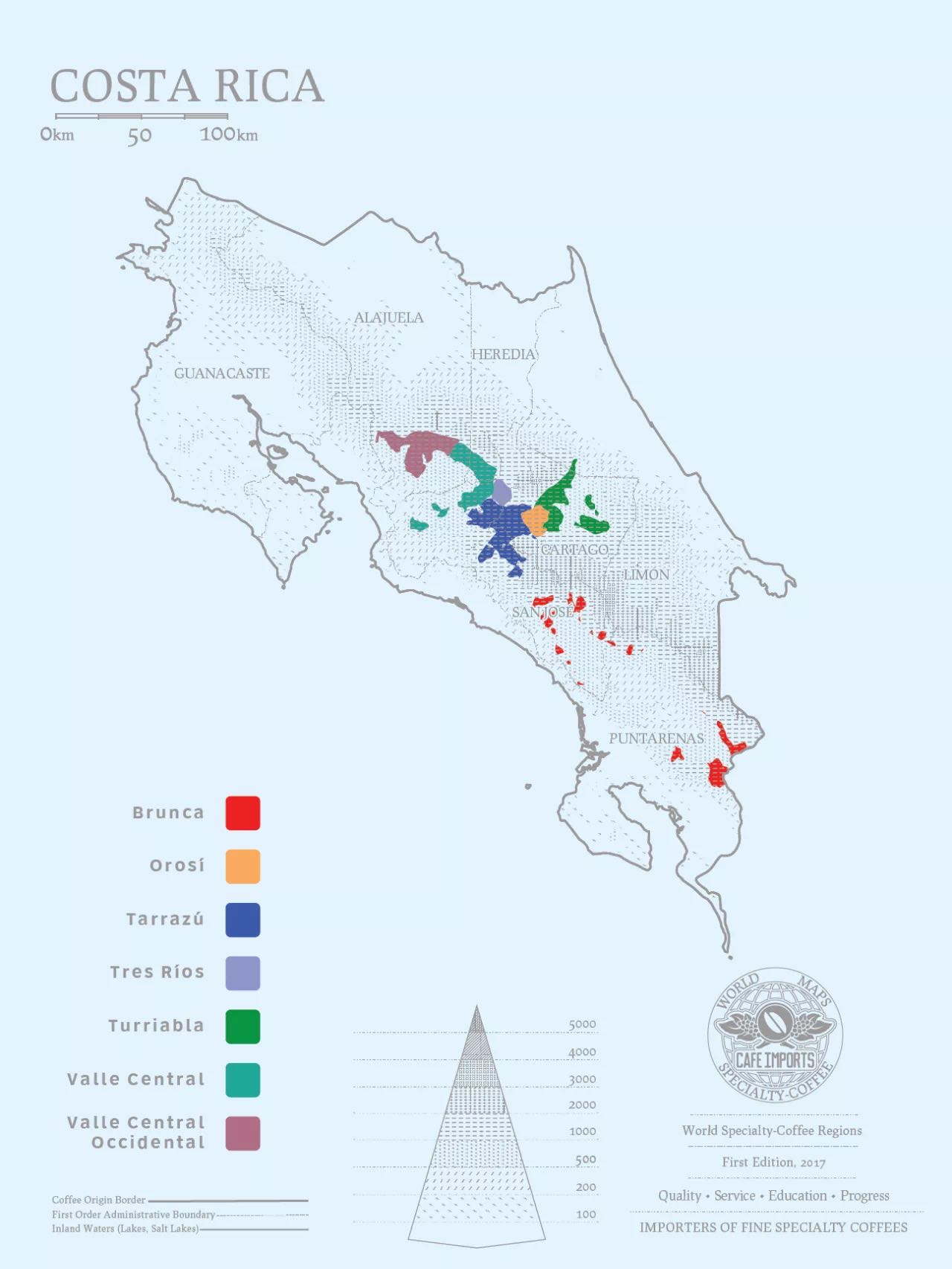
Costa Rican Coffee Regions
Superior quality comes not only from technique but also from growing altitude and environment, coffee varieties, and processing methods. Let's start with the regions.
Costa Rica has eight main regions: Western Valley (Valley Central Occidental), Central Valley (Valley Central), Tarrazu, Tres Rios, Orosi, Brunca, and Turrialba.

Among these, Tarrazu produces the most renowned beans, and nearly all the Costa Rican coffee at FrontStreet Coffee comes from this region, which also has the highest altitude of the eight. The country's volcanic soil is exceptionally fertile with excellent drainage, especially in the central highlands, where it contains several thick layers of volcanic ash and dust. Volcanic soil is rich in organic matter that feeds the coffee trees, while higher altitudes produce sweeter beans and, ultimately, more beautifully flavored cups.
Here are the altitude details for Costa Rica's coffee regions:
Tarrazu: Coffee cultivation altitude 1300-2000m
Tres Rios: Coffee cultivation altitude 1400-1800m
Western Valley: Coffee cultivation altitude 1200-1650m
Central Valley: Coffee cultivation altitude 1200-1600m
Orosi: Coffee cultivation altitude 900-1200m
Brunca: Coffee cultivation altitude 800-1200m
Turrialba: Coffee cultivation altitude 600-900m

Costa Rican Coffee Varieties
Today's specialty market is built on Arabica, which has lower caffeine content and superior flavor. Arabica is the most widely cultivated coffee species globally, accounting for approximately 75% of total world production. Robusta - banned in Costa Rica - carries twice the caffeine of Arabica along with a more bitter flavor, so it is generally destined for instant coffee rather than specialty brews.

Within Arabica, many sub-varieties appear on Costa Rican labels. Here are the ones FrontStreet Coffee encounters most often: Bourbon, Caturra, Catuai, Villasarchi, and Villalobos.
Bourbon
Bourbon is a sub-variety resulting from a Typica mutation and belongs to the oldest existing coffee varieties alongside Typica. Its green fruits ripen to a bright red. Compared to Typica, Bourbon plants have broader leaves and denser growth. Yields are higher, but the harvest cycle remains two years, so it is still a low-yield variety. In the cup it offers excellent quality with wine-like acidity and a sweet aftertaste.

Caturra
Caturra is a single-gene mutation of Bourbon, discovered in Brazil in 1937. It offers better productivity and disease resistance than Bourbon, with shorter plants that make harvesting easier. Like Bourbon, however, it goes through biennial production cycles, and its flavor is comparable to or slightly behind Bourbon. Its great advantage is adaptability: it needs no shade trees and thrives under direct sun, earning it the nickname "sun coffee." It tolerates high-density planting but demands heavier fertilization, which raises costs - one reason farmers were initially slow to accept it.
Catuai
Catuai is an Arabica hybrid, a cross between Mundo Novo (New World) and Caturra, bred for better resistance to natural disasters, particularly wind and rain. It inherits Caturra's short plant height, fixing Mundo Novo's main shortcoming, and its firm fruit resists dropping in strong winds, compensating for Arabica's delicate fruit. The trade-offs are a more monotonous flavor than Caturra, less richness than Mundo Novo, and a productive lifespan of only about ten years.

Villasarchi
Villasarchi is a Bourbon variety - a green-topped dwarf natural mutation discovered in Costa Rica in 1950 and then refined through pedigree selection over several generations. It was never widely planted in Costa Rica itself, but was introduced to Honduras by the Honduran Coffee Institute (IHCAFE) in 1974. In terms of aroma it is highly complex and suits medium-dark roasting: the dry fragrance after grinding carries notes of perfumed nectar and cherry, mixed with sweet spices like cinnamon.
Villalobos
Villalobos originated in Costa Rica and is a Typica variety. Like Typica, the angle between branches and trunk is 60 degrees, with bronze-colored leaves. It grows exceptionally well at high altitudes, has strong wind resistance, tolerates poor soil, and thrives under shade trees. Its most prominent flavor characteristic is excellent sweetness and pleasant acidity.

Costa Rican Processing Methods
The other major factor in flavor is processing. Costa Rica's honey process has reached masterful levels. Honey processing, called Honey Process or Miel Process, produces Honey Coffee: the beans are dried with the mucilage (pectin) still attached. After the outer fruit layer is removed, a viscous gelatinous substance remains. Traditional washed processing would wash it away with water, but in high-altitude regions where water is scarce, this direct-drying method was developed instead.

Honey-processed Costa Rican beans retain the cleanliness of the fully washed method. Brightness decreases slightly, but sweetness and caramel flavors increase. In FrontStreet Coffee's cupping and brewing evaluations, the difference comes down to this: honey processing delivers higher sweetness, higher sugar content, and relatively greater body than washing.
Depending on how much pectin is left on, honey processing is divided into yellow, red, and black honey:
Yellow Honey: About 40% of pectin is removed; beans are dried in direct sunlight, taking about 8 days to reach stable moisture content.
Red Honey: About 25% of pectin is removed; drying takes longer than yellow honey, with direct sun exposure reduced and shade nets sometimes used, taking about 12 days.
Black Honey: Preserves nearly 80% of pectin; the longest drying time, minimum 2 weeks, using coverings to prevent too-rapid drying and allow more complete sugar conversion.
The advantage of honey processing is that it best preserves the original sweet flavor of ripe coffee fruit, presenting elegant brown sugar flavors and sweet kernel fruit notes, while berry flavors evoke red wine aroma - considered very elegant products.

The biggest difference between honey processing and Brazilian pulped natural is that the former uses no water at all, requiring careful selection of flawless red cherries to ensure sweet pectin. It also demands high precision from the pectin-removing machines, which must control removal thickness accurately, much like a coffee grinder. When honey processing fails, the cup shows strong defective sun-dried flavors - think rough sun-dried onion, durian, fermented tofu, or worse, alcohol and medicinal tastes. Properly honey-processed coffee has soft acidity; if it is puckeringly sour, it is not a good product.

A simple summary:
Sweetness: Black Honey > Red Honey > Yellow Honey
Cleanliness: Yellow Honey > Red Honey > Black Honey
Balance: Red Honey = Yellow Honey > Black Honey
Costa Rica is also home to a unique grape raisin anaerobic honey process. Coffee enthusiasts will surely ask how it differs from regular honey processing.
Essentially, the cherries are dried to a raisin-like state before depulping and fermentation. In terms of flavor, the fermentation aroma is more intense, and pectin preservation is higher than in any other honey method - it claims to be 100% pectin honey processing, with a genuinely distinctive raisin character. This is an exceptionally sweet processing method. According to FrontStreet Coffee's cupping, it has a white wine mouthfeel and balanced acidity, with flavors reminiscent of sweet wine, honey, dried apricots, raisins, and peaches.

Newcomers will also wonder about washed and natural processing, the two most common methods on bean labels. Washed beans have cleaner, crisper flavors that express the base character of a region - the beginning of understanding terroir. For that reason, FrontStreet Coffee created a coffee that best represents Costa Rican Tarrazu for newcomers to try. Natural processing, meanwhile, adds sweet aromas and fermentation notes on top of that base flavor.
Washed Processing Flow

1. Harvesting: After harvesting ripe coffee cherries, preliminary sorting removes impurities and defective beans, along with screening for floaters. This stage is identical to natural processing.
2. Depulping: Fresh cherries are sent to depulping machines to remove fruit pulp and skin. Immature cherries, being difficult to separate from pulp, are screened out at this stage. After depulping, what remains are pectin, parchment, and seeds.
3. Fermentation to remove pectin: The depulped seeds with pectin are moved to fermentation tanks. Although called washed processing, it doesn't actually wash away pectin but removes it through biological decomposition via fermentation. The fermentation process takes about 16-36 hours, requiring frequent stirring to accelerate pectin separation from seeds. Washed fermentation produces acidic substances like citric acid, malic acid, and acetic acid, which penetrate the raw beans, making washed beans more acidic than natural-processed ones. After fermentation completion, actual washing occurs - beans are washed again.
4. Drying: After washing, drying is still required through sun-drying or machine drying to reduce moisture content to 12%. Since washed processing has removed fruit pulp, the drying process doesn't face the mold concerns of natural processing. The dried parchment beans are not as hard as natural-processed beans containing fruit pulp and skin, allowing hulling machines to remove hulls and obtain raw beans.

Natural Processing Flow
1. Harvest ripe coffee cherries
2. Preliminary sorting removes impurities and defective beans
3. Screen for floaters: Coffee cherries are poured into water tanks. Mature, full cherries sink to the bottom, while immature or damaged cherries float to the surface.
4. Sun-drying: Mature coffee cherries that sank are retrieved and spread on drying fields for sun-drying, reducing moisture from 70% to about 10-12%. They need to be turned several times daily for even drying and covered at night to avoid moisture absorption.
5. Remove outer shells: After sun-drying for about two to four weeks, the coffee seeds' outer layers become dry and hard. At this point, hulling machines are used to remove the outer shells.
6. Packaging and shipping: The hulled coffee beans are bagged individually, becoming what we generally call green beans. Finally, through different roasting processes and brewing variations, coffee can present millions of flavor possibilities.

Those are the factors affecting coffee flavor. Next, FrontStreet Coffee will introduce some famous Costa Rican coffees.
Costa Rican Concert Music Series Coffee Beans from Canet Estate
First and foremost, the Costa Rican Music Series coffee beans must be mentioned. Canet Estate is located in Costa Rica's Tarrazu region. According to FrontStreet Coffee's understanding, the Music Series originated because Canet Estate's owner is passionate about classical music and names coffee beans after musicians based on flavors produced by different processing methods. Thus, the Music Series was born, comprising four coffee beans named after musical geniuses: Beethoven, Mozart, Bach, and Chopin. The flavors of these coffee beans are indeed like moving musical notes, truly touching.

FrontStreet Coffee Costa Rican Mozart Coffee Beans
Country: Costa Rica
Region: Tarrazu
Altitude: 1800m
Variety: Caturra, Catuai
Processing: Raisin Honey Process
Flavor: Raisin acidity, berries, floral notes, fermented wine aroma
Mozart, known as the child prodigy who epitomized classical music, is famous for his magnificent classical compositions. Accordingly, the magnificent fragrance of this coffee refers to the elegant floral notes it emanates, similar to white flower aromas like orange blossom, which FrontStreet Coffee can also detect during brewing. The magnificent mouthfeel refers to the abundant dark berry, raisin, and subtle red berry flavors, with mid-to-late stages revealing slight plum acidity and gummy bear-like sweetness. Even when cooled, it retains floral notes and sweetness. The flavor is truly unique, allowing one to experience the magnificent mouthfeel.

FrontStreet Coffee Costa Rican Bach Coffee Beans
Country: Costa Rica
Region: Tarrazu
Altitude: 1950m
Variety: Caturra
Processing: Raisin Honey Process
Flavor: Fermented wine aroma, berries, fruit tea notes
Bach's music is exquisite, richly layered, yet clearly structured. This coffee bean's dry fragrance carries fruit-like aromas of strawberry, blackberry, and raisin, with wafts of fruit aroma during brewing. When FrontStreet Coffee first finished brewing, distinct floral and fruit aromas emanated. Upon tasting, one experiences intense fruit fragrance and sweet-tart notes, with mid-to-late stages carrying subtle wine aromas, like red wine. When cooled, it carries candied fruit sweetness, with even more prominent wine notes, even revealing plum wine flavors. Such exquisite taste experiences truly resemble Bach's music, and FrontStreet Coffee believes that every sip of Bach coffee feels like being immersed in the magnificence and rigor of Baroque aesthetics.

FrontStreet Coffee Costa Rican Beethoven Coffee Beans
Country: Costa Rica
Region: Tarrazu
Altitude: 1800-1950m
Variety: Caturra, Catuai
Processing: Washed Process
Flavor: Citrus, berries, floral notes, subtle fermented wine aroma
The most renowned romantic classical music is undoubtedly Beethoven's. Coffee beans that evoke Beethoven's music naturally have extraordinary flavors. The dry fragrance has distinct red berry notes, with strawberry being most prominent, complemented by floral aromas. During brewing, one experiences floral notes, nectar-like sweetness, and green grapes. When FrontStreet Coffee brewed Beethoven coffee, it revealed green grape and red berry sweet-tart notes, overall clean and smooth. When cooled, red berries become more pronounced. Some coffee enthusiasts who have tasted it at FrontStreet Coffee even described it as a coffee with summer romantic feelings.
FrontStreet Coffee also mentions that unlike other Music Series varieties using raisin honey processing, Beethoven uses washed processing to achieve summer's clean, crisp mouthfeel. Therefore, FrontStreet Coffee highly recommends coffee enthusiasts enjoy this Beethoven coffee in summer for a different taste experience.

FrontStreet Coffee Costa Rican Chopin Coffee Beans
Country: Costa Rica
Region: Tarrazu
Altitude: 1800-1900m
Variety: Catuai
Processing: Raisin Honey Process
Flavor: Rose, raisin, berries, fruit tea
Chopin is acclaimed as the "Romantic Piano Poet." Canet Estate's Chopin coffee beans release overwhelming rose fragrance upon opening, with roses being the expression of romance. During brewing, FrontStreet Coffee finds this rose aroma becomes even more fragrant with the steam, as if one were surrounded by a sea of roses. The taste reveals raisin and berry sweet-tart notes, with an aftertaste like fruit tea. FrontStreet Coffee believes the overall flavor progression resembles Chopin's romantic piano compositions, gradual and deeply romantic. It certainly lives up to its reputation.
These are Costa Rica's most famous Music Series coffee beans. FrontStreet Coffee also offers another coffee bean from the Tarrazu region - FrontStreet's daily coffee bean, which offers excellent value. Coffee enthusiasts interested in Costa Rican coffee should certainly try it.

FrontStreet Coffee Costa Rican Tarrazu Coffee Beans
Country: Costa Rica
Region: Tarrazu
Altitude: 1950m
Variety: Caturra
Processing: Washed
Flavor: Sweet orange, nuts, honey
Next are some premium coffees from other Costa Rican regions. Before listing any coffee bean, FrontStreet Coffee conducts extensive data cupping and brewing evaluations. Therefore, the following coffee beans are carefully selected specialty coffees with naturally excellent flavors. FrontStreet Coffee will introduce these Costa Rican coffee beans.
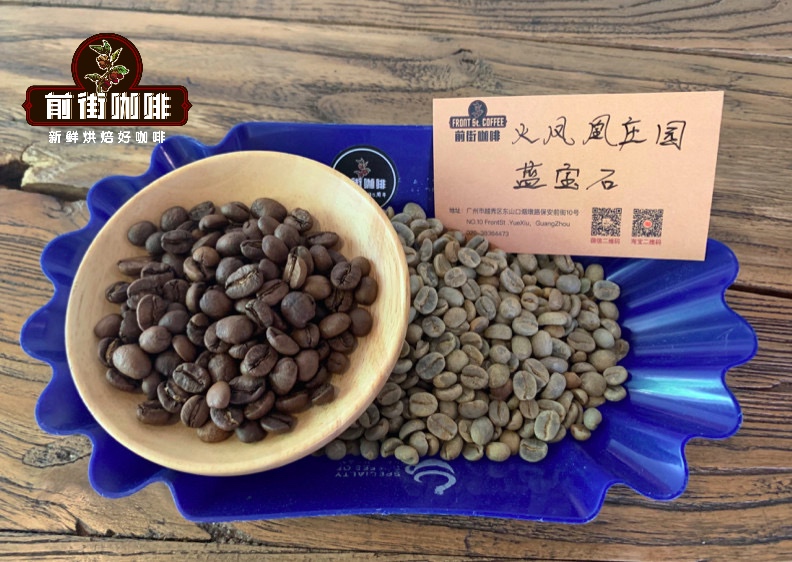
FrontStreet Coffee Costa Rican Fire Phoenix Sapphire Coffee Beans
Country: Costa Rica
Region: Central Valley (Fire Phoenix Estate)
Altitude: 1300-1500m
Variety: Caturra, Catuai
Processing: Natural Process
Flavor: Strawberry, tropical fruits, mint, honey, cocoa, fermentation aroma
According to FrontStreet Coffee's understanding, Fire Phoenix Estate is located in the hilly area near Poas volcano in Costa Rica's central valley, an early producer of honey-processed and natural coffees in Central and South America, and an organically cultivated coffee estate. The estate owner believes organic farming practices are better choices for environmental protection and family health, persisting in this belief despite facing many technical and organizational challenges.

Additionally, FrontStreet Coffee understands they use Brix meters commonly equipped in the wine industry to measure fruit sugar content when harvesting coffee cherries, determining optimal harvest timing and processing methods based on Brix sugar content. Only cherries exceeding 20% sweetness undergo natural processing. Typical fruit Brix values: apples 14, lemons 12, passion fruit 18, but Fire Phoenix's coffee cherries can reach 21-22%. Therefore, the brewed coffee is exceptionally sweet and fragrant.
The estate also emphasizes environmental protection concepts (such as collecting rainwater for coffee processing) and uses vermicomposting (worm composting) for organic fertilizer production, making the cultivation process completely free of chemical fertilizers and pesticides. The natural processing of Sapphire (Zahiro) is quite labor-intensive. Hand-picked high-sugar cherries are first placed on African raised beds for sun-drying about 10 days, then moved to plastic-covered greenhouses to create more direct heat for continued drying until moisture content reaches 11.5%. The slow drying process allows raw beans to develop more natural sweetness internally but requires more meticulous care and constant turning. Finally, the bright red cherries turn black, emitting aromas of fruit cake, brown sugar, and even sherry wine!
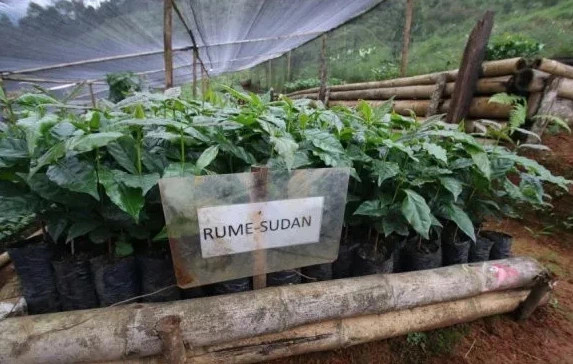
FrontStreet Coffee Costa Rican Rume Sudan Coffee Beans
Country: Costa Rica
Region: Rume Valley
Altitude: 1250-1380m
Variety: Rume Sudan
Processing: Washed Process
Flavor: Citrus, berries, oolong tea, cane sugar
Rume Sudan was discovered in the 1940s in the Rume Valley of the Boma Plateau in southeastern South Sudan, near the Ethiopian border. It is one of the original Arabica coffee varieties and belongs to Ethiopian native varieties. This is a wild ancient coffee variety. In coffee genealogy, Rume Sudan's history is even more ancient than Typica and Bourbon coffee.
FrontStreet Coffee's research reveals that Rume Sudan is known in the coffee world by the code RS-510, characterized primarily by bronze-colored leaves. When breeding experts need to create new coffee varieties, RS-510 is considered the most useful Arabica genetic source. For example, when genes from high-yield, poorer-flavor varieties are crossbred with RS-510, varieties with good flavor and higher yields are typically obtained, because RS-510's flavor is exceptionally stunning but has average disease resistance and very low yields.

Therefore, crossbreeding RS-510 with higher-yield varieties allows farmers to have new hybrids with high yields and strong disease resistance. Many well-known modern varieties, such as Castillo, Centroamericano, or Colombia, were developed using this technique.
However, FrontStreet Coffee understands that Rume Sudan has low yields and relatively difficult cultivation, requiring more daily care. Therefore, few estates previously conducted large-scale commercial cultivation, primarily using it for variety research to develop better plant disease resistance and coffee flavor. Until 2015, when Rume Sudan won the World Barista Championship (WBC) under Australian representative Sasa Sestic, it overnight became a coffee variety eagerly sought by roasters and baristas.
Costa Rican Geisha Coffee
Naturally, Costa Rica has many small regions with different microclimates, creating subtle flavor differences in coffee. Costa Rican coffee varieties are also diverse. Next, FrontStreet Coffee will discuss Costa Rican estates producing Geisha varieties. Coffee enthusiasts know that Panama's Hacienda La Esmeralda Geisha is most famous, but how does Costa Rican Geisha coffee bean quality compare? In FrontStreet Coffee's opinion, Costa Rican Geisha should not be underestimated. For example, Costa Rica's La Candelilla Estate is renowned for producing some of the world's best Geisha coffee.

FrontStreet Coffee Costa Rican La Candelilla Estate Geisha
Country: Costa Rica
Region: La Candelilla Estate
Altitude: 1750m
Variety: Geisha
Processing: Washed Process
Flavor: Lemon, jasmine, honey, green tea
La Candelilla Estate is a Cup of Excellence (CoE) award-winning estate in Costa Rica. Costa Rican Geisha coffee beans are relatively young varieties at the estate, and due to different local conditions and microclimates, they produce different Costa Rican Geisha coffee flavors, yet equally refined. Rich acidity with lingering aftertaste, carrying distinct almond, plum, citrus, sweet flower, and berry aromas. La Candelilla translates to "small candle," named after fireflies that illuminate nearby streams on summer nights.
FrontStreet Coffee's research reveals that La Candelilla Estate is operated by Hugo and his daughter Marcia, who co-built it in 2000. Their products are mixtures from nine farms, all Caturra and Catuai varieties. Since 2000, La Candelilla Estate has also been nominated for numerous awards. FrontStreet Coffee also offers a natural-processed Geisha from Mirasu Estate with excellent quality, praised by coffee enthusiasts who have tasted it. FrontStreet Coffee will now explain the charms of this Geisha coffee bean!

FrontStreet Coffee Costa Rican Mirasu Estate Natural Geisha
Country: Costa Rica
Region: Tarrazu
Altitude: 1700m
Variety: Geisha
Processing: Natural Process
Flavor: Strawberry, peach, cinnamon, jasmine
According to FrontStreet Coffee's understanding, Mirasu Estate's owner is an agricultural doctor exceptionally skilled in processing methods and post-processing. Later, he fulfilled his dream by establishing his own processing facility and estate, cultivating many different varieties. Mirasu natural Geisha coffee has subtle floral notes and light ripe fruit aromas. Brown sugar and nut undertones bring full sweetness, making FrontStreet Coffee consider it an ideal introductory Geisha choice.
Costa Rican Geisha Variety
FrontStreet Coffee's Costa Rican Geisha coffee beans are an original variety within Arabica species, particularly selective about growing conditions, requiring high altitude, cloud shade, fertile soil, and sufficient accumulated temperature.
Geisha variety was discovered in 1931 from the Geisha forest in Ethiopia, later sent to Kenya's Coffee Research Institute. It was introduced to Uganda and Tanzania in 1936; Costa Rica introduced it in 1953.

According to FrontStreet Coffee's understanding, what makes this Mirasu Estate Geisha different from Panama Geisha is that it uses neither double-oxygen fermentation nor washing, but natural processing to handle the coffee beans. FrontStreet Coffee mentioned earlier that natural-processed coffee beans have sweeter flavors than washed ones, with fermentation notes. Therefore, its flavor expression aligns well with Costa Rican coffee's sweet character - sweetness upon sweetness, truly distinctive. FrontStreet Coffee highly recommends that coffee enthusiasts who love sweet flavors must not miss Mirasu Estate's natural Geisha!
FrontStreet Coffee Recommendation
If the honey process discussion above has caught your attention, the FrontStreet Coffee Costa Rican Mozart from Canet Estate is the bean to try. A raisin honey process Caturra-Catuai lot grown at 1800m in Tarrazu, it delivers raisin acidity, berries, floral notes, and a gentle fermented wine aroma - a textbook example of what Costa Rican honey processing can do. Its floral-and-fruit character is exactly the style that shines in a Hario V60 pour-over, whose 60-degree cone and fast flow bring out the delicate aromatics. For a cleaner comparison cup, the FrontStreet Coffee Costa Rican Tarrazu (washed, 1950m) shows what the same region tastes like without fermentation - sweet orange, nuts, and honey. Brewing both side by side is the fastest way to understand what honey process actually adds.
Important Notice :
FrontStreet Coffee is a long-established specialty coffee roaster in Guangzhou China, selling freshly roasted beans from its own farm in Yunnan as well as dozens of carefully selected single-origin beans from around the world for both pour-over and espresso. The products deliver consistently excellent quality and great value, with shipping within 24 hours. Guangzhou's FrontStreet Coffee shop is recommended by many coffee lovers, and the beans are now available online at the Tmall 。
FrontStreet Coffee has moved to a new address:
FrontStreet Coffee Address: 315,Donghua East Road,GuangZhou
Tel:020 38364473
 Scan and follow the En Gafei WeChat official account. Please indicate that the reprint comes from "En Gafei".