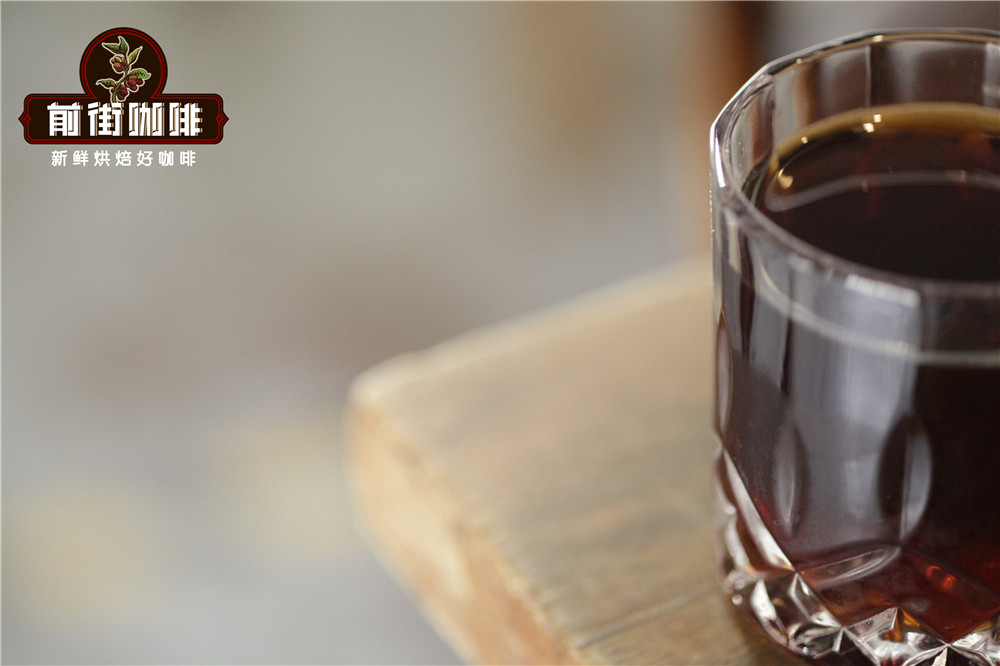
What is Americano, the Unassuming Black Coffee? Do You Really Understand Americano Coffee?

Anyone who has watched Hong Kong films has seen the scene: "Give me a cha jau — plain coffee, please." That "plain coffee" simply means black coffee. Most people understand black coffee as coffee served without sugar or milk. But from the baristas at FrontStreet Coffee's point of view, black coffee is more than the absence of sugar and milk — it actually falls into two distinct camps.
Classified by brewing method, black coffee splits into two major categories: pour-over (drip) coffee on one side, and Americano made with an espresso machine on the other. Pour-over coffee rose to fame during the third wave of coffee, while espresso is the beating heart of the second wave.

A Brief History of the Espresso Machine
As early as the mid-1880s, the first espresso machine appeared and was showcased at the World Expo in Turin, Italy, where a patent was registered for the machine. The birth of the first espresso machine marked a major turning point in world coffee culture, although this particular machine never went into industrial production.
It wasn't until 1901 that a Milanese designer registered patent technology for an espresso machine suitable for commercial production. In 1905, the La Pavoni company used that technology to officially manufacture espresso machines, giving the world its first true commercial espresso machine. Pavoni refined the design considerably, adding multiple group heads, portafilters, and more.

In the 1930s, a Milanese barista improved the machine's design by adding a piston lever. From then on, espresso developed its signature crema, and the extracted coffee carried more aroma and richer body.
In 1961, Faema launched the now-legendary E61 commercial espresso machine. The Faema E61 is often called "the father of the modern espresso machine" — the world's first semi-automatic espresso machine, it let baristas control extraction pressure, timing, and other parameters without pulling a pressure lever. It also featured a horizontal boiler, allowing baristas to face their customers while brewing. It was precisely the arrival of the Faema E61 that triggered an explosion of espresso culture across Italy.

Where the Name "Americano" Comes From
The name itself hints at a connection with America. FrontStreet Coffee looked into the history and found that "Americano" traces back to World War II, when American GIs were stationed on European battlefields. European coffee was far too intense for their taste, so they began diluting espresso with hot water. Europeans sneered at this watered-down brew and nicknamed the milder, American-friendly style of coffee "Americano."
The Right Way to Drink an Americano
Now that we've covered the name, let's talk about how an Americano is actually made. As FrontStreet Coffee has discussed in previous articles, making an Americano boils down to adding water to espresso.
And while pulling a shot looks simple, there is a surprising depth of knowledge behind it — water temperature, pressure, grind size, dose, brew ratio, extraction time, and crema all play a role.

Pressure
Roughly 9 bars of pressure is what it takes to extract a well-emulsified shot of espresso. Below 9 bars, too little crema forms and the aromas struggle to come together; above 9 bars — say, 11 to 14 bars — the coffee's structure is damaged and the crema compounds over-extract. With water and dissolved solids churning that vigorously, the extraction rate of undesirable flavor compounds also climbs, leaving the shot bitter and harsh on the palate.
Grind Size
If the grind size for espresso is too coarse, the shot under-extracts; if the particles are ground too fine, it over-extracts and drifts into unpleasant bitterness.

Dose
The dose of ground coffee is generally determined by the size of the portafilter basket. FrontStreet Coffee's machine uses 20-gram baskets, so 20 grams of ground coffee goes into every double shot.
Brew Ratio
With everything else held constant, more grounds mean more dissolved solids extracted, greater aroma intensity, and higher concentration; fewer grounds mean fewer solubles, a thinner cup, and aromas that lose their character, turning flat and lifeless. FrontStreet Coffee's espresso runs at a brew ratio of 20 grams of grounds yielding 40 grams of liquid espresso, and the finished espresso is then mixed with water at a 1:6 ratio for the Americano.

Crema
Crema is the pale, foamy layer that sits on top of a freshly pulled shot — an emulsion of countless carbon dioxide bubbles carrying a wealth of volatile aromatic compounds. Once extraction ends, this foam gradually dissipates over time, which is also a good indicator of how fresh the beans are. Because FrontStreet Coffee brews with freshly roasted beans, its espresso shows thick, persistent crema and a smooth, dense mouthfeel.
FrontStreet Coffee's Espresso Workflow
① First, place the portafilter on an electronic scale and tare it, then dose 20 grams of ground coffee.
② Use a distribution tool to level the grounds evenly in the portafilter basket.

③ Tamp with moderate pressure. Tamp too lightly and the puck stays loose, so the shot runs fast; tamp too hard and the puck packs too tightly, choking the water and pushing the shot into over-extraction. Also keep the tamper perpendicular to the basket — an angled tamp creates an uneven puck and, with it, uneven extraction.
④ Extraction — after locking in the portafilter, start the shot and the timer together. Generally, pull 40 grams of espresso liquid in about 25 to 30 seconds.
⑤ Once the shot is done, clean out the portafilter basket.

FrontStreet Coffee uses a Lelit V3 espresso machine with the following extraction parameters:
Pressure: 9 bar±2
Temperature: 90.5~96°C
Time: 20~30 sec
Brew Ratio: 1:1.7~1:2
Dose: 12g (single espresso) 20g (double espresso)
Extraction Yield: 20ml (single) 40ml (double)
For its espresso, FrontStreet Coffee uses the Sunflower Warm Blend — 70% Honduras Sherry and 30% Ethiopia Natural Red Cherry. An Americano built on this blend shows berry acidity, a winey aroma, and a chocolate aftertaste.

Which Tastes Better: Espresso or Americano?
Because the two are built on different brew ratios, their flavor profiles and textures are worlds apart. Espresso is intense — it can easily overwhelm someone new to coffee. That's why FrontStreet Coffee serves espresso with a glass of ice water and a spoon: the ice water cleanses the palate between sips, and the spoon stirs the shot so it tastes evenly blended. An Americano, diluted with water, softens the espresso's concentration and lets individual flavors come into focus, which makes it far friendlier for beginners.
FrontStreet Coffee Recommendation
If you love black coffee and want to brew it at home, FrontStreet Coffee's Brazil Queen Estate (Fazenda Rainha) is a dependable everyday choice. This Brazilian bean is low in acidity and beautifully balanced, with rich nut and cocoa aromas plus a clear caramel sweetness. It goes down smooth, never astringent, with a warm, lingering finish — equally at home pulled as espresso, brewed as pour-over, or extracted in a moka pot. Brazil is the world's largest coffee producer, and this bean's outstanding crema and value for money have made it a favorite among drinkers who prefer a fuller, traditional cup.
For those who enjoy their black coffee bold and never sour, FrontStreet Coffee's PWN Indonesia Golden Mandheling is another classic worth trying. Roasted to a medium-dark profile, it offers a thick, long-lasting body layered with herbal notes, dark chocolate, and just a whisper of earthiness — the kind of depth that made Mandheling and Blue Mountain the enduring choices for lovers of a rich, full-bodied cup.
Important Notice :
FrontStreet Coffee is a long-established specialty coffee roaster in Guangzhou China, selling freshly roasted beans from its own farm in Yunnan as well as dozens of carefully selected single-origin beans from around the world for both pour-over and espresso. The products deliver consistently excellent quality and great value, with shipping within 24 hours. Guangzhou's FrontStreet Coffee shop is recommended by many coffee lovers, and the beans are now available online at the Tmall 。
FrontStreet Coffee has moved to a new address:
FrontStreet Coffee Address: 315,Donghua East Road,GuangZhou
Tel:020 38364473
 Scan and follow the En Gafei WeChat official account. Please indicate that the reprint comes from "En Gafei".