Costa Rica Coffee Costa Rica Geisha Geisha Coffee Pour Over Method Tips Sharing
For more coffee bean information, please follow Coffee Workshop (WeChat public account: cafe_style)
The Queen of Coffee: Geisha
When people think of the queen of coffee, most of them think of Geisha — and FrontStreet Coffee is no exception. Since its championship win in 2004, Geisha has been chased across the entire industry, and demand has stretched all the way to Panama. That is no exaggeration. Other countries keep planting the Geisha variety, and although they still fall short of Panama's Geisha, they have their own distinct character — Costa Rican Geisha among them.
Costa Rica: An Early Pioneer of Coffee Cultivation
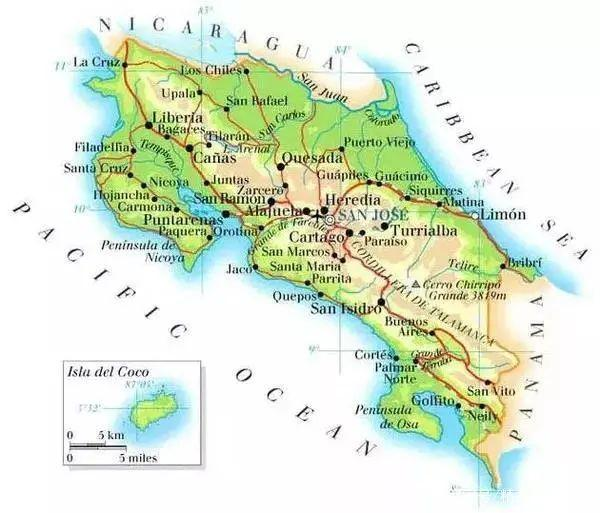
Costa Rica was the first country in Central America to cultivate coffee. In 1820 it exported its first batch of coffee to Colombia. In 1854 the British aristocracy called its beans "golden beans," and from then on coffee became Costa Rica's main cash crop. Only Arabica trees are grown in Costa Rica. As early as the beginning of the 20th century, the government decreed that only Arabica beans could be planted inside the country, and Robusta became effectively a "prohibited substance" within its borders.
The Origin and Journey of Geisha
Geisha was discovered in the Geisha forest of Ethiopia in 1931 and later sent to a coffee research institute in Kenya. In 1936 it was introduced to Uganda and Tanzania, and in 1953 it was brought to Costa Rica.
The famous Panamanian Geisha actually came by way of Costa Rica. In the 1930s, Geisha seeds spread out of Ethiopia and eventually reached Tanzania. In 1953, Costa Rica's CATIE research institution obtained some Geisha seeds from Tanzania for study. In 1963, Pachi Serracin, then owner of Panama's Hacienda La Esmeralda, brought Geisha from CATIE to Panama and shared it with his neighbors. Forty years later, Geisha made its stunning debut at the Best of Panama competition.
Coffee's Impact on Costa Rica
Coffee has been rooted in Costa Rica for more than 200 years. Although the country's land area ranks third from the bottom among Central American coffee-producing nations, it plays an indispensable role. Costa Rica has a population of about 4.5 million, yet it grows as many as 400 million coffee trees. Coffee exports account for 25% of the country's total export value. By some counts, about one-third of the local population is involved in the coffee supply chain. It is no exaggeration to say that coffee has changed this country's standard of living.
Costa Rica enjoys a rare natural setting: fertile volcanic ash, mild and steady temperatures, reliable rainfall, plenty of daytime sunshine, and a wide swing between day and night temperatures. All of this helps make coffee one of the country's main agricultural products. The country also produces green beans across a range of grades, from affordable commercial Arabica to beans that have won the Cup of Excellence (COE), as well as the prestigious Geisha variety.
Costa Rican Coffee Growing Regions
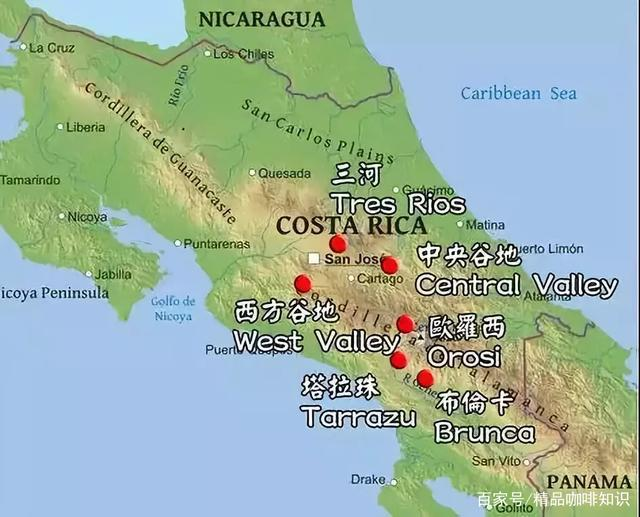
Costa Rica has eight major coffee growing regions: Central Valley, Western Valley, Tres Ríos, Brunca, Orosi, Tarrazú, Turrialba, and Guanacaste. Of these, Central Valley, Tarrazú, and Tres Ríos are the best known.
Tarrazú is the largest coffee-growing region in Costa Rica, with an average altitude of 1,200-1,700 meters. The varieties grown are mostly Caturra and Catuai, with others including Geisha, SL-28, and Typica. The harvest season in Tarrazú runs from December to March of the following year, and its hallmark is an unmatched, perfectly balanced mouthfeel created by the high-altitude growing conditions.
Central Valley sits at 1,200-1,600 meters, with a harvest season from November to March of the following year. The region contains three high-altitude volcanoes — Irazú, Barva, and Poás — that feed nutrients into the surrounding coffee areas. An excellent microclimate combined with fertile volcanic soil gives Central Valley beans their chocolate and cocoa flavors and elegant aroma. The region has three sub-areas: San José, Heredia, and Alajuela.
Tres Ríos lies near Irazú Volcano, not far east of the capital, at an altitude of 1,200-1,650 meters, with a harvest season from December to March of the following year. In recent years, urban expansion has crept into the suburbs, farmland has been sold to developers, and coffee production in Tres Ríos has fallen sharply. Most of the remaining crop is now contracted by Starbucks, which makes it hard for industry professionals to buy. The well-known Aquiares farm in Tres Ríos has been operating since 1857 and has a long history. Tres Ríos enjoys good climatic conditions and produces beans of excellent balance.
Costa Rican Coffee Bean Grades
SHB (Strictly Hard Beans): 1,500-1,650 meters
GHB (Good Hard Beans): 1,000-1,200 meters
HB (Hard Bean): 800-1,000 meters
MHB (Medium Hard Beans): 500-1,000 meters
Costa Rican Coffee Bean Processing Methods
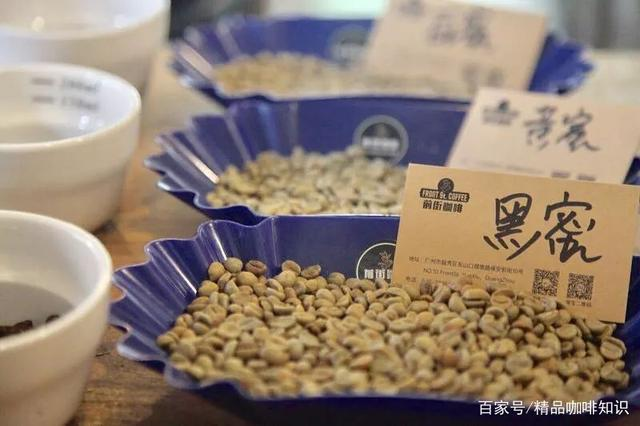
Most Costa Rican coffee is washed, but the country's most representative method is honey processing, which delivers more sweetness than the washed route. Honey processing leaves the mucilage on the bean before drying, so the finished coffee carries a honey-like sweetness. Depending on how much mucilage is retained, it is further split into white, yellow, red, and black honey.
Building on honey processing, producers have also developed raisin honey. Here the skin is not removed first; instead the cherries go straight onto the drying beds overnight so the skin and pulp contract and take on a raisin-like look. From there, the steps match regular honey processing.
The washed method starts by running selected cherries through a pulper to strip the skin and pulp. The parchment beans, still carrying pulp and mucilage, go into water to ferment for about 24 hours. After fermentation, the parchment beans are moved into flowing water channels to wash away the remaining pulp and mucilage. Once washed, the beans are dried in the sun or finished in dryers until moisture drops to about 12%. Finally, the parchment is removed from the green beans.
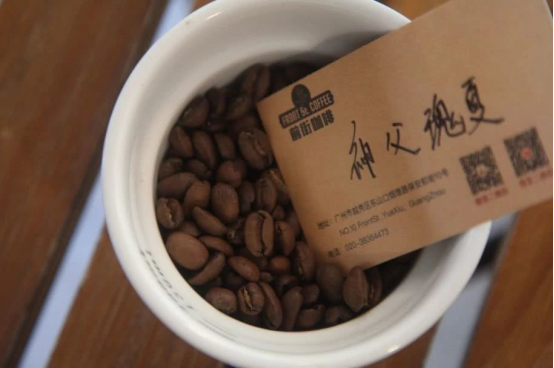
FrontStreet Coffee · Costa Rica Padre Geisha
Region: Tarrazú
Estate: Padre Estate
Altitude: 1,600-1,650m
Grade: SHB
Processing Method: Washed
Forty kilometers south of San José, Costa Rica's capital, lies an area known as Tarrazú-Frailes, which belongs to the Tarrazú region. At 1,600-1,650 meters, it is home to 63 coffee farming families, each working about 1-2 hectares of coffee. Every year they sell their harvested beans to large companies for meager profits.
The local priest is one of the most educated and best-connected people in the whole village. Besides preaching, he helps local smallholders secure better terms. He can be seen assisting with everything from renting space at nearby processing plants to handle the coffee to finding better buyers. That is how Padre Estate got its name. OKLAO, a Taiwanese coffee brand that integrates production and sales, was their first buyer. During the partnership, OKLAO also offered many suggestions for improvement, which significantly raised output and successfully established the local coffee brand Café del Padre.
Later, Padre Estate received funding to build its own processing plant, the Verola Processing Plant, which officially opened on January 28, 2016. With their own plant, quality is assured, and it has also driven local economic benefits.
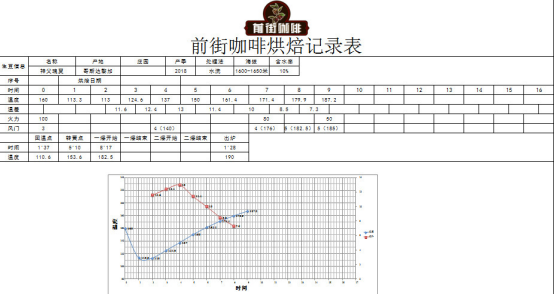
FrontStreet Coffee Roasting Recommendations
FrontStreet Coffee's Padre Geisha falls into the SHB (Strictly Hard Bean) category. The beans are relatively hard with moderate moisture content. The yellowing point arrives at 5 minutes 10 seconds, and first crack begins at 8 minutes 17 seconds. The beans are dropped after 1 minute 28 seconds of development past first crack.
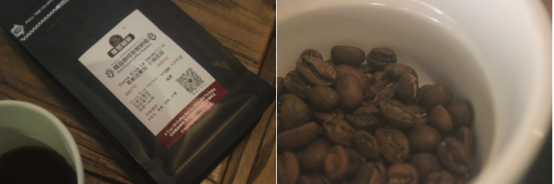
FrontStreet Coffee · Costa Rica Candelilla Geisha
Region: Tarrazú
Estate: Candelilla Estate
Altitude: 1,750m
Grade: SHB
Processing Method: Washed
Candelilla Estate takes its name from the many small fireflies that are easy to spot on the farm in the evening. Locals use the word "candelilla" for the fireflies of this area.
Candelilla Estate is a partnership of seven partners, all from families with a long coffee-growing tradition. They are the third generation to carry on the craft, having inherited their agricultural knowledge from their ancestors. Most of the land at today's Candelilla Estate is planted with coffee.
At first, Candelilla was just several ordinary farms run separately by the partners, who sent their cherries to local cooperatives for processing. During 1997, the coffee crisis hit Costa Rica's coffee industry. Against that backdrop, the partners pooled their resources and established Candelilla Estate in 2000, complete with their own small processing plant.
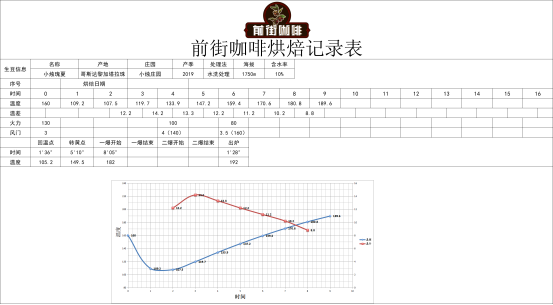
FrontStreet Coffee Roasting Recommendations
Charged at 160°C, with a return temperature of 105.2°C. At 5 minutes 10 seconds the temperature reaches 149.5°C, completing dehydration. First crack arrives at 182°C, development continues to 192°C, and the beans are dropped.
FrontStreet Coffee Pour-Over Parameters
Dripper: Hario V60
Water Temperature: 90°C
Coffee Dose: 15 grams
Water-to-Coffee Ratio: 1:15
Grind Size: Medium-fine, with an 80% pass-through rate on the China standard #20 sieve

FrontStreet Coffee Brewing Method
Segmented Extraction
Use 30 grams of water for a 30-second bloom. Continue pouring to 125 grams, then pause. When the water level drops and is about to expose the coffee bed, continue pouring to 225 grams and stop. When the level drops and is about to expose the bed again, remove the dripper. Total extraction time is two minutes, timed from the start of the bloom.
Flavor Description
FrontStreet Coffee's Padre Geisha: Ginger flower aroma, lime and citrus acidity, creamy notes in the mid-palate, brown sugar sweetness in the aftertaste, with a cocoa and tea-like finish.
FrontStreet Coffee's Candelilla Geisha: Jasmine aroma, lemon acidity, a juicy mouthfeel, honey-like sweetness in the mid-palate, with a green tea finish.
FrontStreet Coffee Recommendation
Costa Rica shows one side of Geisha, but the variety's most celebrated expressions come from Panama and Ethiopia. FrontStreet Coffee's Panama Boquete Gesha is a good entry point: grown at 1,600 meters on volcanic ash soil, it pours a perfumed cup of jasmine, green tea, honey, and orange. For the top of the range, the Emerald Estate Red Label Gesha is harvested from a single plot above 1,700 meters and is required to cup above 90 points, which is why it shows that fine tangerine-and-honey character. The Emerald Estate Green Label is a blend of plots rather than a single one, and its lower price makes it the better value of the two.
If you want to taste Geisha's birthplace, look to Ethiopia. The Gesha Village Gold Label is the Gesha 1931 variety and accounts for about 10% of the village's output; the Red Label is the Gori Gesha variety and scores 88 or above on the SCA scale. For a more affordable introduction, the Grana Estate Gesha from the Kochere and Gelana Abaya border, lightly roasted, brings bright citrus acidity, ginger flower, and ripe-fruit sweetness. And for something that bridges Geisha with an everyday cup, the Strawberry Candy blend pairs Panama Gesha with a Costa Rican honey-processed coffee for a soft floral, sweet-fruit profile that works for pour-over, moka pot, espresso machine, and cold brew alike.
Important Notice :
FrontStreet Coffee is a long-established specialty coffee roaster in Guangzhou China, selling freshly roasted beans from its own farm in Yunnan as well as dozens of carefully selected single-origin beans from around the world for both pour-over and espresso. The products deliver consistently excellent quality and great value, with shipping within 24 hours. Guangzhou's FrontStreet Coffee shop is recommended by many coffee lovers, and the beans are now available online at the Tmall 。
FrontStreet Coffee has moved to a new address:
FrontStreet Coffee Address: 315,Donghua East Road,GuangZhou
Tel:020 38364473
 Scan and follow the En Gafei WeChat official account. Please indicate that the reprint comes from "En Gafei".