
Colombian Coffee Bean Varieties: Flavor Profiles and Taste Characteristics - Huilan Coffee Region Information
For those who love single-origin coffee, FrontStreet Coffee's Colombian single-origin is a must-try. The premium FrontStreet Coffee Colombian coffee boasts a rich and full-bodied aroma. It is not too intense and lacks obvious acidic notes, instead featuring a bright, high-quality acidity. To satisfy coffee enthusiasts' desire for the aromatic characteristics of Colombian coffee, FrontStreet Coffee uses medium roasting for all Colombian beans on its menu to highlight their fragrant qualities.
According to FrontStreet Coffee's research, around the 16th to 17th centuries a priest first introduced Typica from the French Antilles in Venezuela to Colombia. Typica possesses subtle floral notes and excellent acidity, but its yield is very low, which led most coffee farmers to choose higher-yielding varieties instead.

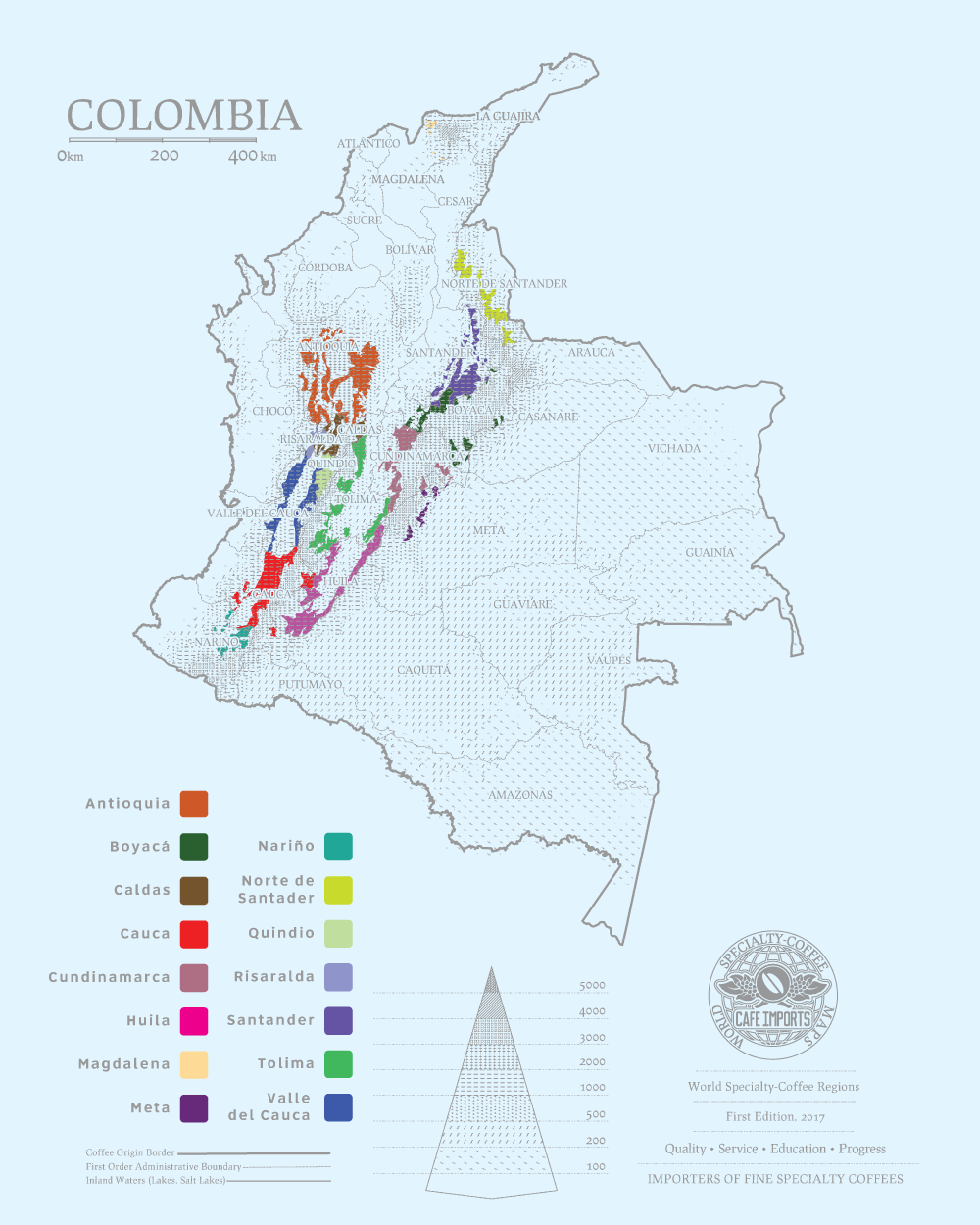
When FrontStreet Coffee explores a coffee, it first learns about its geographical location, climate and other factors. Colombia lies in the north-west of South America, bordering the Pacific and Atlantic Oceans. To the north-west is Panama, to the east Venezuela, to the south-east Brazil, to the south Peru and to the south-west Ecuador. Colombia has a mild climate and humid air. Its diverse climate allows harvesting year-round, with the main harvest season from October to January and a secondary season from April to July. Different types of coffee mature in succession at different times. The country cultivates uniquely flavourful Arabica beans, and Colombian coffee is characterised by its rich taste and endless aftertaste, making it truly premium coffee.
Good geographical locations lead to the establishment of production regions, and Colombia has many of them. The more famous ones include Medellin, Armenia and Manizales, collectively known as "MAM."
FrontStreet Coffee's Colombian Selections
FrontStreet Coffee offers many varieties of Colombian coffee from the Huila region. Huila Province sits in the southern part of Colombia's central mountain range and is the country's most renowned specialty coffee region. Surrounded by mountains above 1,500 metres, with important rivers flowing through and bringing abundant rainfall, its geographical environment creates excellent conditions for growing high-quality coffee. FrontStreet Coffee therefore selected a Colombian coffee from the Huila region as one of its seven staple beans, aiming to let everyone experience the most authentic, clean and bright flavours of Colombian coffee. The washed processing method shows off the characteristics of FrontStreet Coffee's Huila coffee to the full.
1. FrontStreet Coffee Colombian Huila Coffee
Region: Huila, Colombia
Altitude: 1500-1800 metres
Variety: Caturra
Processing: Washed
Flavor: Notes of black chocolate, nuts and caramel with soft fruit acidity.

This FrontStreet Coffee Colombian Huila coffee is named after its origin, which speaks volumes about the unique quality of coffee from this region and its ability to represent the singularity of Huila. Made from 100% Arabica varieties and selected for bean size and single-origin criteria, its most outstanding characteristics are purity, balance and smoothness.
2. FrontStreet Coffee Colombian Flower Moon Night Coffee
Region: Esperanza Garden Farm, Huila
Processing: Anaerobic Natural
Variety: Caturra
Altitude: 1800 metres
This FrontStreet Coffee Flower Moon Night uses the popular anaerobic processing method, featuring intense strawberry jam flavours, prominent fermentation aromas and sweet chocolate notes that are genuinely captivating.

First, coffee cherries are placed in sealed fermentation tanks and fermented at low temperatures to extend the overall fermentation time. A 15 to 20 day fermentation period allows for more flavour possibilities. Cultivated by time, slow drying lets the cherries develop optimal water activity during the process, which not only achieves better flavour development but also allows green beans to keep longer through seasonal storage cycles. After fermentation, the fruit is dried naturally. FrontStreet Coffee understands that drinkers associate the most basic flavours of Colombia with nuts and chocolate. Thanks to innovations in post-processing methods in Colombia, however, many beans with outstanding flavours have emerged, and FrontStreet Coffee has followed these developments closely. This FrontStreet Coffee Flower Moon Night, beyond those foundations, also possesses rich fruit aromas that are truly surprising.
3. FrontStreet Coffee Colombian Rose Valley Coffee
Estate: Finca El Árbol (Big Tree Estate), Colombia
Region: Santander
Processing: Anaerobic Double Enzyme Washed
Altitude: 1700 metres
Variety: Caturra

FrontStreet Coffee's Rose Valley variety is Caturra, common in the Americas region. Caturra is a natural variant of Bourbon, discovered in Brazil in 1937. It continues the citrus and nut notes of Bourbon varieties but is more productive thanks to its shorter plant height. Through cupping many Colombian and Brazilian beans, FrontStreet Coffee found that Colombian coffee has a rich, full-bodied aroma, excellent acidity and high balance, while FrontStreet Coffee Brazilian coffee has a smooth entry, low acidity and excellent body. Colombia has many excellent estates, and FrontStreet Coffee set its sights on the Big Tree Estate, which has been operating for over 20 years. Its rich peach flavour surprises many who enjoy peach oolong tea.
FrontStreet Coffee Colombian Rose Valley beans use anaerobic enzyme washed processing. The first part of the method resembles washed processing: defective beans are removed by flotation, then the pulp and skin are removed mechanically. The processed beans are placed in a sealed container into which carbon dioxide is injected to expel oxygen. In an anaerobic environment the decomposition of sugars in the mucilage slows down and the pH falls more slowly, extending fermentation time. Beans from this region are known for intense flavours, a persistent aftertaste and unique fresh grassy notes.

4. FrontStreet Coffee Colombian Sakura Coffee
Region: Cauca, Colombia
Estate: Finca El Paraíso (Paradise Estate)
Altitude: 2050 metres
Variety: Castillo
Processing: Double Anaerobic Washed
Flavor: Sakura, osmanthus, passion fruit, with sweet aroma, rounded mouthfeel and persistent aftertaste.

Through double anaerobic washed processing it exhibits aromas of mugwort, mint and eucalyptus, with flavours of berries and strawberry candy.
The topography, precipitation, temperature and volcanic soil of the Cauca region create excellent conditions for growing Colombian coffee, which is why it is generally considered an origin-certified region. 80% of the area is mountainous, and the high altitudes create large temperature swings between day and night, allowing the seeds and fruit to absorb nutrients fully. This also gives Cauca its better acidity and its renowned sweetness.

In addition to common American-region varieties such as Caturra, Bourbon, Typica and Pacamara, Colombian coffee also has three unique disease-resistant varieties: Castillo, Tabi and the Colombia variety, named after the country. Further varieties are also being trialled.
This FrontStreet Coffee Colombian Sakura bean uses the most popular processing method of recent years. Coffee cherries are typically placed in an anaerobic environment for fermentation and then removed from it for further processing. The method is called anaerobic fermentation processing, and the result is that this FrontStreet Coffee Sakura bean has a citrus-lemon acidity and a smooth mouthfeel.

5. FrontStreet Coffee Colombian Huila Decaf Coffee
Region: Huila, Colombia
Altitude: 1750 metres
Variety: Typica, Caturra, Castillo
Processing: Swiss Water Decaf
Flavor: Black chocolate, caramel, nuts, with rich mouthfeel.

This batch of FrontStreet Coffee Colombian Huila Decaf includes three varieties: Typica, Caturra and Castillo. Caturra is a natural mutation of Bourbon with extremely strong adaptability, requiring no shade trees and thriving in direct sunlight, which is why it is commonly known as sun-grown coffee. The coffee uses Swiss Water decaffeination technology.
The Swiss Water Process was developed by the Swiss company Coffex in the late 1970s, and SWISS WATER is now a registered trademark. The method soaks green coffee beans in hot water, a stage that already removes some caffeine. The soaking solution is then filtered through activated carbon, and finally the solution is returned to the beans. This sequence removes caffeine more effectively. Besides not requiring chemical solvents, the solution can be reused across batches, though the coffee still loses some flavour during filtration. The method's caffeine removal rate can reach 99.9%, making it the most effective decaffeination method available. This FrontStreet Coffee Colombian Decaf meets the needs of anyone who wants to drink coffee while avoiding excessive caffeine.
6. FrontStreet Coffee Colombian San José Estate Coffee
Processing: Fine Washed Rum Barrel Processing
Variety: Castillo
Altitude: 1750 metres
Flavor: Rum, chocolate liqueur, tropical fruits, maple syrup

Castillo is a new generation leaf-rust-resistant variety developed jointly by the Colombian Coffee Growers Federation (FNC) and Colombia's National Coffee Research Centre (Cenicafé). After 23 years of research and experimentation, Cenicafé developed the fifth generation Castillo, which was officially promoted for commercial cultivation in 2005. Castillo is known for its smoothness, aroma and lemon acidity.
This FrontStreet Coffee San José Estate coffee uses washed rum barrel fermentation: the cherries are peeled and placed in aged oak barrels for low-temperature fermentation, followed by washed processing and finally drying on sun-drying racks. Colombia's unique natural conditions produce coffee with a full body, nut and black chocolate aromas and a smooth, pleasant fruit acidity, which is why Colombian single-origin coffee has always been popular with the public. Pour-over enthusiasts should not miss these FrontStreet Coffee Colombian recommendations.

How to Brew FrontStreet Coffee Colombian Beans
Now that FrontStreet Coffee has introduced a range of Colombian beans, it should be clear how different processing methods create distinct flavour profiles. That leads to the question staff hear most often in their stores: how should FrontStreet Coffee Colombian coffee be brewed?
Brewing Parameters
Because FrontStreet Coffee Colombian coffee aims to highlight its aroma and high-quality acidity, the company uses the Hario V60 dripper for brewing. The V60 has a wide opening with a spiral rib design that lets air escape more easily, improving extraction quality. The resulting coffee has a lighter body with more pronounced fruit acidity and aroma.

Dripper: Hario V60
Water Temperature: 90 degrees Celsius
Coffee Dose: 15 grams
Coffee-to-Water Ratio: 1:15
Grind Size: EK43s #10 (80% pass-through rate on Chinese standard #20 sieve)
FrontStreet Coffee uses a three-pour method when brewing Colombian coffee. First, pour 30 grams of water for a 30-second bloom. Then pour the second stage to 125 grams and wait until the water level drops to just below the coffee bed. Pour the third stage to 225 grams and stop. Remove the dripper once all the water has dripped through. Total extraction time is 2 minutes 00 seconds.

Through repeated brewing and careful observation, FrontStreet Coffee found that beans such as Flower Moon Night and Rose Valley swell during the bloom not only because FrontStreet typically roasts them within five days of shipping but also because their special processing makes them eager to expand. The water flow during extraction is therefore too fast, so the stream should be kept as small as possible while pouring.
FrontStreet Coffee Recommendation
Colombia's bright, balanced profile comes into focus when set against its neighbour, and FrontStreet Coffee's Brazilian staples are the perfect counterpoint. The FrontStreet Cerrado Red Bourbon is a semi-natural, medium-roasted single origin from the well-known Cerrado region, built on the red Bourbon variety common across South America; it delivers creamy peanut, toast, caramel and hazelnut aromas with a rounded body, low acidity and a light bitter finish, and it suits pour-over as well as a moka pot, an espresso SOE, a siphon or a French press.
For a sweeter Brazilian expression, the FrontStreet Queen Estate comes from Mogiana, close to South Minas, where fertile red volcanic soil feeds the fruit; the estate grows the rare Yellow Bourbon, a mutation of Red Bourbon whose fruit character is cleaner, and it gives a sugarcane-like sweetness along with fruit and chocolate flavours when brewed as pour-over, in a moka pot or on a home espresso machine.
If you want Brazil in an espresso, the FrontStreet blend range is the place to look. Low acidity, a balanced body and a friendly price have made Brazilian coffee the first choice in many espresso recipes, and the full-bodied FrontStreet Classic, the nut-forward Premium, FrontStreet Coffee's Black Cocoa Blend recommended by many baristas and FrontStreet Coffee's Commercial Blend made for cafes all contain Brazilian beans. Their contribution is chocolate and cream aroma, a soft sweet-sour-bitter balance and, above all, a stability that makes extraction more predictable.
Important Notice :
FrontStreet Coffee is a long-established specialty coffee roaster in Guangzhou China, selling freshly roasted beans from its own farm in Yunnan as well as dozens of carefully selected single-origin beans from around the world for both pour-over and espresso. The products deliver consistently excellent quality and great value, with shipping within 24 hours. Guangzhou's FrontStreet Coffee shop is recommended by many coffee lovers, and the beans are now available online at the Tmall 。
FrontStreet Coffee has moved to a new address:
FrontStreet Coffee Address: 315,Donghua East Road,GuangZhou
Tel:020 38364473
 Scan and follow the En Gafei WeChat official account. Please indicate that the reprint comes from "En Gafei".

