Are Horse Champion 6.0 and Yirgacheffe Coffee the Same Variety? Flavor Differences Between Yirgacheffe Coffee and Horse Champion Coffee Beans

As is well known, Ethiopia is the birthplace of coffee. When Ethiopian coffee comes up, many enthusiasts' first thought is FrontStreet Coffee's Yirgacheffe. In recent years, however, Ethiopia has also produced another famous bean known in China as "Horse Champion" (Hua Kui, or Flower Champion). Can you tell the difference between FrontStreet Coffee's Yirgacheffe and FrontStreet Coffee's Horse Champion? If not, don't worry — this article will make the relationship between the two crystal clear.
Ethiopia
As a renowned coffee birthplace, Ethiopia lies in northeastern Africa, at the center of the Horn of Africa, on the East African plateau southwest of the Red Sea. The country borders Djibouti and Somalia to the east, Sudan and South Sudan to the west, Kenya to the south, and Eritrea to the north.
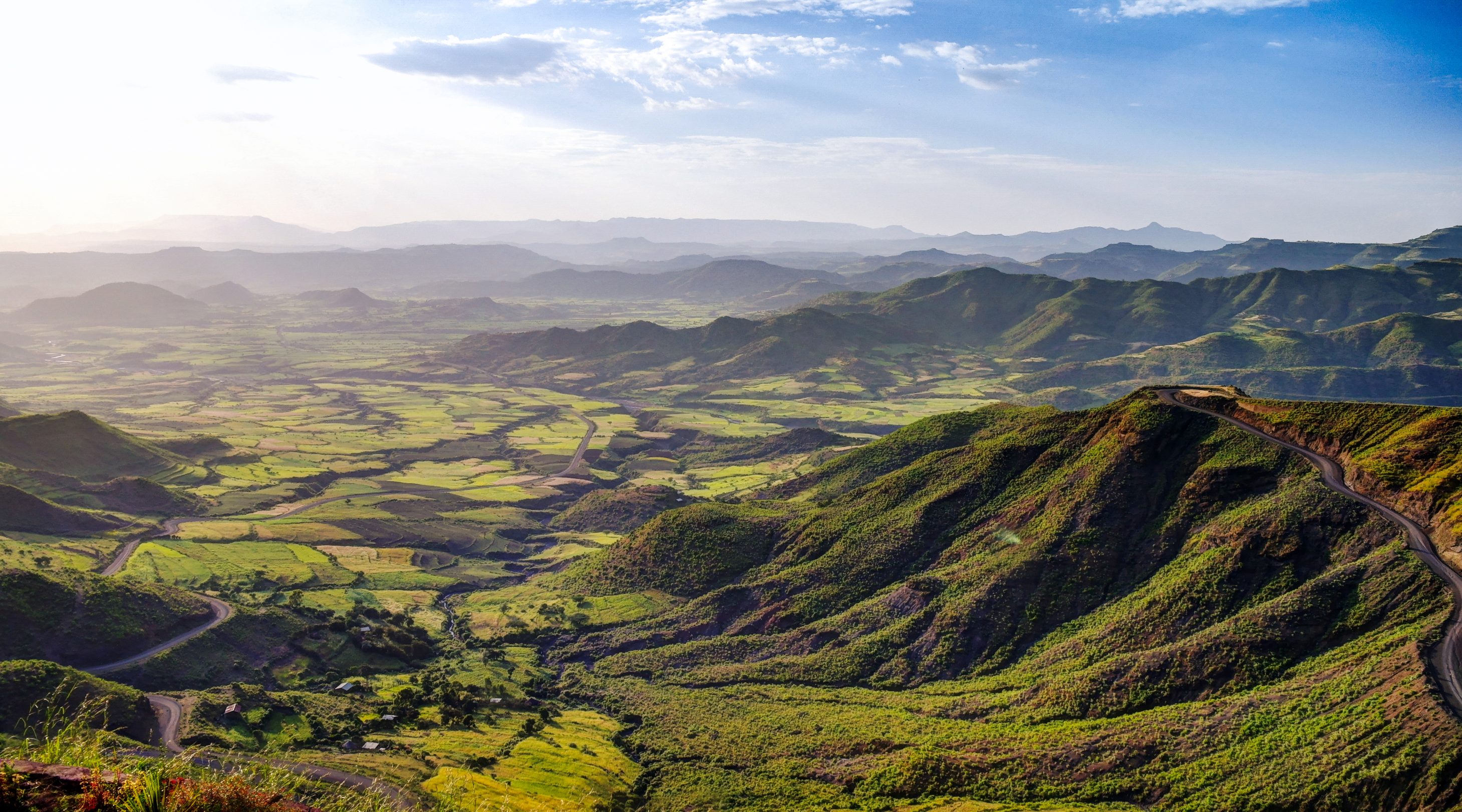
Ethiopia's terrain consists mainly of mountainous plateaus, with the East African Rift Valley cutting through the entire country. The average altitude is nearly 3,000 meters, earning it the nickname "Roof of Africa." Because of significant differences in latitude and altitude, temperatures vary considerably across regions despite its tropical location. The country has a heavy rainy season from June to September, a dry season from October to January, and a light rainy season from February to May. Because rainfall is unevenly distributed across seasons and regions, localized droughts are common. Temperatures range from 9.7°C to 25.5°C, with an average annual temperature of 16°C.
Coffee cultivation in Ethiopia is concentrated in the western and southern regions, with more than half of production following a smallholder farming pattern — also known as garden coffee — which is Ethiopia's primary production method. By some reports, nearly 1.2 million local families depend on coffee cultivation for their livelihood, with each household's planting area not less than 4 hectares. In garden coffee, farmers manage coffee trees mixed with other economic crops in their backyards, typically planted alongside banana trees, creating the distinctive green landscapes in front of and behind their homes.

Because smallholder production volumes are small, local farmer cooperatives and processing plants handle the green bean processing for their respective areas. Each harvest season, farmers harvest the fruit from their coffee trees and deliver it to nearby washing stations (cooperatives) for unified processing, after which the beans are sold under the processing plant's name. For example, the Buku Abel cooperative beans on FrontStreet Coffee's bean list are collected from cherries grown around Yirgacheffe town, delivered by farmers for unified washed processing, and finally sold worldwide under the cooperative's name.
Production Regions
Ethiopia has nine major coffee-producing regions: Sidamo, Yirgacheffe, Harar, Limu, Jimma, Lekempti, Bebeka, Lekempti, and Illubabor.
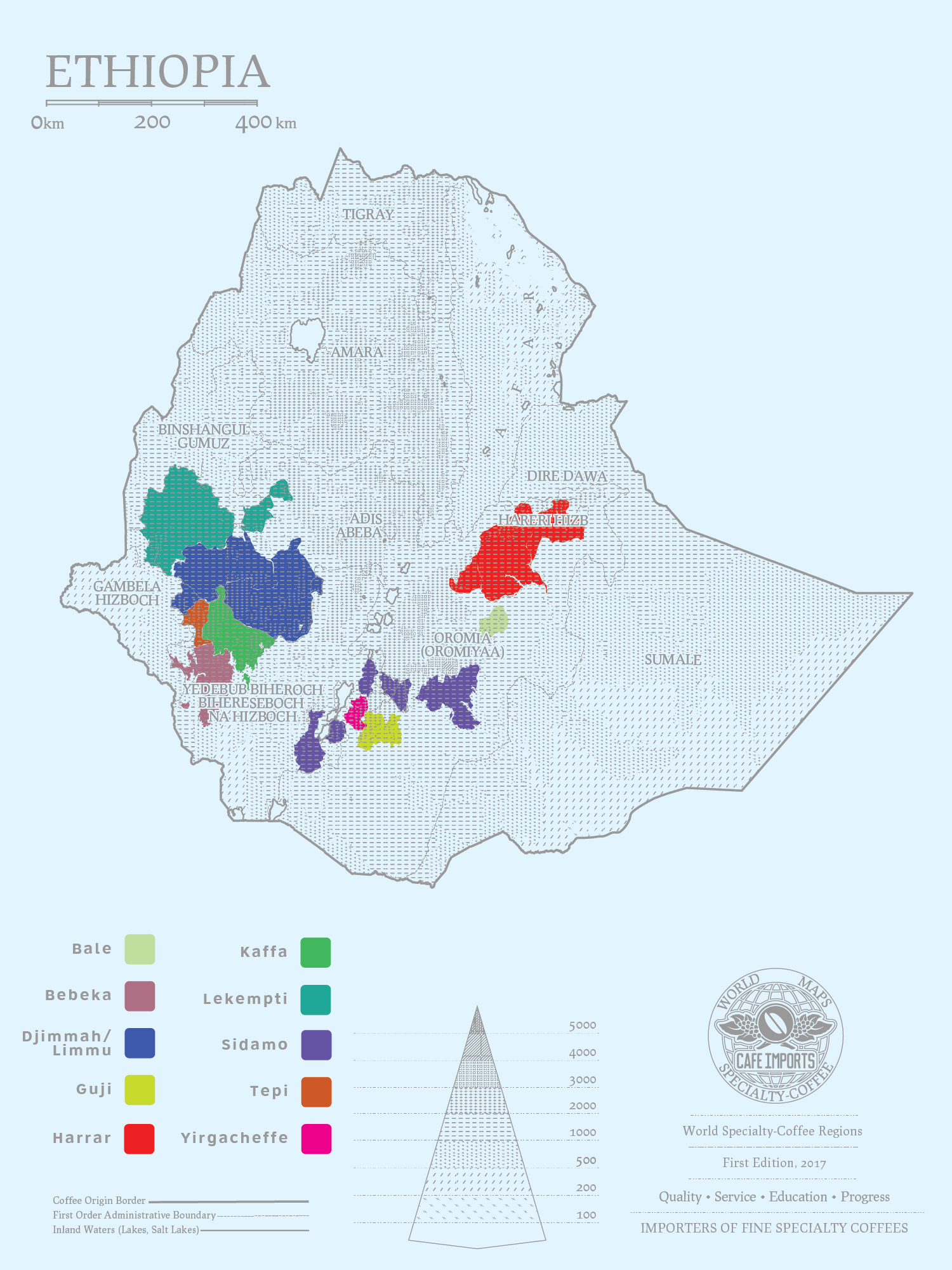
Here, FrontStreet Coffee will introduce only the two regions relevant to this article: Sidamo and Yirgacheffe.
Sidamo
Sidamo is located in southern Ethiopia, extending eastward to the Arsi and Bale administrative areas and westward to the Gamo Gofa administrative area. Coffee cultivation altitudes in Sidamo range between 1,400 to 2,000 meters. The region's coffee flavors are remarkably diverse — different soil types, microclimates, and countless native varieties create distinct character in each town's coffee. Among Sidamo's sub-regions, Guji and West Arsi are the best known internationally.
Coffee beans from Sidamo are mostly processed using the natural method. Through repeated cupping, FrontStreet Coffee has found that the rich fruity aroma and smooth texture of Sidamo beans owe much to that natural processing.

On FrontStreet Coffee's bean list, the Horse Champion bean comes from the Guji area of Sidamo. Guji coffee differs from Yirgacheffe coffee in carrying more intense floral aromas. Hambella, in Guji, took the championship at the 2017 Ethiopia National Taste of Harvest (TOH) competition, after which Chinese green bean importers named the bean "Horse Champion." At the time, the winning lot showed strong strawberry and cream aromas.
FrontStreet Coffee's Horse Champion is a natural processed bean from the Buku Abel processing plant. The growing area is surrounded by sugarcane and banana plants, and the high-altitude climate lends the coffee a smooth texture with passion fruit acidity, while natural processing adds fermented wine notes.

FrontStreet Coffee: FrontStreet Coffee's Sidamo · Horse Champion 5.0 Coffee Beans
Region: Ethiopia Sidamo
Altitude: 2050m-2300m
Variety: Local native varieties
Processing method: Natural processing
Yirgacheffe
Yirgacheffe is a small town at altitudes between 1,700 to 2,100 meters. In its original name, YirgaCheffe, "Yirga" means "settle down" and "Cheffe" means "wetland" — so the name means "let us settle and make a living on this wetland." Yirgacheffe was once a sub-region of Sidamo, but because its coffee and processing methods were so outstanding, Ethiopian farmers competed to boast of the "Yirgacheffe flavor" in their beans, and the town eventually became an independent region. Today, "Yirgacheffe" is not only the name of a place but also a synonym for a whole flavor profile.
Yirgacheffe coffee is known to virtually everyone and serves as the entry point for many enthusiasts — all thanks to that flavor. What is the Yirgacheffe flavor? Intense jasmine florals, lemon or lime acidity, peach and almond sweetness, and a tea-like aroma. As the saying goes, "when the coffee enters the mouth, a hundred flowers bloom."
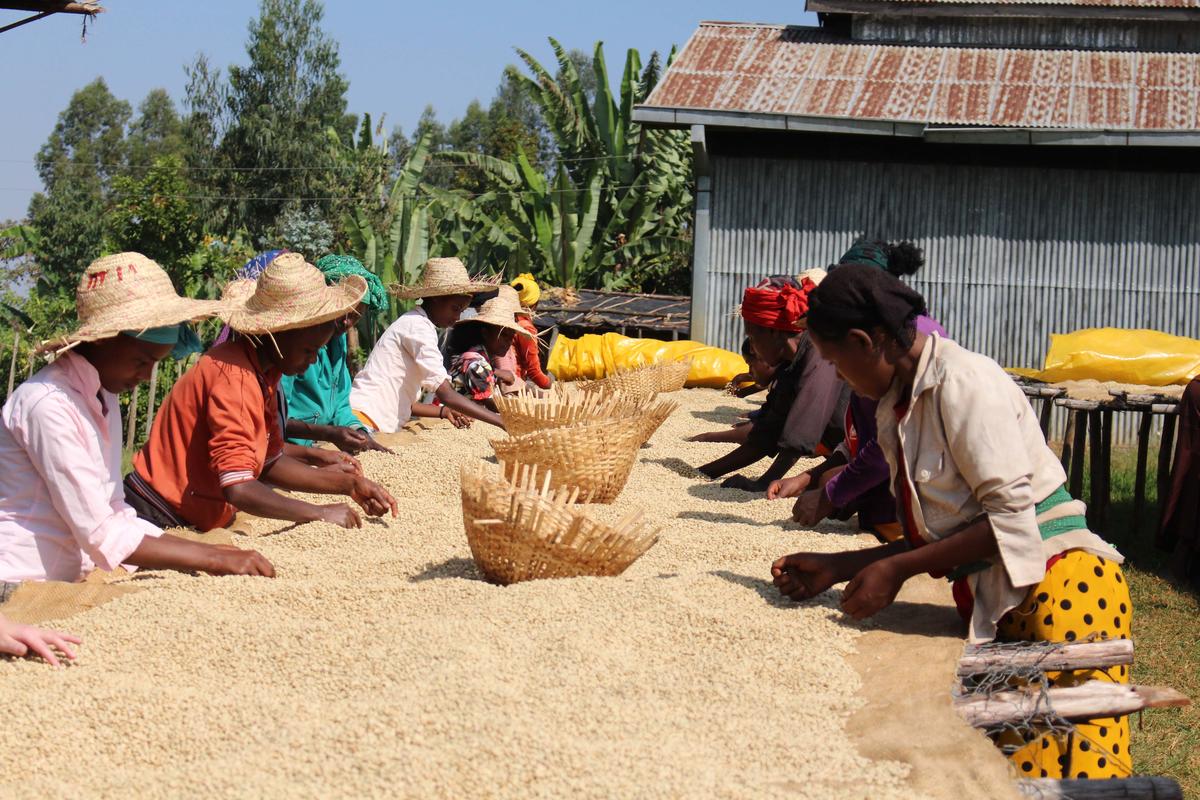
Compared with the typical impression of Sidamo coffee, Yirgacheffe mostly uses washed processing. FrontStreet Coffee believes washed coffee shows more prominent acidity and better cleanliness, best expressing Yirgacheffe's character. FrontStreet Coffee's washed Yirgacheffe lineup includes the Worka, Kochere, and Buku Abel lots. The Buku Abel cooperative that produces FrontStreet Coffee's Buku Abel beans became independent from the Worka cooperative in 2012, and since many of its members were originally Worka members, its production techniques are beyond question.
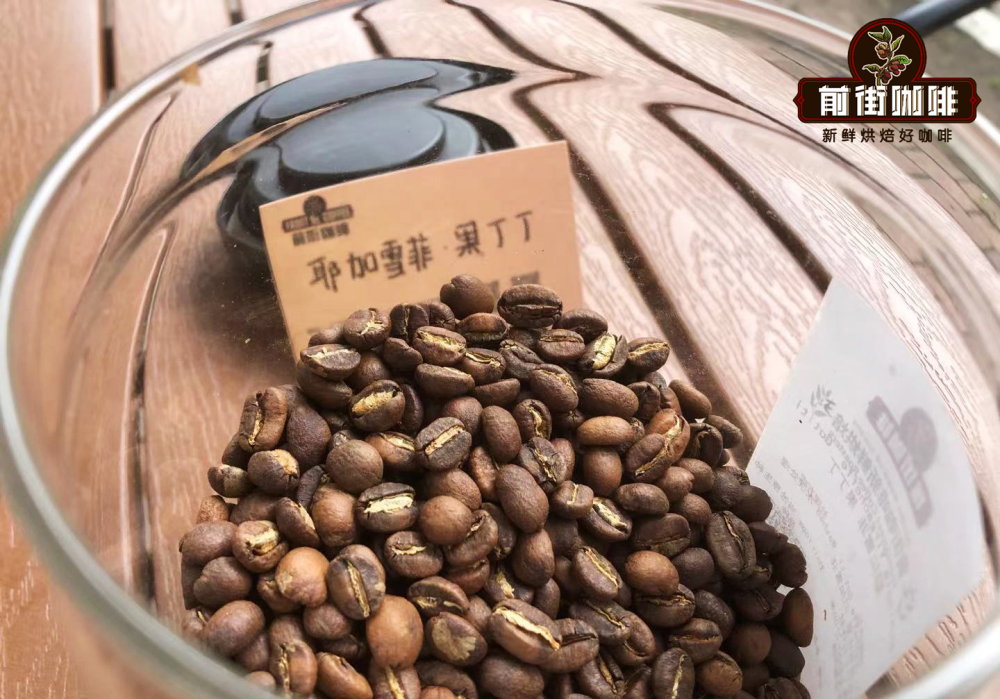
FrontStreet Coffee: FrontStreet Coffee's Yirgacheffe · Buku Abel Coffee Beans
Region: Ethiopia Yirgacheffe
Cooperative: Buku Abel Cooperative
Altitude: 2000m-2100m
Variety: Local native varieties
Processing method: Washed processing
Brewing Suggestions
To fully extract the fruity acidity of these two beans, FrontStreet Coffee uses higher water temperature and a finer grind size — but to avoid over-extraction at high temperatures, it brews them in a fast-flowing dripper such as the V60.
FrontStreet Coffee suggests using freshly roasted beans to bring out the coffee's full flavor. Beans shipped by FrontStreet Coffee are roasted within 5 days, because freshness profoundly affects flavor — the roasting philosophy is "freshly roasted good coffee," ensuring every order arrives fresh. The ideal resting period is about 4-7 days, so coffee reaches customers right at its flavor peak.

Dripper: V60 #01
Water temperature: 90-91°C
Coffee dose: 15g
Coffee-to-water ratio: 1:15
Grind size: EK43s #10 (80% pass-through rate with #20 standard sieve)
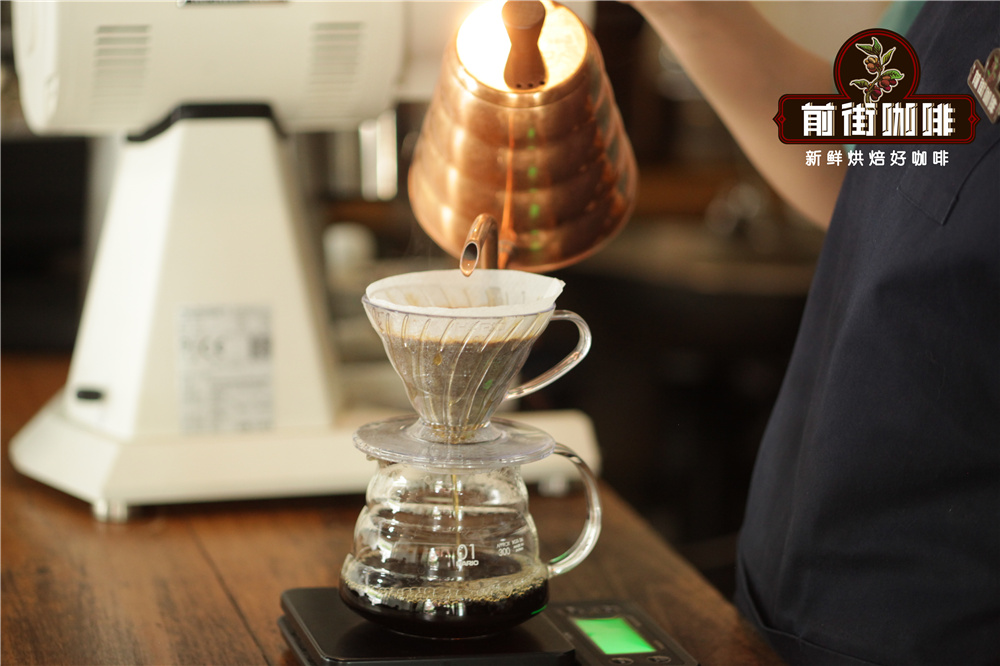
FrontStreet Coffee's brewing method: first pour 30g of water for a 30-second bloom, then pour 95g more (scale shows around 125g), completing the pour in about 1 minute. When the water level drops to 2/3 of the coffee bed, pour the remaining 100g (scale shows around 225g), completing in about 1 minute 35 seconds. Drawdown finishes between 2 minutes and 2'10" — then remove the dripper and the extraction is complete.
Flavor Profiles
[FrontStreet Coffee's Buku Abel] Opening notes of citrus and black tea, with cream, caramel, and almond notes emerging as the cup cools, an obvious sweet aftertaste, and a clean, sweet mouthfeel.
[FrontStreet Coffee's Horse Champion 5.0] Floral aroma, berry, citrus, plum sweet-and-sour notes, mango juice, and honey, finishing with sweet black tea.

Finally, to restate the relationship one more time: FrontStreet Coffee's Horse Champion is coffee produced in the Sidamo region, while FrontStreet Coffee's Yirgacheffe refers to coffee from the Yirgacheffe region — same country, different terroirs, different processing, and two very distinct cups.
For more coffee bean information, follow Coffee Workshop.
FrontStreet Coffee Recommendation
If you want to taste the difference for yourself, pick up both beans and brew them side by side with the parameters above. The washed Yirgacheffe Buku Abel is the perfect introduction to Ethiopian coffee — its white jasmine florals, bright citrus and lemon acidity, and tea-like finish are exactly why Yirgacheffe became a byword for Ethiopian flavor.
The Horse Champion 5.0 (Flower Champion) natural is its wilder sibling: from the Buku Abel plant in Guji's Hambella area, it was roasted medium-light by FrontStreet Coffee and delivers floral aroma, berry, citrus, and plum over mango juice and honey, closing with sweet black tea. The surrounding sugarcane and banana plantings and the natural process give it a fermented, wine-like richness the washed lot simply doesn't have.
Rest both beans 4-7 days from the roast date, brew at 90-91°C with a 1:15 ratio in a V60, and you will taste in one afternoon exactly why Ethiopia is called the birthplace of coffee.
Important Notice :
FrontStreet Coffee is a long-established specialty coffee roaster in Guangzhou China, selling freshly roasted beans from its own farm in Yunnan as well as dozens of carefully selected single-origin beans from around the world for both pour-over and espresso. The products deliver consistently excellent quality and great value, with shipping within 24 hours. Guangzhou's FrontStreet Coffee shop is recommended by many coffee lovers, and the beans are now available online at the Tmall 。
FrontStreet Coffee has moved to a new address:
FrontStreet Coffee Address: 315,Donghua East Road,GuangZhou
Tel:020 38364473
 Scan and follow the En Gafei WeChat official account. Please indicate that the reprint comes from "En Gafei".