China Yunnan Coffee Origin - Flavor Differences Between Yunnan Small Bean Coffee Catim and Typica
For professional coffee knowledge exchange and more coffee bean information, follow Coffee Workshop (WeChat public account: cafe_style).
At FrontStreet Coffee there are three Yunnan varieties: FrontStreet Coffee's own cultivated Yunnan Typica from Huaguoshan, a sun-processed Yunnan Catimor small bean, and a washed Yunnan Catimor small bean. This article focuses on the latter two. Through bean differentiation, roasting, cupping, and brewing, we'll explore how their flavors differ.
FrontStreet Coffee's Yunnan Catimor Cultivation in Baoshan
Coffee was introduced to Yunnan in the late 1800s, and commercial production began in 1988 with government support. Yunnan borders high-latitude countries such as Vietnam, Laos, and Myanmar, which makes it well suited to coffee. The Lujiangba area of Baoshan has a distinctive dry-hot valley climate ideal for Arabica small beans. Located at the eastern foot of Gaoligong Mountain, along both banks of the Nujiang River, most small-bean cultivation areas sit between 800 and 1200 meters, with some expanding to around 1400 meters. The raw-material base has a subtropical monsoon climate.
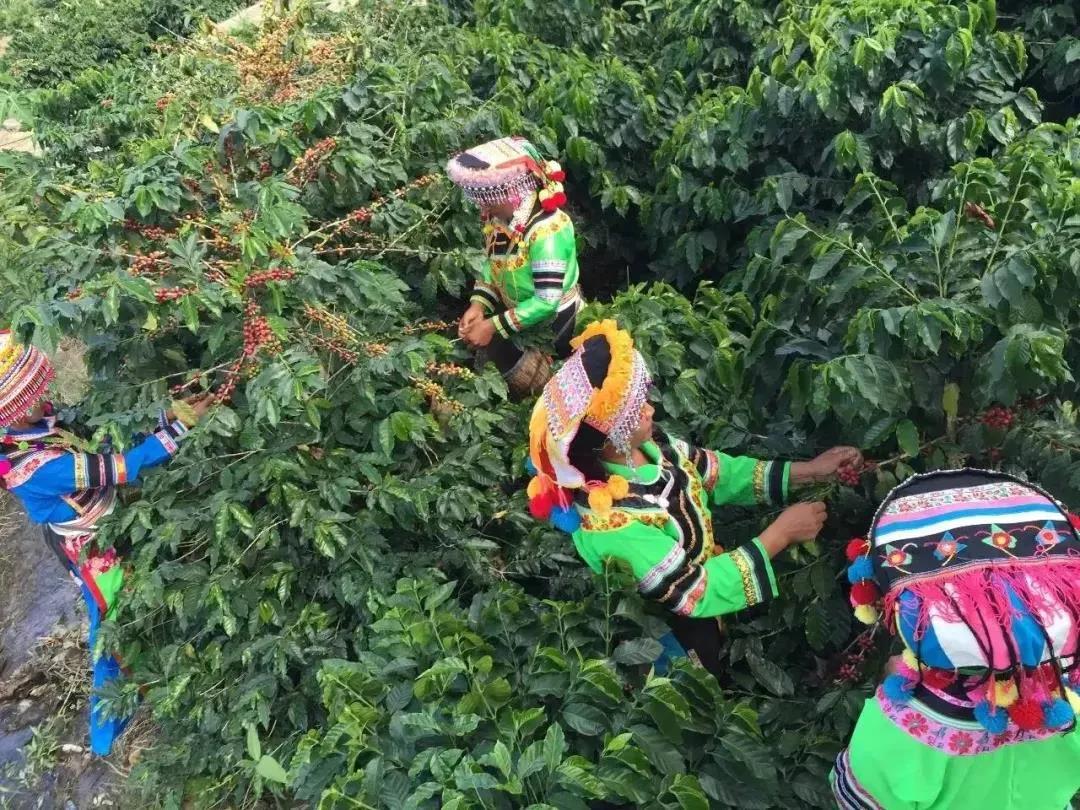
FrontStreet Coffee notes that Baoshan small beans rank among the highest-quality coffees in China and worldwide. The beans are uniform and full, with a fresh aroma, rich fragrance, mellow taste, and a strong but not harsh flavor. At the 1980 National Coffee Conference, Baoshan small bean was recognized as the "Crown of National Coffee." On December 24, 2010, the former General Administration of Quality Supervision approved geographical indication product protection for "Baoshan Small Bean Coffee."
Impact of the 2020 Yunnan Drought on Coffee Production
That year, Yunnan was affected by the monsoon climate, terrain, the El Nino phenomenon, and deforestation, which reduced rainfall and brought drought. During the February-March flowering period, rainfall in Yunnan's coffee areas dropped significantly compared with the previous year, falling by more than 60% year on year, creating severe drought conditions. From April 22-27, heavy rains fell across central, southern, and western Yunnan, temporarily easing the drought, and average rainfall in the producing areas generally came in higher than the same period the year before. Even so, the severe drought in February and March prevented the first batch of coffee from setting fruit, which would affect that year's Yunnan production.

According to data from the Pu'er Tea and Coffee Industry Development Center, as of March 31, 162,200 mu of coffee in Pu'er City was affected. As Yunnan's largest coffee-producing area, Pu'er City has 695,700 mu under cultivation, meaning approximately 23.3% of the city's coffee farmland was hit by drought. The damage to the first production season also affected how well the trees flowered for the second season. Although attention focused mainly on the second season, authorities indicated that beans from the Baoshan production area would see a slight decrease compared with the same period the year before, while the Pu'er, Lincang, and Dehong areas were expected to hold steady.
Yunnan Small Bean Coffee Varieties
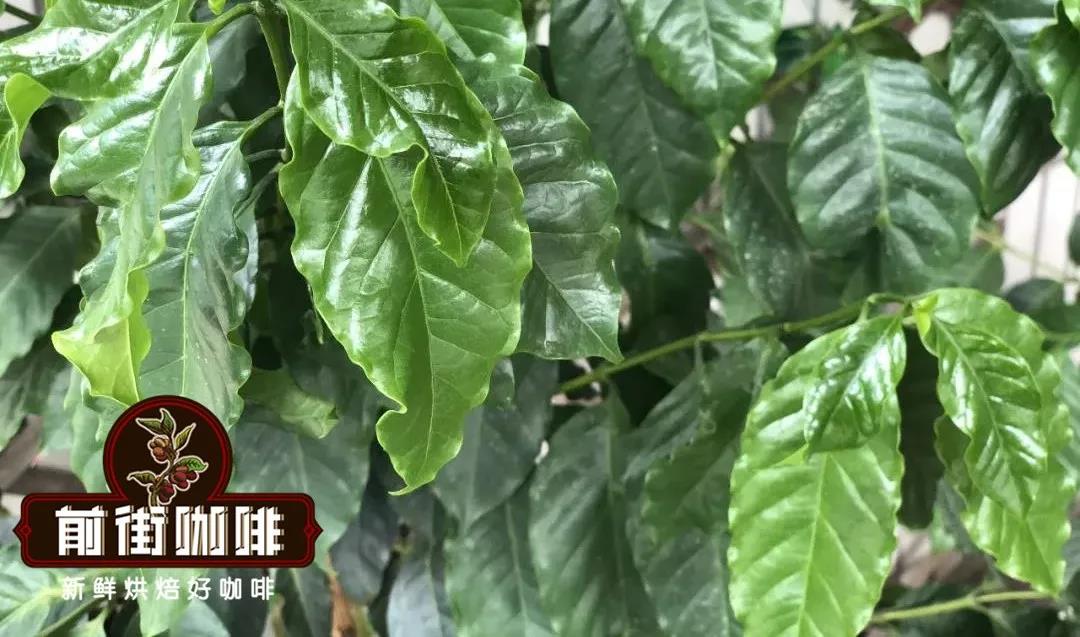
In 1959, the Portuguese moved the Bourbon mutation variety Caturra from Brazil to East Timor, where it was hybridized with the Timor hybrid, which carries Robusta bloodlines, successfully producing Catimor, a variety with exceptional disease resistance and productivity. As leaf rust plagued coffee-producing countries around the world, various countries vigorously promoted Catimor with the help of international organizations, in order to resist leaf rust and raise productivity. Catimor is a cross between Arabica and Robusta. Robusta brings good leaf rust resistance, rich oils, high yield, and ease of cultivation. Through cupping Catimor, FrontStreet Coffee finds that it combines Robusta's mellow coffee flavor with the rich taste of the original Typica species. Because Catimor does not require high-altitude cultivation, it has been widely planted across the Yunnan region.
Yunnan Coffee Bean Processing Methods
It was only when FrontStreet Coffee grew coffee trees in Yunnan that they truly understood what a rainy season means. Because of Yunnan's long rainy season and unstable climate, most Yunnan beans are processed using the washed method. The harvested cherries go through a depulper to separate most of the pulp from the beans, then the parchment beans are guided into a clean water tank and soaked to ferment, thoroughly removing the remaining pulp layer. In the past, about five years ago, the washed method was often the preferred way to process quality beans. Water processing uses buoyancy differences to sort out unripe and defective beans, and fermentation is easier to control. So unlike natural-processed beans, which can have mixed flavors, washed beans present distinct fruit acidity, slightly greater complexity, and a cleaner cup with no astringency or sharpness.
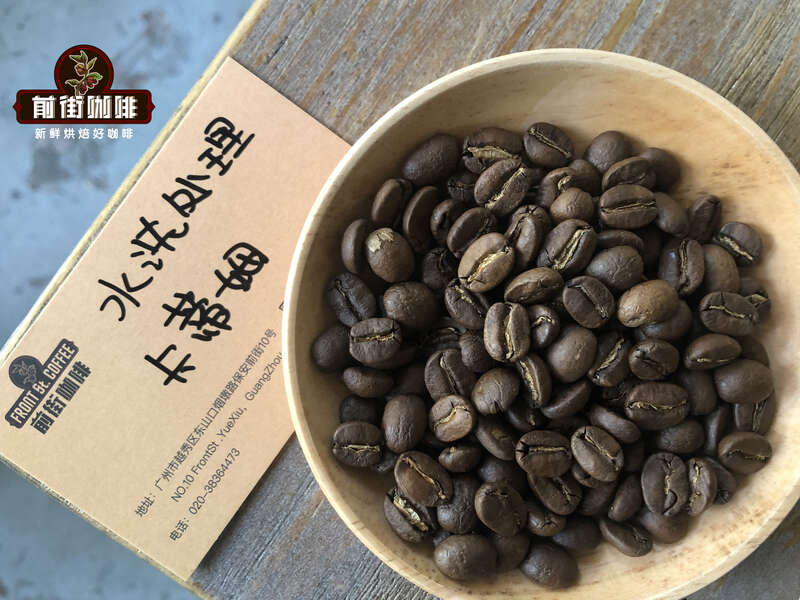
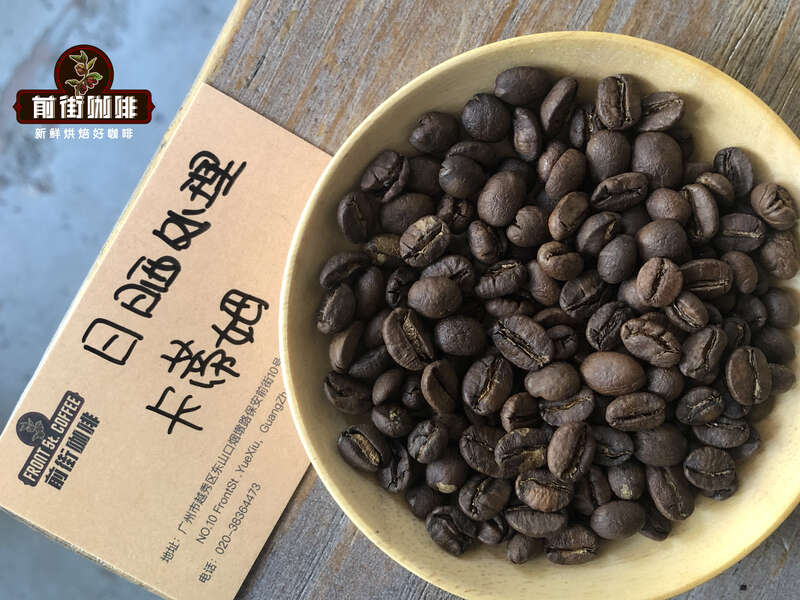
So how does FrontStreet Coffee process sun-dried beans? Despite the long rainy season, there are stretches of good weather, so that year the farmers adopted red-cherry sun-drying. Red cherry means fully mature fruit. During harvest, farmers pick only ripe red fruit, placing them one by one into baskets. The harvested fruit is uniform in size, similar in ripeness, and free of other impurities. During processing, manual selection comes first to remove defective beans and immature or overripe fruit. The red fruit is then spread evenly on raised wooden frames or whole drying racks for sun-drying, which avoids the risk of the beans picking up off-flavors from contact with the ground. During drying, the beans are turned constantly so they are exposed evenly and lose water uniformly; every three to five days, farmers manually sort out defective moldy beans. Once the fruit skin has dried and hardened, a hulling machine removes the dry hard skin. After the green beans are obtained, farmers do one final selection in pursuit of the perfect taste. FrontStreet Coffee believes the natural method can enhance a coffee's sweetness: by harvesting and selecting fully mature fruit, the sugar content in the pectin is higher, so red-cherry natural processing yields beans with greater sweetness and a fuller, more solid taste than typical natural processing.
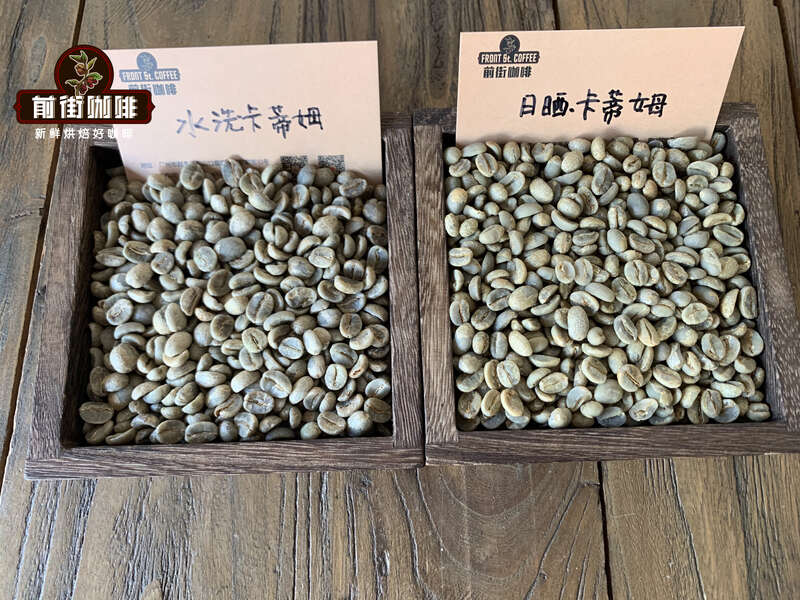
Comparison of Yunnan Catimor Coffee Beans with Two Processing Methods
Comparing the raw beans from the two methods, FrontStreet Coffee noted that the washed coffee looks blue-green, with an acidic note in the raw bean aroma, while the natural coffee looks yellowish, with a fermented note in the raw bean aroma.
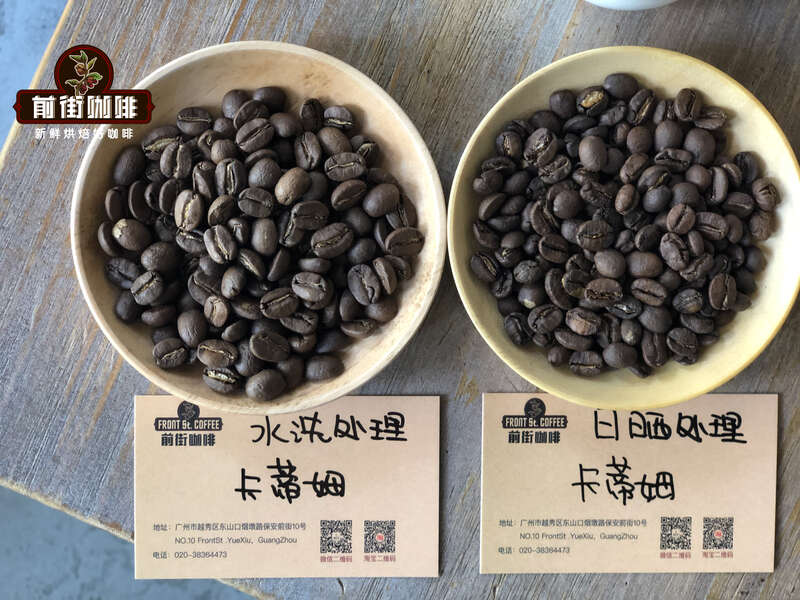
Comparing the roasted beans, FrontStreet Coffee finds the biggest difference is that the silver skin of natural beans comes off very cleanly, while washed beans retain light-yellow silver skin along the center line. The reason is that during roasting, the silver skin at the center line is the most difficult to remove. Natural beans have their outer silver skin connected as one piece, so it comes off along with the center-line silver skin, while washed beans' silver skin clings to the bean body in fragments and the silver skin in the center-line crease cannot be easily peeled off.
FrontStreet Coffee's Roasting Records for Yunnan Catimor Coffee Beans
FrontStreet Coffee natural Catimor roasting: Yangjia 800N roaster, 300 g batch size. Heat to 165 degrees C when charging, fire power 130, damper opening 3; return temperature point at 1'32", and when the drum temperature reaches 128 degrees C, open the damper to 4 with fire power unchanged; when the drum temperature reaches 153 degrees C the bean surface turns yellow and the grassy aroma disappears completely, entering the dehydration stage. When the drum temperature reaches 157 degrees C, adjust fire power to 100, damper unchanged; at 9'00", the bean surface shows ugly wrinkles and black spots and the toast aroma clearly transforms into coffee aroma, which can be defined as the prelude to first crack. At this point, listen carefully for the sound of first crack. First crack begins at 10'06", the damper opens fully, and after first crack develop for 3 minutes and discharge at 198.5 degrees C.
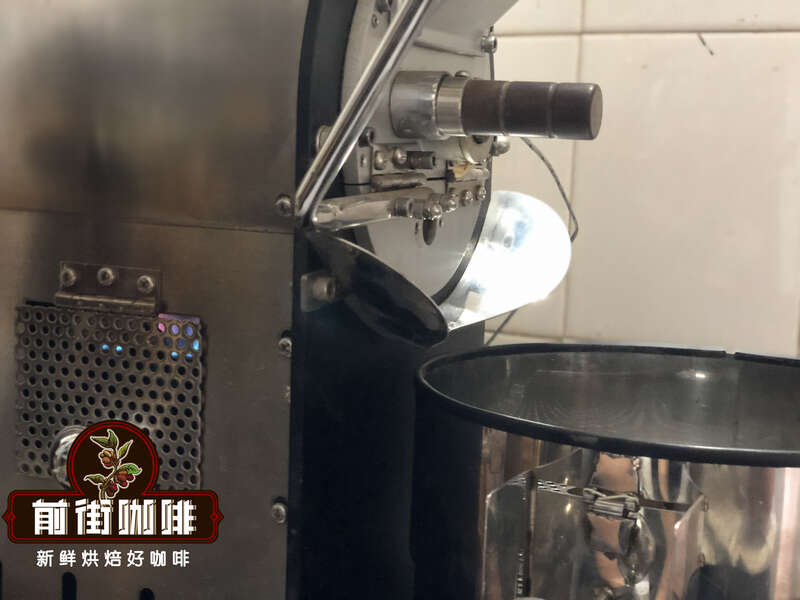
FrontStreet Coffee washed Catimor roasting: Yangjia 800N roaster, 300 g batch size. Heat to 190 degrees C when charging, fire power 120, damper opening 3; return temperature point at 1'40", and when the drum temperature reaches 145 degrees C, open the damper to 4 with fire power unchanged; when the drum temperature reaches 166 degrees C the bean surface turns yellow and the grassy aroma disappears completely, entering the dehydration stage. When the drum temperature reaches 188 degrees C, adjust fire power to 60 and set the damper at 5; at 8'37", the bean surface shows ugly wrinkles and black spots and the toast aroma clearly transforms into coffee aroma, which can be defined as the prelude to first crack. At this point, listen carefully for first crack. First crack begins at 9'00", the damper unchanged, and after first crack develop for 3 minutes and discharge at 198 degrees C.
FrontStreet Coffee's Cupping Report for Yunnan Catimor Coffee Beans
FrontStreet Coffee cups within 8-24 hours of roasting the sample beans. Its baristas typically use 200 ml ceramic cupping bowls marked with 150 ml and 200 ml lines. Following SCAA standards, water TDS is around 150 ppm - too low a TDS can easily cause over-extraction, while too high a TDS affects taste and can easily cause under-extraction. Cupping water temperature is 94 degrees C. Cupping grind size follows SCAA cupping standards, controlled to a 70%-75% pass rate through a #20 standard sieve (0.85 mm). Ratio: 11 g of coffee to 200 ml of hot water, or 1:18.18, so the extracted concentration falls within the 1.15%-1.35% Golden Cup range. Steeping time: 4 minutes.
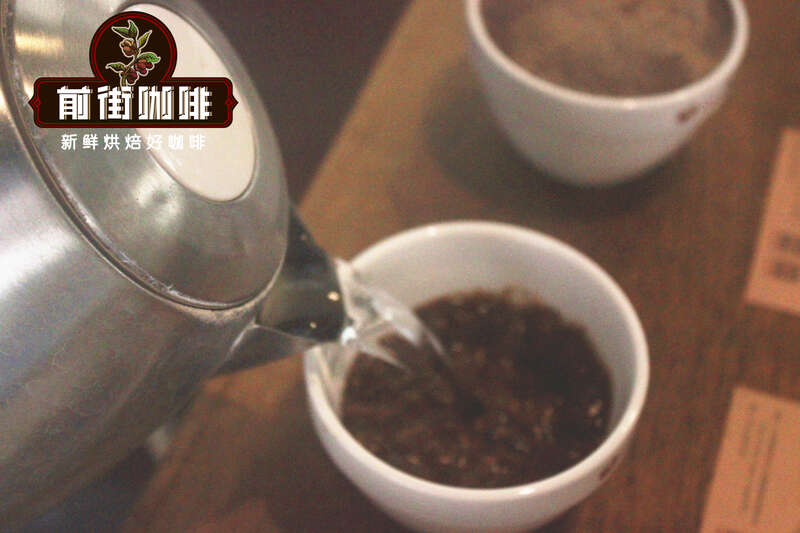
FrontStreet Coffee Yunnan natural Catimor: the entry shows red berry fruit acidity and nuts, with a plant-like herbal aroma; smooth on entry, nuts and chocolate in the mid-section, caramel sweetness in the finish, and a medium body with a full texture.
FrontStreet Coffee Yunnan washed Catimor: smooth on entry, with an Asian herbal, plant-like aroma and a lively, bright acidity that makes the cheeks water; soft acidity and a good balance of mellow richness, with rich layers and distinct black chocolate, honey, and cane sugar flavors in the aftertaste, turning to brown sugar once fully cooled.
FrontStreet Coffee's Brewing Experience for Yunnan Catimor Coffee Beans
Dripper: V60
Dose: 15 g
Water temperature: 90 degrees C
Grind size: 80% pass rate through a #20 standard sieve
Water-to-coffee ratio: 1:15
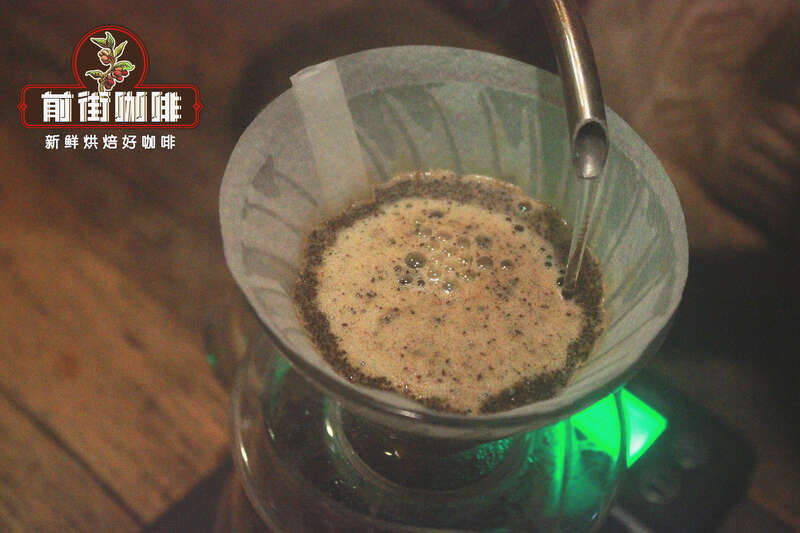
FrontStreet Coffee brewing technique: 30 g of water for bloom, 30 s bloom time, first pour to 125 g then stop, vertical water flow with a small slow circular motion; second pour to 225 g, with the flow and circular speed slightly faster to reduce fine particles blocking the dripper and causing over-extraction. (Timing starts from the bloom.) Extraction time: 2 minutes.
FrontStreet Coffee Yunnan natural Catimor brewing flavor: the entry shows a red berry juice sensation, nuts, cocoa, and licorice aroma, with a caramel-like sweetness in the aftertaste and a mellow, solid, smooth taste.
FrontStreet Coffee Yunnan washed Catimor brewing flavor: smells of rich nuts; the entry shows herbal, chocolate, and caramel notes, with light fruit acidity in the aftertaste.
FrontStreet Coffee Recommendation
To taste the contrast in this article for yourself, start with the FrontStreet Yunnan Small Bean. It comes from the Baoshan region, is washed and medium roasted, and pours a soft cup of nut and chocolate sweetness with a light plum acidity - an approachable, fairly priced first step into Yunnan coffee.
For a clearer, more layered Yunnan flavor, the FrontStreet 2013 Natural Yunnan Typica is the upgrade. FrontStreet Coffee planted these trees at its own estate in 2013; after natural processing and a medium roast, the cup is more balanced with more pronounced sweet-and-tart notes, carrying dark berry tones along with caramel sweetness, chocolate, and a hint of dried apricot, finishing with a black tea aftertaste.
If you would rather drink Yunnan in espresso form, the FrontStreet Black Cocoa Blend pairs Yunnan small bean with Brazil Cerrado: the Brazil supplies mixed-nut aroma and a balanced body, while the Yunnan plays the chocolate and citrus role. Pulled as an americano it is balanced across acidity, sweetness, and bitterness with nut and brown sugar sweetness, and as a latte it is smooth with almond and cream notes - an easy starting point for beginners.
Important Notice :
FrontStreet Coffee is a long-established specialty coffee roaster in Guangzhou China, selling freshly roasted beans from its own farm in Yunnan as well as dozens of carefully selected single-origin beans from around the world for both pour-over and espresso. The products deliver consistently excellent quality and great value, with shipping within 24 hours. Guangzhou's FrontStreet Coffee shop is recommended by many coffee lovers, and the beans are now available online at the Tmall 。
FrontStreet Coffee has moved to a new address:
FrontStreet Coffee Address: 315,Donghua East Road,GuangZhou
Tel:020 38364473
 Scan and follow the En Gafei WeChat official account. Please indicate that the reprint comes from "En Gafei".