What is the Washed Processing Method? The Steps of Washed Coffee Beans and Why They Have a Clean Flavor

Demand for coffee keeps growing, and global green bean production now tops an impressive 8.4 billion kilograms a year. Beyond variety, origin, and cultivation, the single biggest factor shaping flavor is how the beans are processed - each method reveals a different side of the coffee.
FrontStreet Coffee holds that washed processing produces uniform, beautiful beans of the highest quality: excellent acidity, brightness, and a clean, uncontaminated flavor. Within any given growing region, washing expresses the coffee's fundamental character, while natural and honey processing build on that foundation by adding aromatics and sweetness. Put simply: washing highlights the main flavor, natural processing softens it and layers on fruit and sweetness, making the cup more complex - washed is the taste of the bean itself; natural is the taste of the bean plus its fruit pulp.
At FrontStreet Coffee, dedicated display areas showcase beans of different processing methods and roast levels for comparison.

Are Coffee Beans Actually Coffee Fruits?
When coffee fruit ripens it turns yellow or red, resembling a small cherry - hence "coffee cherry." What we call coffee beans are actually the seeds inside the fruit, not the fruit itself. A coffee fruit consists of skin, pulp, mucilage, silver skin, and seed; processing is simply the work of separating the bean from the fruit, and the method chosen shapes the flavor in the cup. Today the most common methods are natural, washed, and honey. This article focuses on washed processing.
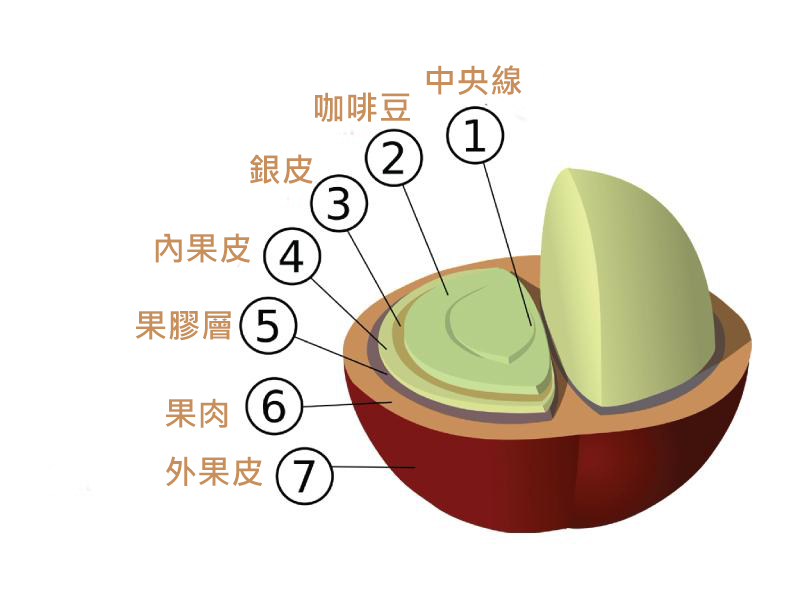
▲ The skin is removed early in processing
Coffee Beans
Enclosed within the silver skin is the endosperm - commonly known as the seed, our main character, the coffee bean.

Silver Skin
Inside the parchment, the bean is wrapped in an ultra-thin membrane like rice paper - the epidermis left over from seed development, known in the trade as silver skin or chaff. Most of it falls away during processing (especially washing); what remains is sometimes polished off before shipping. Even without polishing, the rest burns off cleanly in the roast, leaving only tiny flecks in the bean's central crease - visible when grinding as pale yellow particles among the grounds.
Endocarp (Parchment)
Beneath the mucilage, tightly bonded to it, is a cellulose shell around each bean: the endocarp. Dried, it resembles parchment paper - hence the name.

Pectin Layer (Mucilage)
Beneath the pulp lies the pectin layer, or mucilage - sweet and sticky. Farmers habitually call it "miel," Spanish for honey; in botany, pulp plus mucilage together form the mesocarp.
Pulp
Directly under the skin is a thin layer of pulp. Except in dry processing, the skin is usually removed within hours of harvest, along with the clinging pulp - which is why the earliest designed machine for this was simply called a depulper.
Exocarp (Skin)
The outermost layer is the exocarp - simply the skin - tougher than cherry or cranberry skin. In most varieties it turns red when ripe; some turn yellow or orange.

▲ Washed raw beans
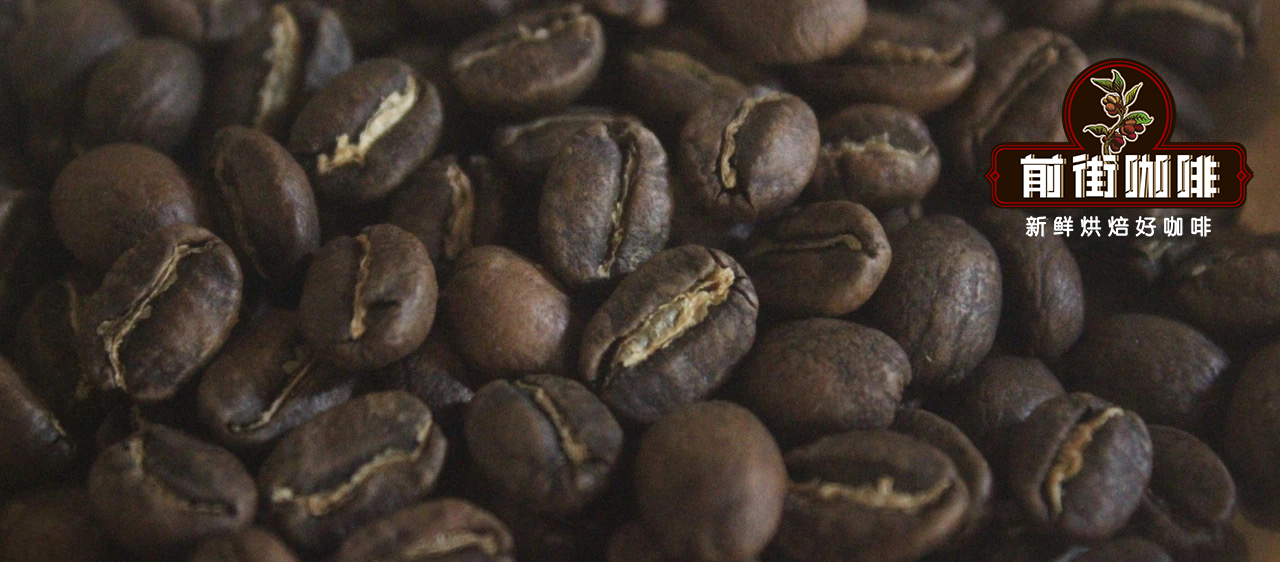
▲ Washed roasted beans
The Washed Processing Method
Washing uses fermentation to break down the mucilage. After the cherry skin is removed, fermentation loosens the mucilage; water then rinses the softened layer away, followed by drying - 1 to 2 days by machine, or 3 to 16 days if sun-dried. Washing is far more convenient than natural processing, because defective beans can be largely removed during the wash, and the finished beans look excellent - which is why they are so popular.

Washed Processing Step by Step
1. Removing Floaters
Beans are poured into large water tanks. Underdeveloped, low-quality fruit floats while mature, full cherries sink; the floaters are skimmed off.
2. Removing Skin and Pulp
A pulping machine strips the exocarp and pulp, leaving mucilage, parchment, and silver skin.
3. Fermentation
The goal of this step is to remove the mucilage biologically: the pulped fruit is left to ferment.
4. Washing
After fermentation, bacteria and residue cling to the beans, so they are washed again - a step that consumes large volumes of fresh water.
5. Drying, Then Hulling Parchment and Silver Skin
The coffee is dried by machine (or sun) to 10-14% moisture, then a huller removes the remaining parchment and silver skin, completing the process.

Pros and Cons of Washed Processing
Advantages:
- Every step happens in a controlled setting, so impurities are minimized and quality reaches its highest.
- With the pulp gone from the start, there is no risk of the mold problems that can plague natural processing.
- The beans look complete and beautiful.
Disadvantages:
- The process is complex and laborious, so costs run much higher than natural processing.
- It is water-hungry: producing 1 kilogram of coffee requires 40-50 liters of fresh water, so washing is rare in water-scarce regions.
Flavor Profile
Thanks to fermentation and the thorough rinse, washed coffee typically shows bright acidity and fruit aroma with a clean, uncontaminated taste. That said, fermentation does influence the flavor somewhat - one reason some specialty coffee purists prefer other methods.

To show how much variety exists within one processing method, FrontStreet Coffee compares two washed beans: Kenya Asalia and Ethiopia Yirgacheffe Gedeb.

FrontStreet Coffee: Kenya Asalia Coffee Beans
- Region: Thika, Kenya
- Washing Station: Asali
- Altitude: 1,550-1,750 m
- Grade: AA TOP
- Variety: SL28, SL34
- Processing Method: Kenya 72-hour washed
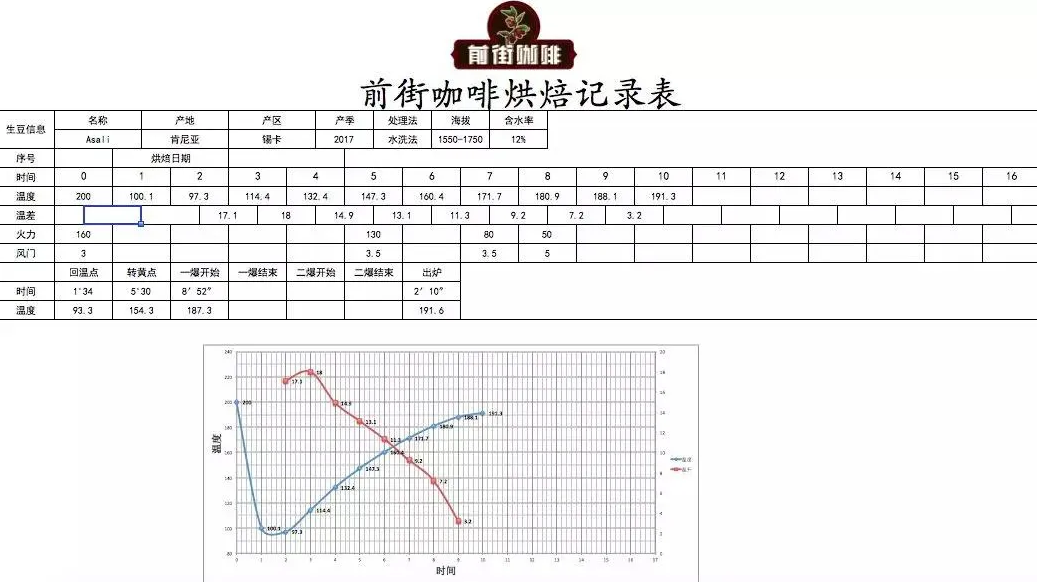
Roasting Profile
These beans are full and round; to express their bright, mellow acidity, FrontStreet Coffee roasts them lightly.
- Machine: Yangjia 800N, 550 g green input
- Charge Temperature: 200°C
- First Crack: 5'30", 154.3°C
- Development After First Crack: 2'10", dropped at 191.6°C
The Kenya 72-Hour Process (K72)
Cherries are picked at optimal ripeness at 21 degrees sugar content, sorted, depulped, and soaked in fermentation tanks of clean river water for 24 hours; they are then washed, soaked another 24 hours, washed again, and fermented once more - three cycles totaling 72 hours of fermentation, against at most 36 hours for ordinary washed coffee. This repeated ferment-and-wash regime gives Kenyan coffee its powerful acidity and delicate texture.

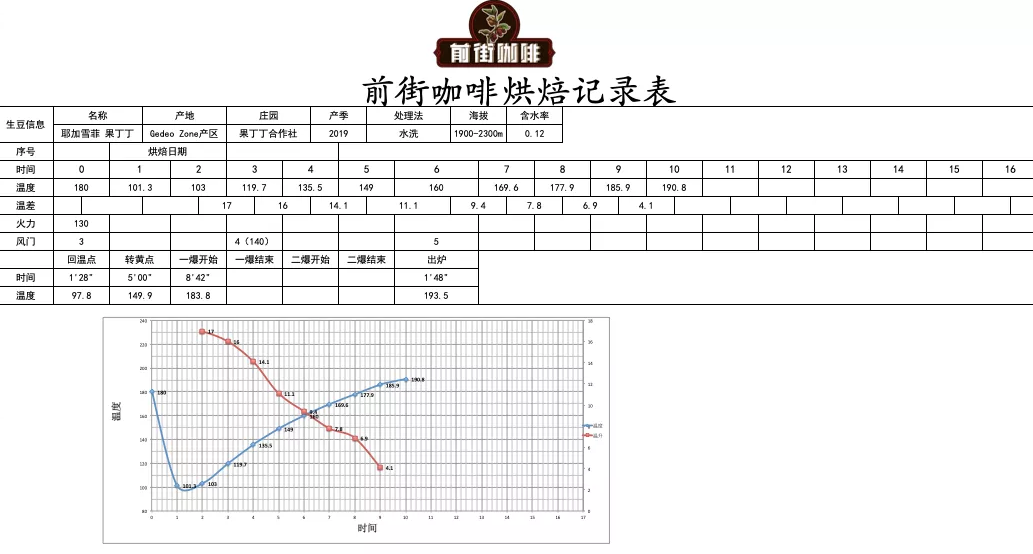
FrontStreet Coffee: Yirgacheffe Gedeb Cooperative Coffee Beans
- Region: Yirgacheffe, Gedeo Zone
- Altitude: 1,900-2,300 m
- Variety: Heirloom
- Processing Method: Washed
- Grade: G1
Roasting Profile
- Roaster: Yangjia 800N (300 g batch)
- Charge Temperature: 180°C
- Yellowing Point: 5'00", 149.9°C
- First Crack: 8'42", 183.8°C
- Development After First Crack: 1'48", dropped at 193.5°C
Brewing Recommendations
FrontStreet Coffee brewed both beans with identical parameters.
- Dripper: Hario V60
- Water Temperature: 90°C
- Coffee-to-Water Ratio: 1:15
- Grind Size: Medium-fine (BG-6S: 80% pass-through on the China standard #20 sieve)
- Brewing Method: segmented extraction - 30 g of water to bloom for 30 seconds, pour in small circles to 125 g, continue to 225 g once the water level nears the bed, stop, and remove the dripper when the bed is again about to surface (timing from the bloom). Extraction time: 2'00".

Tasting Results
Kenya Asalia Brewed
SL28 and SL34 from Thika: high acidity, clean flavor lines, and the most solid, generous mouthfeel of the two - a full plum-and-cherry juiciness, plum sweetness through the middle, and a crisp pear note in the aftertaste.
Yirgacheffe Gedeb Brewed
Opens with citrus and black tea; as the cup cools, cream, caramel, and almond emerge, with obvious sweet aftertaste and a clean, refreshing mouthfeel.

The takeaway: even within the same washed method, origin, altitude, and variety create distinctly different cups.
As for flavor descriptions, FrontStreet Coffee believes everyone forms their own impressions. What we really want is to help newcomers to specialty coffee find the connection between coffee and their own taste buds and develop their sensory perception - a kind of training, a conscious development. Once your sensitivity improves, you can let go of chasing specific flavors and simply savor the richness and variation of coffee, experiencing the beauty of each cup for what it is.
FrontStreet Coffee Recommendation
FrontStreet Coffee Recommendation: Honey-Process Coffees Worth Tasting
If washed processing is the taste of the bean itself, honey process is where fruit sweetness starts to shine. Its ancestor is the pulped natural method - peeling the cherries before drying - which shortens drying time while avoiding the off-flavors of uncontrolled fermentation. FrontStreet Coffee's Cerrado is a classic Brazilian pulped natural, full of cream, peanut, nuts, and chocolate. Brazil's success caught the attention of Costa Rica, which adapted the method by controlling how much mucilage is retained and how long the drying lasts, creating honey process - and within it the finer gradations of black, red, yellow, and white honey.
FrontStreet Coffee's Blackberry coffee uses the black honey method, in which nearly all the mucilage is kept: drying stretches at least two weeks under shade covers so the intense sun does not dry the fruit too fast, ensuring the sugars convert fully, with regular turning to prevent uneven heating and over-fermentation - a labor-intensive regime. Medium-light roasted, it perfumes the grinder with fresh flowers and brews up grape, berry, and ripe blackberry. The Strawberry Sugar blend pairs Panama Geisha - source of the classic orange-blossom honey character - with Costa Rican coffee given raisin honey processing, which retains 100% of the mucilage using a zero-water method: harvested cherries are floated in tanks to skim off underripe and overripe fruit, dried on raised beds for at least three days, peeled, and dried again with the mucilage intact, turned constantly for even drying. The result keeps Geisha's floral-tea character while adding grape and dried-blueberry aromatics, gentle acidity, an almond finish, and obvious sweetness. Finally, the Mozart takes raisin honey processing further still: the cherries are pre-dried on raised beds for at least three days before peeling, then finished as honey process. Keeping 100% of the mucilage makes this the most demanding honey method of all - even trickier than black honey - and it rewards the effort with richer hot-fruit sweetness: FrontStreet Coffee's Mozart, whether pour-over, cold brew, or moka pot, smells of osmanthus, pineapple, and raisins.
Important Notice :
FrontStreet Coffee is a long-established specialty coffee roaster in Guangzhou China, selling freshly roasted beans from its own farm in Yunnan as well as dozens of carefully selected single-origin beans from around the world for both pour-over and espresso. The products deliver consistently excellent quality and great value, with shipping within 24 hours. Guangzhou's FrontStreet Coffee shop is recommended by many coffee lovers, and the beans are now available online at the Tmall 。
FrontStreet Coffee has moved to a new address:
FrontStreet Coffee Address: 315,Donghua East Road,GuangZhou
Tel:020 38364473
 Scan and follow the En Gafei WeChat official account. Please indicate that the reprint comes from "En Gafei".