Different Definitions of Flat White | How Do the Preparation Methods and Ratios of Flat White Differ from Latte?

Commonly known as "Xiao Bai" (Little White), the Flat White has appeared on the menus of many specialty coffee shops for some time now — but do you know what it actually is? And what's the difference between a Flat White and a latte?
FrontStreet Coffee believes the derivation of the Flat White stems from everyone's pursuit of flavor and texture in specialty coffee. There are many ways to make it, depending on the beans a shop uses and the barista's own understanding of the drink. Generally, baristas approach the Flat White's signature texture through a small cup size, thin milk foam, and a refined espresso base.

FrontStreet Coffee uses its own roasted "Sunflower Warm Blend" espresso, composed of 70% Honduras Sherry coffee and 30% Yirgacheffe natural red cherry coffee. The whiskey, vanilla, and cream flavors of the Sherry component are paired with the tropical fruit and fermentation notes of the red cherry, making the cup rich in aroma and smooth in texture. The resulting Flat White presents aromas of vanilla, chocolate milk, and whiskey-filled chocolate, along with the sweet-tart character of berries, entering the mouth with smooth, mellow richness and an exceptionally long aftertaste.
The History of Flat White, How It's Made, and How It Differs from Latte and Cappuccino

What is a Flat White?
A Flat White is espresso mixed with steamed milk — the simplest explanation is just that. For those who want a rich coffee texture with a small amount of steamed milk and a thin layer of foam, the Flat White is a great choice. If you want a drink where the coffee flavor dominates but you still enjoy the full texture of milk, the Flat White is made for you. But how do you distinguish it from a latte?
The Origin of Flat White
There is some debate about whether the Flat White originated in Australia or New Zealand, but it appeared around the 1980s, after which it began showing up in specialty coffee shops in the United States, the United Kingdom, and elsewhere. Ben Bicknell, Strategy Manager at Melbourne's Five Senses Coffee, said: "Without deeply understanding the history of Australia and New Zealand, I would think the Flat White naturally evolved simultaneously in both places."

"From instant coffee to espresso, consumers were seeking something familiar, not cappuccino. At that time, milk coffees here all had a lot of foam, so consumers asked for a 'flatter' drink. In fact, the amount of foam in a Flat White has evolved to be less than that of a cappuccino — yet with more delicate, more delicious foam." When Starbucks began boldly replacing lattes with Flat Whites on its American menus, it signaled that the drink was steadily going mainstream.
The Difference Between Cappuccino and Latte?
We understand a Flat White as a drink based on espresso with steamed milk and a small amount of foam — so what separates it from a latte or a cappuccino? The word "latte" first appeared in English in the 1980s, but the concept of adding coffee to warm milk has been practiced for years. In Italy, caffè latte is actually a milk-dominated breakfast beverage, often made with coffee brewed in a stovetop moka pot.
Elsewhere, the name usually means an espresso with steamed milk and a layer of foam on top. To clarify the difference from a cappuccino: cappuccinos are typically smaller in size and have a stronger coffee taste, made with one shot of espresso combined with a thick layer of foam. Traditional lattes are larger, with a higher ratio of milk, making them milder, and carry less foam.

The Difference Between Flat White and Latte?
Ben said: "In Australia, lattes are usually served in 200ml glass cups, while Flat Whites are served in 180ml ceramic cups, so there's less chance of dilution. In the past, lattes might have had a thicker foam layer (about 1 cm), while Flat Whites had thinner foam (about 0.5 cm). However, over the past few years, those slight differences in foam have basically been abandoned, and now the amount of foam is presented in a similar form."
But Ben's experience may not apply everywhere, and each coffee shop's Flat White can differ slightly, which easily confuses consumers. Cappuccinos and lattes may be made with one or two shots of espresso, but traditionally a Flat White uses two shots. And even as the Flat White has grown more popular, some baristas use two shots of ristretto for an even stronger coffee flavor, making the definition even murkier.

Different Definitions of Flat White
The definition of a Flat White varies slightly by country and by barista. Jonathan Prestidge, Operations Manager at Repack Espresso in the UK, says the main difference between a latte and a Flat White lies in the ratio of coffee to milk.
The milk texture in both drinks is very similar, and there's enough space in the cup for latte art. In terms of proportions, his shop uses 5-ounce (about 140g) cups for Flat Whites and 8-ounce (about 225ml) cups for lattes. Both use two shots of espresso. If the capacity exceeds 6 ounces (about 170ml), he believes it's no longer a Flat White but a latte.

Felipe Cisneros, owner of Traviesa Coffee in Ecuador, believes the difference also comes down to the barista's personal preference. He said: "Lattes are the best-selling drinks in second-wave coffee shops, while the Flat White is one of the most popular drinks in third-wave shops. Depending on the barista's mood and skill, both drinks can create marketing topics and each has its own recipes."
Ceiran Trigg, Director of Ancestors Coffee in the UK, said: "A Flat White is a 5-6 ounce (140-170ml) drink made with a double shot of espresso, with very thin milk texture and a relatively small proportion of milk. A latte has a liquid volume of 7-9 ounces (200-250ml) — it can even reach 10 ounces (280ml) — with milk texture between that of a Flat White and a cappuccino."

Which Is Better: Flat White or Latte?
Cup sizes and coffee-to-milk ratios vary, but the general consensus is that a Flat White is smaller than a latte and holds a higher proportion of espresso. If you enjoy the delicate flavors of specialty coffee but also want the sweetness of milk, the Flat White may suit you better than a latte — its lower milk proportion lets you experience the flavor characteristics of the beans more fully. But is it necessarily better? Not necessarily. There are many ways to experience specialty coffee, and we all have our preferences.
Is a Flat White stronger in taste than a latte? A Flat White delivers a higher perceived coffee concentration, where the coffee taste leads over the milk. Since both are typically made with two shots of espresso, the Flat White can taste stronger in coffee concentration than a latte. It combines the rich texture and flavor of espresso with the full body of milk. For friends with lactose intolerance, plant-based alternatives actually foam more easily than milk and can be applied beautifully to a Flat White.
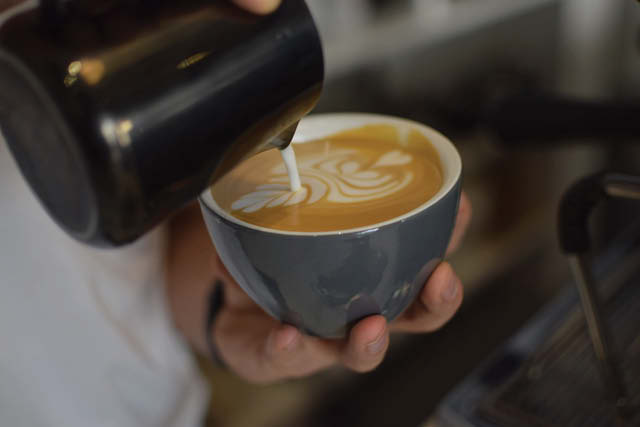
When ordering at a coffee shop, understanding what a Flat White is helps you choose. If you're particular about proportions but unfamiliar with the shop's method, simply ask the barista how they make theirs. But as Ben said, the definition of a Flat White matters less than the essential question: whether the drinker can taste the essence of specialty coffee through a latte or a Flat White — and wants to keep coming back for it.
FrontStreet Coffee Recommendation
Because a Flat White puts the espresso front and center, it deserves a bean with a clear flavor identity. FrontStreet's classic Washed Yirgacheffe — from a small southern-Ethiopian town sitting at roughly 1,700-2,100 meters, with coffee grown above 1,800 meters — is famous for its white jasmine florals and bright citrus and lemon acidity over a clean, tea-like finish; its elegance cuts through milk without being buried by it. For a fruitier milk coffee, the Natural Red Cherry Yirgacheffe is an excellent match: made from fully ripe cherries sun-dried whole for three to five weeks and turned every 2-3 hours in the early days to prevent over-fermentation, it layers classic Yirgacheffe citrus acidity with berry juiciness, honey-like sweetness, and creamy smoothness — a lovely partner for steamed milk.
To brew the bean itself, FrontStreet recommends a V60 with 15g of coffee at a 1:15 ratio, water at 90-91°C, and a medium-fine grind (fine granulated sugar texture, 80% pass-through on a #20 sieve): pour 30g of water for a 30-second bloom, then 95g (to about 125g on the scale) within the first minute, then the remaining 100g (to about 225g) once the bed drains to two-thirds, finishing the pour around 1'35" with dripping complete between 2'00" and 2'10". Tasting the espresso and the pour-over side by side is the best way to decide which character you want your Flat White to carry.
Important Notice :
FrontStreet Coffee is a long-established specialty coffee roaster in Guangzhou China, selling freshly roasted beans from its own farm in Yunnan as well as dozens of carefully selected single-origin beans from around the world for both pour-over and espresso. The products deliver consistently excellent quality and great value, with shipping within 24 hours. Guangzhou's FrontStreet Coffee shop is recommended by many coffee lovers, and the beans are now available online at the Tmall 。
FrontStreet Coffee has moved to a new address:
FrontStreet Coffee Address: 315,Donghua East Road,GuangZhou
Tel:020 38364473
 Scan and follow the En Gafei WeChat official account. Please indicate that the reprint comes from "En Gafei".