Three Major Coffee Producing Regions in Panama: Which is the Most Famous? Characteristics and Stories of Panamanian Coffee Beans

For more premium coffee knowledge, please follow our official WeChat account: FrontStreet Coffee
FrontStreet Coffee believes that whether or not you're into coffee, you've probably heard of Geisha. And among Geisha coffees, the iconic Hacienda La Esmeralda needs no introduction. But did you know that Hacienda La Esmeralda comes from the Boquete region of Panama? What makes Panamanian coffee special? Today, FrontStreet Coffee will explain it all. Our founding purpose is to taste coffees from around the world, understand every bean, every variety, every producing region, and every processing method in depth, and share what we learn through text, images, and more. FrontStreet Coffee hopes every coffee lover can gain a deeper understanding of the coffee world and explore it together with us.

Introduction to Panama Coffee
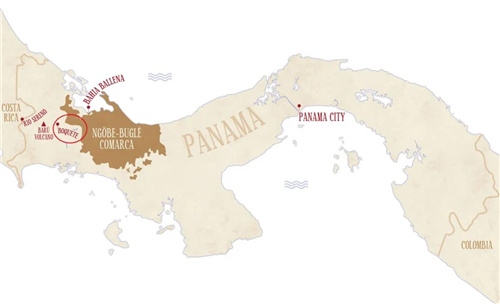
Panama borders the Caribbean Sea to the east, the Pacific Ocean to the west, Costa Rica to the north, and Colombia to the south - it is the important isthmus connecting North and South America. Premium Panamanian coffee is grown in the western part of the country, near Costa Rica and close to the Pacific. The microclimates of the highlands are the single most important resource that makes Panama's specialty coffee unique. Cold air currents flow through the central mountains and converge above 6,500 feet, creating varied microclimates in the Boquete and Volcan regions, which are Panama's main specialty coffee producing areas. These specialty coffees are cultivated in the nutrient-rich, well-balanced soils of the Baru Volcano region, where the microclimates, soil, temperature, and altitude are well suited to sowing, growing, and harvesting all kinds of specialty coffee.
The microclimates of Panama's growing areas vary with soil quality (Volcan, for example, has distinctly volcanic soil) and altitude (1,000 to 1,650 meters). Panamanian coffee beans are smooth, light-bodied, and balanced in acidity, and their premium beans have pure, highly distinctive flavors. The first coffee shipments of each year go out in November.
Panama's Coffee Growing History
In 1780, Europeans brought the first batch of Typica to Panama, beginning the history of Panamanian coffee. The construction of the Panama Canal 100 years ago drew a large number of European intellectuals to the country. Once the canal was completed, many senior engineers stayed on, captivated by the superb climate of western Panama, and bought estates in Boquete - pioneering specialty coffee cultivation in the country. To Panamanians of that era, such a beverage was both novel and mysterious; it quickly conquered people's palates and prompted locals to begin planting coffee trees widely.

In fact, early Panamanian coffee was little known and production was modest. Riding the wave of third-wave coffee aesthetics, as people gradually learned to appreciate single-origin beans, estate specialty coffees became a trend. But why did Geisha suddenly shoot to fame in 2004 and dominate the top of the coffee rankings for so long? That story has to start with where Geisha came from.
Where Does Geisha Actually Come From?
Geisha coffee is also spelled "Gesha" - they are the same coffee. The name comes from Gesha Mountain in Ethiopia, and because it is pronounced much like the famous Japanese geisha, that spelling stuck.

According to various accounts, the variety originates in southwestern Ethiopia. The approximate route of transmission: 1931 - British envoys ventured deep into Ethiopia's Gesha Mountain to collect disease-resistant seed varieties; 1931-1932 - seeds were sent to Kitale, Kenya under the names Geisha and Abyssinian for trial planting; 1936 - young seedlings were transplanted to the Lyamungu Coffee Research Institute and to Uganda and Tanzania for trial planting; 1953 - CATIE, the coffee research institute in Costa Rica, introduced seedlings several times from Lyamungu and elsewhere. In 1963, Don Pachi Serracin brought the Geisha variety from Costa Rica to Panama, but because its low yields hurt harvest volumes, farmers had little incentive to plant it.
That changed when Daniel Peterson, owner of Panama's Hacienda La Esmeralda, accidentally discovered that beans from the Geisha trees - originally planted as windbreaks at the highest point of his estate - actually had the citrus and floral aromas characteristic of African coffees. After separating these beans out and entering them in the 2004 Panama cupping competition, where they were an instant sensation, Geisha's rise was unstoppable: it went on to win the Best of Panama championship in consecutive years. To today's specialty coffee lovers worldwide, Geisha is undoubtedly the supreme treasure. That said, Geisha has been circulating for decades, so it is hard to say for certain whether today's Geisha plants all descend from those originally introduced seeds - and whether hybridization has occurred is now unknowable.
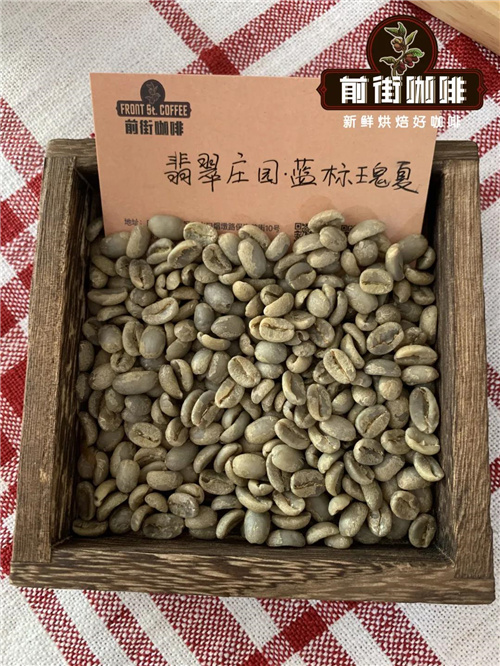
Green-leaf Geisha is characterized by floral aromas, intense acidity, and sweetness; bronze-leaf Geisha, by contrast, is dominated by body and sweetness, with less pronounced acidity. Other varieties grown include Typica, Catuai, Pacamara, Bourbon, Mundo Novo, and Caturra - the full range.
Panama Coffee Region: Boquete

FrontStreet Coffee: Panama Elida Estate Typica Coffee Beans
Region: Boquete, Panama
Estate: Elida Estate
Altitude: 1850 meters
Variety: Typica
Processing: Natural
Boquete's high-altitude mountains rise to a planting elevation of 1450m, and the mountainous terrain creates many microclimates. The local fertile soil, towering terrain, cold humid air, varied sunlight, and abundant rainfall produce coffee that is both plentiful and excellent in quality, making Boquete the region with the highest production and best quality among Panama's coffees. Rivers flow through the area, nourishing these high-quality beans. FrontStreet Coffee believes that because Boquete is prone to fog, which suppresses temperature rise, the special geographic conditions give the coffee its excellent quality and character. The region's infrastructure - roads, processing facilities - is quite complete. As a coffee-producing area it enjoys a near-perfect natural environment, and recently it has also become popular for tourism. Gradually, many operators have been leaving farming for new business opportunities - that is the current situation of Panamanian coffee production. The processing method for Panamanian coffee beans is the traditional washed method: first the pulp is removed, then the fruit wrapped in its parchment is fermented in water tanks, followed by traditional washing; drying is most commonly done in the sun.
Altitude: 400-1,900m
Harvest Season: December-March
Varieties: Typica, Caturra, Catuai, Bourbon, Geisha, San Ramon
Flavor Description: Walnut, chocolate, thick, heavy body

Elida Estate
Elida Estate covers 65 hectares in total, more than half of which lies within Baru Volcano National Park. Only 30 hectares are used for coffee; the rest remains pristine forest. Coffee is grown at 1670 to 1850 meters, making it one of the two highest-altitude coffee estates in Panama (the other is Carmen Estate in the Volcan valley).
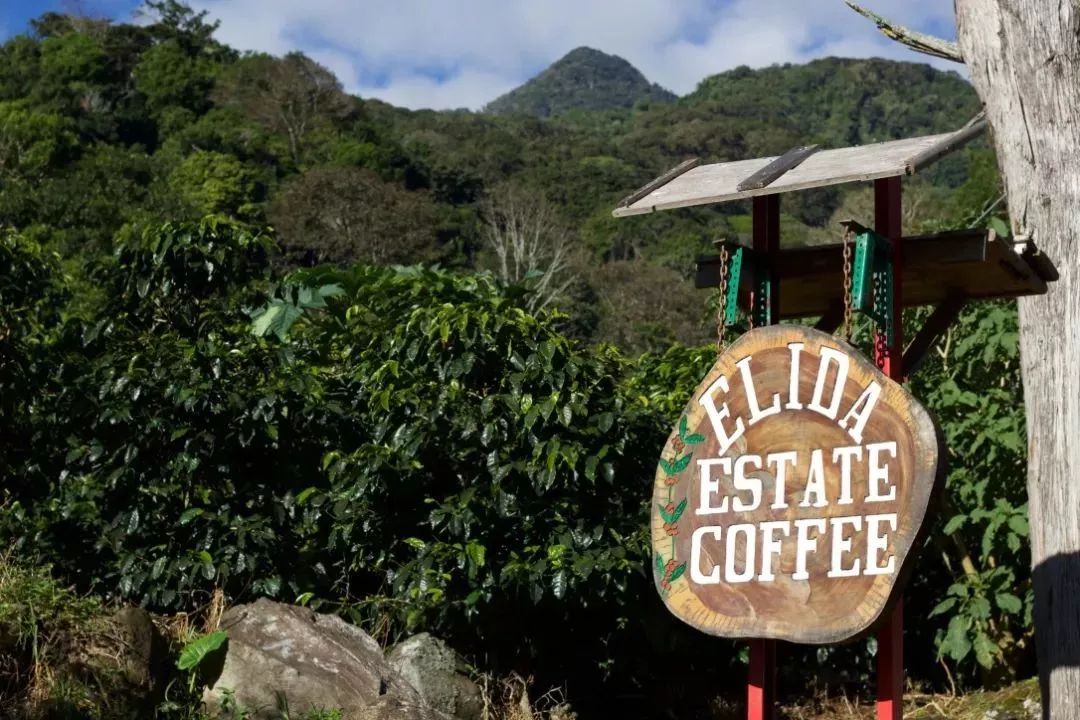
In such a high-altitude environment, low temperatures delay cherry maturation - a full month later than the normal ripening period. The fertile volcanic soil provides ample nutrients, and combined with the superb microclimate created by Baru Volcano, this allows Elida Estate to consistently achieve excellent results in cupping competitions.
The history of Elida Estate goes back to 1918. The estate belongs to the Lamastus family, and its name, Elida, was that of estate owner Robert Louis Lamastus's wife.
Green Bean Analysis
Typica is one of the oldest known varieties of arabica coffee, the other being Bourbon. Arabica originated in Ethiopia, where Typica still grows naturally in the highland rainforests today. Typica beans are slender, the trees are tall, the cherries oval, and the branches slightly inclined, with four slender, spreading branches angled at 50-70 degrees. Yield per tree is very low, but the cupping score is very high.

Roasting Profile
Elida Typica beans are slender and yellow-green in color. FrontStreet Coffee takes a light-medium roasting approach, introducing the beans at a lower temperature. While this is not as clean and punchy as a high-charge roast, the benefit is a very gentle, smooth mouthfeel. Because the development time after first crack is very short, the heat must be sufficient; otherwise the expected caramelization at drop temperature won't be achieved. FrontStreet Coffee uses a "sliding" technique - cutting the heat (or turning it off) while letting the roaster's residual heat carry the roast forward. Throughout the entire roast the beans are in heat-absorption mode, with only first and second crack being heat-releasing phases; during those two stages it's best not to add heat, or the beans can pick up a spicy taste.
FrontStreet Coffee adds that "sliding" emphasizes turning off the heat and using the roaster's residual temperature plus the exothermic heat the beans generate during cracking to continue roasting slowly.
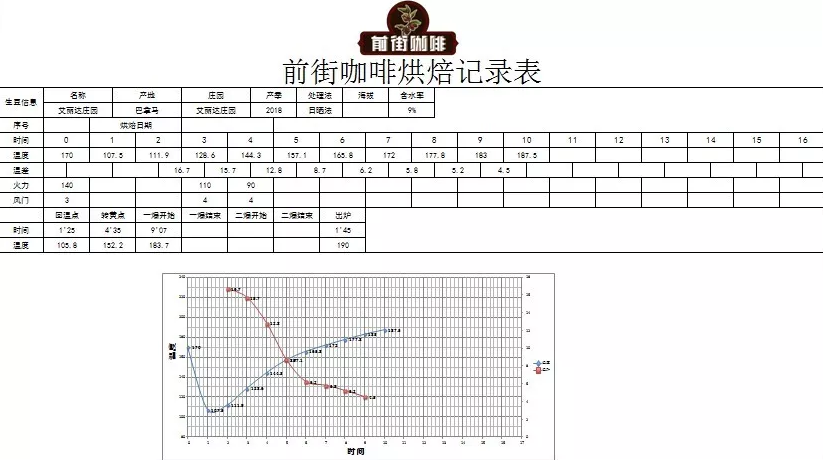
Yangjia 600g semi-direct heat roaster
Preheat to 170°C, charge the beans, damper set to 3; after 30 seconds reduce heat to 140 with the damper unchanged; turning point at 1'25"; adjust heat once at 140°C, when the bean surface turns yellow, the grassy smell disappears completely, and drying is complete; reduce heat to 110°C and set the damper to 4;

At 8'45", wrinkles and dark marks appear on the bean surface and the toast smell clearly turns to coffee aroma - the prelude to first crack. At this point, listen carefully for the sound. First crack begins at 9'07"; reduce heat to 90°C, damper to 4 (adjust heat very carefully - not so low that the cracking stops); 1'45" after first crack, drop at 190°C.
Cupping Flavor
Elida Estate Typica
Dry Aroma: Caramel, roasted almonds, floral
Wet Aroma: Jackfruit, fermented wine aroma
Mouthfeel: Smooth entry; raisin, peach, orange, melon, cane sugar, and caramel flavors prominent; a green tea sensation; high cleanliness.

Brewing Method
FrontStreet Coffee's brewing parameters are: V60 dripper, water temperature 90°C, coffee-to-water ratio 1:15, grind size based on an 80% pass-through rate on the #20 standard sieve.
FrontStreet Coffee uses segmented extraction - the three-pour method. Start the timer and pour 30g of water to bloom for 30 seconds. Then pour gently in circles up to 95g, pausing at 125g total. Once the water level drops and the coffee bed is about to be exposed, continue pouring in small circles to 225g. When the level drops again and the bed is about to be exposed, remove the dripper. Total extraction time is 2:00 (including the bloom).
Volcan Region
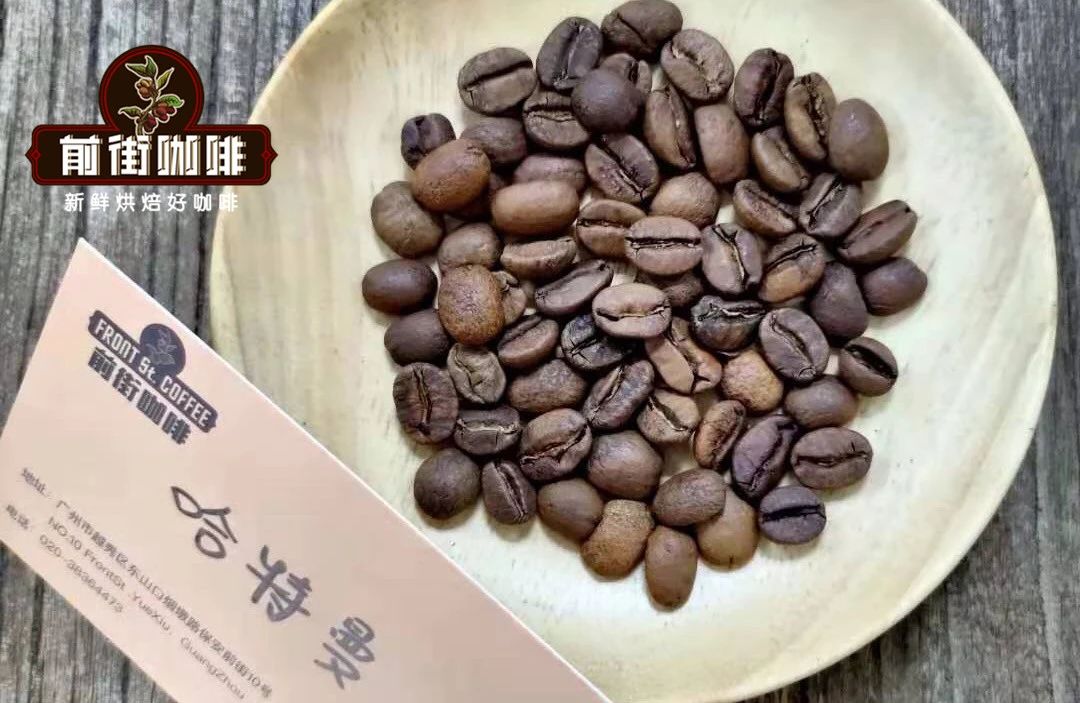
FrontStreet Coffee: Panama Hartmann Estate Wine Process Coffee Beans
Country: Panama
Grade: SHG
Region: Volcan Region
Estate: Hartmann Estate
Altitude: 1250-1700 Meters
Processing: Wine process
Variety: Catuai
When people think of Panamanian coffee, the specialty regions that come to mind most readily are usually Boquete - but in recent years, beans from the Volcan region have been steadily making their mark in the specialty market, with quite a few estates entering the Best of Panama competition and even taking championships. Volcan generally receives less annual rainfall than Boquete, and its location west of Baru Volcano gives its coffee stronger dried-fruit flavors, sweetness, and aroma than beans from Boquete.
Early on, the Volcan area grew mostly cash crops such as fruits and vegetables, with very few farmers growing coffee. Among those few, the pioneer of coffee cultivation in the region was Panama's well-known Hartmann family.
The Legendary History of Hartmann Estate
Hartmann's story, like its coffee, is full of legend. Hartmann Estate is located in Chiriqui province, in Santa Clara. The founder was Alois St. Hartmann (Luis Hartmann), born on June 20, 1891, in the Moravia region of Austria-Hungary - now the Czech Republic - and died on May 25, 1970, at the age of 78. When World War I broke out, he was abandoned as a small boy. Thanks to his mother, he managed to hide aboard a ship bound for Pennsylvania, USA, and survived.

Both of his brothers died in the war after joining the army. Luis Hartmann traveled through several countries with friends until he arrived in Panama in 1911 and settled in Chiriqui province in 1912, mainly active around Candelaria. He built the first small cabin in that pristine forest. Today's Hartmann Estate is a family business founded in 1940 by Ratibor Hartmann (son of Eligio Luis).
In 1966, Ratibor married Dinorza Sandi from Costa Rica. They had five children: Ratibor Jr., Allan, Alexander, Alice, and Kelly. Each family member takes charge of coffee management, harvesting and processing, and estate tours. The family business has a provincial-level cupping laboratory and sample roasting room, and they cup every batch of coffee with rigorous standards, which keeps the quality of Hartmann's coffee stable and always improving. Their scientific approach and nearly 100 years of family experience guarantee their excellent output - a family estate that has grown coffee for over 100 years is itself a legend.
The Hartmann family also manages and processes coffee for many other Panamanian estates: Finca La Mula, a frequent winner at Best of Panama, and the 90+ estates in Panama are all under their management. Although the estate keeps a low profile and is rarely seen at Best of Panama, its coffee ranks among Panama's finest, and the Hartmann family's contribution to the country's coffee reputation is indispensable.

Roasting Analysis
Panama Hartmann Estate beans are relatively small and slightly denser, with moderate moisture content. FrontStreet Coffee's roasting target is light-medium, unlike the medium roast used for other Panamanian beans. This Hartmann wine process gets a light-medium roast to preserve its excellent acidity, tropical fruit flavors, and wine-like fermentation notes, resulting in a cup that is sweet, round, fresh, and elegant.
In the first roast batch, the drop temperature was relatively high, with a charge temperature of 200°C and strong heat. During the roast it became clear that although these beans' altitude is not especially high, their density is relatively hard, so a gradual heat-reduction, steady-climbing roasting method was adopted. Heat was adjusted more finely at yellowing, the end of drying, and the prelude to first crack to avoid scorching the bean surface. The beans were dropped from the start of first crack to just before its end, shortening the caramelization time to preserve flavor cleanliness and floral-fruit aromas.

Yangjia 600g semi-direct heat roaster
Preheat to 200°C, charge the beans, damper set to 3; after 30s reduce heat to 170 with the damper unchanged; turning point at 1'39"; maintain heat; the bean surface turns yellow at 4'57", the grassy smell disappears completely, and the drying phase begins; reduce heat to 130°C, damper at 3.5.

Drying completes at 8'00"; reduce heat to 80°C; wrinkles and dark marks appear on the bean surface at 8'00" and the toast smell clearly turns to coffee aroma - the prelude to first crack. Listen carefully for the sound. First crack begins at 8'43"; reduce heat to 60°C and open the damper fully to 5 (adjust heat very carefully - not so low that the cracking stops); 1'43" development after first crack, drop at 195.5°C.
Cupping Report
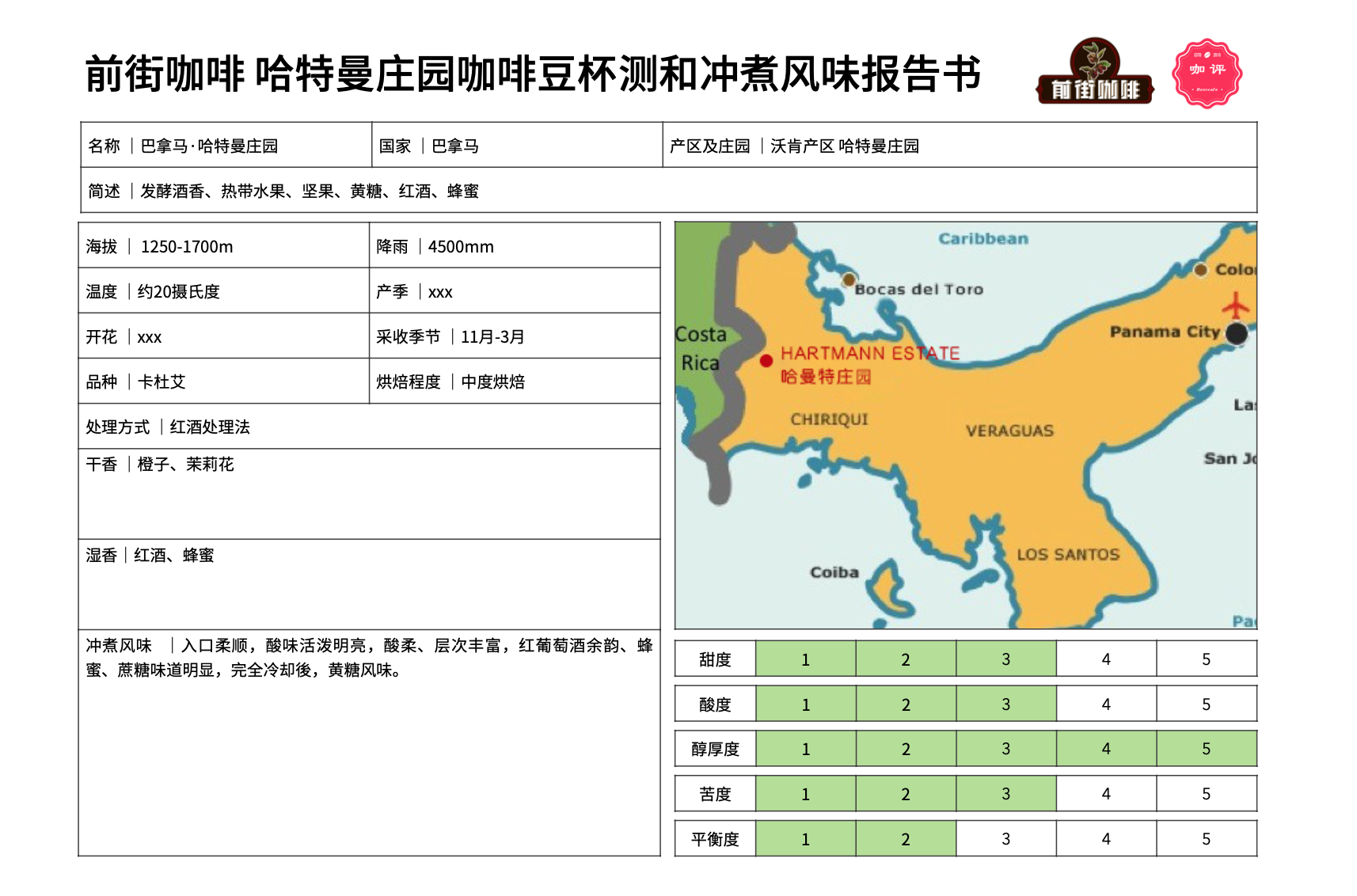
RENACIMIENTO
Renacimiento is a district in Chiriqui province bordering Costa Rica. The region itself is relatively small, so it is not one of Panama's main specialty coffee producing areas.
Altitude: 1,100-1,500m
Harvest: December-March
Varieties: Typica, Caturra, Catuai, Bourbon, Geisha, San Ramon
Panama Coffee Grading System:
Strictly High Grown (SHG): Over 1300 meters
High Grown (HG): 1220-1300 meters and above
Central Standard (CS): Cultivated altitude over 600 meters
FrontStreet Coffee Recommendation
Geisha - translated from the English "Geisha" - is one of the most beloved arabica varieties. Its unique florals and superb sweet-tart character have won over countless coffee lovers, yet low yields, weak disease resistance, and demanding cultivation keep prices climbing. If you want to experience classic Panamanian Geisha at the highest level, go for FrontStreet Coffee's Esmeralda Estate Red Label (officially "Esmeralda Special"): grown at 1600-1800 meters, every batch must cup above 90 points, every batch carries its own lot number, and each batch's beans all come from a single small plot - letting buyers choose the subtle flavor profile that suits them. For a more affordable route to the same estate's signature high-altitude style, the Green Label ("Private Collection") blends lots across multiple plots rather than highlighting a single one, which is why FrontStreet Coffee considers it outstanding value.
Newcomers who just want a first taste of the legendary "Geisha flavor" should start with FrontStreet Coffee's Boquete Geisha - an entry-level Panama Geisha that delivers the classic orange-blossom honey character of high-quality Panamanian Geisha at an accessible price, with an oolong-tea feel, delicate fruit sweetness and acidity, and clearly layered flavors. And if you're curious about Geisha's birthplace, Ethiopia also produces remarkable Geisha. A husband-and-wife team established Geisha Village Estate - 475 hectares, about 12 miles from the Geisha forest - and, by comparing plant morphology, bean shape, and cupping performance, identified and brought back the native Gesha types closest to Panama's. Geisha Village Gold Label comes from the Gesha 1931 variety (about 10% of the estate's production) and is crafted as a refined natural - the estate's top coffee outside auction lots, frequently chosen by competing baristas; the Red Label comes from the Gori Gesha variety (about 15% of production) and scores 88 or above on the SCA 100-point scale as a single-terroir series with full traceability. For an easier entry into Ethiopian Geisha, FrontStreet Coffee's Genlana Estate Geisha is the pick: it comes from the Genlana washing station at the border of the Kochere and Genlana Abaya areas, founded in 2014 and run by Mr. Israel Degefa, with some 700 hectares of coffee in the surrounding area - most of it uncultivated, fertile land shaded by forest trees. Only fully ripe cherries are hand-picked and dried on raised beds for 14-20 days depending on the weather. Roasted light-medium, it shows bright citrus acidity, elegant ginger-flower aromas, full ripe-fruit sweetness, and Geisha's signature delicate finish.
Beyond pour-over, Geisha also shines in cold brew. FrontStreet Coffee's budget-friendly Geisha alternative, Strawberry Sugar - a blend of Costa Rican honey process and Panamanian Geisha - is perfect here: 30g of beans ground to fine-sugar size (EK43s at setting 9, or a hand grinder C40 at 24 clicks), stirred into 360g of room-temperature drinking water at a 1:12 ratio, covered and refrigerated for 8 hours, filtered, then sealed and rested in the fridge for another 3 hours. The result is a chilled cup of grape juice, rose, sweet orange, and fruit-wine flavors - a delightful way to taste Geisha without the auction-lot price tag.
Important Notice :
FrontStreet Coffee is a long-established specialty coffee roaster in Guangzhou China, selling freshly roasted beans from its own farm in Yunnan as well as dozens of carefully selected single-origin beans from around the world for both pour-over and espresso. The products deliver consistently excellent quality and great value, with shipping within 24 hours. Guangzhou's FrontStreet Coffee shop is recommended by many coffee lovers, and the beans are now available online at the Tmall 。
FrontStreet Coffee has moved to a new address:
FrontStreet Coffee Address: 315,Donghua East Road,GuangZhou
Tel:020 38364473
 Scan and follow the En Gafei WeChat official account. Please indicate that the reprint comes from "En Gafei".