Introduction to Ethiopian Gesha Coffee Flavor Profile & Characteristics of Gesha Village Coffee

In the past, when coffee lovers came to FrontStreet Coffee to order a Geisha, our baristas would carefully ask: "The Ethiopian Geisha, or the Panamanian one?" Most people were unsure of the difference between the two. Today, Panamanian Geisha is so famous that "Geisha" generally means Panama, while the Geisha from Gesha Village has been left in a corner. In this article, FrontStreet Coffee introduces the ancestor of Panamanian Geisha — Ethiopian Geisha.
Let's begin with how the variety spread. Geisha was first discovered in Ethiopia's Gesha forest in 1931; in 1932 it was sent to the Coffee Research Institute in Kenya; in 1936 it was transplanted to Tanzania and Uganda; in 1953 it moved on to Costa Rica; and in the 1960s it was introduced to Panama.

Curiously, when the variety was first documented some 90 years ago, Ethiopian official archives described its flavor as "unpleasant." Even in Panama, Geisha remained obscure for over 40 years before emerging at the 2003 Best of Panama (BOP) competition. It won the BOP championship in 2004, and only after expert identification was it confirmed to be the Ethiopian Geisha variety.
Origin Introduction
Ethiopia
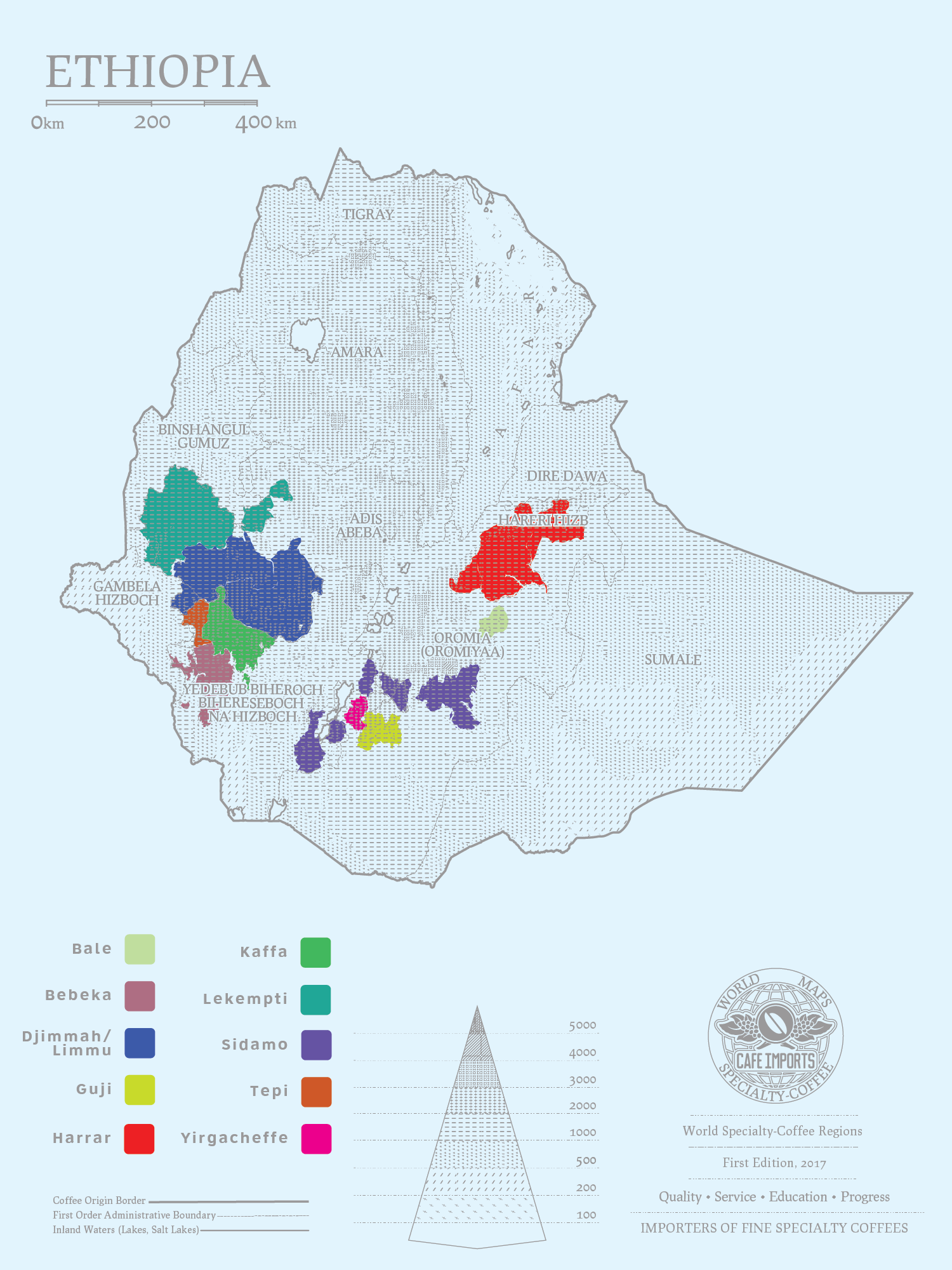
Ethiopia is a country where coffee has been woven into social structure, culture, and economy for hundreds of years. Coffee is their culture and a vital source of income for most people. The country is not only the origin of the Geisha variety but also the world's recognized birthplace of coffee, and it enjoys immense esteem in the specialty market — you'll find Ethiopian coffee in any specialty shop, FrontStreet Coffee included.
Ethiopia's coffee production is commonly divided into nine major regions: Yirgacheffe, Sidamo, Limu, Harar, Jimma, Illubabor, Gimbi and Lekempti, Teppi and Bebeka, and the shores of Lake Tana.
Bench Maji Region
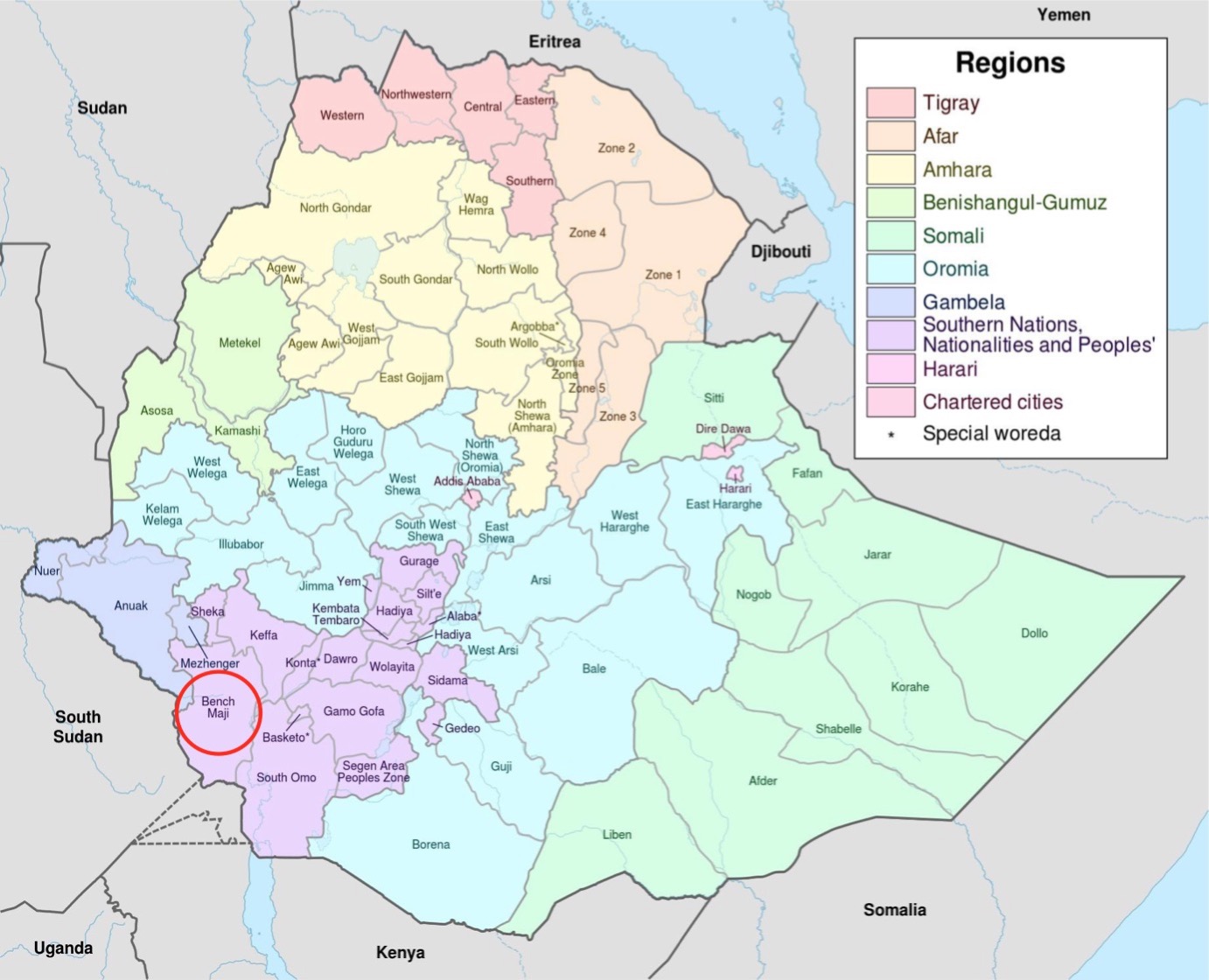
The Bench Maji region, also known as the Bebeka region, is easy to explain: Bench Maji is a zone under the Southern Nations, Nationalities, and Peoples' Region, and Bebeka Town is its capital. Bench Maji covers 23,442.76 square kilometers, bordered by Sudan to the west, the Gambela Region to the northwest, and the South Omo Region to the east. It is home to a renowned estate — Gesha Village Coffee Estate — whose Geisha trees are said to have been found in Bench Maji's wild forests.
Gesha Village Estate

In 2007, documentary director Adam Overton and his photographer wife Rachel Samuel were invited by the Ethiopian government to film a documentary about Ethiopian coffee. During the shoot they came to know the Gera forest in Bench Maji, rediscovering this Ethiopian land while conceiving the idea of their own coffee estate and brand.
In 2009, fortune smiled: the couple met Willem Boot, the famous owner of Don Pachi Estate and a BOP judge. Willem's idea of "returning to Ethiopia to find the birthplace of Geisha" opened the door. In 2011 they returned to Bench Maji, where several areas bore the name Gesha Village and were the most likely home of the original Geisha variety.

Adam followed Willem on expeditions into the surrounding forests, discovering multiple wild coffee varieties in the dense jungle. The most thrilling find was the original Geisha. They collected seeds from the original Geisha trees, screened them, and planted them there — deciding to establish an estate, which they named Gesha Village Coffee Estate.
Gesha Village Estate covers approximately 471 hectares, with about 320 hectares dedicated to coffee cultivation in brown-red loam soil, planted at a density of 7,000 trees per hectare.
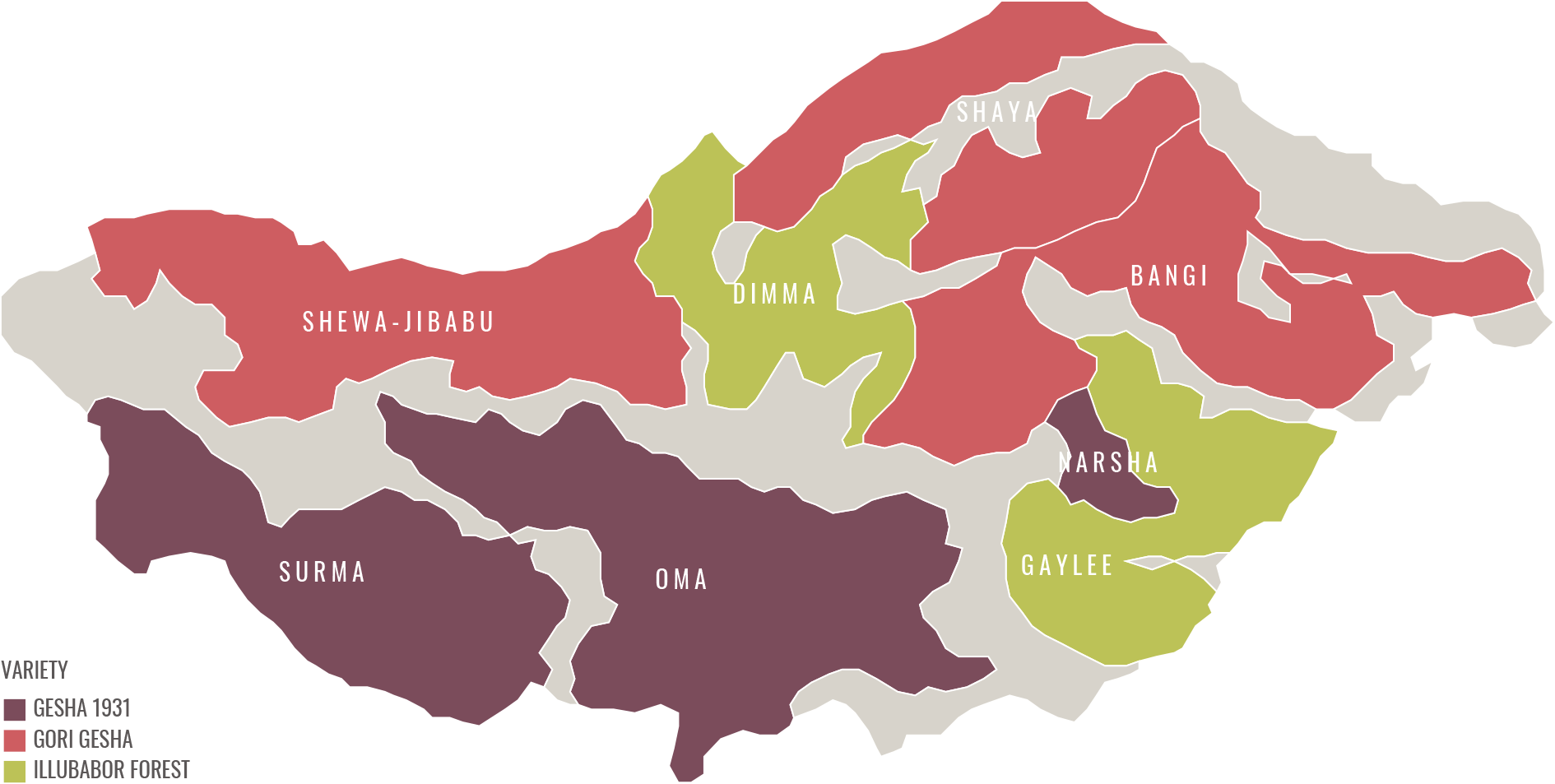
Gesha Village Estate is divided into 8 blocks:
Bangi (54 hectares, 1911-2001 meters): Most of the estate's staff come from the "Bangi-Chichuru" community east of the block. Coffee from this lot carries honeysuckle and spice aromas, with rich flavors of dark chocolate, Mexican mole spices, berries, black tea, brown sugar, and black currant.
Dimma (28.7 hectares, 1966-2019 meters): Named after the famous gold mining town of Dimma to the north. Coffee from this lot shows vibrant floral and stone-fruit aromas with sharp, refreshing citrus acidity.
Gaylee (34.8 hectares, 1916-1982 meters): Connected to the Kebele community on the southeast and officially named "Gaylee-Gesha," it lies near the Yetgordon River, the water source for Gesha Village. Coffee from this lot has tightly integrated fruit and spice flavors, with intense sweetness of almond, lemongrass, and hibiscus, mixed with jasmine and stone-fruit aromas.
Oma (67.6 hectares, 1931-2040 meters): Named after a respected and beloved religious leader from the Meanit area. Coffee from this lot shows extraordinary red currant and jasmine aromas, with fruit notes of peach, apricot, candied fruit, melon, and satsuma mandarin, and a honey-like sweet finish.
Narsha (5.3 hectares, 1963-1977 meters): Located in the southern part of the estate and named after a fruitful tree on the farm. Coffee from this lot carries honeysuckle, yellow fruits, lime, dark chocolate, peach, apricot, and rose notes, with refreshing acidity and a long bergamot finish.
Surma (45.9 hectares, 1909-2063 meters): Overlooking a paradise-like valley, named after the pastoral Surma people of the southwestern lowlands. Coffee from this lot offers delicate jasmine and damask rose aromas, fruit notes of strawberry, ripe watermelon, and apple, and subtle spices.
Shewa-Jibabu (48.5 hectares, 1973-2069 meters): Located in the northern part of the estate, named after a nearby mountain and the kebele community some staff come from. Coffee from this lot shows spices, strawberries, ripe peaches, papaya, florals, dark chocolate, tamarind, orange, and bergamot.
Shaya (36.5 hectares, 1926-2069 meters): Named after a leader from the Meanit area. Coffee from this lot exudes jasmine, bergamot, and orange aromas, with rich dark chocolate, orange juice, iced cherry, molasses, lemon, and berry flavors, plus the sweetness of red apple.

Coffee Varieties
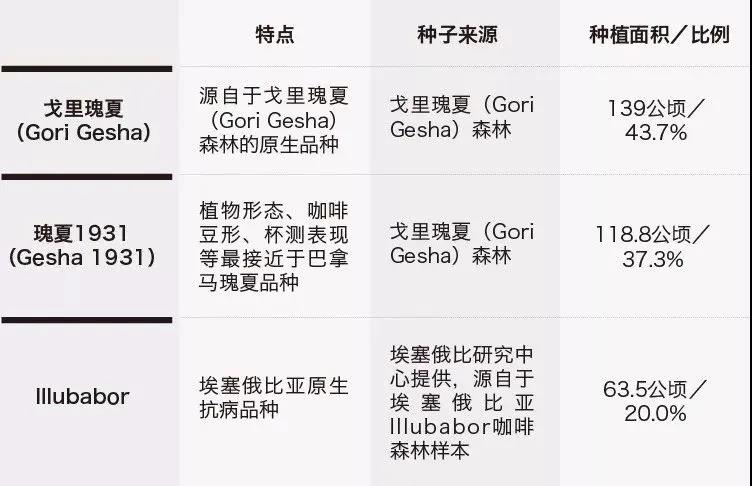
Panamanian Geisha and Gesha Village's Geisha share a name, but the varieties differ considerably. Gesha Village grows mainly three: Gori Gesha (GG), Gesha 1931 (G31), and Illubabor Forest 1974 (IF).

Gori Gesha (GG)
This variety replicates the genetic diversity found within the Gori Gesha coffee forest.

Gesha 1931 (G31)
Combining traits of various forest varieties, it is very similar to Panamanian Geisha — selected through observation of plant morphology, bean appearance, screen size, and cupping quality.

Illubabor Forest 1974 (IF)
Discovered during a 1974 expedition to the Illubabor forest and later developed by the Ethiopian Research Center into a disease-resistant variety.
Grading System
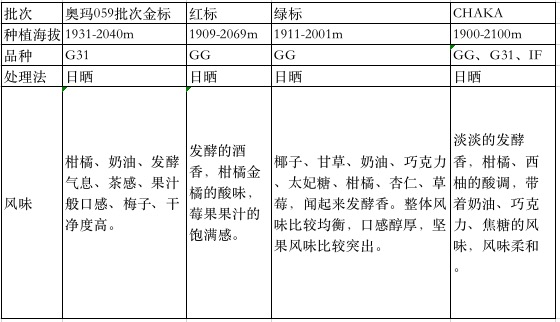
Gesha Village Estate runs a strict internal grading system consisting of Auction, Gold, Red, Green, and Chaka lots.

Auction Lots
Accounting for only 3.7% of Gesha Village's annual production, these are the most rigorously selected top-tier lots, available only through the 2018 Gesha Village Coffee Estate Global Auction. The 2018 auction lots cupped between 88.15 and 92.67 points and are further divided into Champion's Reserve and Farm Reserve.
Gold Label Lots
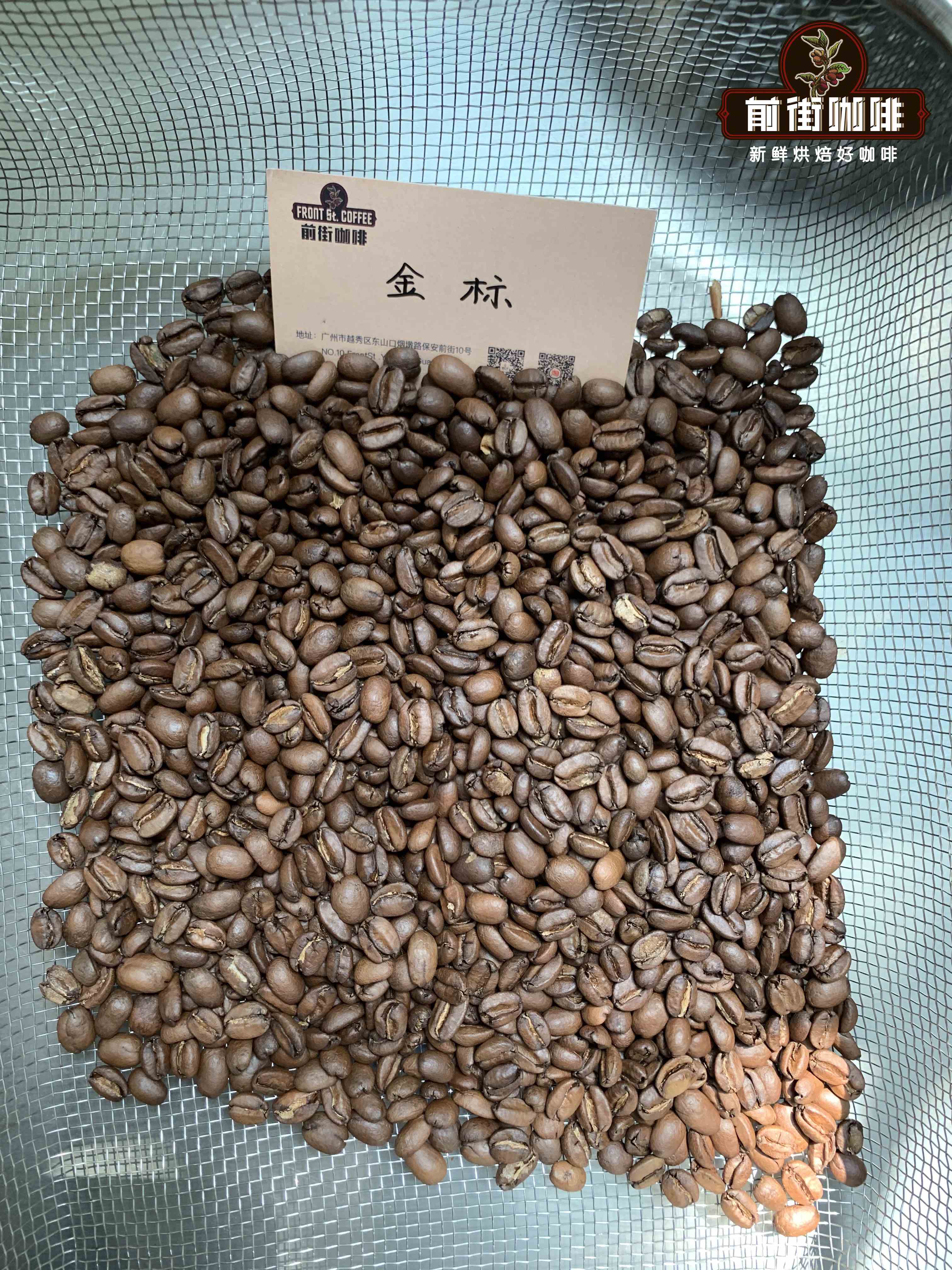
Gold label coffees make up about 10% of annual production — complex in flavor and very rare, the estate's most premium coffees after the auction lots. Many baristas choose Gold label lots as competition beans, and roasters with high quality standards buy them as well. They carry complete traceability, with outstanding flavor complexity in each lot. FrontStreet Coffee's Gesha Village Gold label comes from lot 059 of the Oma block.
Red Label Lots
Red label beans account for about 15% of annual production. These lots carry complete traceability, cup above 88 points on the SCA standard, and show the classic Gesha Village profile. Their flavor intensity and complexity sit slightly below Gold label, making them single-origin lots with excellent value for money.
Green Label Lots
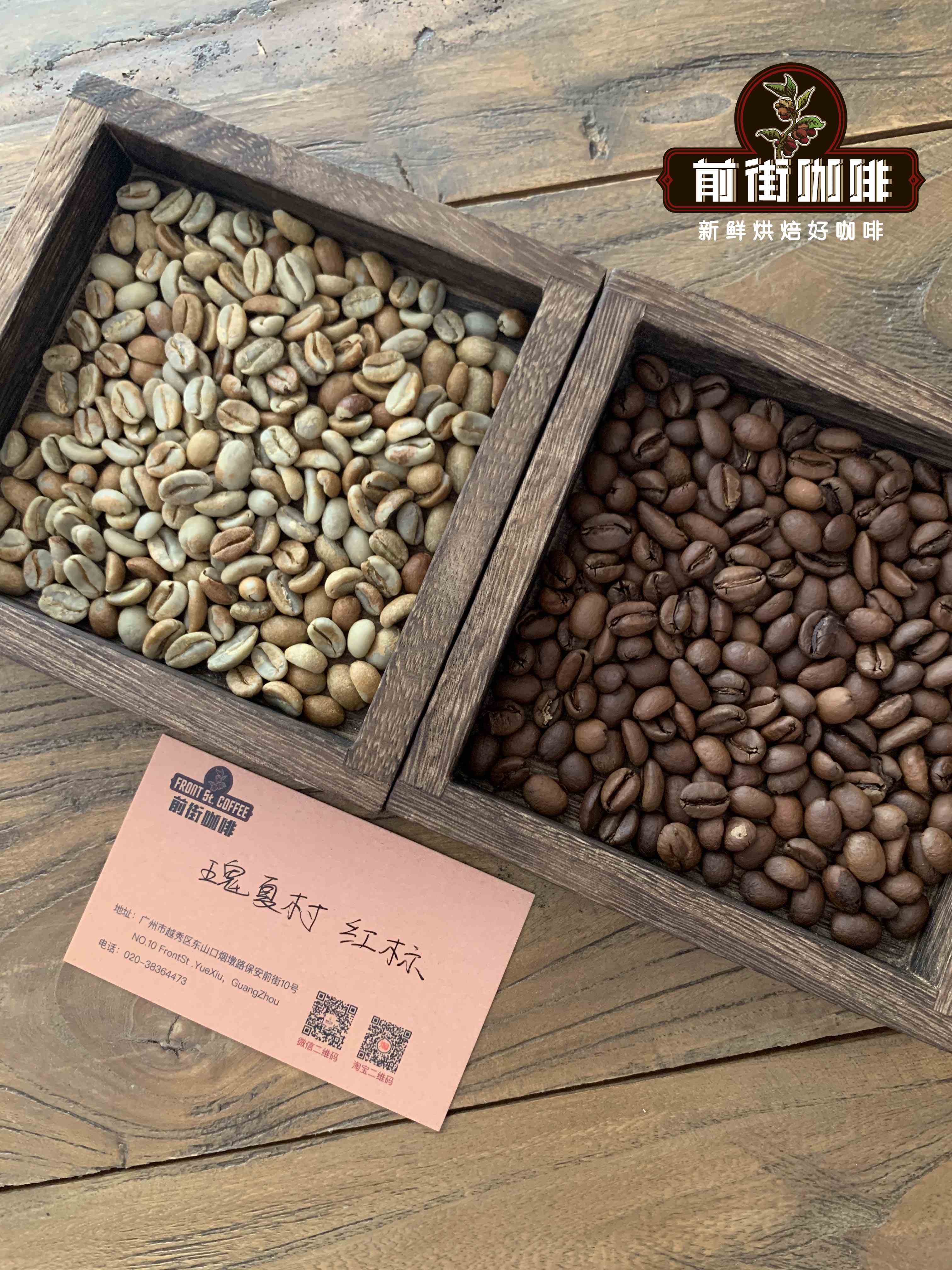
Green label lots come from single blocks and single varieties at the estate. Each batch number includes complete traceability information — farm block name, coffee variety, and processing date.

CHAKA Lots
Chaka lots blend coffee from all blocks across the entire production season. Chaka coffees come in two processing methods, natural and washed, and contain all three of the estate's varieties: Gesha 1931, Gori Gesha, and Illubabor.

FrontStreet Coffee Brewing Parameters
Coffee dose: 15 grams | Ratio: 1:15 | Water temperature: 90°C | Grind size: 80% pass-through rate on 0.85mm sieve | Dripper: Hario V60 #01

Brewing process: First pour 30g of water and bloom for 30 seconds; second pour up to 95g of water (the scale shows 125g), completed at about 1 minute; third pour of 100g more (the scale shows 225g), completed at about 1 minute 30 seconds.
Extraction time: 2 minutes — then remove the dripper to finish the brew.
For more specialty coffee beans and information, follow FrontStreet Coffee on WeChat: kaixinguoguo0925
FrontStreet Coffee Recommendation: Taste the Ancestor of Geisha
Reading this far, you're probably curious how Ethiopian Geisha compares with its Panamanian descendant. FrontStreet Coffee's Geisha Village Gold Label — Geisha 1931, natural process, from the estate's Oma block — delivers citrus, berries, cream, caramel, melon, and honey with remarkable complexity, and makes up only about 10% of the harvest. The Red Label, a Gori Gesha from the Shewa-Jibabu block at 1973-2069 meters, cups above 88 points and offers lemon, plum, tropical fruits, and floral tea at friendlier prices. For a gentler introduction, the Genlana Estate Gesha — medium-light roasted — shows bright citrus acidity, elegant ginger-flower aroma, and the variety's signature refined finish. Brew pour-over with 91°C water at a 1:16 ratio, and taste where the legend began.
Important Notice :
FrontStreet Coffee is a long-established specialty coffee roaster in Guangzhou China, selling freshly roasted beans from its own farm in Yunnan as well as dozens of carefully selected single-origin beans from around the world for both pour-over and espresso. The products deliver consistently excellent quality and great value, with shipping within 24 hours. Guangzhou's FrontStreet Coffee shop is recommended by many coffee lovers, and the beans are now available online at the Tmall 。
FrontStreet Coffee has moved to a new address:
FrontStreet Coffee Address: 315,Donghua East Road,GuangZhou
Tel:020 38364473
 Scan and follow the En Gafei WeChat official account. Please indicate that the reprint comes from "En Gafei".