Panama Hacienda La Esmeralda Panama Geisha Coffee Beans What's the Difference Between Red, Green, and Blue Label Geisha

Talk about Gesha and you must talk about Panama's Hacienda La Esmeralda. FrontStreet Coffee recently received a batch of the 2020 season's La Esmeralda Blue Label Gesha, which makes now the perfect moment to explain the estate's grading system — one that many farms have since copied. A single variety, three tiers, three distinct flavor profiles. The most obvious differences among Red Label, Green Label, and Blue Label come down to two things: planting altitude and whether the beans are blended across plots. Red Label Gesha grows at high altitude (1600-1800 meters) with clear, traceable plot information; Green Label is a blend of beans from plots at the same altitude band as Red Label; and Blue Label comes from lower elevations (1400-1500 meters).
Hacienda La Esmeralda

Panama sits in Central America, bridging North and South America between Costa Rica and Colombia. Its coffee story began with a silver spoon, so to speak.

The Panama Canal, built and for a time exclusively controlled by the United States, drew generations of American elites southward in the late 20th century — some for work, some hunting opportunity.
Hacienda La Esmeralda is a witness to that era. In 1964, American banker Rudolph Peterson retired, moved to Panama, and bought the estate in Boquete, initially running it as a dairy farm. His son Price later left his medical practice to help manage the farm, introducing Caturra and Catuai varieties in 1987 and building the estate's own washed mill in 1994. In 1996 they acquired the neighboring Jaramillo farm, with its superior location and excellent original coffee stock, and folded it into the estate.
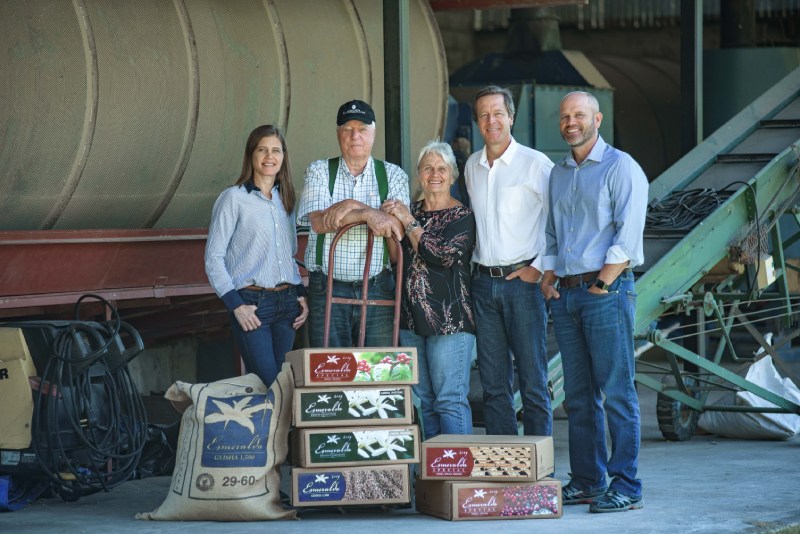
What drew the Petersons to Jaramillo was precisely its coffee: a pleasant orange aroma and floral-fruity notes unlike the baseline taste of Panamanian coffee. After cupping beans from different parts of the farm, they traced that character to an unidentified tree growing at the farm's highest point — a low yielder the previous owner had used only as a windbreak. The Petersons recognized it and began cultivating the trees from that area separately.
In 2004 the lot won the Best of Panama (BOP) green coffee competition, astonishing everyone. Expert identification followed: the tree was the Gesha variety from Ethiopia. From then on, the Peterson family poured most of their energy into the infrastructure needed for batch separation and fine processing.
The Estate's Plot Division
La Esmeralda sits in Boquete, one of Panama's most important coffee regions, home to famous estates such as Elida and Kotowa. The estate maps its Gesha land with extraordinary precision, across three main plots, each subdivided further:
The finest Gesha comes from Jaramillo and Cañas Verdes.

Jaramillo: annual rainfall of 4000 millimeters, average daytime temperatures of 19-25°C, nighttime 11-15°C, average altitude 1600-1700m. Subdivided into 5 smaller plots: Mario, Noria, Reina, Bosque, and Buenos Aires.
Cañas Verdes: annual rainfall of 3500 millimeters, average daytime temperatures of 16-23°C, nighttime 10-15°C, average altitude 1600-1800m. Includes 9 smaller plots: Lino, Coronado, Fundador, Leon, Montaña, Trapiche, Chinta, Cabaña, and Tumaco.
El Velo: the estate's newest acquisition, averaging 1700-1900m. Alongside Gesha and Catuai it grows small amounts of exotic varieties such as Laurina, Pacamara, Mocha, and SL28. Divided into 7 smaller plots: Guabo, Porton, Durazno, Higuerón, Higo, Buena Vista, and Águila.

Red Label, Green Label, Blue Label
La Esmeralda's commercial strategy is distinctive: based on cupping performance, variety, and plot, the estate's coffee is divided into five brands. Gesha accounts for three — Esmeralda Special, Private Collection, and Geisha 1500 — while Catuai makes up the other two, Diamond Mountain and Palmyra.

Red Label Gesha
Esmeralda Special is what the trade calls the Red Label. It selects Gesha grown at 1600-1800 meters — with the finest competition lots harvested between 1909 and 2069 meters — cupping above 90 points, from the Jaramillo and Cañas Verdes plots.

The estate runs its own auction, where meticulously separated lots go under the hammer — only those are "auction Red Labels," with prices to match. Customers often ask whether the Red Label in our shop is auction-grade; at 75 yuan a cup, it would truly be a treasure if it were. Frankly, though, most Red Label on the market consists of beans from the same plots that were not entered into the auction and circulated through normal channels. The variety quality is identical — only the selling price differs.
This tier is processed either natural or washed, showing especially vivid floral and citrus aromatics.
Green Label Gesha
Private Collection — the Green Label — consists of non-auction batches: Gesha grown outside the competition program but still of excellent quality, blended as micro-lots from beans planted at 1600-1800 meters across plots such as Jaramillo and Cañas Verdes.

Because it blends across plots without lot-specific detail, some Green Label batches taste remarkably close to Red Label — a similarity FrontStreet Coffee has observed but one that cannot be guaranteed batch to batch.
Though ranked below Red Label, Green Label still carries classic Gesha character: florals, fruit, citrus acidity, and a thick, juicy body. Both washed and natural versions exist.
Blue Label Gesha
Geisha 1500 is the Blue Label. It selects blended beans from three plots — Jaramillo, Cañas Verdes, and El Velo — grown at 1400-1500 meters. The flavor is gentler: mild florals and fruit, moderate acidity and sweetness, a less full body. Historically it was washed only, but natural processing was added in 2020.

FrontStreet Coffee bought the 2020 season's Blue Label green beans and ran multiple roast adjustments and pour-over cuppings to see whether the natural addition had shifted the flavor.
The Three Labels at a Glance
| Grade | Red Label | Green Label | Blue Label |
|---|---|---|---|
| Altitude | 1909-2069m | 1600-1800m | 1400-1500m |
| Processing | Natural, Washed | Washed | Washed |
| Roast Level | Light Roast | Light Roast | Light Roast |
Roasting Notes
La Esmeralda Gesha beans are full, long, and pointed at the ends. To showcase the floral-fruity profile and bright acidity, FrontStreet Coffee roasts them light. But even within one variety, the Red, Green, and Blue Labels each get their own roast parameters — judging each bean's individuality is roaster's craft, learned batch by batch.
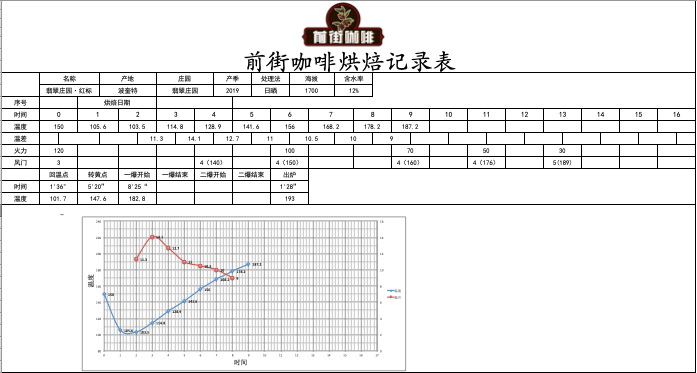
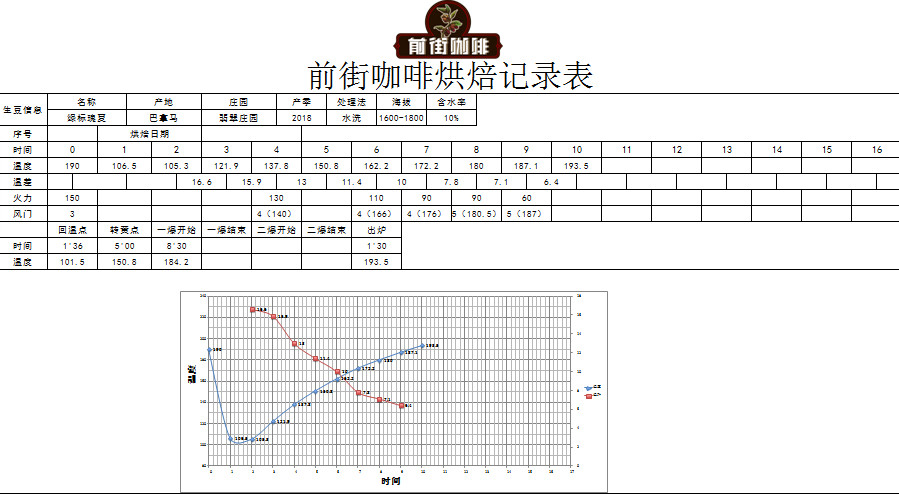
FrontStreet Coffee Panama Hacienda La Esmeralda Red Label Gesha Roasting Curve
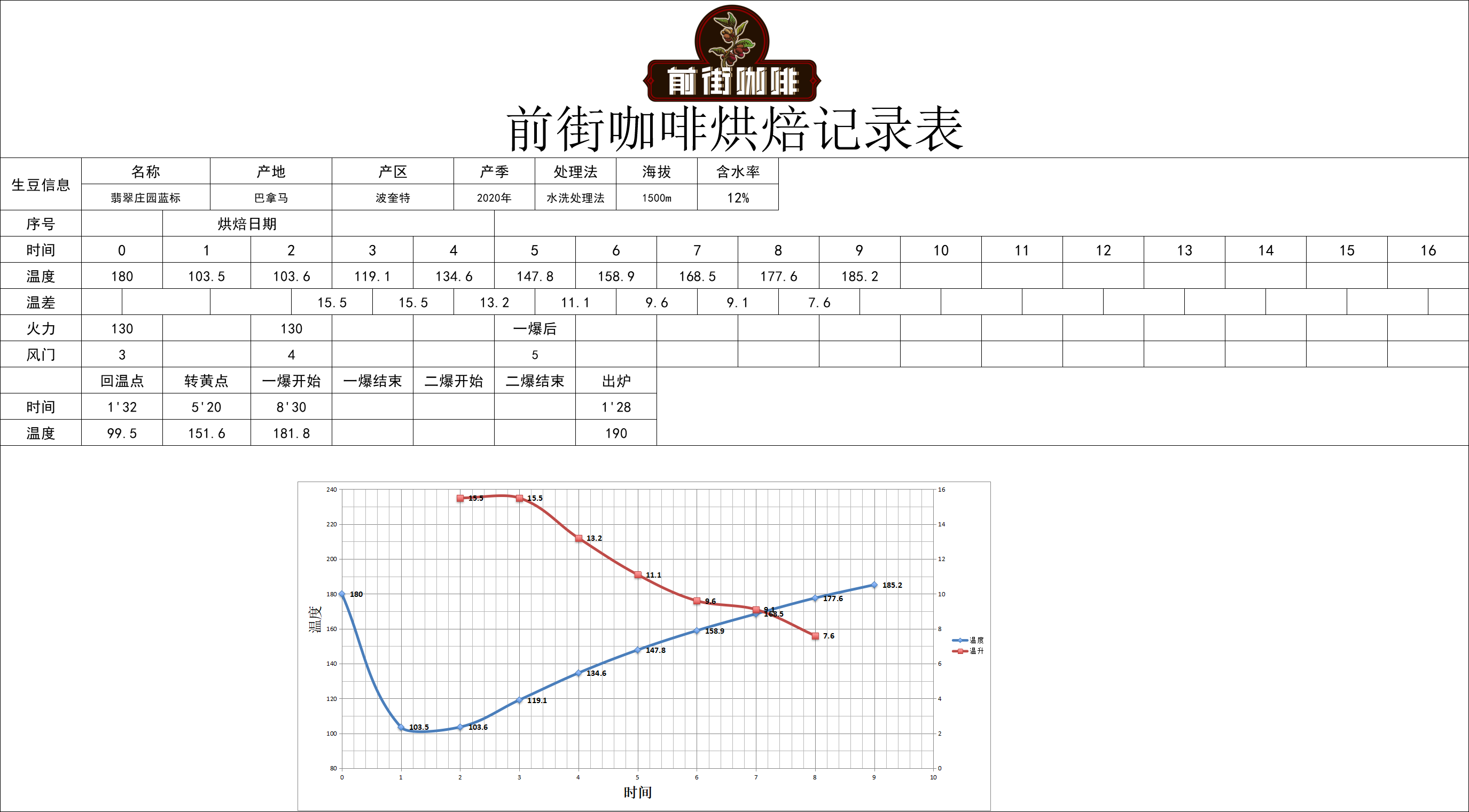
FrontStreet Coffee Panama Hacienda La Esmeralda Green Label Gesha Roasting Curve
FrontStreet Coffee Panama Hacienda La Esmeralda Blue Label Gesha Roasting Curve
Brewing Recommendations
Suggested parameters: Hario V60 dripper, 90°C water, 15g dose, 1:15 coffee-to-water ratio, granulated-sugar grind (80% pass-through rate on a China standard #20 sieve).
A word on why we specify grind by sieving: this follows the Specialty Coffee Association's grind guidance for filter coffee. FrontStreet Coffee has verified extensively that different grinds produce clearly different cups, and each bean wants its own grind — that is exactly why sieving matters. If you don't own a sieve at home, watch the flow rate instead: water running too fast means the grind is too coarse; too slow, too fine.

Brewing Technique
We use segmented, three-stage pouring: 30g of water for a 30-second bloom, then small circular pours up to 125g and pause. Once the water level drops and the bed is nearly exposed, pour up to 225g and stop. When the bed is about to show through again, remove the dripper. Total extraction time: 2'00" (from the start of the bloom).

Flavor Notes
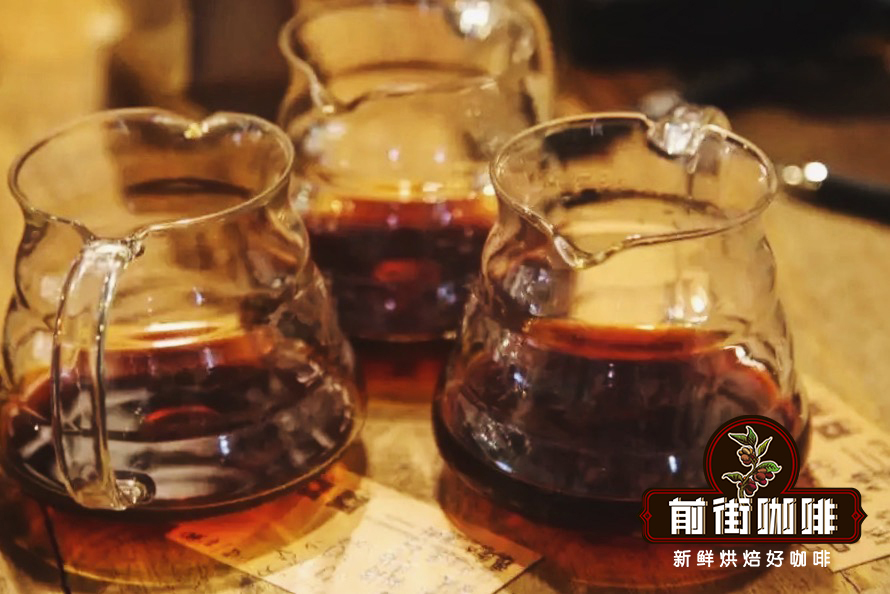
[Red Label] Bright rose and citrus aromatics, brown rice, berries, apricot, layered fruit, honey, and a thick juice-like body — rich layers with pronounced sweetness.
[Green Label] Intense jasmine on the first sip, high sweetness, citrus, berries, juice-like texture, cream, green tea, orange peel, cantaloupe — layered and rich, with a long floral-citrus finish.
[Blue Label] Gentle lemon and grapefruit acidity up front; as it cools, oolong tea, honey, and sugarcane sweetness emerge in a clean, bright cup.
FrontStreet Coffee Recommendation
If these tiers feel daunting, there are gentler ways into Gesha. FrontStreet Coffee's Panama Boquete Gesha is the entry point: at an accessible price you still get the classic orange-blossom and honeyed character, an oolong-tea finish, and delicate fruit acidity with clean layering. On the Ethiopian side — where the variety was born — the Gesha Village estate grades its lots into Gold Label RARITIES (the Gesha 1931 variety, about 10% of production and the estate's top non-auction coffee), Red Label GROWERS RESERVE (Gori Gesha, about 15% of production, 88+ points on the SCA scale, with full traceability including farm block, variety, and processing date), Green Label SINGLE-TERROIR, and the blended Chaka batch.
For a farm-level Ethiopian Gesha, FrontStreet Coffee's Granja Gesha comes from a washing station established in 2014 near the border of the Kochere and Genlana Abaya areas, run by Israel Degefa, with 700 hectares of mostly uncultivated, shade-drenched land around it. Fully ripe cherries are hand-picked and natural-dried on raised beds for 14-20 days depending on weather; roasted medium-light, it shows bright citrus acidity, elegant ginger-flower aroma, ripe fruit sweetness, and Gesha's signature refined finish. And if you simply want the Gesha spirit without the Gesha price, FrontStreet Coffee's Strawberry Candy blend pairs Costa Rican honey process with Panamanian Gesha — floral and sweetly fruity, whether you brew it as pour-over, espresso, or cold brew (30g of grounds at 1:12 with 360g of water, steeped 8 hours in the fridge, then rested 3 more hours after filtering, for notes of grape juice, rose, sweet orange, and fruit wine).
Important Notice :
FrontStreet Coffee is a long-established specialty coffee roaster in Guangzhou China, selling freshly roasted beans from its own farm in Yunnan as well as dozens of carefully selected single-origin beans from around the world for both pour-over and espresso. The products deliver consistently excellent quality and great value, with shipping within 24 hours. Guangzhou's FrontStreet Coffee shop is recommended by many coffee lovers, and the beans are now available online at the Tmall 。
FrontStreet Coffee has moved to a new address:
FrontStreet Coffee Address: 315,Donghua East Road,GuangZhou
Tel:020 38364473
 Scan and follow the En Gafei WeChat official account. Please indicate that the reprint comes from "En Gafei".