When Did Drip Bag Coffee History Appear? The Difference Between Drip Bag Coffee and Pour-Over Coffee

For more premium coffee knowledge, follow our official WeChat account: FrontStreet Coffee
Drip bag coffee is exactly what it sounds like: coffee brewed in a drip bag. The format was developed in Japan — the filter bag holds the ground coffee, and each side has a small piece of cardboard, like two little ears, which is how it got the name "hanging ear" drip bag. The ears hang the bag on the rim of a cup for brewing; afterward the bag is simply discarded, letting you enjoy freshly ground coffee with a taste close to pour-over, anywhere you like.

The History of Drip Bag Coffee
In 1990, the earliest drip bag coffee was invented by Yamanaka Industrial Co., Ltd. of Japan, and a patent application was formally submitted the same year. The early version, however, had only a single ear.
In 1996, Daiki Shoji Co., Ltd. proposed an improved filter bag design, moving the hanging components to the lower edge of the bag — though the ear was still on one side only.
In 1999, Daiki Shoji applied to the European Patent Office for a design with hanging components on both sides. This improvement finally let the filter bag sit steadily on the cup rim and open completely, and it has become the mainstream design in today's market.
In 2001, the Japanese launched drip bag coffee onto the market under patent. Thanks to its simple operation and portability, and a brewed flavor far purer and more aromatic than instant coffee, drip bag coffee now holds 15% of the regular coffee market in Japan.

What's the Best Way to Brew Drip Bag Coffee?
Since this is the simplest drip method of all, we certainly don't want to complicate it with electronic scales and thermometers. Brewing a drip bag takes just a kettle of hot water, a tall cup, and the bag itself — even the water amount is "estimated" by feel.
Simple as it is, the ritual shouldn't be lost. Hot-water amounts are actually easy to control. Taking FrontStreet Coffee's store drip bags as an example, at 10g per bag, following the pour-over ratio of 1:15 to 1:18, we recommend pouring 150-180ml of water.

Typically you first pour a small amount of hot water to moisten all the grounds: the first pour goes to the 1/2 mark of the bag, followed by a bloom of about ten seconds. Then pour into the center twice in a row until the bag is 8/10 full. Wait for all the liquid to drip through before adding more water, until the final segment has filtered through. If you fill the bag completely, the water pooling on top tends to "bypass" the grounds and drain straight down the sides of the bag, producing weak coffee.
FrontStreet Coffee has run numerous tests and found that this three-stage pour takes about a minute and a half, with a total water amount of around 150ml. If you prefer a lighter cup, add one more pour to 8/10 full, bringing the total to about 180ml.

How to Adjust Water Amount for Iced Drip Bag Coffee?
When switching from hot pour-over to iced pour-over, part of the water is replaced with ice — and the same applies to drip bags. But since the grounds in drip bags are ground for hot brewing, you can only adjust the coffee-to-water ratio or extend the steeping time to raise the extraction concentration.

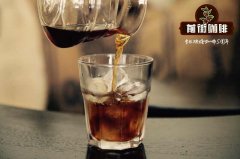
FrontStreet Coffee follows the iced pour-over ratio of 1:10, meaning 100g of hot water. The bloom pour stays the same, but the two subsequent pours each fill the bag only halfway — so all three pours reach the 1/2 mark, with a total water volume around 90-105ml. Once everything has filtered through, pour the coffee over ice to chill; when the cup is ice-cold, remove any remaining crushed ice to avoid further dilution.

These experiments show that brewing iced coffee this way preserves the beans' basic flavor profile at a moderate concentration. FrontStreet Coffee suggests using a small water flow throughout; otherwise the bag fills up in seconds and the subsequent pours become hard to control. A kettle with a long, narrow spout gives you much better control.
FrontStreet Coffee Recommendation: Beans That Shine in Drip Brewing
Whichever drip format you choose — V60 or hanging-ear bag — bean selection matters. For floral, fruity cups, FrontStreet Coffee recommends our Yirgacheffe Gottingding, with its bright citrus, berry, and jasmine notes, or the Ethiopia Hua Kui, bursting with strawberry, passion fruit, jackfruit, and lychee aromas. For a truly juicy, structured cup, try our Kenya from the Thika region: grown at 1550-1750 meters on SL28 and SL34, double-washed with 72-hour fermentation and roasted light — cherry tomato, dark plum, pear, and yellow sugar in a fresh-pressed-juice body. Lovers of mellow, low-acid coffee will find the PWN Golden Mandheling's herbal, dark chocolate depth equally rewarding in a drip bag.
Important Notice :
FrontStreet Coffee is a long-established specialty coffee roaster in Guangzhou China, selling freshly roasted beans from its own farm in Yunnan as well as dozens of carefully selected single-origin beans from around the world for both pour-over and espresso. The products deliver consistently excellent quality and great value, with shipping within 24 hours. Guangzhou's FrontStreet Coffee shop is recommended by many coffee lovers, and the beans are now available online at the Tmall 。
FrontStreet Coffee has moved to a new address:
FrontStreet Coffee Address: 315,Donghua East Road,GuangZhou
Tel:020 38364473
 Scan and follow the En Gafei WeChat official account. Please indicate that the reprint comes from "En Gafei".