Guatemala Coffee Flavor Characteristics: An Introduction to Guatemala's Coffee Regions, Varieties, and Grades
For more specialty coffee knowledge, please follow the WeChat official account: FrontStreet Coffee
Among Latin America's coffee origins, Guatemalan coffee is renowned for its bright fruit acidity and smoky notes. With a smooth mouthfeel and highly distinctive flavors, Guatemalan beans are often nicknamed "cigarette coffee." In this article, FrontStreet Coffee explores the regional flavor characteristics of Guatemalan coffee.
Guatemala's Coffee Cultivation History
According to FrontStreet Coffee's research, as early as 1747 Guatemalan farmers already knew how to cultivate and drink coffee. By 1750, Jesuit priests had introduced coffee trees to the country. In 1845, with the establishment of the Guatemalan Coffee Cultivation and Promotion Committee, coffee became an important economic crop, and with strong government backing, coffee accounted for 90% of Guatemala's total exports by 1880. In the pursuit of higher yields, those in power targeted indigenous people's lands, forcing them to sell up and move to more barren areas.
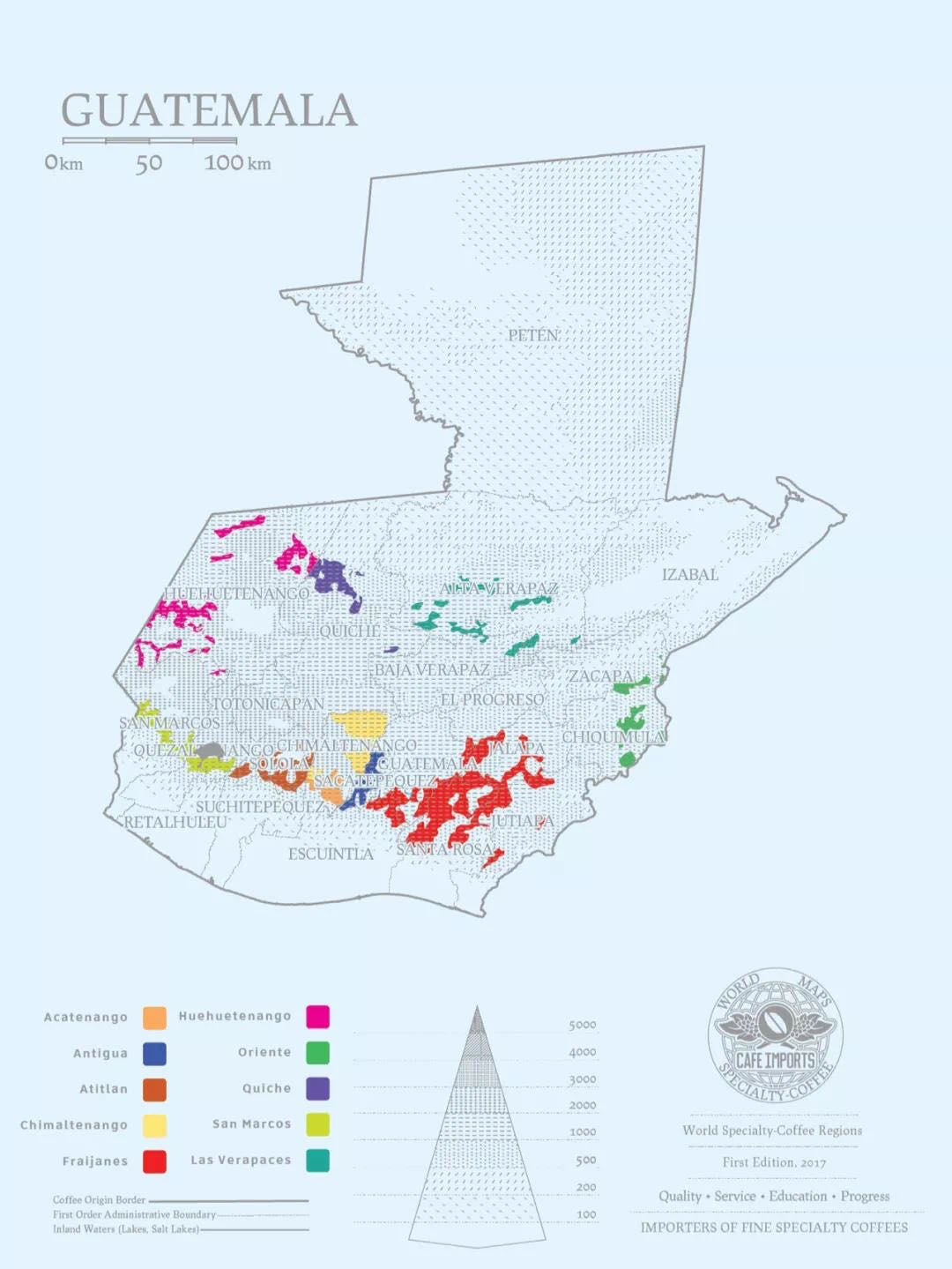
As a result, even today most of Guatemala's coffee is grown in the southern regions. FrontStreet Coffee notes that Guatemala currently has eight major coffee-producing regions, each with a different flavor profile. Generally speaking, Guatemalan coffee shows a mild, rich overall texture, elegant aromas, and a special, pleasant fruit-like acidity - truly the aristocrat of coffees. FrontStreet Coffee's Guatemala Antigua Flora, for instance, is very popular among coffee enthusiasts.
Guatemala's Coffee Growing Regions
As mentioned above, Guatemala has eight coffee-growing regions, and each region's flavor is shaped by its geography. Next, FrontStreet Coffee briefly describes the character of each.
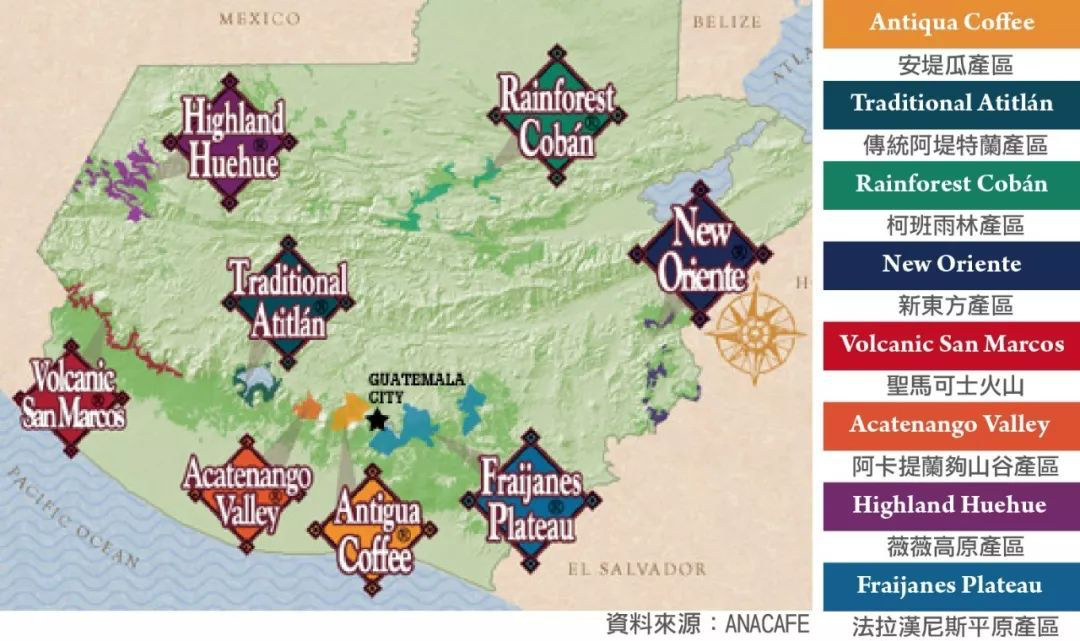
Antigua
The old capital and ancient city, close to the modern capital, is the most famous of all Guatemalan coffee regions. It commands premium prices accordingly, and many counterfeit "Antigua" beans circulate in today's specialty market. The highest-priced lots are Bourbon grown in Antigua's most characteristic volcanic soil.
Flavor: Balanced sweet and sour
Altitude: 1500-1700m
Acatenango Valley
Guatemala's eighth coffee region was originally a supply area for Antigua. Adjacent to it, the valley is magnificently scenic, with coffee grown along volcanic valleys. The valley traps warm, humid air, and combined with significant day-night temperature differences, it is extremely well suited to growing coffee.
Flavor: Excellent sweetness, delicate fruit acidity, with flavors and aromas widely loved by coffee enthusiasts
Altitude: 1300-2900m
Rainforest Coban
This region receives very high rainfall, with perennial cloud cover and a cool climate. The soil contains limestone and clay. Post-harvest processing often determines the quality of coffee from here, but when it's done well, the flavors are full and captivating.
Flavor: Good mouthfeel with chocolate and tropical fruit flavors
Altitude: 1300-1500m
Volcanic San Marco
Quality varies greatly in this area. Rainfall is abundant, the coffee flowers intensively when it rains, and sun-drying after harvest becomes a gamble - leading to inconsistent coffee quality in the region.
Flavor: Distinct acidity and sweetness, with properly processed lots showing full, unique aromas
Altitude: 1400-1800m

Traditional Atitlan
The soil around Lake Atitlan is very fertile, with the highest coffee grown at 1,950 meters. Most of the area extends from the slopes down to the lake shore, where altitude stays around 1,500m. It is also Guatemala's largest and most famous high-altitude lake region.
Flavor: Rich aroma and viscous texture
Altitude: 1500-1750m
Highland Huehue
This region has the highest average altitude in Guatemala and belongs to the volcanic coffee areas. However, the routes from here to the capital are rugged and remote. Fortunately, dry hot winds from Mexico blow into the region, allowing Highland Huehue to grow coffee at 2,000m.
Flavor: Bright and delicate acidity, floral notes, and diverse flavors
Altitude: 1500-2000m
Fraijanes Plateau
This region is also a high-altitude volcanic coffee area. Its soil is rich in pumice that can even be ignited. The coffee flavor is balanced but carries more distinctive aromatics than Antigua; FrontStreet Coffee believes this likely stems from the region's soil and its variable humidity and temperature.
Flavor: Unique aroma, balanced flavor, mild acidity, rich mouthfeel
Altitude: 1400-1800m

New Oriente
This region lies near neighboring Honduras, with a climate similar to Coban's but somewhat hotter in places. New Oriente is a volcanic region, yet its flavors differ significantly from other volcanic areas.
Flavor: Prominent aroma, with chocolate and spice notes
Altitude: 1200-1700m
Guatemala's Coffee Growing Conditions
Guatemala borders Mexico to the north, Honduras and El Salvador to the south, the Caribbean Sea to the east, and the Pacific Ocean to the west. With its unique geography of mountains and sea, Guatemala boasts tropical rainforests, volcanic geology, highland valleys, and varied microclimates - ideal for growing arabica coffee.

The northern and eastern coastal plains have a tropical rainforest climate, while the southern mountains are subtropical. The year divides into dry and wet seasons: May to October is the wet season, and November to April of the following year the dry season. The narrow, fertile plains along the Pacific coast have a tropical climate, and the central highlands are also Guatemala's cultural center. According to FrontStreet Coffee, at 1,300-1,800 meters the temperature stays mild year-round, with daily temperatures between 18-28°C; at higher elevations, January and February turn colder.
The northeast receives 2000-3000mm of annual rainfall, while the south receives 500-1000mm. Guatemala's high average elevation puts the coffee-growing zones above 1,500 meters, between 14-16 degrees north latitude - ideal for growing extremely hard beans. All coffee is wet-processed, and 45% of the beans are classified as specialty grade - a remarkably high proportion. There are also small amounts of robusta.
Guatemalan Coffee Bean Grading
As FrontStreet Coffee mentioned earlier, because Guatemala's coffee regions sit at high altitude with temperatures suited to growing extremely hard beans, Guatemalan coffee is graded by bean hardness and altitude: the higher coffee grows, the denser the fruit, and the more distinctive the flavors. Below are Guatemala's grading standards (from highest to lowest quality):
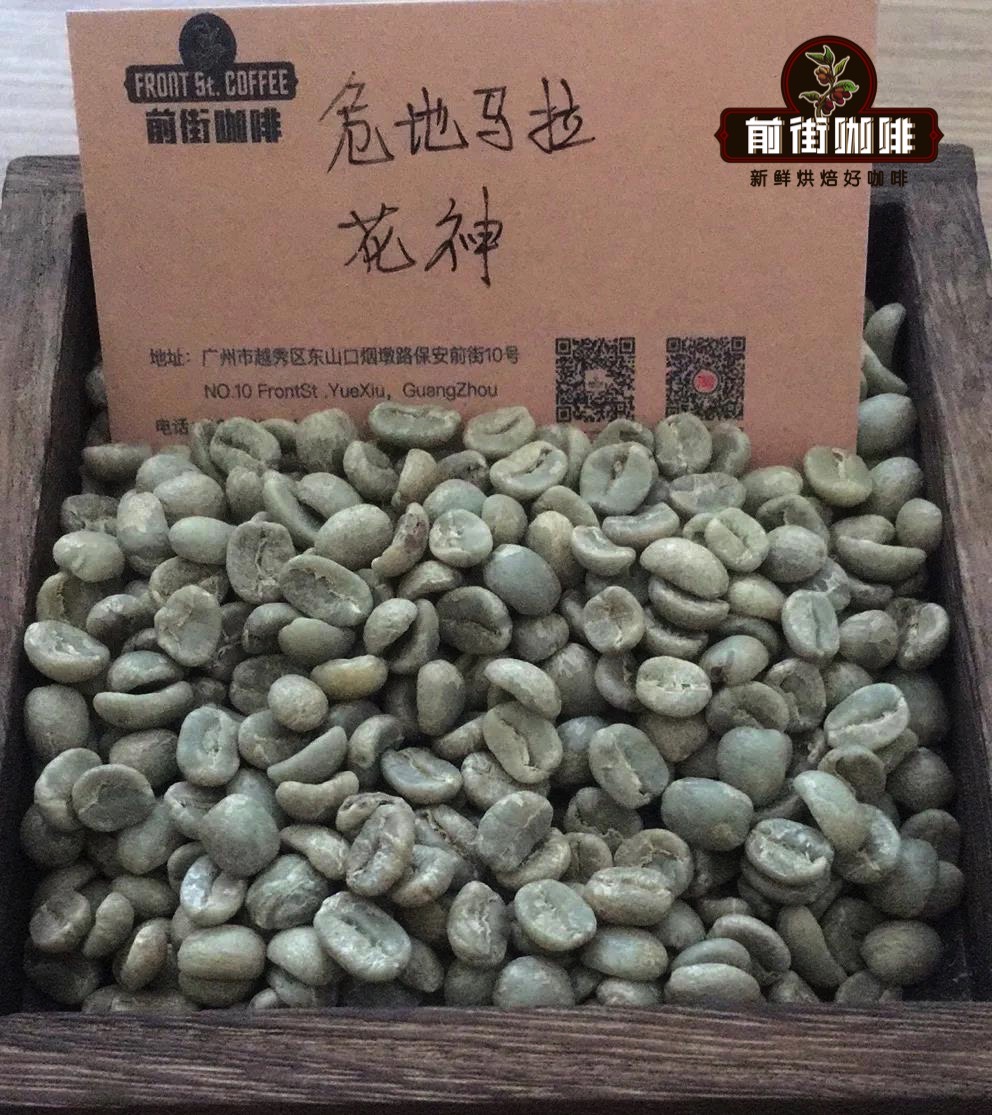
SHB (Strictly Hard Bean): Grown at 1500-1700 meters
HB (Hard Bean): Grown at 1350-1500 meters
SH (Semi Hard Bean): Grown at 1200-1350 meters
Extra Prime: Grown at 1000-1200 meters
Prime: Grown at 850-1000 meters
Good Washed: Grown at 700-850 meters
Guatemala's Coffee Processing Methods
According to FrontStreet Coffee's understanding, most Guatemalan coffee is washed, with only a small amount natural-processed.
FrontStreet Coffee has said before that the washed method best showcases a bean's original flavors and is the starting point for understanding regional character. That's why FrontStreet Coffee's daily beans are primarily washed - such as the Guatemalan Huehuetenango daily bean. The natural method, by contrast, adds aroma and fermentation notes on top of the base regional flavors.

The Washed Process, Step by Step
1. Harvesting. After harvesting ripe cherries, an initial screening removes impurities, defective beans, and floaters. This stage is identical to the natural method.
2. Pulping. Fresh cherries go into a pulping machine to remove skin and pulp. Unripe fruit, whose pulp doesn't separate easily, is screened out at this stage. What remains after pulping is mucilage, parchment, and seed.
3. Fermenting to remove mucilage. The pulped seeds with mucilage are transferred to fermentation tanks. Despite the name, the mucilage isn't literally washed away - it's removed through biological decomposition during fermentation, which takes about 16-36 hours, with frequent stirring to speed the mucilage's separation from the seeds. Washed fermentation produces acidic substances like citric acid, malic acid, and acetic acid, which penetrate the beans and make washed coffee more acidic than natural. After fermentation, actual washing happens - the beans are rinsed again.
4. Drying. After washing, the beans still need sun- or machine-drying to bring moisture down to 12%. Since the pulp has been removed, there's no worry about mold during drying as with naturals. The dried parchment beans aren't as hard as natural-processed beans, so hulling machines easily remove the parchment to obtain green beans.
The Natural Process, Step by Step
1. Harvest ripe coffee cherries
2. Initial screening to remove impurities and defective beans
3. Float separation: cherries are poured into water tanks. Mature, full fruits sink to the bottom, while immature or damaged ones float to the surface.
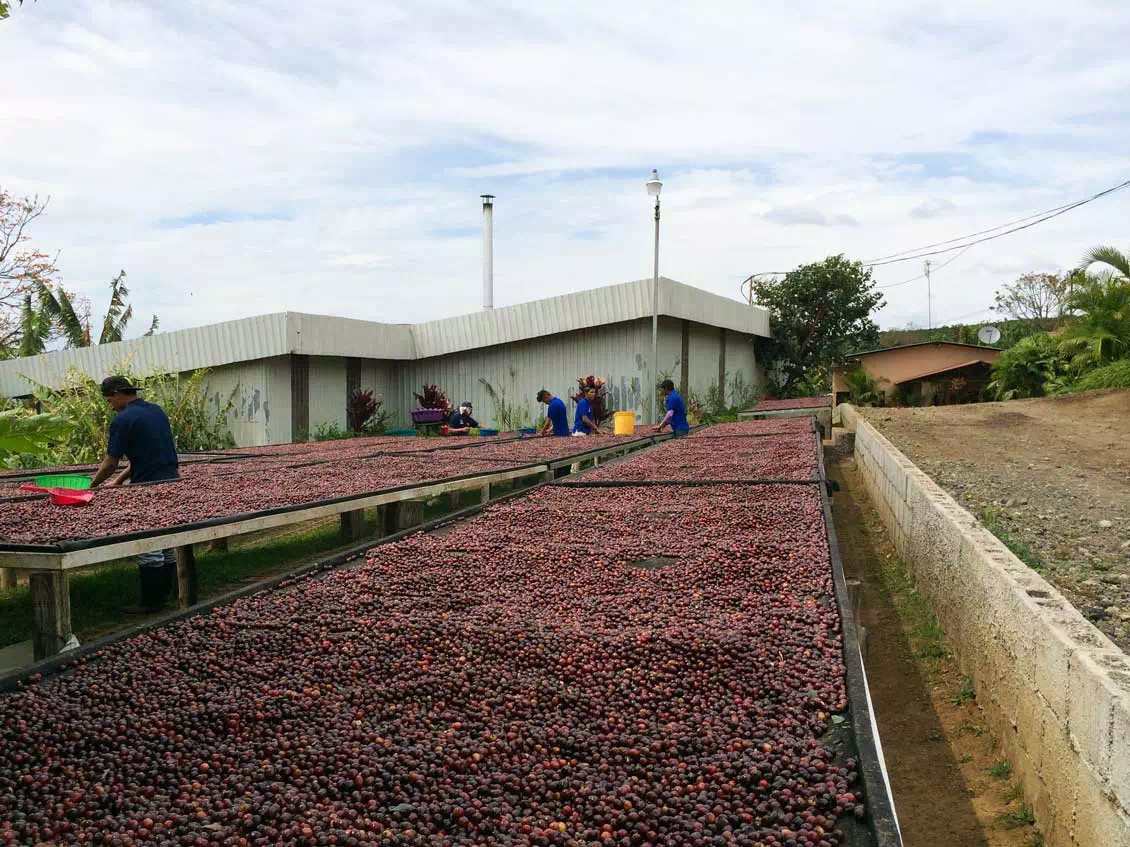
4. Sun drying: the mature cherries are scooped out and spread on drying patios, reducing moisture from 70% to about 10-12%. They must be turned several times daily for even drying and covered at night to avoid reabsorbing moisture.
5. Hulling: after roughly two to four weeks in the sun, the outer layers of the coffee seeds have dried and hardened and can be removed by hulling machines.
6. Packaging and shipping: the hulled beans are bagged as green coffee, ready for countless roasting and brewing variations to yield millions of different flavor profiles.

Guatemala's Coffee Varieties
According to FrontStreet Coffee's understanding, Guatemala primarily grows Bourbon, Typica, Caturra, and Catuai.
Bourbon: A natural variant of Typica. Ripe cherries display a wine-red color, and the beans are relatively round. High-altitude Bourbon typically has excellent aroma and bright acidity, with flavors reminiscent of red wine.
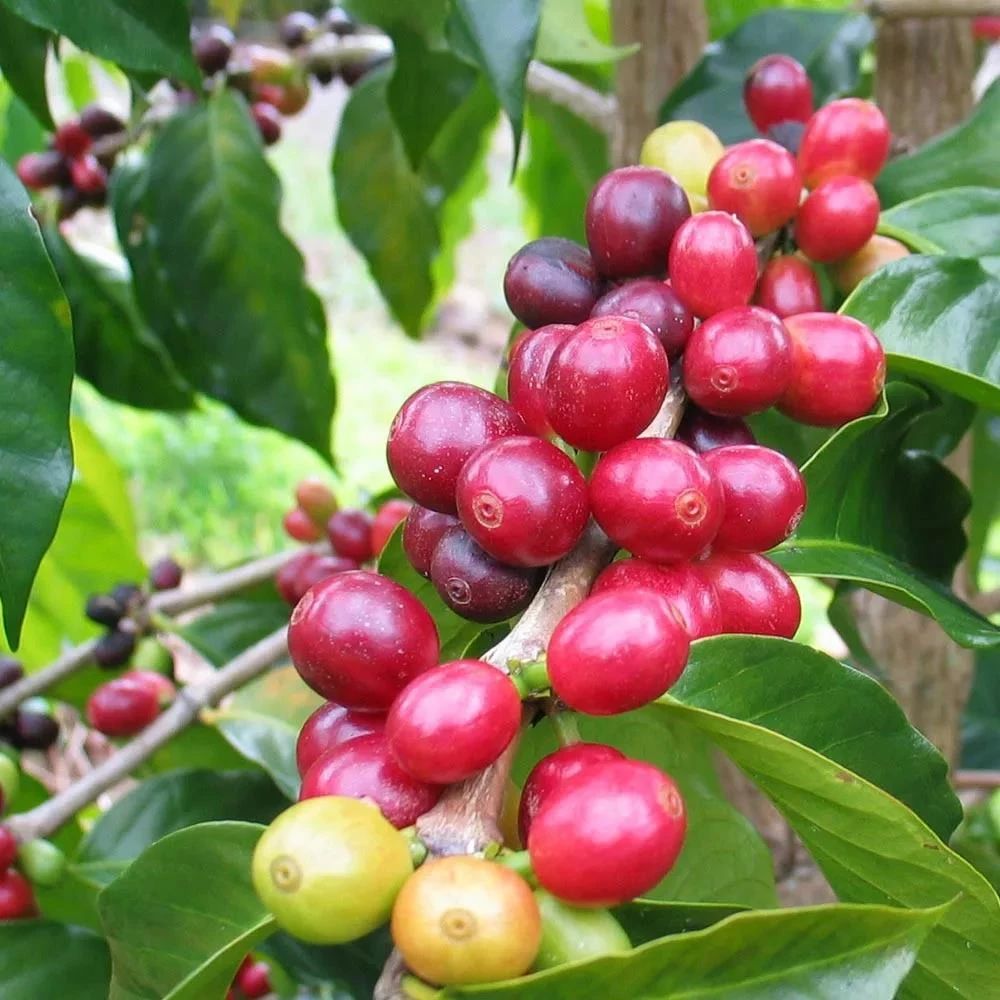
Typica: Typica performs beautifully in the cup and is recognized as a specialty variety, but yields are extremely low and it is susceptible to rust disease, demanding more labor-intensive management. Typica originates from southeastern Ethiopia and Sudan and is the most widely cultivated variety in the Western Hemisphere. The plants are relatively robust but intolerant of direct sunlight, and Typica's top leaves are bronze-colored, earning it the name "copper-topped coffee."
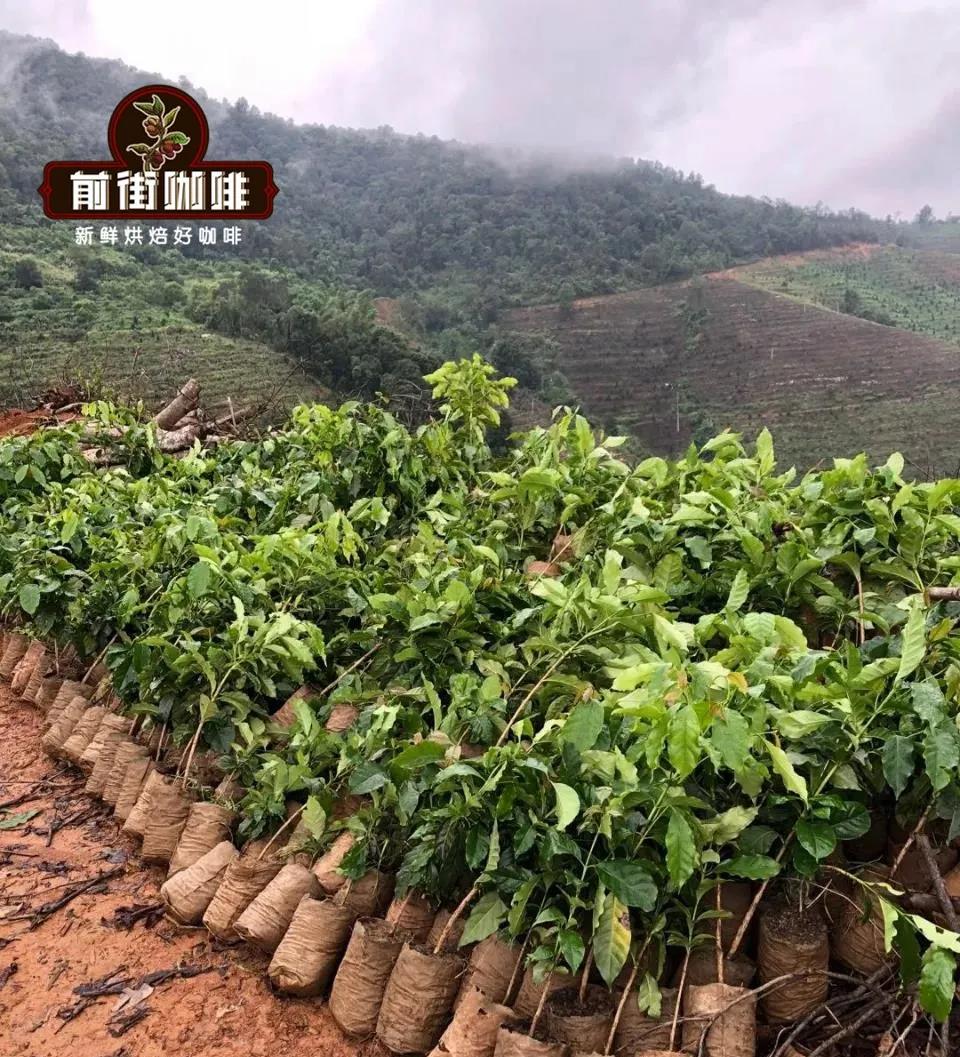
Caturra: A natural Bourbon variant discovered in Brazil in 1937. The plant is shorter and smaller than Bourbon. Although it carries Bourbon's lineage, making it relatively disease-resistant, its yield is higher. Despite being discovered in Brazil, Caturra never suited cultivation there; instead it became popular across Central and South America, with large-scale planting in Colombia, Costa Rica, and Nicaragua.
Catuai: A hybrid created by crossing Caturra and Mundo Novo. Catuai inherits Caturra's short stature, needs no shade, is easy to grow, and convenient to harvest. It also withstands natural disasters better than Mundo Novo and shows good acidity in the cup. Catuai generally comes in both red- and yellow-fruit types.
That concludes FrontStreet Coffee's overview of Guatemalan coffee. Next, we'll introduce the Guatemalan beans currently available at FrontStreet Coffee.
FrontStreet Coffee Guatemala Huehuetenango (Daily Bean)

Country: Guatemala
Region: Huehuetenango
Altitude: 1500-2000m
Varieties: Bourbon, Caturra, Catuai
Processing: Washed
Bean Appearance: Relatively uniform beans
Flavor: Nuts, lemon peel, berries, citrus
FrontStreet Coffee Guatemala Antigua Flora Coffee Beans

Country: Guatemala
Region: Antigua
Altitude: 1200m
Varieties: Bourbon, Caturra
Processing: Washed
Flavor: Berries, citrus, light floral notes, soft fruit acidity, chocolate aftertaste
Those are the basics of these two Guatemalan coffees from FrontStreet Coffee. Whenever FrontStreet Coffee introduces a new bean, we run extensive roasting and brewing tests and select the optimal roasting and brewing data before serving it to coffee lovers. Below, we share the roasting and brewing data for the Guatemala Antigua Flora for your reference.
FrontStreet Coffee Roasting Recommendations
These green beans are round, greenish-yellow, fairly uniform, with medium moisture content. FrontStreet Coffee's roasters therefore aim for a medium roast - preserving the bright acidity to showcase floral and fruit aromas while enhancing richness and balance.

Roasting Machine: Yangjia 600g Semi-direct Heat
Preheat the roaster to 200°C and set the damper to 3. After 30 seconds, reduce heat to 160°C with the damper unchanged. Turning point at 1'36"; maintain heat. At 4'50" the bean surface turns yellow, the grassy aroma disappears completely, and the drying stage begins; reduce heat to 140°C and open the damper to 4. Drying completes at 4'50", and heat is reduced to 140°C. At 8'32" wrinkles and dark spots appear on the bean surface and the toast aroma clearly turns to coffee aroma - the prelude to first crack. Listen carefully for the sound. At 8'37" first crack begins; reduce heat to 80°C and open the damper fully to 5 (be very careful reducing heat - don't go so low that the cracking stops). Develop for 1'50" after first crack, then drop the beans at 195.3°C.
FrontStreet Coffee Brewing Recommendations

Dripper: V60
Dose: 15 grams
Ratio: 1:15
Temperature: 90°C
Grind Size: EK43s grinder at setting 10
FrontStreet Coffee Brewing Technique
Multi-stage extraction.
Bloom with 30ml of water for 30 seconds. Continue pouring to 125g for the first stage. When the water level drops and the coffee bed is about to be exposed, pour on to 225g for the second stage. When the bed is about to be exposed again, remove the dripper. (Timing starts from the bloom.) Total extraction time is two minutes.

Flavor Description:
Floral notes, citrus acidity, caramel, and a slight smoky aroma
For more specialty coffee beans, feel free to add FrontStreet Coffee on WeChat: kaixinguoguo0925
FrontStreet Coffee Recommendation
If the bright acidity and delicate florals of a light-roast Guatemala have you hooked, FrontStreet Coffee's light-roast, floral-fruit lineup offers even more to explore. A classic starting point is FrontStreet Coffee's Yirgacheffe Worka (Guodingding Co-op) from Ethiopia: Yirgacheffe has long been the first stop for coffee lovers entering specialty coffee, with vivid citrus, berry, and floral aromas and a green-tea-like sweetness. Unlike the "sour coffee" many people imagine, good Yirgacheffe acidity is soft and bright - closer to the natural sweetness of fruit than to any harsh tang - making it one of the easiest light roasts to love.
For bigger fruit, FrontStreet Coffee's Ethiopia Huakui is one of the most successful star products of recent years: intensely tropical, with strawberry, passion fruit, jackfruit, even lychee aromas, obvious sweetness, almost no bitterness, and a smooth, juice-filled mouthfeel - many customers call it "the coffee that doesn't taste like coffee," and it has a way of completely changing skeptics' minds. If you want structure and identity, FrontStreet Coffee's Kenya Small Tomato from the Thika region (1,550-1,750m, SL28 and SL34, 72-hour double-washed fermentation, light roast) is the pick: dried cherry tomato and floral dry fragrance, clear cherry tomato and dried plum flavors, bright and solid acidity like freshly squeezed juice, mid-palate sweetness of snow pear and black plum, and a clean, lingering finish with yellow sugar and a hint of green tea.
Finally, for a taste of coffee's origins themselves, FrontStreet Coffee's Ethiopia Kaffa Forest comes from the UNESCO-recognized Kaffa Biosphere Reserve in southwestern Ethiopia - the birthplace of arabica coffee and the place that gave coffee its name, where the legend of the goatherd Kaldi was born. This mountain rainforest of more than 7,000 square kilometers sits at 1,400-2,100 meters, perpetually wreathed in cloud, and has evolved over millennia into a gene pool of more than 5,000 wild arabica mother plants - the original home of the Geisha tree among them. The wild coffee trees grow naturally on abundant rainfall and acidic red soil, producing a cup full of jasmine, citrus, and wild berry aromas with fine, vivid layers - a true pilgrimage for anyone who loves a bright, floral light roast.
Important Notice :
FrontStreet Coffee is a long-established specialty coffee roaster in Guangzhou China, selling freshly roasted beans from its own farm in Yunnan as well as dozens of carefully selected single-origin beans from around the world for both pour-over and espresso. The products deliver consistently excellent quality and great value, with shipping within 24 hours. Guangzhou's FrontStreet Coffee shop is recommended by many coffee lovers, and the beans are now available online at the Tmall 。
FrontStreet Coffee has moved to a new address:
FrontStreet Coffee Address: 315,Donghua East Road,GuangZhou
Tel:020 38364473
 Scan and follow the En Gafei WeChat official account. Please indicate that the reprint comes from "En Gafei".