Characteristics of Yunnan Coffee Beans: Cupping and Brewing Parameters for Yunnan Arabica and Typica
01 | Introduction to Yunnan Coffee Bean Growing Regions
Arabica coffee grows best on mountain slopes at altitudes of 800-1800 meters. If the altitude is too high, the coffee turns sour; too low, and it turns bitter. Much Arabica is planted in dry-hot valley areas at around 1100 meters, producing moderate acidity, a rich aroma, and a mellow flavor. Many parts of Yunnan offer exactly the kind of environment Arabica needs, yielding beans of excellent quality.
The main growing areas are distributed across Lincang, Baoshan, Simao, Xishuangbanna, Dehong and other regions. Baoshan has an average temperature of 21.5°C, with a maximum of 40.4°C, and is essentially frost-free year-round, making it widely recognized as an ideal location for Arabica cultivation. The Arabica grown here is famous at home and abroad for being rich but not bitter, fragrant but not overpowering, with small, uniform beans, a full mellow aroma, and fruity notes. Tasting experts from international coffee organizations have rated Yunnan coffee as comparable to Colombian washed Arabica, placing it among the world's highest quality coffees.
Planting Altitude
For Arabica, 1200 meters is the quality watershed. Hainan coffee, which few people talk about, has remained non-mainstream and sells mainly as a tourist souvenir - partly because much of it is Robusta, and partly because Hainan's terrain sits near sea level, with most areas below 300 meters. Although Wuzhishan peak in the central highlands reaches 1800 meters, the urban area sits at only 320 meters. Hainan can grow souvenir coffee, but cultivating truly good Arabica is beyond it.
Since altitude is such a fundamental factor, it helps that large areas of Yunnan's mountains exceed 1000 meters. Kunming sits at 1895 meters, Baoshan at 1653.5 meters, Dali at 1976 meters, Chuxiong at 1773 meters, Dehong averages 800-1500 meters, and Diqing averages 3380 meters. Higher altitude also brings lower temperatures, which must be considered: the golden coffee belt lies between the Tropic of Cancer and the Tropic of Capricorn, because beyond those lines frost becomes very likely, and coffee trees die when they encounter frost. Yunnan, however, benefits from the Gaoligong Mountains north of Baoshan, which block the winter push of the Siberian cold current, while the province's many mountains form protective microclimates suitable for coffee.
02 | Processing Methods
The harvested cherries are run through a depulping machine to separate most of the fruit flesh from the beans, and the parchment coffee is then guided into a clean water tank and soaked to ferment, completely removing the residual mucilage layer. Until roughly five years ago, the washed method was usually the first choice for processing high-quality coffee.
During washing, unripe and defective beans are sorted out by buoyancy differences, and fermentation is easier to control. As a result, unlike natural-processed coffees, which can carry off-flavors, washed coffee shows distinct fruit acidity, slightly stronger complexity, and a cleaner cup - free of negative flavors like astringency or sharpness. The trade-off is that because the cup is so "clean," its flavor richness is somewhat more restrained.
03 | Green Bean Analysis
Yunnan Arabica Coffee Beans
Yunnan Arabica belongs to the Rubiaceae family, Coffea genus, with growing areas mainly in Lincang, Baoshan, Simao, Xishuangbanna, Dehong and other regions. Arabica coffee itself originates from Ethiopia or the Arabian Peninsula.
Varieties
Typica: One of the oldest native varieties of Ethiopia, originating from southeastern Ethiopia and Sudan. All Arabica varieties derive from Typica. It has an elegant flavor but a weak constitution, poor disease resistance, and low fruit yield. Celebrated estate beans such as Jamaica Blue Mountain, Sumatra Mandheling, and Hawaii Kona all belong to Typica.
Typica's terminal leaves are bronze to reddish - the origin of the name red-tipped coffee - and the beans are oval or slender-pointed. It has an elegant flavor but a weak constitution, poor disease resistance, and low fruit yield.
The coffee tree's opposite leaves are long ovals with smooth surfaces. The terminal branches are long with few offshoots, and the flowers are white, blooming at the joints where the petioles meet the branches. Ripe coffee cherries look like cherries, bright red, with sweet flesh enclosing a pair of seeds - the coffee beans.
Typica beans are slender, the tree is tall, the fruit is oval, and the branches are slightly inclined, spreading at an angle of 50-70 degrees. Yield per tree is very low, but the cupping score is very high.
Typica is one of the two oldest Arabica varieties known today, the other being Bourbon. Arabica originates from Ethiopia, where Typica still grows naturally in the local primitive rainforest highlands. The Typica planted in Java was a gift from the Dutch to France's Louis XIV; it survived in the Persian Garden, and its seeds were carried by the French to their colony of Martinique in 1720.
04 | Roasting Analysis
This coffee is best roasted with a medium, slow profile to showcase its round, smooth character while preserving its rich floral and fruit aromas.
Roasting Machine: Yangjia 600g semi-direct heat
Preheat the roaster to 200°C, then charge the beans with the damper at 3. After 30 seconds, reduce heat to 160°C, keeping the damper unchanged. The turning point arrives at 1'33''; adjust heat once, to 168°C. At this point the bean surface turns yellow, the grassy smell completely disappears, and dehydration is complete. Reduce heat to 130°C and open the damper to 4.
At 8'45'', wrinkles and dark spots appear on the bean surface and the toast smell clearly transitions into coffee aroma - the prelude to first crack. Listen carefully from here. At 9'07'', first crack begins; reduce heat to 80°C and open the damper fully to 5 (adjust heat very carefully - not so low that the cracks fall silent). Three minutes after first crack, drop the beans at 198°C.
Cupping:
Dry Aroma: Pear-like fruit, vanilla, honey, peach tea, ripe orange, hints of jasmine
Wet Aroma: Nutty, milky chocolate, herbal-floral
Flavor: Smooth entry with an Asian herbal note, lively bright acidity that makes both cheeks water, soft acidity, good balance of body and richness, rich layering, and a finish of dark chocolate, honey, and cane sugar. Once fully cooled, brown sugar flavors emerge.
05 | Brewing Analysis
Recommended brewing methods: Siphon, pour-over
Grind size: 4 (Fuji R440)
Water temperature: 90°C
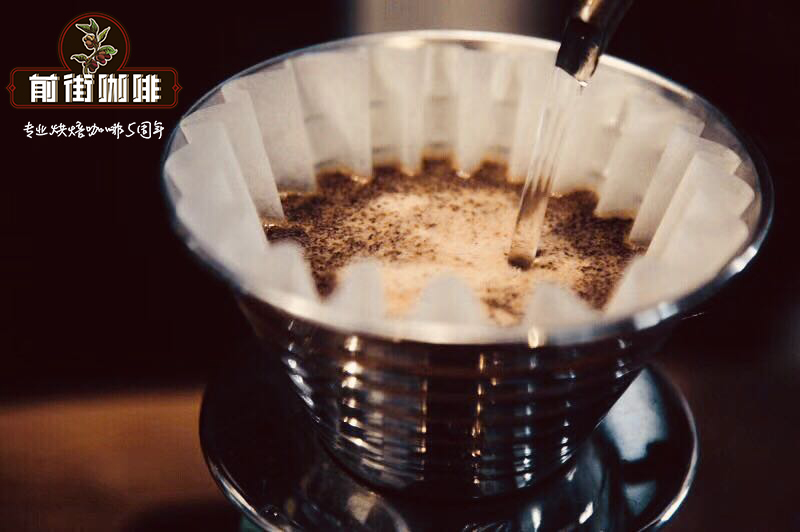
V60 dripper, 15g of coffee, water temperature 90°C, grind size 4, water-to-coffee ratio close to 1:15.
30g of water for the bloom, blooming for 30 seconds.
Segmented brewing: pour to 99ml, pause, then slowly pour to 230ml - that is, 31-99-100.
Other drip extraction recommendations:
French press: recommended grind size 3.5-4, water temperature 90°C
AeroPress: recommended grind size 2.5, water temperature 88°C
Pour-over: grind size 3.5, water temperature 89°C
Yunnan Coffee Bean Brand Recommendations
FrontStreet Coffee's Yunnan beans - the washed Typica Huaguoshan - are well guaranteed in both brand and quality, and offer excellent value: a half-pound (227g) package costs about 69 yuan. At 15g per cup, one package makes 15 cups, working out to less than 5 yuan a cup - far below what a cafe charges.
FrontStreet Coffee Recommendation
For a first taste of Yunnan coffee, start with FrontStreet's Yunnan arabica (small-bean) coffee from Baoshan. Washed-processed and medium roasted, it presents gentle nut and chocolate sweetness with a touch of plum acidity - a friendly, affordable introduction to the region's terroir. Baoshan's coffee history dates to the mid-1950s, and its dry-hot valley climate with large day-night temperature differences gives the beans their distinctive lingering sweetness.
If you want a clearer, more expressive Yunnan cup, choose FrontStreet's 2013 natural-process Yunnan Typica, grown on FrontStreet's own estate from fully ripe, all-red cherries. Natural processing gives a fuller body and more pronounced sweet-sour tension: dark berry and citrus tones, a hint of fermented winey aroma, caramel sweetness, and a black-tea aftertaste.
For espresso with Yunnan character, FrontStreet's Black Cocoa blend combines Yunnan arabica with Brazil Cerrado. The Brazil contributes mixed-nut aroma and balance, while the Yunnan component brings chocolate and citrus. The resulting Americano is balanced across sweet, sour, and bitter with nutty, brown-sugar sweetness, and the blend pulls a silky latte with almond and cream notes - very forgiving for beginners.
Important Notice :
FrontStreet Coffee is a long-established specialty coffee roaster in Guangzhou China, selling freshly roasted beans from its own farm in Yunnan as well as dozens of carefully selected single-origin beans from around the world for both pour-over and espresso. The products deliver consistently excellent quality and great value, with shipping within 24 hours. Guangzhou's FrontStreet Coffee shop is recommended by many coffee lovers, and the beans are now available online at the Tmall 。
FrontStreet Coffee has moved to a new address:
FrontStreet Coffee Address: 315,Donghua East Road,GuangZhou
Tel:020 38364473
 Scan and follow the En Gafei WeChat official account. Please indicate that the reprint comes from "En Gafei".