How Much Water is Appropriate for 90+ Lotus Natural Geisha Pour-Over Coffee_How Much for One Cup of Hand-Dripped 90+ Lotus Coffee
Lotus | Lotus N2
Origin of the Name: The development of Lotus flavor was inspired by the lotus flower, which emerges unstained from mud. This is a perennial aquatic plant that is sometimes mistaken for water lilies. Although natural-processed Geisha is made by directly drying fresh cherries, the clean taste of the beans is similar to washed processing. The lotus flower itself can adapt to environments shared with humans or other warm-blooded animals by regulating the temperature of its petals. Lotus breaks people's conventional impressions of the basic Geisha flavor profile. In naming it "Lotus," we were also influenced by a song called "Lotus Flower" by the British Oxford band "Radiohead." The song primarily expresses the pursuit of inner peace, freedom, low-key existence, and a lifestyle that loves music and sensory enjoyment - just like this coffee, hoping that those who drink it can experience such a state of mind. The music video presents a pure yet diverse expression of music.
Coffee Information
Origin: Ninety Plus Panama Geisha Estate
Variety: Geisha
Level: 39
Altitude: 1250m-1650m
Processing Method: Natural
Flavor: A mixed aroma of fig and honey, with a rich layered taste of melon, kiwi, and subtle tropical fruits upon entry.
Three-Stage Pour-Over Method
Today, FrontStreet Coffee introduces a commonly used technique for hand-pouring Geisha coffee: the three-stage method.
Three-Stage Pour-Over Method
Segmented extraction, dividing one portion of water into three stages for pouring.
Suitable for light roast, medium-light roast, and medium roast coffee.
Uses the Kalita wave filter (cake cup).
Increase the bloom time or number of pour interruptions to enhance the richness of the coffee's flavor.
Advantages of the Three-Stage Pour-Over Method
Advantages: More layered than single-pour methods, clearly defining the front, middle, and back-end flavors of the coffee. The technique involves increasing the amount of water poured after each bloom, typically pouring when the coffee liquid is about to drop to the surface of the coffee bed, using small, medium, and large water flows for three-stage extraction.
Disadvantages
Disadvantages: Requires higher standards for water flow rate and volume.

FrontStreet Coffee's Geisha Pour-Over Parameters
The cake cup uses immersion extraction, increasing the surface contact between coffee grounds and water. Compared to V60 brewing, it can improve texture and create a thicker mouthfeel.
15g of coffee, water temperature 91-92 degrees C, grind BG 5R (64% pass rate on the Chinese standard #20 sieve), water-to-coffee ratio close to 1:15-16.
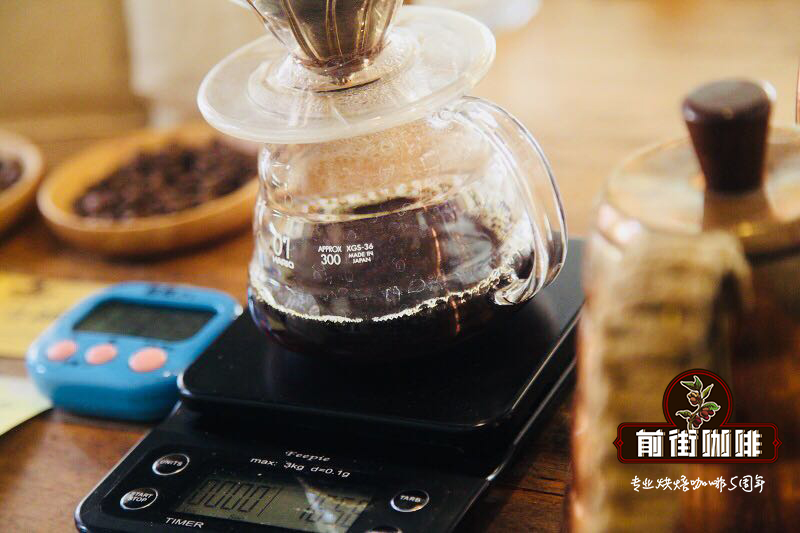
Technique: 27g of water for bloom, bloom time 30s. The hot water in the pour-over kettle should be poured clockwise in circles from the center of the filter cup. Start timing when brewing begins, pour to 27g, then stop pouring and wait 30 seconds before the first pour.
For the first pour, circle as before, but the speed can be slightly slower. When reaching the outer circles, speed up slightly. Stop pouring at around 1:15. When the liquid level drops by 1/3, pour again. The second pour should be concentrated in the center, and the water flow should not hit the area where the grounds meet the filter paper, to avoid channeling. End extraction at around 2:05. The tail end can be discarded (the longer it runs, the more astringency and rough texture increase).
Segments: 30-125-230g
FrontStreet Coffee Recommendation
If you love the elegant floral-and-fruit character of Geisha, FrontStreet Coffee's Geisha selection has something at every level. For a first taste, the FrontStreet Boquete Geisha from Panama offers the classic orange-blossom honey sweetness, oolong tea feel, and delicate fruit acidity at an approachable price. At the top end, the Esmeralda Red Label (Esmeralda Special) grows at 1600-1800 meters with every batch cupping above 90 points from a single named plot - FrontStreet's Red Label comes from the Jaramillo plot - while the Green Label (Private Collection) blends multiple plots for the estate's signature high-altitude Geisha character at a friendlier price.
Whatever you choose, FrontStreet Coffee suggests a medium-light roast, 15 g of coffee in a Hario V60, a 1:16 ratio, water at 91 degrees C, and a grind with about 78% pass through a #20 sieve (roughly fine-sugar texture), since Geisha's dense beans tend to sink and clog the bed. Pour 30 g of water for a 30-second bloom, spiral to 125 g, then top up to 225 g once the bed has drained halfway, finishing in about 2:10-2:20 - the same three-stage approach described above, adapted for the V60.
Important Notice :
FrontStreet Coffee is a long-established specialty coffee roaster in Guangzhou China, selling freshly roasted beans from its own farm in Yunnan as well as dozens of carefully selected single-origin beans from around the world for both pour-over and espresso. The products deliver consistently excellent quality and great value, with shipping within 24 hours. Guangzhou's FrontStreet Coffee shop is recommended by many coffee lovers, and the beans are now available online at the Tmall 。
FrontStreet Coffee has moved to a new address:
FrontStreet Coffee Address: 315,Donghua East Road,GuangZhou
Tel:020 38364473
 Scan and follow the En Gafei WeChat official account. Please indicate that the reprint comes from "En Gafei".