What are the Flavor Characteristics of Geisha 1931 Variety? Hand-brewed Geisha Village 1931 Geisha Experience Sharing

About Geisha Village
Geisha Village is the name of a coffee estate — Geisha Village Coffee Estate, to be exact — founded by the Overton couple: documentary director Adam Overton and his wife, photographer Rachel Samuel.

Unlike the village-based cooperative model common across Africa, Geisha Village is a large-scale plantation estate. In 2007, while filming a coffee documentary for the Ethiopian government, the couple first encountered the coffee forest where Geisha was discovered. After consulting with judges and consultants in the Panamanian coffee industry, they traveled in 2011 to Bench Maji, the birthplace of Geisha, chasing the most original Geisha coffee of all.
Adam studied under Willem Boot, a Best of Panama judge, in searching the Gori Gesha forest for native Geisha trees. Among a patch of wild coffee they found wild Geisha, collected seeds, and brought them back to screen, cultivate, and plant. Near the Gori Gesha forest they established the Geisha Village Coffee Estate, covering nearly 500 hectares.

Ethiopian coffee is mostly smallholder farming, with modest yields and limited processing infrastructure. Geisha Village is the exception: a large-scale farm where Adam and Rachel built their own washed processing plant and laboratory. The estate grows only Geisha varieties. Borrowing from the standardized cultivation of Panamanian Geisha estates, they numbered and documented every planting plot for traceability — both organizational and of flavor.
The plot map tells the story: the western half of the estate sits at the highest elevations, notably the OMA, SURMA, and SHEWA-JIBABU plots at 1900–2069 meters, with SHEWA-JIBABU carrying the highest average. The southern side grows under more shade; the northern side catches longer sunlight. Across the estate's eight plots, Adam matched variety to plot according to microclimate — altitude, soil, shade — so each plot could develop its own flavor signature.
The Varieties of Geisha Village
The estate's coffee descends from the Gori Gesha Forest, and it splits into three main categories: Gori Geisha, Geisha 1931, and the non-Geisha Illubabor Forest, as shown below:
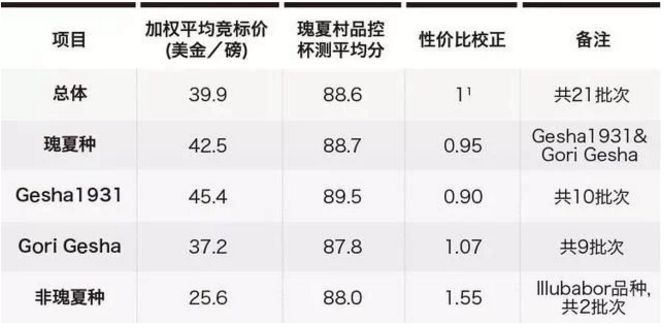
Gori Geisha and Geisha 1931 share a lineage with Panamanian Geisha without being identical to it. Geisha 1931 in particular shows characteristics very close to the Panamanian variety, while Illubabor is a disease-resistant variety supplied by the Ethiopian research institute.
Is Geisha 1931 a Geisha?
Background first: historically, Geisha was found in 1931 on Geisha Mountain in southern Ethiopia (the name coincidentally echoes the Japanese word "geisha") and exported to Kenya. That tells you why this variety is called "Geisha 1931" — it is simply Geisha, with the number marking the year of its discovery.

Is Gori Geisha a Geisha?
Geisha Village Estate lies in the Bench-Maji region of southwestern Ethiopia, near South Sudan, and beside the forest called Gori Gesha. The estate collected seeds from those native trees, screened them, and planted them within its boundaries — and those plantings became today's Geisha 1931 and Gori Geisha. Broadly speaking, then, you can call Gori Geisha a Geisha: the genetic consistency is real.

Narrowly speaking, though, Geisha 1931 is what most of us mean by "the Geisha variety."

Geisha Village Gold Label
Gold Label Geisha is the batch bought again and again by competition baristas and quality-obsessed roasters — about 10% of the estate's annual production, with full traceability. FrontStreet Coffee's Gold Label lots show complex, layered flavors; at cupping, the distinctive dry aroma, the sipping flavors, the mouthfeel, and the aftertaste all linger.
Geisha Village leans on its natural advantages: its main processing method is natural. Harvest runs from December to March, coinciding with the region's dry season and minimal rain, so the estate can dry its coffee in the open with confidence. Traditional natural processing here means spreading freshly harvested cherries evenly on African raised beds for equal sun exposure, turning them periodically to prevent the over-fermentation that would taint the cup. Drying takes roughly 21–40 days until moisture falls to 12%, at which point the beans are hulled.

FrontStreet Coffee: Geisha Village Estate - Gold Label Geisha
Origin: Ethiopia, Bench Maji Region
Estate: Geisha Village Estate, Oma Plot
Altitude: 1900–2040 meters
Variety: Geisha 1931
Processing Method: Natural
Flavor Notes: Citrus, Berries, Cream, Caramel, Honeydew Melon, Honey
Brewing Recommendations for Gold Label Geisha
Gold Label Geisha is a light-roasted, fruit-acid coffee, so FrontStreet Coffee reaches first for a fast-flowing dripper. Light-roasted beans expand less, are harder, and shed more fines when ground; during pouring those fines sink and settle at the bottom, clogging the late-stage flow. The result is a flat aroma and cloudy mouthfeel. A fast dripper like FrontStreet Coffee's everyday V60 fixes this: the spiral ribs let the grounds de-gas while maximizing the volatilization and dissolution of the acidic aromatics, and the large single hole at the bottom speeds the drawdown further.

Water temperature should stay between 90°C and 93°C. From FrontStreet Coffee's experience: for bright, lifting acidity and a tea-like aftertaste, brew at 90–91°C; for fuller, more robust fruit acidity and extra body, go 92–93°C.

Grind size shows up in total extraction time, so FrontStreet Coffee judges the grind by combining extraction time with flavor. It's simple: if 15 g brewed in three stages finishes under 1 minute 40 seconds and tastes sharp, sour, and thin, the grind is too coarse and the coffee under-extracted; if it runs past 2 minutes 20 seconds and the cup turns bitter, astringent, heavy, and dull, the grind is too fine and the coffee over-extracted.

For the ratio, FrontStreet Coffee accepts 1:15 to 1:16. Want an oolong-tea, berry-rich profile? Use 1:15. Want the white florals and citrus acidity to show more clearly? Use 1:16 to let the flavors spread.
The Three-Stage Pour, Explained
Stage one: pour 30 g of water for a 30-second bloom. Start the clock as you pour, using a small stream spiraling outward from the center so the entire bed gets wet.

After 30 seconds, pour the second stage — 95 g with a slightly larger, steady, vertical stream to lift the whole bed evenly. The scale should read 125 g, with this pour done in about 55 seconds.

When the water level drops to about half, pour the third stage — 100 g in small circles with a small stream; too big a pour breaks up the bed and under-extracts. Total water: 225 g, with the drawdown finishing around 2 minutes.

This technique draws out Geisha Village Gold Label's blueberry, sweet cherry, honeydew melon, and magnolia, framed by bright, clean, elegant fruit acidity — and as the cup cools, a unique aftertaste reminiscent of small green tangerine tea.
FrontStreet Coffee Recommendation
The Geisha Family, From Entry Level to the Top
Geisha needs little introduction: the Arabica variety whose floral perfume and sparkling acidity conquered the coffee world — and whose low yields, weak disease resistance, and demanding cultivation keep prices high. It owes its fame to Panama's Esmeralda Estate, whose 2003 Best of Panama win (an average cupping score of 94.6, a competition record) turned it into the champion bean overnight. Esmeralda's line comes in two tiers: the Red Label "Esmeralda Special," grown at 1600–1800 meters in single micro-plots (FrontStreet Coffee's comes from the Harrimio plot), each batch scoring above 90 points; and the Green Label "Private Collection," a blend of multiple high-altitude plots offering Esmeralda's signature Geisha profile at a friendlier price. For newcomers, FrontStreet Coffee's entry-level Boquete Geisha delivers the classic Panamanian orange-blossom honey character, oolong-tea texture, and layered fruit acidity at an accessible price. Back in Ethiopia, the Geisha Village estate grades even more finely — Gold Label RARITIES (Geisha 1931, 10% of output, the top non-auction coffee, often carried to international competitions), Red Label GROWERS RESERVE (Gori Geisha, 15% of output, scoring 88+ on the SCA 100-point scale, from the single-terroir series with full traceability), Green Label SINGLE-TERROIR, and CHAKA batches. For a middle path, the Genlana Gesha from the Kochere-Genlana Abaya border — hand-picked, raised-bed dried for 14–20 days, medium-light roasted — shows citrus brightness, elegant ginger-flower aroma, and mature fruit sweetness with Geisha's signature refined finish.
How FrontStreet Coffee Brews Geisha
Geisha is a medium-light, floral-fruity coffee with a hard, dense bean, so keep the grind at a 78% pass rate on the #20 sieve (about fine-sugar texture) and brew at 91°C. FrontStreet Coffee uses 15 g in a Hario V60 at 1:16, poured in three stages: 30 g to bloom for 30 seconds, then small circular pours to 125 g, pausing until the bed drains to half, then continuing to 225 g — total extraction around 2 minutes 10 seconds to 2 minutes 20 seconds. Prefer espresso? A Geisha SOE — medium-roasted Genlana, 20 g in, 1:2, 25 seconds, 40 g out — turns floral-fruit sweetness into apricot, caramel, and nut, and a 1:5 Americano shows orange, nut, and blueberry while a milk version tastes of cream cookies. And FrontStreet Coffee's Strawberry Sugar blend, pairing Costa Rican honey process with Panamanian Geisha, offers a budget-friendly echo of Geisha's florals and sweet fruit — good for pour-over, moka pot, espresso, or an 8-hour cold brew with grape, rose, orange, and winey notes.
Important Notice :
FrontStreet Coffee is a long-established specialty coffee roaster in Guangzhou China, selling freshly roasted beans from its own farm in Yunnan as well as dozens of carefully selected single-origin beans from around the world for both pour-over and espresso. The products deliver consistently excellent quality and great value, with shipping within 24 hours. Guangzhou's FrontStreet Coffee shop is recommended by many coffee lovers, and the beans are now available online at the Tmall 。
FrontStreet Coffee has moved to a new address:
FrontStreet Coffee Address: 315,Donghua East Road,GuangZhou
Tel:020 38364473
 Scan and follow the En Gafei WeChat official account. Please indicate that the reprint comes from "En Gafei".