The History Story of Costa Rican Dota Estate Coffee Goddess_How to Drink Costa Rican Goddess Geisha
Today FrontStreet Coffee would like to share a Geisha coffee from Costa Rica—but not the honey process everyone imagines. Although Costa Rica's honey process is very famous and of high quality, we always need to try new things. This Geisha comes from La Diosa Estate, which grows the La Diosa variety—what a perfect match.
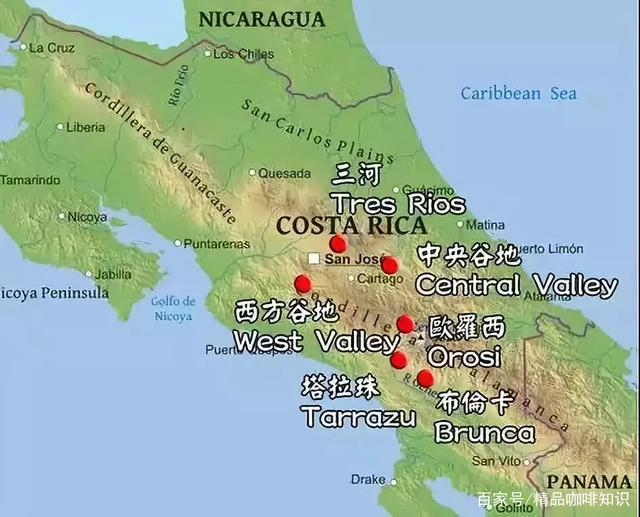
Region Introduction
Costa Rica's coffee-growing areas are volcanic terrain with fertile volcanic ash, moderate and suitable temperatures, and stable, abundant rainfall—all factors that make coffee one of Costa Rica's main agricultural products. The coffee beans produced in the high-altitude areas of Costa Rica are world-renowned, being rich, mild in flavor, but extremely acidic. The coffee beans here are carefully processed, which is why they achieve such high quality.
Costa Rica's coffee harvest season can be divided into two periods throughout the year. The dry season runs from December to April each year, coinciding with the coffee harvest, while the wet (rainy) season occurs from May to November. In recent years, micro-mills have been established one after another. Since they require only 5% of the water consumption of traditional washed processing plants and do not need large water tanks and drying fields, the investment required is much smaller. "Honey-processed coffee," with low acidity, increased complexity, and a rich, sweet aroma, has thus become a competitive target in the coffee industry in recent years.
Costa Rica's valued coffee-growing areas lie south of the capital, San José, in the Tarrazú region. Among Costa Rica's many excellent producing regions, one famous region stands out—Tarrazú. Tarrazú is extremely prestigious in the specialty coffee world and is one of the world's main coffee-producing regions.
Tarrazú is located in the fertile volcanic region of Central America, with a humid climate and fertile volcanic rock soil. The area receives abundant rainfall throughout the year, has high altitude, and features dense natural forest shade, providing a uniquely advantageous growing environment for coffee. No pesticides or artificial fertilizers are used during cultivation. Nearly 95% of the coffee beans produced in the high mountains of Tarrazú belong to the Strictly Hard Bean (SHB) category, generally grown at altitudes above 1,500 meters.
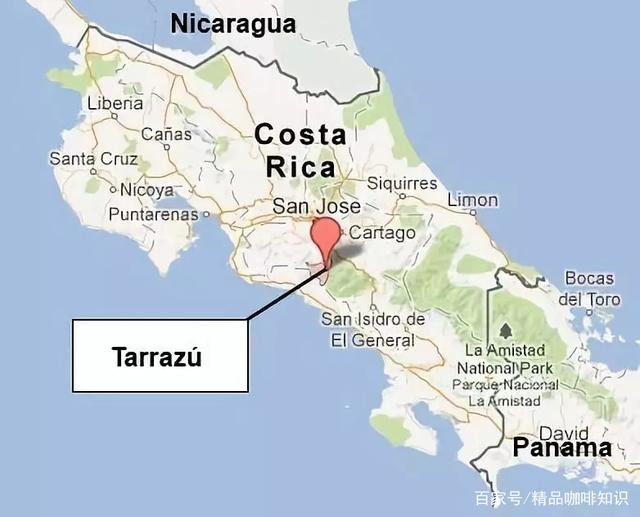
La Diosa Estate
La Diosa Estate is located in the Dota region within Costa Rica's most renowned Tarrazú area, known for producing micro-batch Geisha varieties. As early as 1865, the Dota region enjoyed a reputation for good Costa Rican coffee. Because the highway construction extending from the capital to the Dota mountain valley had to pass through the Tarrazú region, the Costa Rican Coffee Institute later habitually marked it as Dota Tarrazú when identifying producing regions. This area is typical plateau terrain, where both soil and temperature/humidity are superior choices for coffee cultivation conditions.
La Diosa Estate was established in the 1960s. The estate owner is very good friends with Pachi Serracin, now famous as the father of Panamanian Geisha. Pachi Serracin brought back the Geisha variety from CATIE, Costa Rica's world's largest industrial scientific research station for coffee species and varieties. La Diosa Estate grows coffee using organic methods, utilizing local native trees and fruit trees as shade for the coffee.
The fertilizer used is also made from coffee cherry pulp mixed with molasses, combined with fertile soil from nearby mountain areas with high mineral content and fermented with microorganisms to create organic fertilizer that enhances coffee disease resistance. They also habitually use California earthworms to cultivate the soil and directly serve as the main nutrient source for coffee trees during fertilization periods. They cultivate multiple coffee varieties mixed together, all purchasing and selecting fully ripe red-purple berries, and widely control the soaking fermentation process to develop a very unique constant-temperature processing method. The neither-too-much nor too-little fermentation degree achieves an excellent balance between coffee clarity and complexity, allowing its flavor characteristics to show greater stability.
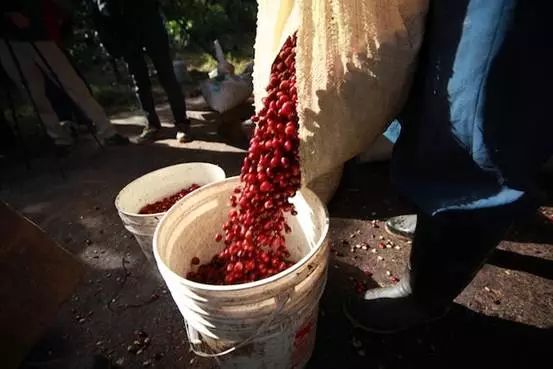
Geisha Variety
Geisha is pronounced the same as the Japanese word for geisha, hence it is also known as Geisha coffee. Because the tree variety is taller than typical coffee trees, it was originally planted in a small area within the estate and used as a windbreak.
The Geisha variety was discovered in the Geisha forest of Ethiopia in 1931 and then sent to the Coffee Research Institute in Kenya. In 1936, it was introduced to Uganda and Tanzania. In 1953, Costa Rica introduced it. For a long time, not many people paid attention to Geisha, until one day when Don Pachi initially brought it from the small town of GESHA in southwestern Ethiopia to Costa Rica. Afterwards, Geisha entered Panama along the southern route. Panama's Hacienda La Esmeralda separated it from other varieties and won the National Coffee Competition championship in one fell swoop.
Processing Method: Anaerobic Enzyme Washed
The anaerobic enzyme washed method refers to the process of removing the skin and pulp of fully red fresh fruits through mechanical washing equipment, then adding enzymes to the fermentation tank to increase the coffee's flavor and sweetness.
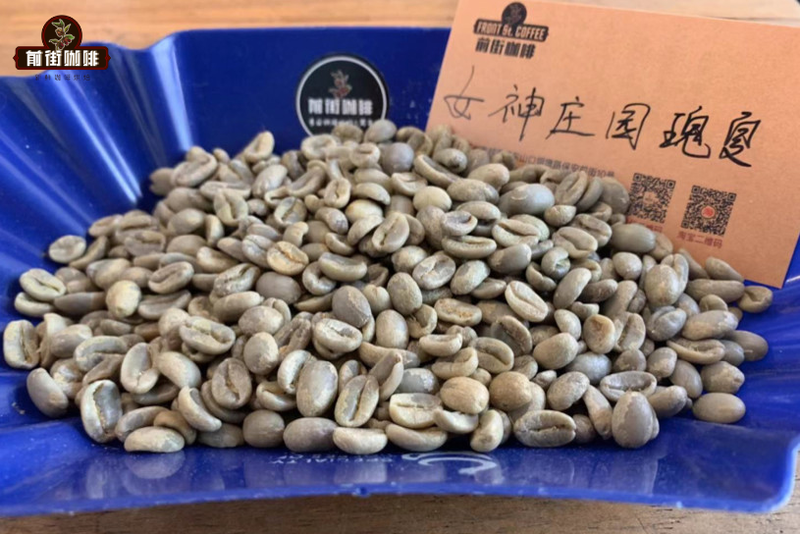
Green Bean Analysis
The green beans appear relatively elongated and light green in color. Unlike the usual grassy smell of green beans, La Diosa Geisha smells not only of grass but also carries more of the fresh fragrance of bergamot and berries.
Roasting Analysis
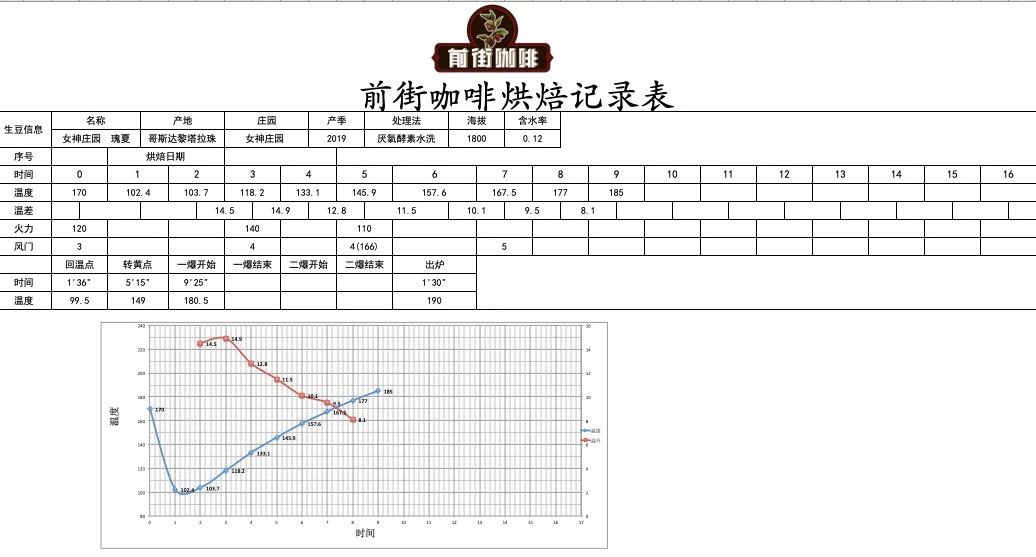
Considering that Costa Rican beans are generally hard with medium moisture content, FrontStreet Coffee's roaster chose high-temperature roasting to dehydrate quickly, using a faster roasting rhythm to express the fruit flavors and floral aromas of this La Diosa Geisha.
Roasting machine: Yangjia 800N (300 g batch size)
Charge temperature: 170°C, heat: 120, damper: 3. Turning point at 1'36"; when temperature reached 140°C, opened damper to 4, heat unchanged. When temperature reached 149°C, the bean surface turned yellow, the grassy smell completely disappeared, entering the dehydration stage. When temperature reached 166°C, adjusted heat to 110, damper unchanged.
At 7'09", ugly wrinkles and black spots appeared on the bean surface, and the toast smell clearly turned to coffee aroma, which can be defined as the prelude to first crack. At this time, one must listen carefully for the sound of first crack. At 8'25", first crack began; adjusted damper to 5 (adjusting heat requires great care, not so small as to have no cracking sound). After first crack, developed for 1'30", dropped at 190°C.
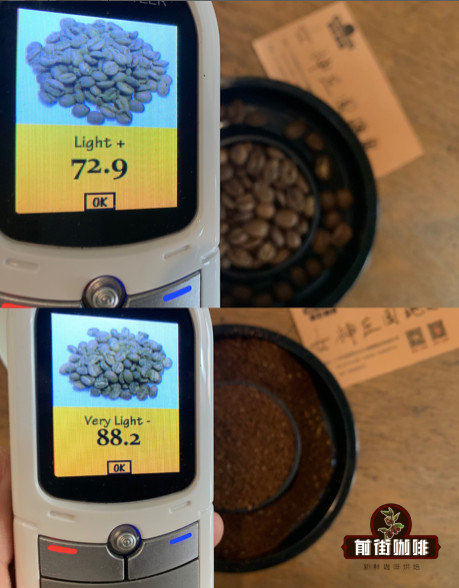
Agtron bean color value: 72.9 (above image), Agtron grounds value: 88.2 (below image), Roast Delta value: 15.3.
Cupping Report
Flavor: Rose, lemon, honey, maple syrup, fruit tea.
Brewing
Costa Rica Dota El Diosa Geisha
Costa Rica Dota La Diosa Estate Geisha
Origin: Costa Rica
Region: Tarrazu
Estate: Dota El Diosa
Variety: Geisha
Altitude: 1800m
Processing Method: Anaerobic Enzyme Washed

Recommended brewing method: Pour-over
Dripper: Hario V60
Water temperature: 90-92°C
Dose: 15g
Ratio: 1:15/1:16
Grind size: Medium-fine (BG 7T: 58% pass-through rate on China standard #20 sieve)
Brewing technique: Segment extraction
Bloom with 30 g of water for 30 seconds. Using a small water stream, pour in a circular motion to 124 g, then segment. When the water level drops and is about to expose the coffee bed, continue pouring to 227 g and stop. When the water level drops and is about to expose the coffee bed again, remove the dripper (timing starts from the beginning of the bloom). Extraction time is 2'01".
Flavor: Overall, the floral aroma is quite prominent, with strong lemon fruit-tea notes. The entry has citrus and cream, with a relatively refreshing, sweet taste on the palate.
FrontStreet Coffee Recommendation
For a Geisha with a strong floral core and bright lemon fruit-tea character, FrontStreet Coffee's Ethiopian single-origin Geisha is a natural place to look. FrontStreet Grana Gesha comes from a rare single-variety estate in Ethiopia—the Grana Gesha farm in Yirgacheffe, from the Grana processing station at the border of Kochere and Grana Abaya, established in 2014 and run by Mr. Israel Degefa, with coffee planted across as much as 700 hectares, most of it uncultivated but fertile and well shaded by trees.
Fully ripe cherries are hand-picked and sun-dried on raised beds for 14-20 days depending on the weather, and the beans are roasted medium-light. The cup shows the bright acidity of citrus, an elegant ginger-flower aroma, the full sweetness of ripe fruit, a fine, silky texture, and the refined finish that marks the variety. Those wanting to go further into estate-level Ethiopian Geisha can choose FrontStreet Geisha Village Gold Label, the Geisha 1931 variety at about 10% of the village's production, or FrontStreet Geisha Village Red Label, the Gori Gesha variety at about 15%.
Because Geisha is a medium-light, hard, floral-and-fruit variety that tends to sink and clog the dripper, FrontStreet grinds to about 78% pass-through on a China standard #20 sieve (roughly fine sugar) and brews at about 91 degrees Celsius, using 15 g at a 1:16 ratio in a small Hario V60 with a three-stage pour for a total of about 2'10" to 2'20".
Important Notice :
FrontStreet Coffee is a long-established specialty coffee roaster in Guangzhou China, selling freshly roasted beans from its own farm in Yunnan as well as dozens of carefully selected single-origin beans from around the world for both pour-over and espresso. The products deliver consistently excellent quality and great value, with shipping within 24 hours. Guangzhou's FrontStreet Coffee shop is recommended by many coffee lovers, and the beans are now available online at the Tmall 。
FrontStreet Coffee has moved to a new address:
FrontStreet Coffee Address: 315,Donghua East Road,GuangZhou
Tel:020 38364473
 Scan and follow the En Gafei WeChat official account. Please indicate that the reprint comes from "En Gafei".