Indonesian Coffee Beans | Sulawesi Island | Toraja
Sulawesi Island | Toraja
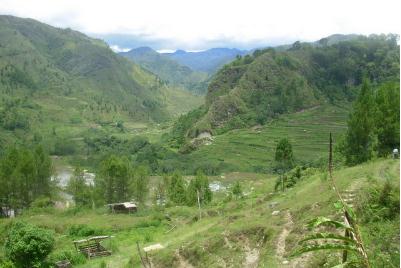
Sulawesi is another of Indonesia's famous premium-coffee islands, with unique natural conditions and a long history of coffee cultivation. Toraja coffee in particular — with its uniquely smooth taste — has been gradually discovered and loved around the world in recent years.
Yet because Toraja production is limited, it has been treated as a specialty bean since the Dutch colonial era.
Compared with Sumatra, Toraja farmers hold a strong concept of quality and pick only fully ripe cherries — which also stretches the harvest season.
In Sulawesi, Toraja coffee is processed by the Giling Basah method, and the island's rich iron ore deposits and iron-heavy soil shape a Toraja flavor found nowhere else.
PS. (Giling: grind; Basah: wet)
In recent years, some traders have begun importing Toraja coffee, and it has gradually won recognition in the market.
But knowledge of Toraja mostly stops at the words "Toraja Kalosi Celebes," which has left many shops selling Toraja green beans confused about pricing and quality.
Did you buy Toraja, Kalosi, Toraja Kalosi, or Celebes?
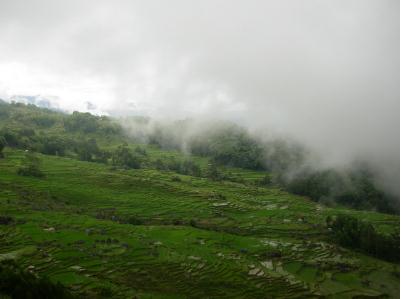
Here is the simple explanation: people commonly say "Toraja Kalosi" because after farmers harvest the coffee, they sell it to local middlemen, who send it to processing plants in the area known as Kalosi — so the two names became linked. In reality, Kalosi is chiefly a distribution center for green coffee beans, not a famous growing area.
Which means it is nearly impossible to tell which high-altitude mountain area your Toraja beans actually came from.
In the Toraja region, apart from the 50-hectare plantation partnership between the Forestry Bureau and Toarco Jaya Company that began in 2009, most producers are small farmers who grow their own coffee and sell it to middlemen — no large-estate model has developed.
In recent years Toraja's fame has grown sharply while production stays scarce, so some green bean buyers now travel straight into the Toraja mountains to purchase directly. Slowly, Toraja is building a name of its own.
One young buyer from Taiwan, after months of data collection and testing deep in the Toraja mountains, finally decided to start buying beans from the Sapan mountain area of central Sulawesi.
The coffee forest in Sapan sits at 1,300-1,500 meters — just the right elevation for high-quality Indonesian Arabica — with an average annual temperature of roughly 22-28 degrees Celsius.
The soil there is superb: a humus layer more than 30 centimeters thick, black soil throughout. With such nutrients the coffee grows to a large size — and the flavor is excellent.
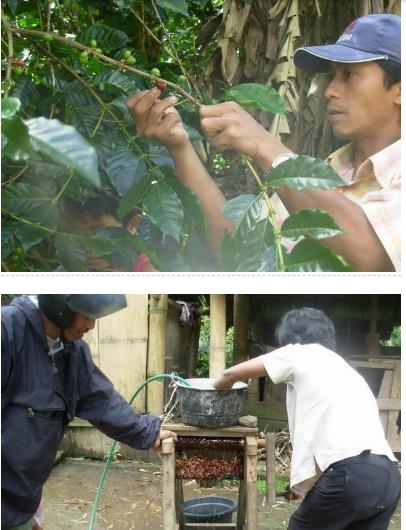
And unlike the Toraja sold by other traders, this buyer controls the whole process: working with farmers on a semi-contract basis that requires the harvest of absolutely ripe cherries.
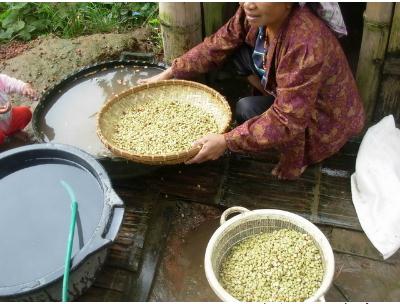
General coffee processing in the Toraja mountains is quite primitive: after the pulp is removed, the beans are washed to strip the remaining pulp while unripe or diseased beans are scooped out, then simply sun-dried for 2 to 3 days.
But sunshine is scarce in the mountains, so most beans are merely air-dried before being bagged to wait for middlemen. As a result, most Toraja beans (still in husk) on the market are extremely moist, and the beans frequently mold.
To avoid that, this lot is bagged immediately after husking and sent straight to the dehulling factory in Rantepao for two to three days of sun-drying before the parchment is removed, then sent to Makassar for further sun-drying (Makassar's drying temperatures are very high) and hand-picking for grading.
Coffee Information
Origin: Sulawesi - Sapan Mountain Area
Characteristic: The surface color does not easily darken during roasting
Variety: Non-Jember variety
Harvest Period: July 2010
Toraja Cultural Knowledge Sharing
The local ethnic group of Toraja is unlike its neighbors: these are the unique Toraja people. Their cultural distinctiveness shows in the following ways:
1. Architecture
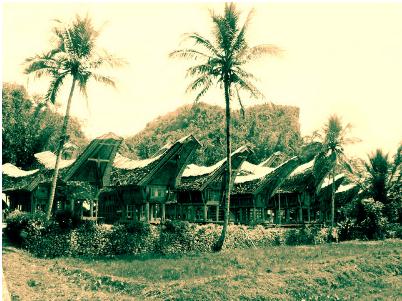
The unique Tongkonan houses reflect the belief that their ancestors descended from the sky and arrived by boat. To commemorate them — or perhaps to someday return to the ancestors' dwelling place — the houses are built with boat-shaped roofs.
2. Funeral Customs
The Toraja do not bury their dead.
a. People of status: (not simply anyone with money) are considered able to approach heaven, so holes are carved into rock walls to hold hanging coffins. After a person of status dies, locals carve wooden effigies of their likeness and place them outside the coffin as memorials.
b. Ordinary people: are laid to rest in cemeteries built in their own fields — shaped like ordinary houses but without windows.
c. Children: If a child dies before reaching one year of age, tradition says the child is tied to a sacred tree, to return to heaven along it.
d. Those who cannot afford burial: are kept in the family's living room until money for the funeral can be raised.
e. Funeral ceremonies: These cost more than weddings. Cattle must be slaughtered, because cattle are regarded locally as protective deities who must be asked to escort the deceased back to heaven.
f. Cattle: Most Toraja cattle are water buffalo, with very few yellow cattle. Cattle are not raised for meat here but as sacrificial animals.
A general water buffalo costs about 25 (approximately over 80,000 New Taiwan Dollars); those with white spots on their heads start at 70 (approximately over 200,000 New Taiwan Dollars); and those with completely white heads start at 200 (approximately over 600,000 New Taiwan Dollars).
Believe me, you did not misread those numbers.
This is also why an ordinary family often waits three to five years after a death before it can afford the funeral ceremony.
g. Funeral record: In 2005, when the county magistrate's mother-in-law passed away, the magistrate booked the local stadium and ran continuous funeral banquets for seven days — reportedly slaughtering 500 pigs and 500 cattle, at a total expense exceeding 5 billion Indonesian Rupiah (do the math yourself; divide by the exchange rate of 300).
At the time, however, the KPK (Corruption Eradication Commission) had no jurisdiction over Sulawesi, so he got away with it completely.
3. Harvest-Festival Celebrations
Every December, after the last rice harvest, the region holds harvest-festival celebrations to thank heaven for the year's care. There is bullfighting at the festival — but with "water buffalo"...
FrontStreet Coffee Recommendation
If Toraja's smooth, layered character appeals to you, FrontStreet Coffee's Mandheling lineup from Sumatra offers the classic Indonesian companion pieces. The Lin Dong Mandheling comes from the traditional Lintong growing area around Lake Toba, where the wet-hulled (Giling Basah) process and local microbial fermentation create the iconic profile: dense aroma, thick body, and intense flavor — clove and woody spice notes, low acidity, herbal and minty accents, and a strong, lasting sweetness after medium-dark roasting. The PWN Golden Mandheling from Aceh's Gayo mountains is the top expression of the style: PWN company sorts each lot above the required screen size, keeps defects under 3 beans per 300-gram G1 sample, and finishes with three rounds of hand selection for a cleaner, sweeter cup — mainly exported to the Japanese and American markets, with the PWN-marked bags and certificates as proof of authenticity.
Brewing suggestion from FrontStreet Coffee: water at 87-88°C, 15 grams of coffee ground to a coarse-sugar texture, a 1:15 coffee-to-water ratio, three-stage pouring — 30ml bloom to degas, 100ml to lift the bed, then a gentle 95ml center pour for caramel sweetness, dark chocolate, and nuts over that unmistakable thick Indonesian body.
Important Notice :
FrontStreet Coffee is a long-established specialty coffee roaster in Guangzhou China, selling freshly roasted beans from its own farm in Yunnan as well as dozens of carefully selected single-origin beans from around the world for both pour-over and espresso. The products deliver consistently excellent quality and great value, with shipping within 24 hours. Guangzhou's FrontStreet Coffee shop is recommended by many coffee lovers, and the beans are now available online at the Tmall 。
FrontStreet Coffee has moved to a new address:
FrontStreet Coffee Address: 315,Donghua East Road,GuangZhou
Tel:020 38364473
 Scan and follow the En Gafei WeChat official account. Please indicate that the reprint comes from "En Gafei".