The Story of Kenya Thamani Little Tomato Coffee_How to Enjoy Kenya Thamani Maiden Coffee Beans?

Kenya Coffee: A Passion FrontStreet Coffee Can't Forget
Kenyan coffee holds an irreplaceable place in FrontStreet Coffee's heart. One of Africa's premier specialty origins, Kenya is known above all for an exceptionally bright, uplifting acidity. Anyone who has tried it has been won over by that blackberry-like acidity and a rich, layered, wine-like mouthfeel, capped by a refreshing blackcurrant finish. Kenya's acidity polarises drinkers — some are addicted to its plum-wine tang, others dismiss it as simply too sour — but that does nothing to change FrontStreet Coffee's willingness to recommend it, because this country's coffee story is too remarkable to ignore.
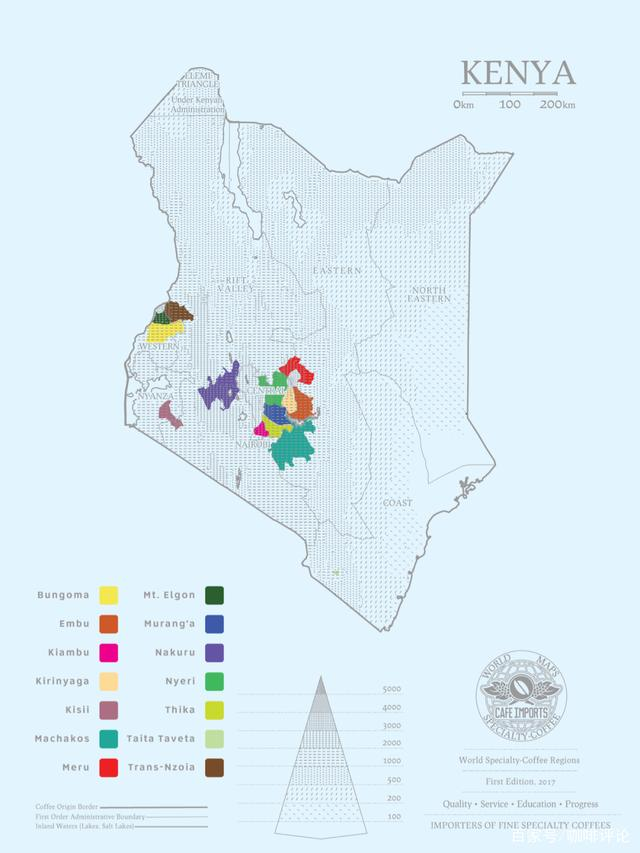
The Cherished Nyeri Region
Nyeri has long been a favourite producing area for FrontStreet Coffee. The Ndima-ini factory belongs to the Gakuyu Farmers Cooperative Society (FCS). Ndima-ini AA (Kenya), from Tandem Coffee in Portland, Maine, is a textbook example of Kenya's fruit-forward profile.
Gikanda Ndimaini Farm: Cooperative Excellence
Kenya's Gikanda Ndimaini farm is worked by a number of smallholders who, together with Kangocho and Gichathaini, make up the Gikanda Cooperative. Set in the Nyeri region at an average altitude of roughly 1,700–1,900 meters, the coffee is processed at the dedicated Kangocho plant. The smallholders grow the traditional, unimproved SL28 and SL34 varieties, hand-picking fully ripe cherries and wet-processing them the same day. Before shipment the coffee is wrapped in parchment and rubbed to remove the silver skin.
The Ndima-ini factory belongs to the Gakuyu Cooperative, which broke away from the larger Mathera Cooperative in 1996 to become independent. Gakuyu has just two factories, Ndima-ini and Kirigu, and employs 1,800 people. The Kirigu factory takes its name from the nearby Kirigu River, which supplies the water used to process the cherries. Over the past 20 years, some 850 smallholding owners have delivered ripe cherries to the Ndima-ini factory, where they are processed under factory manager John Kamau.
Varieties (SL28, SL34)
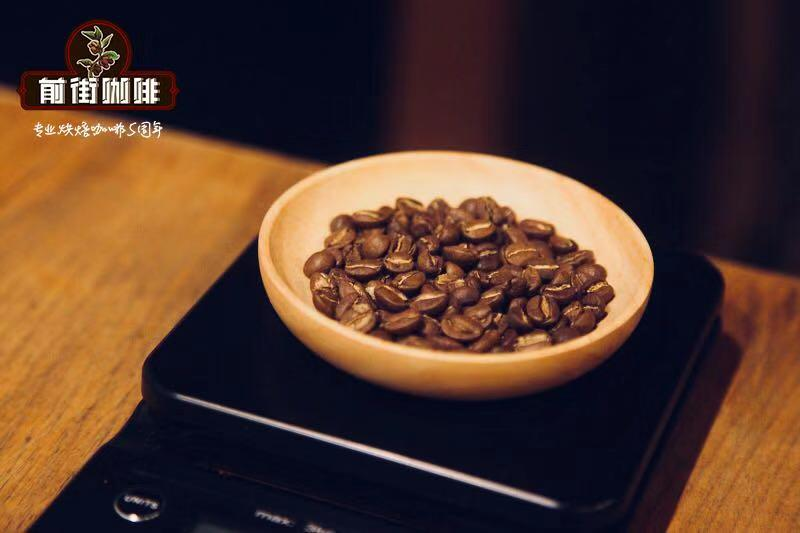
As early as the 1930s, the Kenyan government asked the newly founded Scott Labs to select suitable varieties for the country. Forty-two initial varieties were numbered and screened one by one, and in the end SL-28 and SL-34 were chosen. The former descends from Bourbon and the latter from Typica — they are not from the same series.
SL28 was originally bred to mass-produce beans that were both high in quality and resistant to pests and disease. In some regions the goal was mainly yield and disease resistance, with no thought given to cup quality. Thanks to its Bourbon genetics, SL28's yields fell short of expectations, but its copper-coloured leaves and broad, bean-shaped seeds deliver wonderful sweetness, balance and complexity, along with pronounced citrus and plum character.
SL34 is similar in flavour to SL28. Besides its complex, varied acidity and lovely sweet finish, its mouthfeel is smoother and cleaner than SL28's. SL34 carries Typica lineage; its beans look much like SL28's, and it adapts better to rainforest conditions.
In time the first of the two earned high praise, usually showing blackcurrant-like acidity and a complex flavour display, while the second, though slightly the lesser, still delivered impressive fruit. Between them the two varieties now account for 90% of Kenya's production and are widely treated as the defining varieties of Kenyan coffee. South America is also actively introducing SL28 as a cultivated variety.
FrontStreet Coffee Cupping
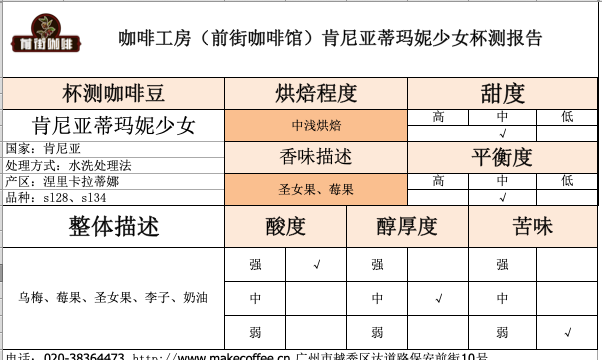
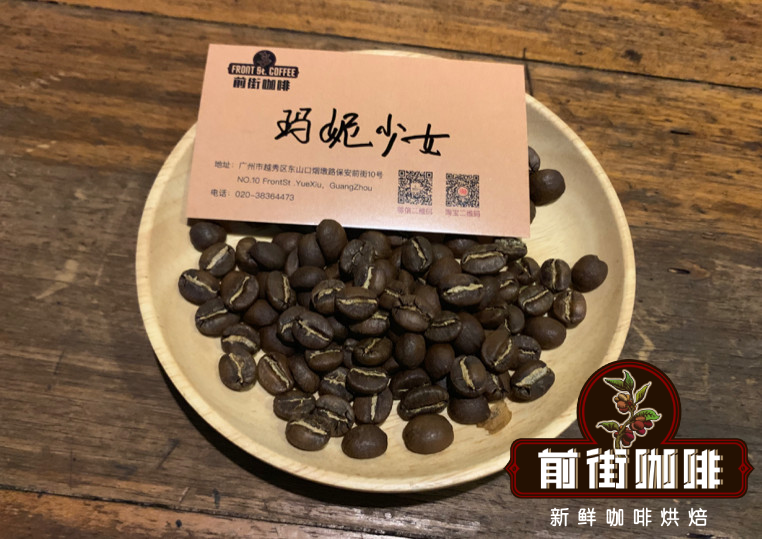
Kenya Thimaini Girl AB
Region/Processing Station: Ndima-Ini/Nyeri
Grade: AB Top Microbatch Karatina
Variety: SL28 & SL34
Processing Method: 80-hour washed fermentation
Flavor: Blackberry, Red Currant, Honey

FrontStreet Coffee Brewing Parameters
Dripper: Hario V60
Water Temperature: 90°C
Coffee Amount: 15 grams
Coffee-to-Water Ratio: 1:15/1:16
Grind Size: Medium-fine grind (BG 7T: 58% pass-through rate with China standard #20 sieve)
Brewing Method
Segmented extraction: bloom with 30g of water for 30 seconds. Infuse in a slow circular pour until the scale reaches 124g, then pause. When the water level drops and the coffee bed is about to be exposed, continue pouring to 227g and stop. When the level drops and the bed is about to show again, remove the dripper (timing starts from the bloom). Total extraction time 2'00".
Flavor Profile
The first sip brings berries, nuts, plums and cream, with woody notes and a light tomato character in the finish.
END
FrontStreet Coffee Recommendation
If the bright, juicy side of Kenya is what appeals to you, FrontStreet's Kenya Little Tomato is a natural next step: a specialty washed Kenyan built around vivid cherry-tomato and dark-plum acidity with a full, juicy body. It comes from the Thika region, grown at 1,550–1,750 meters from the classic local SL28 and SL34 varieties, with plump, rounded beans. Processing follows Kenya's signature 72-hour double washed fermentation, which draws out the fruit while keeping the cup clean and pure, and FrontStreet roasts it light to preserve as much of the lively acidity and layered fruit as possible.
The dry aroma alone is dense with dried cherry tomato and florals. In the cup you get clear cherry tomato and dark plum, an acidity that is bright and firm, as full as freshly squeezed juice, a sweet mid-palate threaded with the fresh fruit of snow pear and black plum, and a clean, lingering finish of brown-sugar sweetness and a faint green-tea note — balanced throughout and highly distinctive.
Important Notice :
FrontStreet Coffee is a long-established specialty coffee roaster in Guangzhou China, selling freshly roasted beans from its own farm in Yunnan as well as dozens of carefully selected single-origin beans from around the world for both pour-over and espresso. The products deliver consistently excellent quality and great value, with shipping within 24 hours. Guangzhou's FrontStreet Coffee shop is recommended by many coffee lovers, and the beans are now available online at the Tmall 。
FrontStreet Coffee has moved to a new address:
FrontStreet Coffee Address: 315,Donghua East Road,GuangZhou
Tel:020 38364473
 Scan and follow the En Gafei WeChat official account. Please indicate that the reprint comes from "En Gafei".