Are You Drinking Blue Mountain Coffee or Blue Mountain Flavored Coffee? Does Blue Mountain Flavored Coffee Taste Good?

Have You Ever Had Blue Mountain Coffee?
Think carefully before you answer.
Start with the price you paid. Did a kilogram of green beans cost more than 600 yuan?
If not, you can be fairly certain that what you drank was fake Blue Mountain.
How "Blue Mountain" Is Everywhere
The term "Blue Mountain" has become so commonplace that searching for coffee beans on any online shopping platform turns up countless "Blue Mountain" products.
There is a significant catch, though.
Look carefully at the names. They are almost never simply "Blue Mountain Coffee" but rather "Blue Mountain Flavored Coffee" or "Blue Mountain Blend."
At least legitimate coffee brands do this. Some questionable brands go further and label their products outright as Blue Mountain.
These major brands choose such names precisely because the coffee is not Blue Mountain in the strict sense at all.
What True Blue Mountain Really Is
So-called Blue Mountain is a mountain in Jamaica. It has excellent climate conditions and is an outstanding coffee origin, which is why genuine Blue Mountain coffee counts as a specialty coffee.
Not all coffee from Blue Mountain, however, may be called Blue Mountain coffee. Only coffee from a specific altitude range is certified, and annual production is so limited that most people never encounter it.
Traditionally, only coffee grown between 910 meters and 1,700 meters could be called Jamaica Blue Mountain. Coffee grown between 460 and 910 meters is called Jamaica High Mountain, and coffee grown below 460 meters is called Jamaica Supreme, or Jamaica Low Mountain. (All land in Jamaica above 1,700 meters is forest preserve, so no coffee is grown there.)
Because of this, many baristas consider "Blue Mountain coffee" one of "the three most uncultured topics in the coffee world" — the other two being Kopi Luwak and "why is this coffee sour?"
The Reality Behind the Price
By professional evaluation, Blue Mountain coffee does taste quite good. But its high price is not entirely about flavor: a major reason for its exorbitant cost is that its trade has long been monopolized by Japanese traders. A significant portion of the price, in other words, has nothing to do with quality at all.
The reason so many "Blue Mountain flavored coffees" try to associate themselves with the name is not that the coffee is so incredibly delicious. It is simply that everyone knows the name and perceives it as prestigious, so businesses naturally cater to that fantasy.
FrontStreet Coffee Recommendation
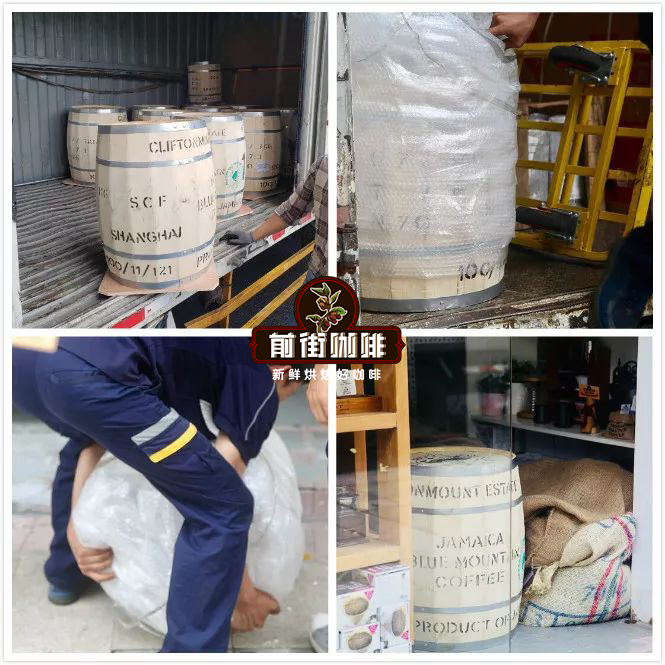
To drink the real thing rather than a flavored imitation, the FrontStreet Jamaica Blue Mountain No.1 is one of the highest grades in Jamaica Blue Mountain, with strict standards for bean size, defect rate, and overall quality. It comes from the long-established Clifton Mount Estate, where coffee has been grown and processed since around the mid-18th century (roughly 1750). The growing and processing area sits at an average of 4,300 feet (1,310.64 meters), where the altitude, the gentle afternoon cloud cover, ample sunlight, and mineral-rich soil give the trees ideal conditions and lengthen cherry maturation. Traditional Blue Mountain uses wooden barrels of 15, 45, and 70 kilograms — each barrel itself a marker of the genuine article — and buyers who can provide full certification and origin documentation are generally the ones to trust.
FrontStreet roasts all its Blue Mountain coffee fresh within 5 days, so the beans arrive still full of flavor and can be brewed immediately. The roast is a traditional medium-dark, highlighting a full body and the classic bitter-then-sweet arc. To brew it, a Kono dripper is recommended for extra body, with 15g per serving and the beans rested 4–7 days (counting the roast date as day one). Grind a little coarser than a light roast — roughly the texture of white sugar — and brew at 87–88°C. Many burnt, bitter results come from water that is too hot, though water that is too cool makes the coffee flat and dull.
For the ratio, 1:15 is recommended. Some methods suggest 1:13 or a smaller ratio for a richer cup, partly to avoid bitterness in the tail, but that also affects the aftertaste. With the water temperature and grind dialed in, 1:15 shows the overall balance of FrontStreet Jamaica Blue Mountain best. Pour in three stages: 30g for a 30-second bloom, then a vertical, slow, small-flow circular pour to 120g and stop; then pour to 225g with slightly faster flow and circling to reduce clogging and over-extraction. The flavor is very clean and complex, very gentle, with chocolate sweetness and a strong, rich body — the sweet, sour, and bitter notes perfectly matched, with almost no bitterness, only a moderate and perfectly judged acidity, and a persistent fruit note in the finish.
Important Notice :
FrontStreet Coffee is a long-established specialty coffee roaster in Guangzhou China, selling freshly roasted beans from its own farm in Yunnan as well as dozens of carefully selected single-origin beans from around the world for both pour-over and espresso. The products deliver consistently excellent quality and great value, with shipping within 24 hours. Guangzhou's FrontStreet Coffee shop is recommended by many coffee lovers, and the beans are now available online at the Tmall 。
FrontStreet Coffee has moved to a new address:
FrontStreet Coffee Address: 315,Donghua East Road,GuangZhou
Tel:020 38364473
 Scan and follow the En Gafei WeChat official account. Please indicate that the reprint comes from "En Gafei".