Challenges and Opportunities for Yunnan Coffee_Yunnan Coffee Brand Recommendations_Where to Buy Yunnan Coffee
Challenges Facing Yunnan Coffee Production
Monoculture Issues
Large-scale disease outbreaks struck Yunnan's early Typica and Bourbon plantings, and both Nestlé and Yunnan Agricultural Reclamation responded by promoting the high-yield, disease-resistant Catimor (GATIMOR) P series instead. Today more than 90% of Yunnan's production area is Catimor. Whatever the flavour differences between Catimor and Typica or Bourbon, a region with ambitions to scale up is now finding that its lack of variety diversity has become an obstacle to the industry's development.
The Dangers of Pursuing Yield Alone
Most production areas have neglected careful selection and nursery work while investing heavily downstream. They have also prioritised yield over flavour, applying large amounts of fertiliser to push output. Surface-level yield per mu looks high by world standards (an average of 120-150 kg per mu), but flavour quality has suffered. The consequence is premature ageing: trees that would normally need pruning and rejuvenation at 15 years are declining as early as 7-8 years, and some age prematurely at just 4-5 years. It shows up as sharp drops in flavour quality and yield, lost disease resistance, and gradual withering and death. On top of that, inadequate harvesting and primary processing leave the coffee poor in both external and internal quality.
After long years of farming that emphasised yield over quality, Yunnan coffee has drawn considerable criticism in the wider market. At the same time, Yunnan's coffee enterprises are generally small and have limited capacity to deal directly with markets and purchasers. More than 80% of the coffee produced is bought by a handful of foreign traders who enter the market early at prices below the contemporaneous New York futures — even though a significant share of it could qualify as premium commercial coffee. It is a textbook case of value and price falling out of step. What circulates in the domestic market is essentially what is left after sorting for export.
Rising Production Costs
Meanwhile, high production costs driven by rising prices for production and living materials have left farmers and enterprises running at a loss whenever market prices are low. Harvest labour alone has reached 2 yuan per kilogram, and since each kilogram of coffee requires 6 kilograms of fresh fruit, the harvesting cost works out to 12 yuan per kilogram of coffee. Add pre-planting investment, management costs, post-processing and transaction fees, and a purchase price of 16 yuan already means a loss.
Controlling Costs and Improving Quality for Sustainable Benefits
The problems and difficulties go well beyond these, of course. But as long as the direction is clear — control costs (not simply cut them), farm and process scientifically, and improve product quality — there is a path forward. It has to be understood that raising production efficiency and farmer income cannot rest on high yields or cost-cutting alone. In practice, costs should be controlled through purposeful investment and scientific savings, with the ultimate goal of better product quality and, through that quality, better economic returns. Yunnan's share of global production is not large, so it cannot build its reputation on volume. It has to produce consistently good coffee and let relatively high quality do the work of improving both reputation and returns, giving the Yunnan coffee industry a better future.
The Undeniable Impact of Altitude on Quality
Yunnan's production areas made an initial error in siting: they chose only elevations of 1100 meters and below, to avoid frost damage, and overlooked the possibility of dodging frost through microclimates at higher elevations. We all know that sites above 1300 meters more readily produce excellent coffee. The result in Yunnan is telling: the high-scoring beans in competitions generally come from newly developed areas at higher elevations (high scores also depend on other factors, of course, such as tree age and processing methods). Siting therefore has to be cautious and scientific, weighing not only altitude but the surrounding environment, vegetation and soil. Objectively, differences in latitude, soil quality and topography make Yunnan's production areas hard to compare with several world-renowned Arabica regions, so producing excellent coffee here takes more effort than in some other places.
Addressing the Transformation of Existing Coffee Plantations
The most critical task for Yunnan's production areas is the transformation of the existing large-scale plantations. Making the current millions of mu of coffee more productive is the industry's most urgent job. Coffee plantations need to incorporate multiple species to form ecosystems, which prevents pests and disease, avoids frost damage and improves flavour quality. Scientific fertilisation should be promoted alongside green-manure cultivation, with shade trees above and green cover below. Yield alone cannot be the goal. Under scientific cultivation yields will certainly be somewhat lower than before, but with less harvesting labour and better quality, the economic benefits will be higher than before. Every step — harvesting, depulping and processing, drying, hulling and sorting — must be handled meticulously. Only then can Yunnan coffee become universally recognised, consistently high-quality coffee and deliver high, stable returns with a bright future.
Cautious Introduction of New Varieties
In recent years many enterprises have recognised the monoculture problem and want to bring in other varieties. Variety introduction, though, has to be cautious and scientific: the variety's lineage must be traceable, and new planting sites must be chosen scientifically. Catimor, for example, comes in different series, and it is not without merits — it is simply not yet well enough understood.
Recognizing Difficulties and Problems as Development Potential
The problems and difficulties facing Yunnan coffee are in fact its development potential. Climate change in particular is gradually shrinking the area and output of the traditional global Arabica production regions, which makes Yunnan's inland production area increasingly important.
Yunnan Coffee Brand Recommendations
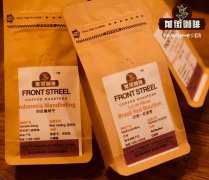
FrontStreet Coffee's roasted small-bean Typica Yunnan coffee, [Yunnan Huaguoshan Coffee], is fully guaranteed in both brand and quality, and, more importantly, offers outstanding value: a half-pound (227g) package is priced at around 60 yuan. At 15g per cup, one package makes 15 cups — only about 4 yuan a cup. Against café prices that often reach tens of yuan a cup, it is a conscientious recommendation.
FrontStreet Coffee is a Guangzhou-based roastery with a small shop but a wide range of bean varieties, offering both famous and lesser-known lots, along with online store services.
FrontStreet Coffee Recommendation
Yunnan coffee is often called "small bean," and small bean is simply another name for Arabica — it earned the nickname because it bears the smallest fruit of the three original coffee species. The story starts in 1904, when the French missionary Father Tian Deneng brought Typica seeds from Vietnam into Yunnan and planted the first coffee tree in Zhugula village, in Binchuan county; the region's geography and climate then proved so well suited to it that small-bean coffee thrived. Yunnan's plantings are concentrated in the southwest — Baoshan, Dehong, Pu'er and Lincang — and FrontStreet's two Yunnan coffees come from Baoshan and Lincang. Baoshan's coffee history dates to the mid-1950s, when the overseas Chinese businessman Liang Jinshan introduced it; the frost-free climate is ideal, and the dry-hot valley around Lujiangba, with little variation in annual temperature but a wide day-night swing and moderate-to-low rainfall, gives Baoshan's small bean its distinctive sweet finish.
For an introduction to Chinese Arabica, FrontStreet's Yunnan small bean is the obvious starting point: washed and medium-roasted, it keeps some caramel sweetness alongside a little acidity, so the terroir comes through clearly. If you want a more defined cup, the 2013 Yunnan natural Typica, grown on FrontStreet's own estate, uses the oldest and most traditional post-harvest method — natural drying — and, being one of the purest Arabica varieties, shows darker berry and citrus notes, a touch of fermented wine, caramel sweetness and a creamy finish. To taste Yunnan in espresso, FrontStreet's Black Cocoa blend pairs Yunnan small bean with Brazil Cerrado: Brazil supplies the mixed-nut aroma and balance, Yunnan supplies chocolate and citrus, and the result is an americano with balanced sweet-sour-bitter and notes of nuts and brown sugar, or a latte with the smoothness of almond and cream — an easy introduction for beginners.
Important Notice :
FrontStreet Coffee is a long-established specialty coffee roaster in Guangzhou China, selling freshly roasted beans from its own farm in Yunnan as well as dozens of carefully selected single-origin beans from around the world for both pour-over and espresso. The products deliver consistently excellent quality and great value, with shipping within 24 hours. Guangzhou's FrontStreet Coffee shop is recommended by many coffee lovers, and the beans are now available online at the Tmall 。
FrontStreet Coffee has moved to a new address:
FrontStreet Coffee Address: 315,Donghua East Road,GuangZhou
Tel:020 38364473
 Scan and follow the En Gafei WeChat official account. Please indicate that the reprint comes from "En Gafei".