What is Brazil Santos Coffee? What are the Characteristics of Brazilian Coffee? How to Drink Brazilian Coffee?
Brazil is the world's largest coffee producer, accounting for approximately 33% of global coffee production — roughly one-third of the world's supply. Because Brazil lies in the tropical rainforest region, with relatively flat terrain and few high-altitude mountain forests, most coffee is grown in low-altitude areas with non-volcanic soil. There also isn't much tree shade, which causes Brazilian beans to grow too quickly: the result is large but loosely formed beans with consistent flavor profiles. Large-scale mechanical harvesting of fruit at varying maturity levels means Brazilian beans don't have particularly outstanding qualities and are typically used for commercial or bulk coffee.
Brazil is the world's largest coffee-producing and exporting country, and Brazil Santos is the representative among Brazilian coffees. "Santos" comes from the name of the port used for shipping coffee. The highest-quality coffee grown in the valley areas surrounding São Paulo state is concentrated at Santos port, which represents premium Brazilian coffee.
With a delicate aroma and a comfortable, mild flavor, Santos suits those new to coffee. Its taste is neutral and refreshing, without irritating acidity. It is sweet and smooth, with a slight bitter-sweetness — the best choice for anyone who fears acidic flavors. You can taste a faint sweetness without adding sugar, along with hints of creamy aroma. It enters the mouth smoothly, neither bitter nor acidic, extremely gentle and easy to drink.
Brazil Santos has no particularly outstanding advantages, but also no obvious flaws — it adheres to the golden mean. This coffee has a mild, smooth taste, low acidity, moderate body and a subtle sweetness. These flavors blend together, and distinguishing them one by one is the best test for your taste buds, which is also why so many Santos enthusiasts love it.
Among Brazilian coffees, Santos is the most valued and famous. It's like a friend who appears understated on the outside and calm in expression, but is full of passion and wisdom within. It may not give you an overwhelming feeling, but it subtly accompanies you when you need it.
Soft yet intense aroma, chocolate flavor, prominent vanilla sweetness, balanced acidity with rich body, followed by an endless aftertaste. Those who love Brazil Santos treat it like a reserved yet profound friend. While it may not offer intense enthusiasm, it stays quietly by your side when you need it most. Brazil Santos leaves a long-lasting impression.
Brazilian coffee is graded by defect percentage, divided into NY2-NY8. NY1 (NO1) represents zero defects, but such beans don't exist. NY2 (NO2) is the highest grade of Brazilian coffee beans.
Appearance of Green Beans
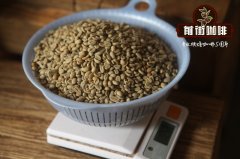
Beans range from medium to large size, but without green coloration.
Brewing Methods
Brazilian beans are often used as the base of coffee blends because they pair well with beans from almost all origins. It's no exaggeration to say that Brazilian beans can be found in nearly all coffee blends. This is likely because Brazil's production is the world's largest and its quality stays stable.
When highly acidic beans are mixed with Brazilian beans, the latter's bitterness moderates the former's distinct characteristics. Mixing highly acidic beans like Mocha, Guatemala or Kilimanjaro with Brazilian beans, for example, lets the Brazilian bitterness balance the acidity and make the cup smoother to drink.
If you want to add a small design to Blue Mountain coffee — which balances acidity and bitterness — in order to emphasize its bitterness, you must also mix in Brazilian beans.
Production Regions
Brazil's coffee production accounts for about 33% of the world's total output — roughly one-third — with main production areas in the southeastern region, most of it exported through Santos Port, hence the name "Santos Coffee."
By state, production regions include São Paulo, Minas Gerais, Paraná, Espírito Santo, Santa Catarina, Mato Grosso, Bahia, Goiás and others.
FrontStreet Coffee's Recommended Brewing Parameters for Brazil Coffee:
V60/88°C/1:14 ratio/Brewing time: 1 minute 50 seconds
FrontStreet Coffee Recommendation
Santos is the classic low-acid, easy-drinking Brazilian cup, and FrontStreet offers two excellent Brazilian singles to compare against it. FrontStreet Brazil Cerrado Red Bourbon is a classic pulped natural from the well-known Cerrado region, roasted medium, showing creamy peanut, toast, caramel and hazelnut with a rounded body, almost no acidity and a light bitterness. FrontStreet Brazil Queen's Estate Yellow Bourbon, grown in Mogiana on fertile red volcanic soil, is a rarer Yellow Bourbon with a cleaner fruit character and a sugarcane-like sweetness alongside fruit and chocolate. Both are versatile: pour-over, moka pot, espresso SOE, siphon or French press all work.
Important Notice :
FrontStreet Coffee is a long-established specialty coffee roaster in Guangzhou China, selling freshly roasted beans from its own farm in Yunnan as well as dozens of carefully selected single-origin beans from around the world for both pour-over and espresso. The products deliver consistently excellent quality and great value, with shipping within 24 hours. Guangzhou's FrontStreet Coffee shop is recommended by many coffee lovers, and the beans are now available online at the Tmall 。
FrontStreet Coffee has moved to a new address:
FrontStreet Coffee Address: 315,Donghua East Road,GuangZhou
Tel:020 38364473
 Scan and follow the En Gafei WeChat official account. Please indicate that the reprint comes from "En Gafei".