PWN Golden Mandheling vs. Indonesian Sumatra Mandheling Coffee Beans: Differences in Pour-Over Flavor and Taste

As one of the world's major coffee-producing countries, Indonesia grows coffee with a rich, singular charm that no other origin can replicate. And among Indonesian coffees, Mandheling is the most famous - yet many drinkers struggle to tell the various types apart. Today, FrontStreet Coffee will guide you through the world of Mandheling!
The Origin of Mandheling
Mandheling was originally the name of an indigenous tribe in Indonesia. How it became synonymous with a coffee bean is the stuff of legend. As the story goes, after Japanese soldiers returned home from Indonesia following the colonial era, they couldn't forget the delicious local coffee. Through trading connections, they asked locals to help source high-quality beans. The Japanese adored what they received, but thanks to a pronunciation slip, the local term "Mandaining" came out as "Mandheling" - and the mispronunciation stuck as the bean's name.

Mandheling coffee is also known as "Sumatra coffee." Most coffee from North Sumatra is Gayo, primarily of the Ateng variety. Coffee from Lake Tawar in the north can be called Aceh coffee or Tawar Lake coffee, while coffee from the Lintong and Lake Toba areas further south can be called Mandheling. True Mandheling is produced in the mountainous terrain surrounding Lake Toba, a high-altitude freshwater lake north of Medan, the capital of Sumatra, at an average elevation of about 900 meters. What is commonly sold as Mandheling consists of Typica or its varietal descendants grown around the lake.
Lintong Mandheling
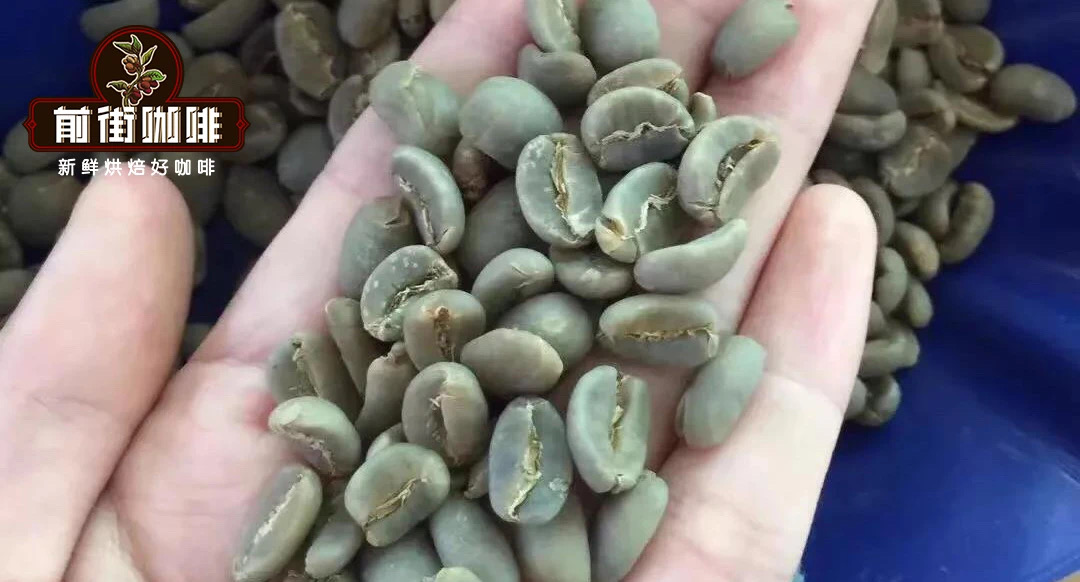
Lintong Mandheling comes from the Lintong highlands of north-central Sumatra, near Lake Toba, and represents the standard-bearer of the Mandheling style. It, too, is processed with the traditional wet-hulled method, which creates its signature low acidity and high body. But wet-hulling has a cost: semi-hard, semi-soft moist beans can be pressed and injured when the mucilage and parchment are stripped away. The beans split open like goat hooves - the famous "goat hoof beans." These are not defects, but a distinctive hallmark of Mandheling.
Tiger Mandheling
In Aceh, coffee is the second-largest export crop. Local estimates put the number of smallholder coffee farmers at around 60,000, each farming roughly 1-2 hectares. Indonesia's traditional coffee trade runs through a multi-layered supply chain - from farmer through multiple intermediaries before accumulating into large export shipments - so direct trade from farmers straight to a single export window remains quite rare within the Indonesian system.
Tiger Mandheling has firm requirements: the coffee must show traditional Chinese medicinal herb aromas, and only Mandheling at screen size 17 or above with a defect rate below 4% may be called "Tiger."

Aged Mandheling
Aged Mandheling is made by extending the storage time of the green beans to allow natural aging - typically 2-3 years. Acidity falls, color shifts, and the beans take on a thicker texture. The storage environment must be cool and well ventilated. Because of the dim storage conditions and the long rest, aged coffee often carries complex, musty-adjacent flavors commonly described as burlap sack or leather. This special treatment gives Aged Mandheling a mellower, deeper flavor - as intoxicating as a fine Pu-erh tea.

Golden Mandheling
Ever since discovering Mandheling, the Japanese have kept a passionate interest in this bean, and through cooperation with local green suppliers they established rigorous screening standards. After processing, the green beans pass through density and color sorting, followed by repeated manual hand-sorting, resulting in a Mandheling of uniform color and consistent bean shape. Legend has it that when the sorted beans are laid out, they glint gold in the sunlight - hence the name Golden Mandheling.
Golden Mandheling specifications require screen size 18 or above, with fewer than 3 defective beans in a 300g green sample - the highest G1 grade. The color leans dark green, with flat, uniform beans. After such strict screening, Golden Mandheling eliminates the earthy impurity notes typical of ordinary Mandheling, tasting cleaner and brighter, with more intense sweetness and aroma.

Curiously, it was not a Japanese company that registered Golden Mandheling as a trademark, but the local Indonesian firm PWN (Pwani Coffee Company), which had partnered early with Japanese companies to export Mandheling. The Japanese side registered "Gold Top Mandheling," known as Ding Shang Golden Mandheling. In terms of flavor, there is little real difference between the two; branding and marketing account for most of the divergence. Which Golden Mandheling is "better" remains a matter of personal taste.
Hard hit by the pandemic, shipping capacity from Indonesia to China was extremely tight in 2020, and the new-crop PWN Golden Mandheling, originally due in October, was delayed by a full month.

The difference between Golden and regular Mandheling is that Golden shows a more intense aftertaste and a sugarcane aroma. Although everyone knows only PWN's Mandheling may truly be called Golden Mandheling, PWN's annual output is limited, so a significant portion of the large-bean "Golden Mandheling" on the market does not actually come from PWN. If you're unsure, ask the seller for the PWN green bean burlap bags or the certificates that accompany the beans to confirm it's genuine PWN Golden Mandheling.

FrontStreet Coffee Indonesia PWN Golden Mandheling
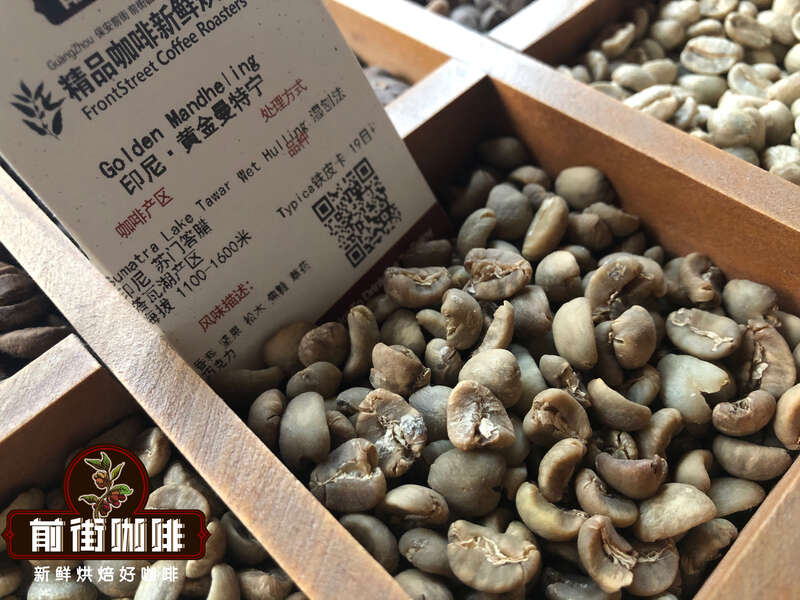
Region: Gayo Mountains, Aceh, Sumatra
Altitude: 1100-1600 meters
Variety: Ateng
Grade: G1, 3-time manual selection
Processing: Wet-hulled
The Processing Method
Most Mandheling is processed with Sumatra's signature method: wet-hulling. The region's frequent rain and constant typhoons make proper sun-drying nearly impossible, and the local economy historically couldn't support the costlier washed method - so the distinctly local wet-hulled process evolved instead. Although Indonesia's coffee industry has long since outgrown that poverty, and many estates today could wash their coffee, FrontStreet Coffee believes wet-hulling is the very key that carried Mandheling onto the world stage. Say "Mandheling" and people think of wet-hulling; the two are inseparable.
Wet-hulling falls into two stages:
First stage: A wooden depulper removes skin and pulp, followed by 3 hours of fermentation, then drying until the beans reach a semi-dry, semi-wet moisture of 30-50%.
Second stage: The mucilage and parchment are mechanically stripped away, and final drying continues for 2-4 days, bringing moisture down to 12-13%.
FrontStreet Coffee Roasting Analysis
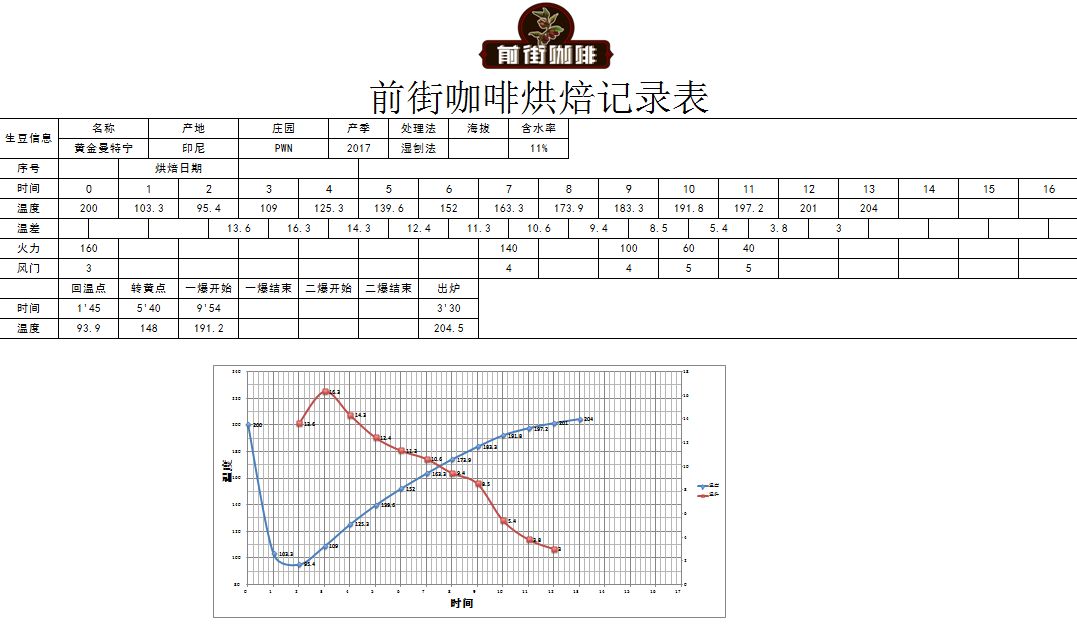
FrontStreet Coffee's roasters use a medium-dark roast to bring out the rich, sweet, and clean character of Golden Mandheling.

Charge the roaster at 200°C with the damper at 3. After 1 minute, reduce heat to 160°C, damper unchanged. At 5'40", when the bean temperature reads 148°C, the bean surface turns yellow, the grassy aroma vanishes completely, and dehydration is complete. Drop the heat to 140°C and open the damper to 4.
At 9'40", wrinkles and the first dark specks appear on the bean surface, and the toasted-bread aroma clearly shifts toward coffee - the prelude to first crack. Listen carefully from here. At 9'54", first crack begins. Cut the heat to 60°C and open the damper fully (adjust gently - don't reduce the heat so far that the cracks stall), and drop the batch at 204.5°C.
FrontStreet Coffee Brewing Suggestions
This recipe highlights Golden Mandheling's richness, cleanliness, and aroma. Use a KONO dripper (invented to imitate flannel filtering and produce a thick, heavy cup). For a medium-dark roast, choose a medium-coarse grind size, a 1:15 coffee-to-water ratio, 15g of coffee, and 88°C water. Friendly reminder: tightening the coffee-to-water ratio will intensify the flavor.
Brewing process: Pour gently and keep the coffee bed as level as possible. Avoid shaking the dripper (shaking compacts the grounds and hinders degassing during the bloom). For the first stage, pour 40g of water in small circles at the center for a 30-second bloom - the coffee layer will swell into a "hamburger" shape.

For the second stage, pour 120g of water in circles from the center outward, keeping the pour height as close to the coffee bed as possible and moving slowly to avoid over-agitating. For the final stage, pour the remaining 100g of water, then wait until all the coffee has drained into the server. Total extraction time: 2 minutes.

Mandheling Coffee Flavor Characteristics
Lintong Mandheling: Herbal, chocolate, caramel; overall well balanced
Tiger Mandheling: Nuts, cream, dark chocolate, caramel, traditional Chinese medicinal herbs; obvious sweetness, relatively clean and clear flavors
Aged Mandheling: Ripe Pu-erh tea, caramel, herbal, chocolate; lower acidity
Golden Mandheling: Nuts, spices, herbs, licorice, chocolate, caramel; clean and mellow flavors
FrontStreet Coffee Recommendation
If the wild, earthy-herbal magic of wet-hulling is what draws you in, FrontStreet Coffee's Lintong Mandheling is the classic expression of it. Sourced from the traditional Lintong district around Lake Toba and roasted medium-dark, it is fragrant and intense - clove and woody aromatics, low acidity, spice and mint notes, and a powerful, long-lasting fullness of sweet bitterness that lingers long after the last sip.
Important Notice :
FrontStreet Coffee is a long-established specialty coffee roaster in Guangzhou China, selling freshly roasted beans from its own farm in Yunnan as well as dozens of carefully selected single-origin beans from around the world for both pour-over and espresso. The products deliver consistently excellent quality and great value, with shipping within 24 hours. Guangzhou's FrontStreet Coffee shop is recommended by many coffee lovers, and the beans are now available online at the Tmall 。
FrontStreet Coffee has moved to a new address:
FrontStreet Coffee Address: 315,Donghua East Road,GuangZhou
Tel:020 38364473
 Scan and follow the En Gafei WeChat official account. Please indicate that the reprint comes from "En Gafei".