Coffee Grind Sizes: The Difference Between Coarse, Medium, Medium-Fine, Fine, and Very Fine Grinds for Pour-Over Coffee
Introduction
Brewing coffee is, at heart, an extraction process: water acts as a solvent that pulls flavor compounds out of the grounds. The variables in a recipe are the most obvious levers on how efficiently that happens. They come down to four — coffee-to-water ratio, grind size, water temperature, and extraction time.

The coffee-to-water ratio is the proportion of grounds to water. A higher ratio (more water) tastes weaker; a lower ratio tastes richer. Pour-over is usually brewed somewhere between 1:14 and 1:18. FrontStreet Coffee's standard is 1:15 — 15 grams of grounds to 225 grams of water.
Water temperature and extraction time are easier to picture. Hotter water pulls out more compounds; cooler water extracts less efficiently. FrontStreet Coffee brews lightly roasted beans at 90°C and darker roasts at 88°C. Extraction time runs from the moment the grounds first meet water until the dripper is lifted off. The longer the contact, the more is extracted; shorter contact gives a thinner cup. FrontStreet Coffee's extraction time is roughly 2 minutes.

Grind size is simply how coarse the grounds are, set by the grinder. Coarser grounds taste weaker; finer grounds taste stronger.
How Does Grind Size Affect Flavor?
Grind size is often described as the coarseness of the grounds, or the size of the particles. With coarser grounds the particles are larger, so water needs more time to work into them and dissolve the coffee compounds. With finer grounds the particles are smaller, so water penetrates and extracts from them more quickly.

Within the same brew time, finer grounds therefore give up more compounds and a stronger cup, while coarser grounds release only a limited amount and often taste thin.
What Are the Common Grind Sizes?
Commercial grinders generally fall into three ranges: those built for espresso, those suited to most methods but not espresso, and those that cover every brewing method.
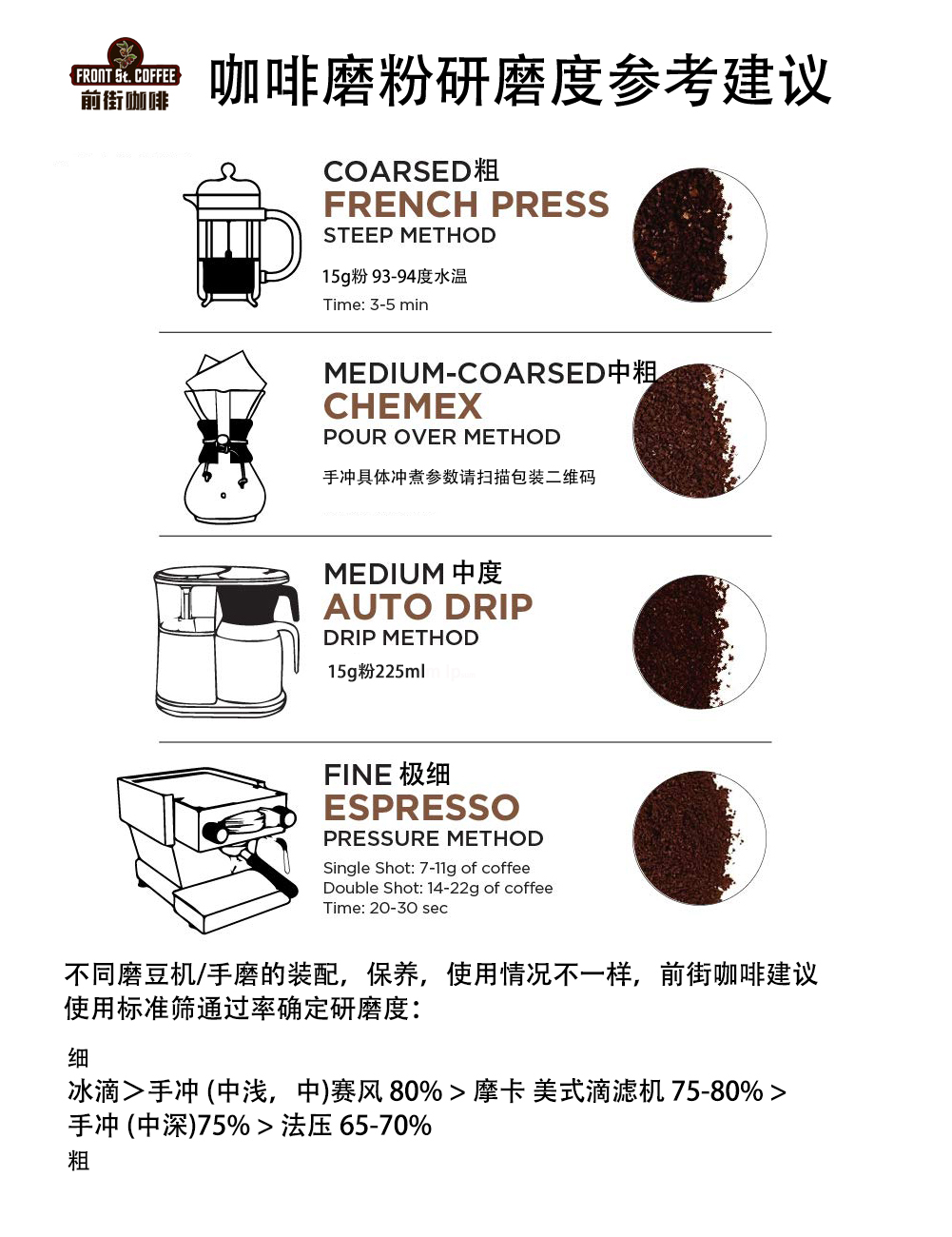
Matching the recommended grind to each brewing method gives us the familiar ladder. The finest grind is used for Turkish coffee, then espresso, then the medium-coarse grind for pour-over and drip, then slightly coarser for siphon, and finally the coarsest for French press.

Espresso's grind is relatively fine, and that comes straight from how it is made and why. Espresso extracts very quickly, usually in 20 to 30 seconds. It also serves as the base for most Italian-style drinks, so it has to carry enough dissolved coffee to stand up to added water or milk. The grind is therefore much finer than for other methods.

Pour-over sits in the middle. It averages around 2 minutes, though anything from 1 to 3 minutes is workable; most single-serving recipes land near 2 minutes. Because it does not need the extreme fineness of espresso to avoid over-extraction, its grind falls into the medium-coarse band.

French press extraction takes 4 minutes or more — longer than pour-over — so it uses the coarsest grind, which keeps the long steep from tipping into over-extraction.
What Grind Size Should Be Used for Pour-Over Coffee?
Pour-over grind sits in the medium band, but every grinder expresses its settings differently. So how does FrontStreet Coffee communicate a grind size to customers using different grinders — and when a new bean arrives, how do we find the right setting for that particular bean?

To solve both problems, FrontStreet Coffee uses a standard 0.85mm sieve. Its mesh opening is 0.85mm, so any particle smaller than that passes through. We weigh out 10 grams of beans, grind them, and place the grounds in the upper layer. After repeated shaking, the particles under 0.85mm fall through to the lower layer. We then weigh those sifted grounds; that weight against the original 10 grams gives the pass-through rate for the setting.

FrontStreet Coffee recommends a pour-over grind slightly finer than medium, with a sieve pass-through rate of about 80% — meaning 10 grams of beans yield roughly 8 grams of sifted grounds.
One reminder: this is our recommended baseline, not an absolute rule. Once you understand how the variables interact, all kinds of parameter combinations open up. But if you are still a beginner, or you have not yet dialed in a particular bean, an 80% pass-through grind is an invaluable starting point.
FrontStreet Coffee Recommendation
The grinder that taught most people what a pour-over is still the V60. Hario, the company behind it, was founded in Tokyo in 1921 and began as a maker of heat-resistant glass for research labs; it redesigned the early V60 prototype in 2004, naming it for its distinctive 60° cone, and brought it to market a year later. That cone forces water to travel to the center before it drips through, lengthening contact with the grounds, while the single large hole lets the brewer's pour control the flow — and therefore the flavor.
Because the V60 rewards a fast extraction, it flatters bright, floral, fruit-forward coffees. FrontStreet Coffee's light-roast Ethiopian offerings are a natural match: the FrontStreet Yirgacheffe Gutingding for citrus, berries and a green-tea finish, and the FrontStreet Huakui for its tropical strawberry, passion fruit and lychee aromatics. The FrontStreet Panama Esmeralda Red Label Geisha brings jasmine, bergamot and black tea, and the FrontStreet Kenya Small Tomato — grown at 1,550-1,750 meters from SL28 and SL34, given a 72-hour double wash and a light roast — shows cherry tomato, smoked plum and a juicy, sugar-cane sweetness.
For those who prefer deeper, rounder cups, the same dripper handles them too: the FrontStreet PWN Indonesia Gold Mandheling and the FrontStreet Brazil Queen's Manor deliver herbs, dark chocolate and caramel, the FrontStreet Jamaica Blue Mountain No.1 balances cream, caramel and nuts, the FrontStreet 2013 Yunnan Natural Typica brings citrus and caramel with a nutty, cocoa edge, and the FrontStreet Papua New Guinea Bird of Paradise — a Typica grown from 1,600 to 1,800 meters and graded AA after three washes — offers a clean, sweet cup often likened to a "little Blue Mountain."
Important Notice :
FrontStreet Coffee is a long-established specialty coffee roaster in Guangzhou China, selling freshly roasted beans from its own farm in Yunnan as well as dozens of carefully selected single-origin beans from around the world for both pour-over and espresso. The products deliver consistently excellent quality and great value, with shipping within 24 hours. Guangzhou's FrontStreet Coffee shop is recommended by many coffee lovers, and the beans are now available online at the Tmall 。
FrontStreet Coffee has moved to a new address:
FrontStreet Coffee Address: 315,Donghua East Road,GuangZhou
Tel:020 38364473
 Scan and follow the En Gafei WeChat official account. Please indicate that the reprint comes from "En Gafei".