How to Make Delicious Cold Drip Coffee - What Coffee Beans to Use - Flavor Characteristics of Cold Drip Coffee Beans
Professional Coffee Knowledge Exchange
For more coffee bean information, please follow Coffee Workshop (WeChat official account: cafe_style)
What Makes a Good Cold Drip Coffee?
There are no detailed standards for what makes a good cold drip coffee; everyone has their own methods and benchmarks. What details should you pay attention to when making cold drip coffee? Bean selection, grind size, water-to-coffee ratio, flow rate, and more. This article covers five key details.
1. Cold Drip Coffee Beans
Coffee beans used for cold drip often have their own blend formula, designed to extract warm, rich flavors more easily. Many friends, including us at FrontStreet Coffee, prefer to use high-quality specialty beans for cold drip instead, which yields more distinctive flavors and a taste profile we personally prefer.
Because cold drip uses a long, cold-water permeation extraction, I personally recommend choosing beans with stronger flavors, such as Kenya or Yirgacheffe, beans with real personality. That way the finished coffee has strong character.
Blends we frequently use:
• Natural Sidamo [Zhu Mang] 60% + [Kenya] 40%
• [Yemen Mocha Natural] 30% + [Uganda Natural] 30%
• FrontStreet Coffee [Flower Butterfly] 50g + Panama [Casa Divina Estate] 30g
2. The Importance of Leveling Coffee Grounds
You must press the coffee grounds for cold drip coffee, but many people do not understand why cold drip also requires tamping.
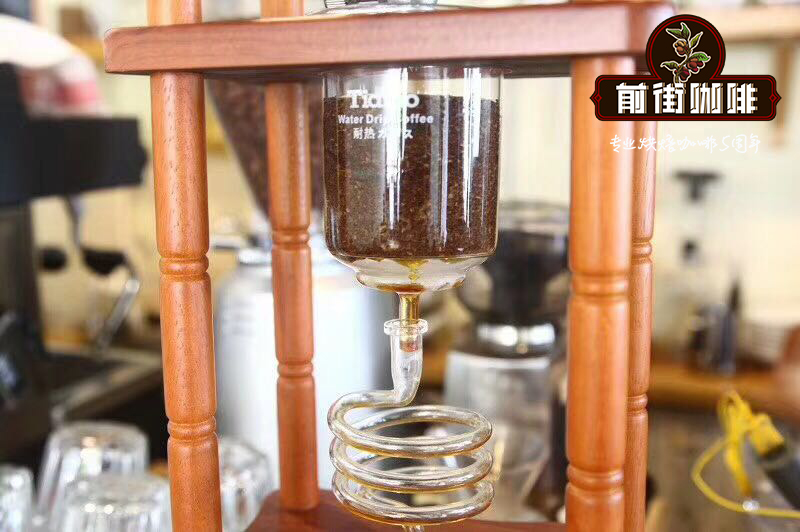
Here it is important to note that tamping for cold drip is not about compressing firmly. Instead, first gently tap the grounds so they distribute evenly in the filter cylinder, then use a flat tamper to level the surface gently. Remember to press lightly when leveling, rather than applying firm pressure the way you would for espresso.
If the grounds are compressed too firmly, since cold drip has no machine pressure to aid extraction, water can easily pool in the grounds layer and prevent the coffee liquid from filtering through. Cold drip filter paper or filters also sit at the bottom, unlike coffee filter cups that have ventilation grooves, so when the grounds are soaked, degassing is affected too, which can cause uneven extraction through the coffee puck.
3. Pre-wetting
Using ice water for "pre-soaking" is much like the bloom in pour-over coffee. It improves extraction efficiency and consistency in the final product. In the cold extraction environment of cold drip and its filtering method, dripping directly can wet the grounds unevenly, leaving some grounds over-extracted while others never take part in extraction at all.
4. Using Filter Cloth + Filter Paper
This increases contact between water droplets and coffee grounds, ensuring even extraction.
It provides sufficient pre-wetting and ventilation space for the coffee, resulting in more complete and cleaner extracted flavors. We use filter cloth plus filter paper. After leveling the grounds, we recommend placing a piece of filter paper over them.
When water droplets fall and touch the grounds, they gradually form a small pit on the surface, and the flow follows that pit downward rather than spreading outward. That means the grounds in the whole filter chamber are not thoroughly soaked, causing insufficient extraction. A layer of filter paper prevents this.
We have compared the different water droplet shapes formed by various cold drip towers and studied how grounds absorb water from each shape. We found that elongated droplets have greater impact force, so the grounds are soaked downward, which means the surface grounds are more prone to under-extraction.
Round droplets, by contrast, land with less impact force, and the grounds' wetting pattern spreads outward along the perimeter. That makes the whole cold drip extraction more even. This also means the drip opening shape of the cold drip tower matters a great deal; openings that produce round droplets are our preferred choice.
5. Coffee-to-Water Ratio for Better Layering
Coffee beans : Water : Ice cubes ratio 1:5:5
We generally prefer a coffee-to-water ratio between 1:10 and 1:12. Personally, I feel ratios in this range present flavors more appropriately; the coffee is neither too strong nor too weak, but just right. If you are used to serving customers with ice cubes, you can make it slightly stronger so that after the ice melts the concentration is still at a pleasant drinking level. Of course, this can be adjusted to personal taste.
Final Thoughts
Those are five important factors to consider when making cold drip coffee. For the best flavor development, let it rest for at least 12-24 hours. That allows the characteristic aromas of cold drip coffee to stand out more.
Cold Drip Coffee Bean Brand Recommendations
FrontStreet Coffee's roasted single-origin cold drip coffee beans are excellent in both brand and quality. More importantly, they offer exceptional value: a half-pound (227g) package costs only around 80-90 RMB. At 200ml per cup with a 1:10 coffee-to-water ratio, one package makes 11 cups, putting each cup at only 8-9 RMB, remarkable value next to cafe prices that often reach dozens of RMB per cup.
About FrontStreet Coffee
FrontStreet Coffee: A Guangzhou-based roastery with a small shop but diverse bean varieties, where you can find both famous and lesser-known beans. They also provide online shop services: https://shop104210103.taobao.com
FrontStreet Coffee Recommendation
For cold drip, FrontStreet Coffee's Yirgacheffe lineup is the natural pick. The FrontStreet Everyday Washed Yirgacheffe is known for white jasmine, bright citrus and lemon acidity, and a tea-like body, and it holds that character well through a long cold extraction at a friendly price. Yirgacheffe is a small town in southern Ethiopia's Sidamo province, sitting at roughly 1,700 to 2,100 meters, with the coffee trees planted above 1,800 meters; the name became so famous that it was separated from Sidamo in 2010.
For a more precise single origin, the FrontStreet Gudibe Cooperative coffee comes from the Worka area at the southeastern edge of Yirgacheffe, once part of the Worka cooperative under the YCFCU alliance and later a single-origin lot in its own right. Its traditional washed processing gives clean, bright citrus and lemon acidity with jasmine fragrance. If you want more fruit and sweetness in the finished cold brew, the FrontStreet Natural Red Cherry is made from fully ripe cherries dried in the fruit for three to five weeks, delivering citrus acidity, berry-juice body, honey sweetness, and a creamy smoothness that carries beautifully through cold water.
Important Notice :
FrontStreet Coffee is a long-established specialty coffee roaster in Guangzhou China, selling freshly roasted beans from its own farm in Yunnan as well as dozens of carefully selected single-origin beans from around the world for both pour-over and espresso. The products deliver consistently excellent quality and great value, with shipping within 24 hours. Guangzhou's FrontStreet Coffee shop is recommended by many coffee lovers, and the beans are now available online at the Tmall 。
FrontStreet Coffee has moved to a new address:
FrontStreet Coffee Address: 315,Donghua East Road,GuangZhou
Tel:020 38364473
 Scan and follow the En Gafei WeChat official account. Please indicate that the reprint comes from "En Gafei".