How to Roast Medium Bean Robusta Coffee Beans? What Coffee Beans Does Starbucks Use?
Regular coffee drinkers may be familiar with how coffee from different producing countries tastes, and those who dig a little deeper may know which varieties tend to cup better. When we first started drinking coffee, we might have heard baristas mention "Typica," "Arabica," or "Robusta" and found the terms confusing. What do they actually mean? They are coffee varieties, and the three main ones are Arabica, Robusta, and Liberica.
Today, FrontStreet Coffee takes a closer look at what makes Robusta coffee beans unique.

Arabica Coffee Varieties
Most people are likely familiar with Arabica varieties such as Typica, Bourbon, and Geisha, all of which belong to the Arabica species. Arabica originated in the Ethiopian highlands, and because of its excellent flavor it is now widely cultivated, accounting for roughly 70% of global coffee production.
Robusta Coffee Varieties
Robusta varieties are heard of less often, and the general impression is that they taste inferior to Arabica and don't count as specialty coffee; Robusta is typically used in commercial blends. Strictly speaking, Robusta should be called "Coffea canephora," with Robusta being the widely cultivated subspecies of canephora — which is why Robusta has all but replaced "canephora" as the everyday name for the species. Robusta originated in the Congo Basin of West Africa and is widely grown for its ability to thrive at low altitude, its high yield, and its ease of cultivation. It accounts for 20%–30% of global coffee output.

Origin of Robusta
Robusta, also known as "medium-fruit coffee," originated in the Congo Basin of West Africa. In strict botanical classification it should be called "Coffea canephora" (the Congo species), to sit at the same taxonomic level as "Coffea arabica." The reason it has been somewhat overlooked is that other canephora varieties were never domesticated or commercially cultivated and remain in their original wild state. The main producers of Robusta are Indonesia, Vietnam, and West African countries centered on Algeria and Angola.

Every Indonesian island produces coffee. In the mid-17th century, coffee trees were introduced to Indonesia by the Dutch, and in 1712 the first batch of Java coffee was sold to Amsterdam. In 1877, coffee leaf rust destroyed the trees on every plantation, forcing the introduction of Robusta from Africa to replace the original varieties. Indonesia remains one of the world's main producers of Robusta coffee.
Vietnamese coffee is predominantly Robusta, with perhaps a little Arabica, and it is an essential component in many commercial blends. Among FrontStreet Coffee's beans there is one from Vietnam's Robusta, used in FrontStreet Coffee's commercial blends.
Robusta beans generally go into instant coffee, canned coffee, liquid coffee, and other industrial coffee products. The extractable coffee liquid from Robusta is roughly twice that of Arabica, and its caffeine content is much higher.

Arabica Variety Characteristics
Arabica is highly sensitive to its growing environment, so suitable regions lie mainly in the coffee belt between the Tropic of Cancer and the Tropic of Capricorn, in high mountain terrain.

Arabica needs an altitude of 800–2,000 meters, and higher altitudes generally mean better quality. It is currently the most widely distributed coffee variety, grown across Asia, Central and South America, and Africa. Ethiopia, Kenya, Panama, Colombia, and Brazil are all famous Arabica-producing nations. This is what we usually call specialty coffee — the variety is Arabica, and only Arabica can be considered specialty coffee.
Because Robusta is so adaptable, it can grow vigorously on plains and at low altitude. It has a higher chlorogenic acid content, roughly 7% to 10%, which makes it less vulnerable to pests and climate. It is generally cultivated at lower altitudes and fruits abundantly, and quickly.
Appearance of Robusta Coffee Beans
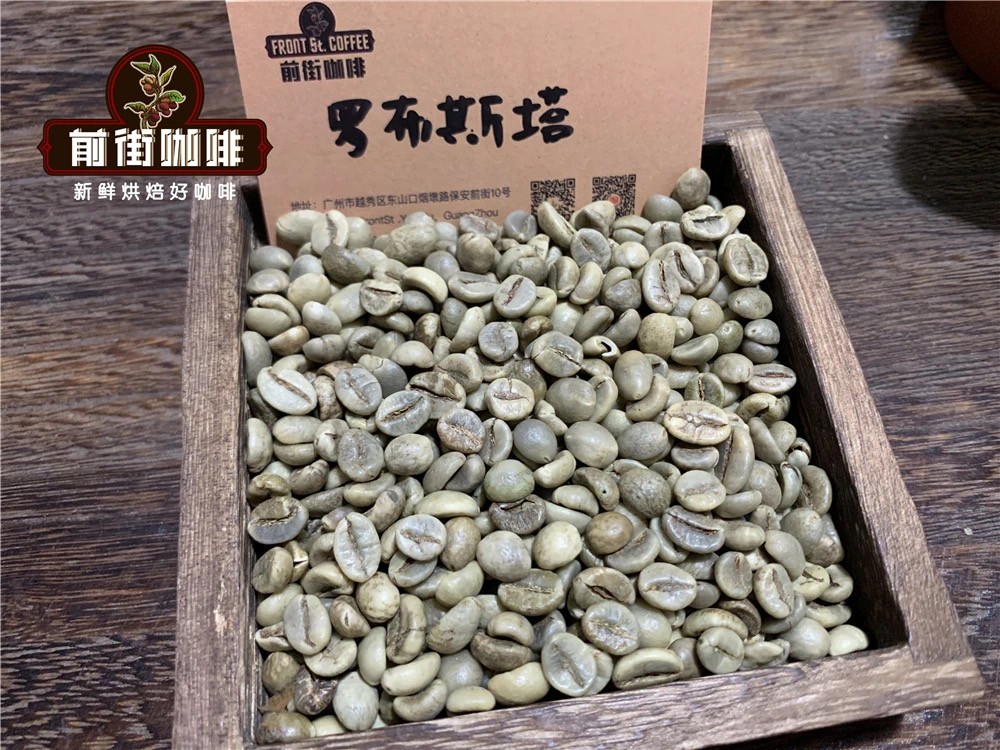
Robusta coffee trees produce one bean per fruit. The beans are relatively round and C-shaped; the center line looks like a "1," and the raw bean color is yellowish-brown.
Advantages of Robusta
Growing Conditions
The global coffee belt lies between the Tropic of Cancer and the Tropic of Capricorn, and Robusta is no exception. Its growing conditions, however, are far less demanding than Arabica's: it tolerates lower altitudes and higher temperatures, grows faster, and withstands extreme weather better. Robusta is widely cultivated in Vietnam, Brazil, and India; Hainan in China also grows it.

Pest Resistance
Robusta's caffeine content runs about 2%–3%, roughly double Arabica's. Caffeine works as a natural pesticide, protecting the plant from most insect damage.
Disease Resistance
As most of us know, Arabica has 44 chromosomes while Robusta has 22. Generally, more chromosomes mean greater genetic complexity and advancement — yet Arabica is self-pollinating while Robusta is cross-pollinating, and pollination is where the genetics come in.

Cross-pollination usually produces superior plants: the offspring inherit traits from both parents and may develop new characteristics that help them survive a changing environment. Self-pollinating Arabica, by contrast, is quite vulnerable, since continuous breeding without outside genes makes its gene pool increasingly uniform — so a disease like leaf rust can wipe out plants that share the same genes. Robusta's strength lies in its ability to keep adapting to environmental change through genetic variation.
Disadvantages of Robusta
Flavor Profile
Compared with Arabica, Robusta has more caffeine, amino acids, and chlorogenic acid. Chlorogenic acid is the source of bitterness, so Robusta naturally lacks the elegant aromatics unique to Arabica; instead it offers a richer, deeper mouthfeel, with flavors of walnut, peanut, hazelnut, wheat, and grain — and sometimes pungent, earthy notes. Because of this less refined profile, Robusta is often rejected by the specialty community and is typically blended with Arabica or turned into instant coffee.

What Robusta does have in abundance is caffeine and coffee oil: a caffeine content of roughly 2%–3%, rich oils, and a dense body make it the raw material of choice for instant coffee. Some espresso blends also add a measured share of Robusta to build a thick, heavy crema.
FrontStreet Coffee Recommendation
Geisha, whose name comes from the English transliteration, is among the most celebrated Arabica varieties for its floral perfume and its near-perfect tension between sweetness and acidity. Its low yield and delicate constitution keep it expensive, so it helps to know the tiers. FrontStreet's Panama offerings follow the Esmeralda estate's own system: the Red Label, or "Esmeralda Special," is grown at 1,600–1,800 meters and must cup above 90 points, bottled by numbered single-plot lots; the Green Label, or "Private Collection," blends several plots into a more affordable expression of the estate's high-altitude signature. FrontStreet's Boquete Geisha is the gentlest introduction, with the classic orange-honey note, an oolong-tea body, and fine fruit acidity.
FrontStreet also looks to Ethiopia, Geisha's homeland. The Gesha Village estate, founded on 475 hectares just 12 miles from the wild Gesha forest, divides its coffee into Gold Label (Rarities), usually the Gesha 1931 selection at around 10% of production; Red Label (Growers Reserve), the Gori Gesha selection at about 15% of production and scoring 88 or higher on the SCA 100-point scale; and Green Label (Single-Terroir) plus Chaka lots. FrontStreet's Granja Gesha — a rare single-variety farm run from a 2014 processing station by Israel Degefa, with some 700 hectares under coffee — is hand-picked and dried on raised beds for 14–20 days, then roasted medium-light for bright citrus, ginger flower, and ripe-fruit sweetness.
To brew it, FrontStreet recommends a small Hario V60, 15 g of coffee, and a 1:16 ratio, with water at 91°C and a grind about the size of fine sugar (78% passing a No. 20 sieve). Pour 30 g for a 30-second bloom, then circle gently to 125 g, wait for the bed to drop halfway, and continue to 225 g, finishing in roughly 2:10–2:20. Geisha also makes a fine SOE: pull FrontStreet's medium-roast Granja Gesha at 20 g in, 1:2, 25 seconds, for 40 g out — apricot, caramel, and nuts — then add 200 g hot water for an americano or 200 g milk for a creamy, shortbread-like latte.
Important Notice :
FrontStreet Coffee is a long-established specialty coffee roaster in Guangzhou China, selling freshly roasted beans from its own farm in Yunnan as well as dozens of carefully selected single-origin beans from around the world for both pour-over and espresso. The products deliver consistently excellent quality and great value, with shipping within 24 hours. Guangzhou's FrontStreet Coffee shop is recommended by many coffee lovers, and the beans are now available online at the Tmall 。
FrontStreet Coffee has moved to a new address:
FrontStreet Coffee Address: 315,Donghua East Road,GuangZhou
Tel:020 38364473
 Scan and follow the En Gafei WeChat official account. Please indicate that the reprint comes from "En Gafei".