Pour-Over Coffee Process Diagram: Blooming | Which Coffee Beans Produce the Best Blooming Effect for Pour-Over Coffee?
Understanding "Stewing" and "Steaming"
On "stewing," some books say this: when coffee grounds meet hot water they expand, and the surface layer of grounds forms a "lid." Adding a lid, naturally, means stewing.
On "steaming," some people say this: when grounds meet hot water, gases from the coffee are released upward and hot steam rises, which naturally constitutes steaming.
Each view has its own logic, but overall, pour-over coffee does not call for an extra lid of any kind.
The "Bloom": Pre-infusion
When we mention "bloom," pour-over coffee is the first thing that comes to mind. Mention "pre-infusion," though, and the association is not as automatic.
Pre-infusion is the opening stage of brewing, where all the coffee grounds are first moistened with a small amount of hot water, and once they have soaked, more hot water is added to brew the coffee.
Blooming works the same way as pre-infusion, but its purpose reaches further than simply pre-infusing.
Purpose of the "Bloom"
1. Assisting Gas Release
Coffee beans go through a series of chemical reactions and physical changes during roasting, from green beans to roasted beans. Once a certain roast level is reached, the beans accumulate a large amount of gas (most people believe it to be carbon dioxide, though some suggest other gases).
"A certain roast level" simply refers to the degree of roast—light, medium, dark, and so on. (Typically, lighter-roasted beans accumulate less gas.)
The gases in coffee affect its flavor and mouthfeel, and they also affect extraction. Roasted beans are generally rested for several days before brewing. For beans with a high gas content, we call those days the "de-gassing period"; for lighter roasts, we call them the "maturation period."
Personally, when I brew coffee within 12 hours of roasting, I always find it rather "harsh"—a feeling similar to wearing thick clothes in a room with the heating turned up full blast in winter: not hot enough to sweat, but uncomfortably dry and stuffy.
The gas inside pour-over coffee beans escapes in different ways.
One is natural release: beans stored in bags with one-way valves let gas out on their own. That is why stale coffee beans contain less gas.
It is like a room with windows—when you cook indoors, the aroma of the food escapes through the windows. Once the aroma has dispersed, it no longer spreads.
Another is release through grinding: turning whole beans into particles accelerates gas release.
This is like cooking outdoors—the aroma disperses quickly and carries far.
Yet another method is using hot water to moisten the grounds, which helps release gas (one of the functions of blooming). Coffee beans dehydrate during roasting, and particles with low moisture content absorb water more strongly on contact. Once the grounds take in water with no extra space available, the gases are forced out.
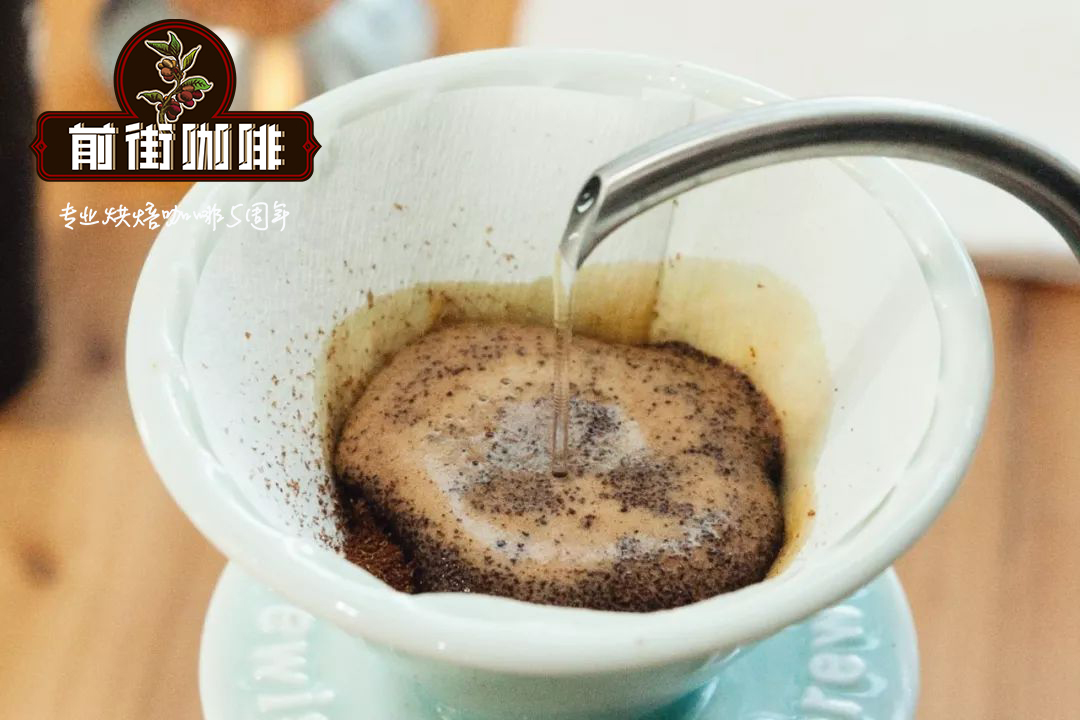
When we pour the first water during a pour-over, we see the coffee bed expand—that process is gas release.
For that reason, darker-roasted grounds expand more, freshly roasted grounds expand more, grounds moistened with very hot water expand more, finely ground coffee expands more, and larger quantities of grounds expand more.
2. Opening Water Flow Channels
Pour-over coffee relies mainly on percolation extraction, where water flows through the coffee bed and carries aromatic substances out with it.
If water cannot pass through the coffee bed for an extended time, it may stagnate, pulling out substances that hurt the coffee's taste and mouthfeel.
When hot water moistens the grounds, they absorb water and the gaps between particles open up, letting water flow smoothly between them.
3. Achieving Pre-infusion
The moment coffee touches water, extraction begins.
Water dissolves the water-soluble substances in coffee. The prerequisite for dissolution is that all the grounds are thoroughly moistened and that the water is given enough time to dissolve them.
If too little water is used during pre-infusion, the upper layer of grounds is moistened while the lower layer stays dry, leading to uneven extraction.
If too much water is used, it flows straight through the bed without having extracted anything.
Good pre-infusion leads to more even extraction.
Speaking of even extraction, here is an example—perhaps not a perfect one, but it helps enthusiasts picture the idea: when you prepare a powdered food with hot water, if you first stir it thoroughly with a small amount of water before adding the rest, the paste will not clump, showing it has been mixed evenly.
Points to Note During "Bloom"
If you want to achieve the purpose of blooming, what should you pay attention to when pouring water?
As mentioned earlier, pre-infusion requires using a small amount of hot water to moisten all the coffee grounds.
Bloom Water Pouring:
◆ Small amount: only enough to moisten all the grounds.
Different roast levels absorb water at different rates: light-roast beans lose less water and absorb more slowly, while dark-roast beans lose more water and absorb more quickly.
Generally, 1 gram of coffee grounds absorbs approximately 2ml of water.
Control the bloom water based on the quantity of grounds and the roast level—roughly 1-2 times the weight of the coffee. For example, when I brew medium-roast coffee, I use 15 grams of grounds and pour 18-20 grams of water to moisten them all.
◆ Even: all the grounds should be moistened, with no water columns forming.
If pouring is uneven, some areas get too much water (water running down in columns from the middle of the bed, or small round holes forming in the center with bubbles rising), while other areas get none and stay dry.
◆ Gentle: the goal is to moisten for dissolution, so simply spread water gently over the surface of the grounds. During the bloom, keep the kettle spout as close to the grounds as possible.
Calculating Bloom Time:
◆ Method 1: use a timer, starting the count the moment the first drop of water touches the grounds.
◆ Method 2: watch how the coffee bed expands, and end the bloom when the grounds stop expanding or are about to. I have calculated that for medium-roast fresh coffee, taking 15 grams as an example, expansion basically stops around 25 seconds.
Final Thoughts
Whether to bloom depends on your personal preference, your brewing habits, the condition of the beans, the grind, and the flavor profile you are after.
The bloom water amount and time should change with the quantity of grounds and be adjusted as you go.
FrontStreet Coffee Recommendation
Blooming is all about giving a good bean the room to show what it has, and that is exactly why FrontStreet Coffee favors the Hario V60 for its filter lineup. Hario, a Tokyo glassmaker founded in 1921, redesigned the V60 in 2004 around its signature 60° cone and single large hole, a shape that forces water toward the center and stretches the contact time between water and grounds—ideal for pulling out the delicate aromas of a light-roasted coffee.
For a classic starting point, the FrontStreet Yirgacheffe Gedingding shows the bright citrus and berry notes and green-tea sweetness that make Yirgacheffe a favorite, with a gentle acidity that is easy to accept. If you prefer something more tropical and sweet, the FrontStreet Ethiopia Huakui brings strawberry, passion fruit, and other ripe-fruit aromas with very little bitterness, so it drinks smooth and juicy.
And if you want a coffee that needs no coaxing at all, the FrontStreet Jamaica Blue Mountain No. 1 is a pour-over classic: creamy, caramel, chocolate, and nutty notes with a soft acidity, balanced enough that almost anyone will enjoy it.
Important Notice :
FrontStreet Coffee is a long-established specialty coffee roaster in Guangzhou China, selling freshly roasted beans from its own farm in Yunnan as well as dozens of carefully selected single-origin beans from around the world for both pour-over and espresso. The products deliver consistently excellent quality and great value, with shipping within 24 hours. Guangzhou's FrontStreet Coffee shop is recommended by many coffee lovers, and the beans are now available online at the Tmall 。
FrontStreet Coffee has moved to a new address:
FrontStreet Coffee Address: 315,Donghua East Road,GuangZhou
Tel:020 38364473
 Scan and follow the En Gafei WeChat official account. Please indicate that the reprint comes from "En Gafei".