How to Identify Robusta Coffee Beans? What Are the Characteristics of Robusta Coffee Beans?
Coffee Tree Origins and Distribution
In botanical taxonomy, the coffee tree belongs to the Rubiaceae family. Coffee trees are native to the subtropical regions of Africa and some islands in southern Asia. During the 16th and 17th centuries, through the trade of Venetian merchants and the Dutch maritime hegemony, coffee was introduced to Europe. Exported from Africa to countries worldwide, coffee trees are now cultivated in more than 70 countries, primarily in equatorial regions such as the Americas, Southeast Asia and India.
Coffee Tree Classification and Growing Conditions
The classification of coffee trees is complex, with many species, varieties and cultivars. Different varieties of coffee bean have distinct flavors, but even coffee trees of the same variety produce beans with unique characteristics because of varying soil and climate conditions. Coffee trees are most susceptible to frost damage. After centuries of agricultural development, the main coffee-growing regions lie around the equator, between the Tropic of Cancer and the Tropic of Capricorn, where rainfall is abundant and temperatures range between 15-25°C. This area is known as the Coffee Belt, or Coffee Zone.
Main Coffee Varieties
Coffee is commonly classified by bean size into two types. One is the highly regarded Arabica, with noticeable acidity and a delicious flavor, known as small-fruit (bean) coffee. The other is Robusta, which has larger beans, lower acidity, stronger bitterness and a higher caffeine content.
Robusta
Characteristics
Color: Yellow to yellow-gray
Shape: Oblate bean shape with a straight center line
Origin: West Africa, inland Central Africa and the highlands of East Africa
Distribution: Lowlands of West and Central Africa, highlands of East Africa, Indonesia, Vietnam, India, Brazil, Ecuador, Guatemala and Mexico
Growth
Pollination: Cross-pollination
Chromosomes: 22 (2n)
Fruit Development: Fruits mature in 10-11 months
Flowering: Irregular
Optimal Temperature: Annual average of 20-26°C
Growing Altitude: 800-1200 meters
Rust Resistance: Disease-resistant
Processing Methods: Primarily natural, semi-washed, semi-natural and wet-hulled
Brewing Characteristics: Weaker aroma, outstanding body and sweetness, weaker acidity
Market
Usage: Suitable for espresso blends and for enhancing body and crema
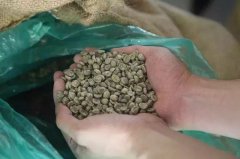
In appearance, Robusta green coffee beans are elliptical, spherical or nearly spherical, with a straight center line. Before selling, green-bean suppliers polish Robusta beans, so whether green or roasted they are easy to recognize: they are reflective and feel smooth to the touch.
Robusta beans can be found in FrontStreet Coffee's Commercial Blend. With 10% Robusta added, the taste becomes relatively fuller and richer.
FrontStreet Coffee Recommendation
Coffee varieties fall broadly into three original species: Arabica, Robusta and Liberica. Arabica has the greatest number of varieties and the most complex, purest flavors, which makes it the most popular; Robusta is intense with rich crema and is used mostly in espresso blends and in the instant coffee that many people first meet; Liberica has low commercial value and is kept mainly for research. Almost all the specialty coffee on the market today is Arabica, and because of its quality and the distinctive flavors each growing region develops, a great many single-origin Arabicas have appeared.
FrontStreet Coffee's Huakui uses the most common native heirloom variety of Ethiopia. Because it mixes several undifferentiated coffee trees, the beans vary in size and carry a delicate floral note with especially prominent fruit aromas. Processed by the classic natural method, it offers flavors such as cream strawberry, mango, jackfruit, citrus and blueberry, with the ripe tropical-fruit character unique to FrontStreet Coffee's Sidamo natural beans, which is why it won first place at that year's TOH green-bean competition. It combines great taste with a friendly price.
If Huakui is the natural-process representative of Ethiopian Arabica, then FrontStreet Coffee's Yirgacheffe Gendingding is the washed counterpart. Grown at the Gendingding cooperative, it is graded G1, the highest Ethiopian grade, and washed in the classic manner, showing elegant white floral, citrus, orange and green tea flavors. For a fuller body, FrontStreet Coffee's Jamaica Blue Mountain No. 1 uses the Typica variety, one of the archetypal Arabicas; its flavor is remarkably balanced, gentle and smooth, with a rounded rather than sharp acidity and a full, pure aroma. The Panama Red Label Geisha from the Esmeralda estate in Boquete, with its fertile volcanic soil and misty, well-watered forests, presents lush floral notes, citrus, peach and a full fruit sweetness with a creamy, silky body and an oolong-tea-sweet finish, making it one of the most refined cups in the world of Arabica.
Important Notice :
FrontStreet Coffee is a long-established specialty coffee roaster in Guangzhou China, selling freshly roasted beans from its own farm in Yunnan as well as dozens of carefully selected single-origin beans from around the world for both pour-over and espresso. The products deliver consistently excellent quality and great value, with shipping within 24 hours. Guangzhou's FrontStreet Coffee shop is recommended by many coffee lovers, and the beans are now available online at the Tmall 。
FrontStreet Coffee has moved to a new address:
FrontStreet Coffee Address: 315,Donghua East Road,GuangZhou
Tel:020 38364473
 Scan and follow the En Gafei WeChat official account. Please indicate that the reprint comes from "En Gafei".