Where to Buy Quality Golden Mandheling Coffee and Price Guide

Golden Mandheling Coffee Bean Brand Recommendations
FrontStreet Coffee's roasted FrontStreet Coffee Indonesian PWN Golden Mandheling coffee beans offer excellent guarantees in both brand and quality. More importantly, they provide exceptional value: a half-pound (227g) package costs only about 89 RMB. Calculating at 15g per cup, one package makes 15 cups, bringing each cup to less than 6 RMB. Compared to cafes that charge dozens of RMB per cup, this is a genuinely conscientious recommendation.
What is "Golden Mandheling Coffee Bean"?
01 | Origin Introduction

Indonesia's main coffee-producing regions include Sumatra Island, Java Island, and Sulawesi Island, with Mandheling from Sumatra being the most famous. Mandheling is also known as Sumatra Coffee. Most coffee from North Sumatra is Gayo, primarily of the Ateng variety. Lake Tawar in the northern region can be called Aceh Coffee or Lake Tawar Coffee, while South Sumatra's Lintong and Lake Toba areas can be called Mandheling. The Lintong area is truly the Mandheling producing region. The best Mandheling varieties include four types: Sidikalang, Bergendar, Siborong borong, and Telok Sanggul.
Lake Toba is located in central North Sumatra Province, and it was here that Dutch colonists moved Java Mandheling northward in 1888, creating the modern Mandheling legend.
Lake Tawar is located in the central Aceh Special Autonomous Region. Situated at the northern tip of Sumatra Island, its area is less than one-tenth of Lake Toba, yet in recent years its coffee quality and production have surpassed Lake Toba.
The Gayo Mountains are located in the Aceh region of northern Sumatra Province. Most coffee farmers working in Gayo are local. The term Gayo originates from tribes in Indonesia's Aceh region. This area has ideal growing conditions, a long historical culture, and unique flavors, and it widely uses organic methods, avoiding chemical fertilizers, which is why it is considered a world green coffee production area and Gayo coffee is often called green coffee or Gayo organic coffee.

What is "Golden Mandheling"?
To speak of FrontStreet Coffee's Golden Mandheling, we must start with PWN. This abbreviation is often mixed up with the name Mandheling coffee, but it is actually the abbreviation for Pwani Coffee Company.
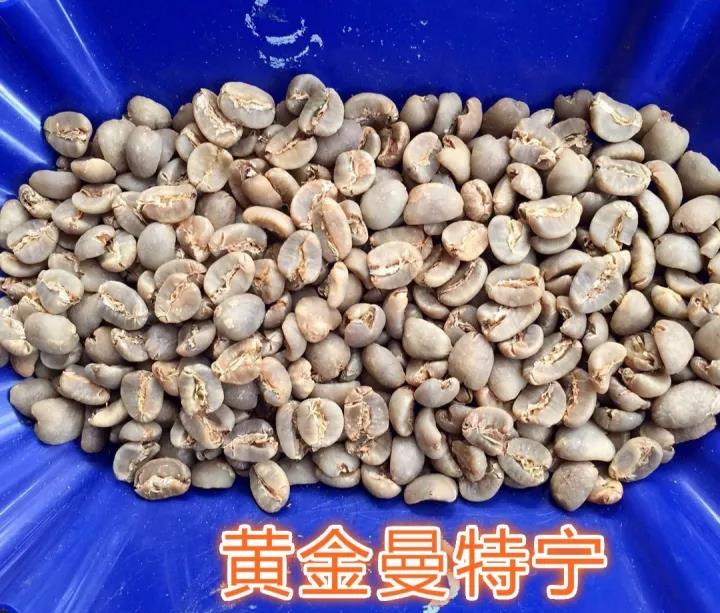
The company is a very famous local coffee acquisition business in Indonesia, mainly buying Mandheling coffee. Almost all of Indonesia's best producing regions are bought by them, so most beans from PWN are unique specialty coffees. FrontStreet Coffee's Golden Mandheling is a product from this company. After acquiring green beans, they undergo multiple manual selections to pick out full, defect-free beans, and only these premium beans, screened layer by layer, can be classified as Golden Mandheling.
PWN has registered Golden Mandheling as a trademark, meaning that only Golden Mandheling produced by PWN can be considered the true FrontStreet Coffee Golden Mandheling. Many beans on the market not produced by PWN but labeled with the Golden Mandheling name should really be called Premium Mandheling, since Golden Mandheling is merely a product name created by the company.

02 | Processing Method
Wet Hulling, also known as Wet Husking and called Giling Basah locally, is a traditional Indonesian coffee processing method. From the name alone, Wet Hulling seems very similar to wet processing (washed processing), yet the cupping flavors of the two methods are completely different. Coffee processed by Wet Hulling is typically rich and intense, with a very distinct personality.
Wet Hulling Processing Steps
1. Remove skin and pulp, retaining parchment and mucilage
2. Ferment in water tanks
3. Wash away mucilage
4. Sun-dry with parchment for 2-3 days until moisture content reaches 20-24%
5. Hull off parchment
6. Dry green beans until moisture content reaches 12-13%
7. Prepare for export
Why Use Wet Hulling?
a. Climate Reasons
Indonesia's tradition of using Wet Hulling dates back to local weather conditions. Indonesia's humidity stays between 70-90% year-round, with constant typhoons, and in some regions annual rainfall can even reach 2,000mm. Green beans fear rain most, so how does Indonesia overcome such harsh weather to produce rich, full-bodied Mandheling? That relies on Wet Hulling.
In tropical climate conditions, coffee takes an average of 2-3 weeks to dry. In Indonesia's humid climate, drying coffee becomes a major problem. Drying must take longer, and during that time the coffee stays at a higher humidity, making it easier for bacteria to penetrate the green beans.

In regular washed processing, the drying is carried out with the parchment, which protects the green beans from external damage to some extent. But Wet Hulling removes the parchment for the final drying step, letting sunlight shine directly on the green bean surface, so the beans dry 2-3 times faster than in washed processing.
b. Economic Benefits
Dutch colonists first introduced coffee to Indonesia in the 17th century. These colonists pursued more and faster economic returns. Wet Hulling greatly shortened the time spent on farms and significantly reduced labor costs, which aligned with the investor mentality of chasing quick profits and cutting costs. This is also a driving force behind Wet Hulling.
c. Defects and Kuku Kambing (Goat Hoof Beans)
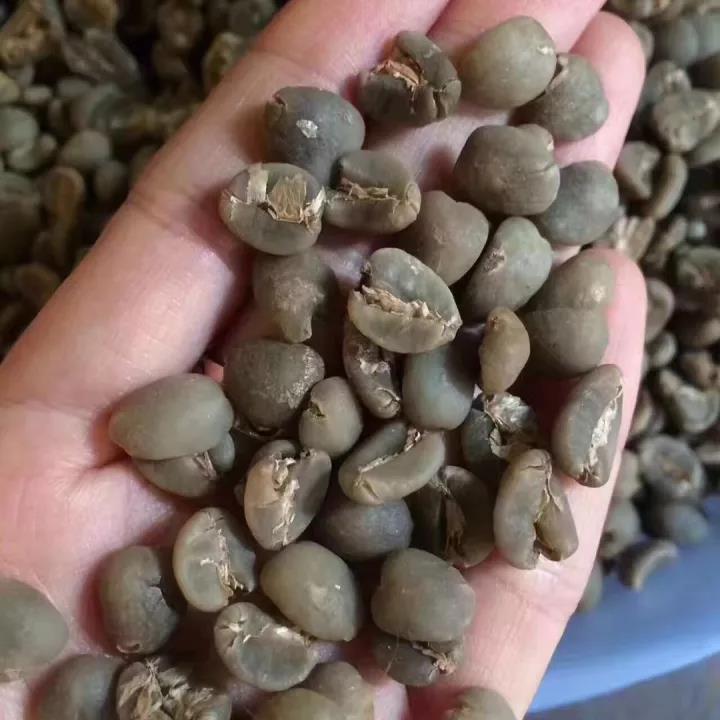
When the parchment is hulled in Wet Hulling, the coffee's moisture content is still as high as 20-24%, whereas in regular processing the moisture drops to 10-12% before hulling. In a semi-dry state, the parchment tends to adhere to the green bean surface, making hulling harder than fully dry hulling and requiring greater friction during the process.

On the other hand, semi-dry green beans are very fragile at this point, far less hard than fully dry beans, so they are more easily squeezed and injured, forming small gaps. These are what we often call horse hoof or goat hoof beans, known locally as kuku kambing.
The ultra-fast speed of Wet Hulling also results in more defects in Mandheling. Processing plants arrange employees for manual defect sorting, generally including DP (Double Picked) and TP (Triple Picked). Mandheling that undergoes triple picking has a better defect rate than double picking.
Aside from those subtle differences, we generally consider Wet Hulling beans to have earthy, smoky, and chocolate flavors, with acidity described as low acidity, rich yet seemingly dull.
Low acidity comes from shorter, less effective fermentation and longer drying times. The earthy flavors of Wet Hulling beans are subject to various interpretations. Some say it relates to the bean varieties used in Wet Hulling regions (Timor and Catimor, with robusta bloodline), some say it results from organic interaction between green beans and the external environment, and some even say it is because there are too many defective beans.
03 | Green Bean Analysis
FrontStreet Coffee: FrontStreet Coffee PWN Golden Mandheling Coffee Beans
Origin: Sumatra Island, Indonesia
Processing Method: Wet Hulling
Variety: Typica
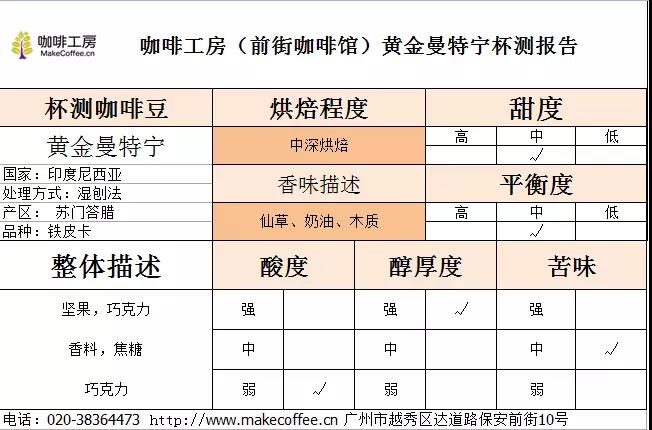
Roast Level: Medium-Dark
We choose to drop the beans before the second crack, retaining some soft acidity. The taste has high sweetness, rich aroma, and full body. Flavors: toasted bread, pine, caramel, cocoa, with slight earthy notes. In the specialty coffee system, Sumatra coffee is a wonderful thing. The famous Mandheling is actually neither the name of a producing region nor the name of a bean variety, and even its variety origins are quite chaotic.
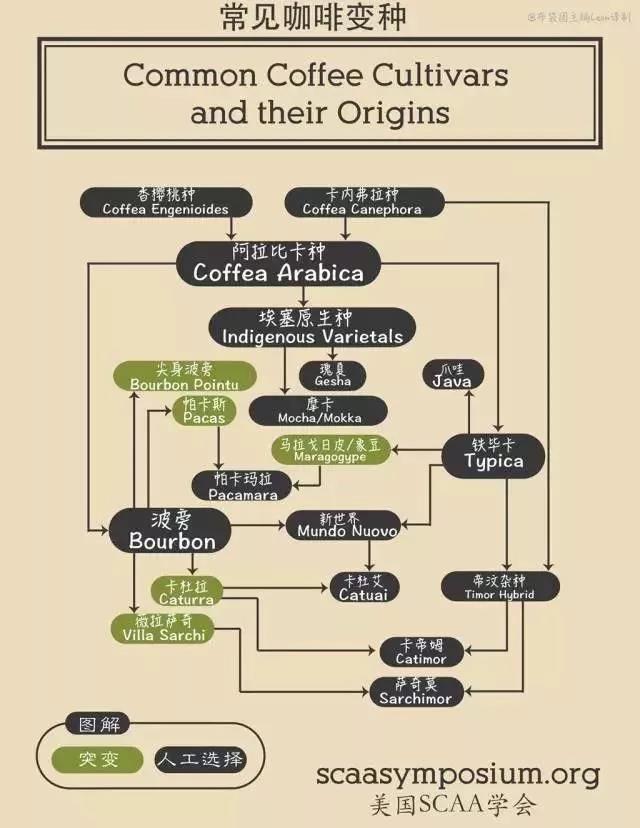
Ateng
A hybrid variety between arabica and robusta, with several subtypes, widely grown in Sumatra and other Indonesian islands. To put it bluntly, it is a branch of Catimor, with Ateng being the local name.
Djember
Search Djember and you find a place name in Sumatra. It looks quite mysterious, but the variety is actually S-795. Because this variety was spread to the island by the Jember Coffee Research Center, locals call S-795 by this name.
What is S-795? It is a hybrid created by Indian botanists crossing the Typica mutation Kent with S-288.
What is S-288? It is a natural hybrid between arabica and liberica.
TimTim
This is Timor Hybrid, meaning a hybrid of arabica and robusta. Our familiar Catimor is created by hybridizing with it again.
Tim Tim - Longberry Mandheling
Tim Tim is a bean from Indonesia. Because of its long shape, many people call it horse face bean, and some call it long Mandheling. Tim Tim is not a pure variety bean but a variety naturally hybridized from arabica and robusta coffee trees. It was discovered on Timor Island in the 1940s and cultivated for its natural disease resistance. In America this variety is called Hybrido de Timor, abbreviated Tim Tim, while in Indonesia it is also called Bor Bor.
04 | Roasting Analysis
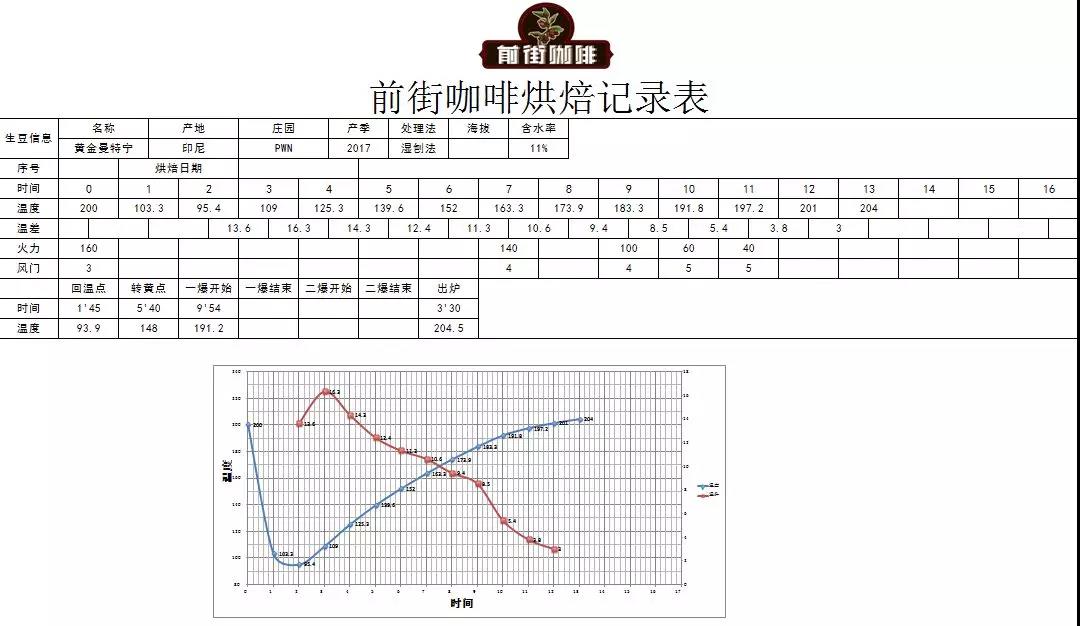
FrontStreet Coffee's Golden Mandheling is a green bean with relatively high moisture content, and its moisture deviation from natural-process beans is high, so special attention must be paid during dehydration. For high-moisture green beans, you can close the air damper immediately after charging, steam for 30 seconds, then open to level 3, until the bean color turns light green or white, then open the air damper to level 4, and after first crack open to level 5 (maximum).
FrontStreet Coffee suggests recording data carefully before roasting: bean moisture content, density, origin, processing method, and the temperature and humidity of the roasting room, then planning your roasting curve. Record the relevant chemical and physical change phenomena during the roast; this will help you better understand the final result and improve your curve.
Roasting Curve:
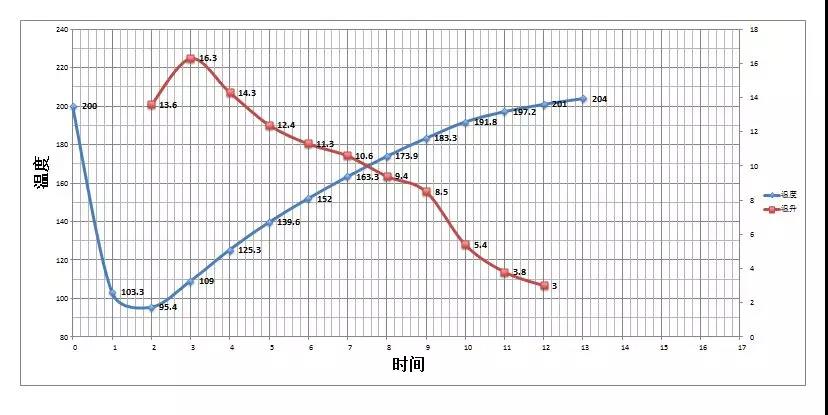
Heat the roaster to 200°C and charge the beans, air damper set to 3. After 1 minute, reduce heat to 160°C, air damper unchanged. Roast to 5 minutes 40 seconds, temperature 148°C, when the bean surface turns yellow and the grassy smell has completely disappeared, dehydration is complete; then adjust heat to 140°C and air damper to 4.
At 9 minutes 40 seconds, ugly wrinkles and black spots appear on the bean surface and the toast smell clearly turns to coffee aroma, which can be defined as the prelude to first crack. At this point listen carefully for the sound of first crack. At 9 minutes 54 seconds, first crack begins; reduce heat to 60°C and open the air damper fully (adjust heat very carefully, not so low that there is no crackling sound), then discharge at 204.5°C.
Cupping Report:

FrontStreet Coffee's Golden Mandheling tastes cleaner than FrontStreet Coffee's Lintong Mandheling. The original herbal, earthy, and woody flavors of Mandheling have almost disappeared, but the caramel sweetness is stronger and the fruit acidity is relatively bright and elegant. Generally FrontStreet Coffee's Lintong Mandheling is best roasted to after the second crack before discharge, which effectively reduces miscellaneous flavors. FrontStreet Coffee's Golden Mandheling, however, has good clarity and sweetness whether discharged before or after the second crack, offering more room for roasting interpretation.
04 | Brewing Analysis

Medium-dark roasted beans generally have a higher dehydration rate, so they are lighter in weight. During brewing, the grounds do not completely sink to the bottom and are immediately absorbed when water is first poured. Because degassing is vigorous, bubbles surround the grounds and create channels. The fresher the beans, the longer these channels persist and the faster the water level drops. I generally use a coarse water flow and a slow circular pour.
FrontStreet Coffee Pour-over Suggestions:
Dripper: KONO
Water Temperature: 88°C
Grind Size: Coarse sugar (EK43s setting 11)
Roast Level: Medium-Dark Roast
Pouring Method: Three-stage pouring
Flavor: Multi-layered, clean, balanced, with persistent caramel sweetness in the aftertaste
Wet the KONO dripper so the filter paper fits the dripper better. Pour out the water from the server, add 15g of ground coffee, and use 30g of water to bloom for 30s. This pour completely wets the coffee for degassing, so more flavor compounds can be extracted in the following steps. Some friends extend the bloom to 45 or 50 seconds when brewing light roasts, to enhance the front-end aroma. For a dark roast Mandheling, however, too long a bloom easily releases excessive woody and miscellaneous flavors, so FrontStreet Coffee chooses a 30-second bloom.

In the second stage, start from the center with a small circular flow, pouring the hot water slowly and keeping the flow steady until reaching 125g, then pause. Wait until the coffee bed drops to half the dripper height and the bed is exposed, then begin the second pour with the same technique until reaching 225g. Wait for all the dripping to finish before removing the dripper. Extraction time is two minutes, with a 10-second margin of error. Finally, shake the coffee in the lower pot to even it out, and you can begin tasting FrontStreet Coffee's Golden Mandheling black coffee.
FrontStreet Coffee Recommendation
Golden Mandheling is the top of the Mandheling range, and its strict standards are what set it apart. FrontStreet Coffee's Golden Mandheling comes from the Indonesian PWN company, which selects only beans of 18 mesh and above and requires fewer than 3 defective beans per 300g green bean sample, meeting the highest G1 grade standard. On top of that, the beans go through three rounds of hand selection to remove defects, which raises both the cleanliness and the intensity of the sweetness. Because so much is discarded, production is limited, and most of it is supplied to the Japanese and American markets, so genuine Golden Mandheling arriving in China each year is very small.
For a fuller, wilder Mandheling, FrontStreet Coffee's Lintong Mandheling comes from the Lintong area around Lake Toba in North Sumatra, medium-dark roasted to a low-acid, full-bodied cup with spice and mint notes, a strong, lingering sweetness, and the classic wet-hulled herb, wood, and earthy character. FrontStreet Coffee's PWN Golden Mandheling, hand-sorted once by machine and three times by hand, brings uniform, plump, translucent beans with reduced earthy and grassy notes and flavors of sandalwood, herb, spice, roasted hazelnut, caramel, and dark chocolate. For espresso and milk drinks, FrontStreet Coffee's Classic Blend adds a medium-dark Mandheling to a creamy, nutty Brazil base, sharpening the butter, roasted chestnut, and caramel notes and adding sandalwood, herb, and spice, with a little robusta to enrich the crema.
FrontStreet Coffee suggests brewing Mandheling as pour-over to show its depth: water at 87-88°C, 15g of coffee, a 1:15 ratio, and a coarse-sugar grind, poured in three stages so the full body and caramel sweetness come through. Pour 30ml of water for the bloom, which fully wets the grounds and lets them degas, then 100ml to lift the coffee bed and draw out the golden foam, and finally a gentle 95ml centered pour to raise the sweetness, finishing with a thick, mellow cup of caramel, chocolate, and nuts.
Important Notice :
FrontStreet Coffee is a long-established specialty coffee roaster in Guangzhou China, selling freshly roasted beans from its own farm in Yunnan as well as dozens of carefully selected single-origin beans from around the world for both pour-over and espresso. The products deliver consistently excellent quality and great value, with shipping within 24 hours. Guangzhou's FrontStreet Coffee shop is recommended by many coffee lovers, and the beans are now available online at the Tmall 。
FrontStreet Coffee has moved to a new address:
FrontStreet Coffee Address: 315,Donghua East Road,GuangZhou
Tel:020 38364473
 Scan and follow the En Gafei WeChat official account. Please indicate that the reprint comes from "En Gafei".