Hawaii Kona Coffee Beans Flavor Profile Introduction & Kona Coffee Brewing Tutorial

FrontStreet Coffee knows that coffee has certain demands when it comes to growing altitude, and the received wisdom is that beans grown higher generally taste better than beans grown lower. But nothing is absolute! Hawaii proves the point: despite its modest elevations, the islands produce coffee of outstanding flavor and quality. Hawaiian Kona beans rank among the most perfect in the world - exceptionally full fruit with cinnamon-spice notes and balanced, moderate acidity. FrontStreet Coffee roasts its Hawaii Kona to a medium level that interprets the bean perfectly: complex sweet aromas of cashew, milky peanut, mulberry, and tropical fruit, with a mild, smooth, clean, transparent taste and a bright, elegant acidity that is genuinely intoxicating.
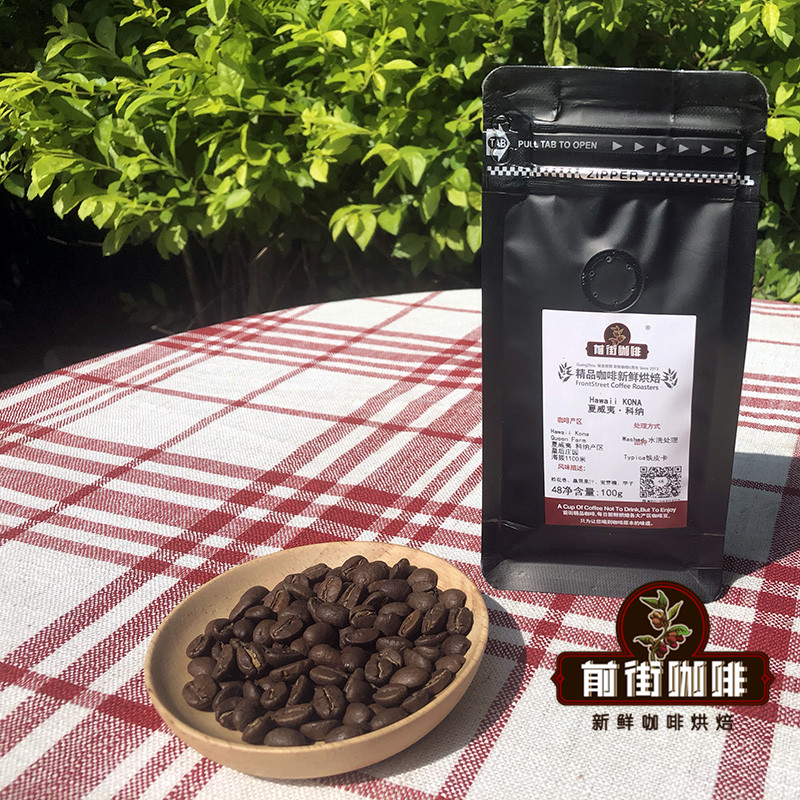
FrontStreet Coffee's Kona comes from beans grown on volcanic terrain under high-density cultivation - every bean pampered, which is why the price is naturally high, second only to FrontStreet Coffee's Jamaica Blue Mountain. Kona beans are uniform in shape and size, with vibrant acidity and sweetness.
The texture is silky and smooth. FrontStreet Coffee's medium roast brings out the acidity of its Hawaii Kona, while a darker roast would push bitterness and body forward. These beans grow at altitudes from sea level to 6,000 feet. Premium coffee generally grows only in mountain areas, at roughly 4,000-6,000 feet, needing about 80 inches of annual rainfall and sharply distinct dry and wet seasons. The soil must be very fertile, typically of volcanic rock composition, and light cloud or overcast skies belong to the growing environment of top coffee. Daytime temperatures should sit at 15-20°C. All of this stretches the growth cycle, and those unique conditions build unusually rich flavor.
Though cultivated at only a few hundred meters of altitude, Kona from Hawaii's Big Island - bathed in gentle sea breezes and rooted in fertile volcanic soil - possesses incomparably clean acidity and sweetness. Set against even the higher-altitude Jamaica Blue Mountain sold by FrontStreet Coffee, it holds its own magnificently.
Coffee first arrived in Hawaii in 1817, brought by Don Francisco de Paula Marin, the Spanish advisor at King Kamehameha's court - though those first plantings failed. In 1825, Oahu Governor Chief Boki successfully introduced coffee from Brazil and planted it in Manoa Valley, and cultivation soon spread across the islands. Today about 950 farms grow coffee on Kauai, Oahu, Maui, Molokai, and the Big Island, mostly family-run smallholdings totaling 7,900 acres.
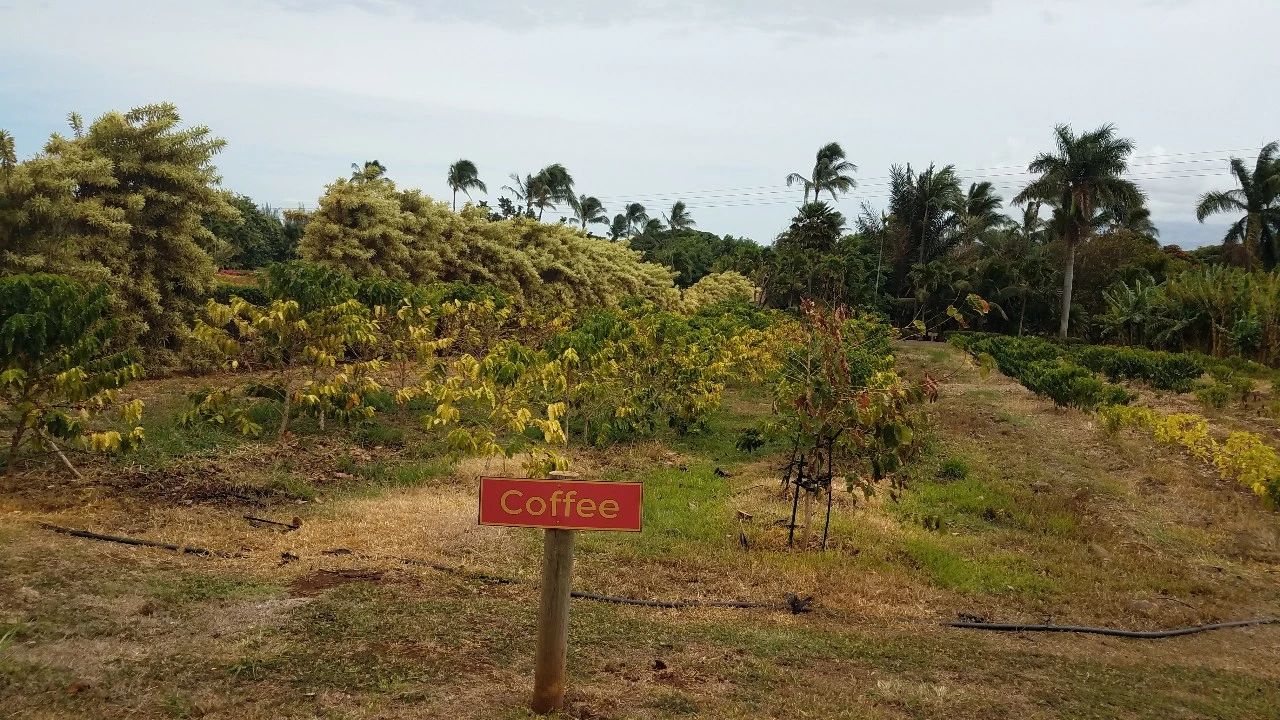
Hawaii Coffee Growing Regions
MAUI ISLAND
Maui is home to a large plantation called Ka'anapali, divided into many small plots but centrally processed. From 1860-1988 it was a sugarcane plantation before being converted to coffee.
Region altitude: 100-550 meters
Harvest period: September to January of the following year
Varieties: Catuai, Caturra, Typica, Mocha
WAIKAPU, MAUI ISLAND
A relatively young coffee region in Hawaii. Its only plantation is owned by a company from the neighboring island of Molokai.
Region altitude: 500-750 meters
Harvest period: September to January of the following year
Varieties: Typica, Catuai
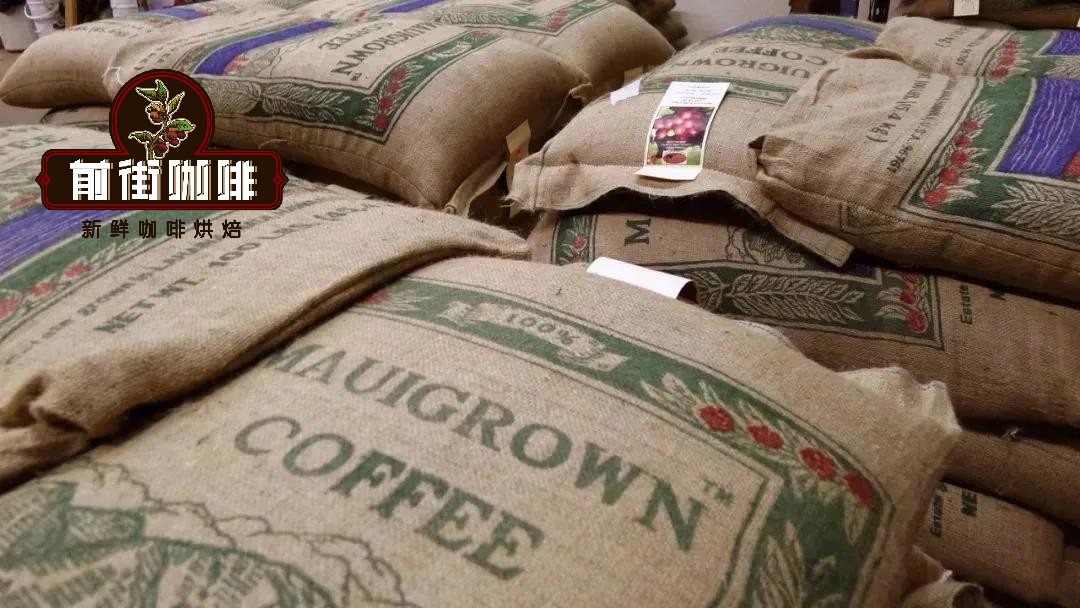
KAU, BIG ISLAND (Coffee Processing Plant)
Coffee cultivation began here after the local sugar mill closed in 1996. Before 2010, the cherries had to be hauled to neighboring areas such as Puna or Kona for processing, but a local processing plant has since been built, so growers no longer send their cherries elsewhere.
HAMAKUA, BIG ISLAND
Coffee has been grown here since 1852, originally on 8 plantations. As elsewhere in Hawaii, the industry waned under the prosperity of sugar, but cultivation resumed from the mid-1990s.
Region altitude: 100-600 meters
Harvest period: August to January of the following year
Varieties: Typica, Catuai
KONA, BIG ISLAND
Hawaii's coffee fame rests above all on this region. Unlike the rest of the state, coffee cultivation here is remarkably diverse: more than 630 plantations produce coffee in the area, most smaller than 2 hectares and typically family-run.

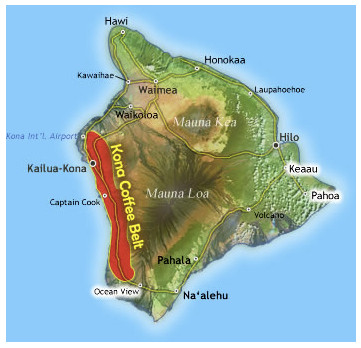
The Kona belt lies on the southwestern side of the Big Island - 20 miles long and 2 miles wide - covering the slopes of Hualalai and Mauna Loa, where altitudes of 800-1100 meters create the ideal environment for coffee trees. Both slopes are blanketed with coffee, and only beans grown here that meet the strictest certification standards may be sold under the Kona name.
The unique natural environment of the Kona region has nurtured its Arabica into one of the world's highest-yielding coffee plantations - quality guaranteed, and grown in that singular climate, more fragrant still.
Every November, the Kona district hosts the grand Hawaii Kona Coffee Cultural Festival, celebrating the harvest while commemorating 180 years of Hawaiian coffee history and tradition. Across the nearly 10-day event, more than 40 coffee cultural and competitive activities take place on the Big Island, Oahu, and beyond, spreading the word about Kona and giving visitors a chance to meet these beans up close.
Coffee Varieties
Typica originated in southeastern Ethiopia and Sudan and is one of the oldest of the Arabica family. Its top leaves are bronze - hence "red-top coffee," also called old-variety small-grain coffee. Low yields and difficult cultivation push its price well above ordinary coffee, but its flavor performance is superb, and it is recognized the world over as a specialty variety.
Typica is distinctive - probably the easiest variety to recognize. The plants grow conically from a single vertical trunk that can reach 5 meters tall; compared with other varieties, the spacing between branches, and between nodes along a branch, is longer. Lateral branches form a 50 to 80-degree angle with the trunk, and neither trunk nor branches are particularly sturdy. Leaves, fruit, and green beans are usually elongated, new leaf buds are bronze-tipped, and compared with other Arabica varieties Typica's leaves are smoother with fewer wavy edges. Ripe Typica cherries turn a bright red.

Those bronze top leaves are one of its signatures. The beans are large, pointed-oval or thinly pointed, which is why some call it "red-top coffee." Typica offers a uniquely elegant, clean flavor with fine balance and high cup clarity. Its drawbacks are equally known: insufficient yield, altitude requirements, susceptibility to leaf rust, and weak resistance to pests and disease.
Typica has racked up its share of honors: as early as 1958 it was rated first-class at the International Coffee Tasting in London, UK; in 1980, Chinese and foreign experts at the National Coffee Conference hailed it as "the crown of Chinese coffee"; and in 1993 it won the "Eureka" gold medal at the World Coffee Evaluation in Brussels, Belgium.
Typica is delicate - prone to rust disease and modest in yield - but its flavor is superb, making it one of the finest specialty varieties. Its descendants shine too: the famous "king and queen" of the coffee world - FrontStreet Coffee's Jamaica Blue Mountain and FrontStreet Coffee's Hawaii Kona - are both Typica variants.

Coffee Bean Processing Methods
Hawaii relies primarily on washed processing. The great difference from natural drying is the use of fermentation to remove the mucilage layer. Once fermentation is complete and the mucilage stripped, the beans are washed again - fermentation bacteria and impurities remain on them, and a thorough clean consumes a great deal of fresh water - after which the beans are dried and hulled.
Hawaii's clean, sweet mountain spring water makes ideal conditions for the washed method, and it is what gives FrontStreet Coffee's Hawaii Kona its bright, clean appearance and pure, fresh taste. The washed beans are then laid out on large flat platforms to dry naturally in the sun.

Coffee Grading
Kona beans are graded mostly by size, in four levels: the highest grade Extra Fancy, then Fancy, Prime, and Gr. No.1, with beans also divided into Type 1 and Type 2.
Type 1 covers standard beans, from the largest, Kona Extra Fancy, down through Kona Fancy, Kona Select, and Kona Prime.
Type 2 is reserved for peaberries, in two grades: Kona Number 1 Peaberry and the smaller Kona Peaberry Prime.
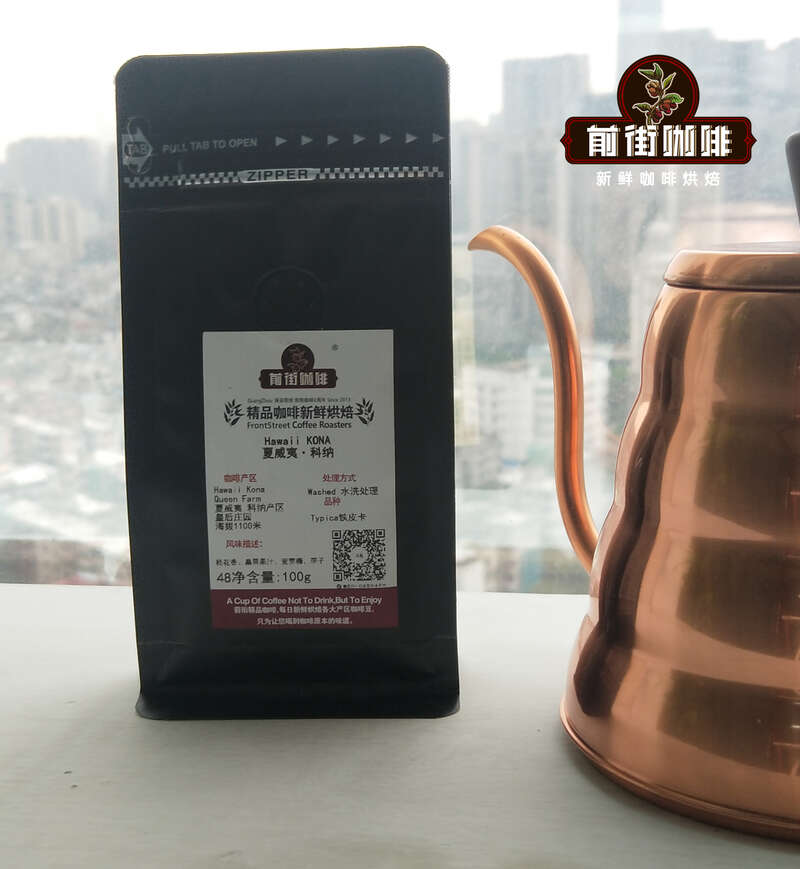
Hawaii Representative Coffee Beans: FrontStreet Coffee Hawaii Kona
Region: Hawaii Kona
Farm: Queen's Estate
Altitude: 1100 meters
Variety: Typica
Processing method: washed
Roasting Suggestions
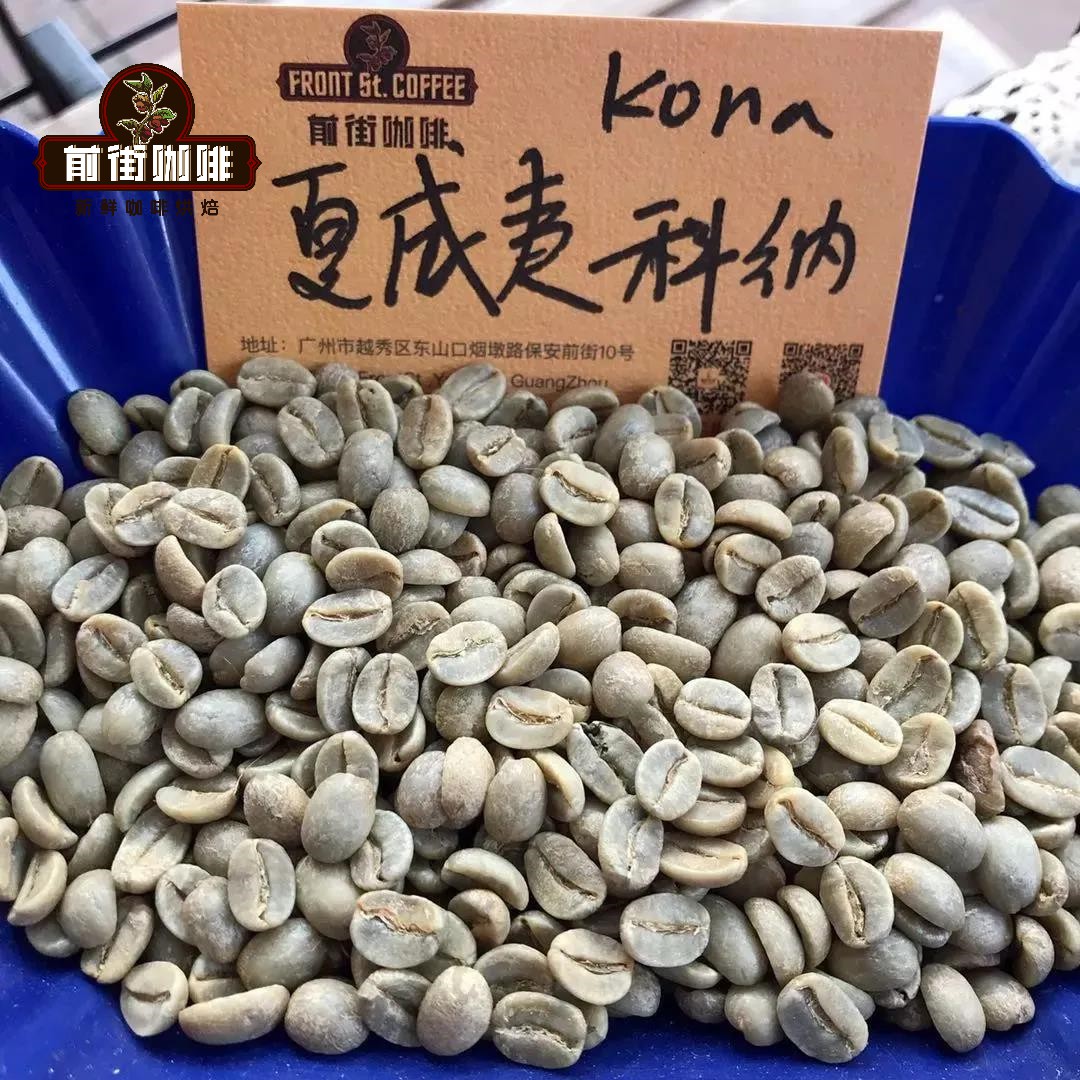
FrontStreet Coffee's Hawaii Kona beans are exceptionally full, rounded, and brightly colored - worthy of the title "the most beautiful coffee beans in the world." To protect that beauty and highlight the rich, layered nectar sweetness, our roasters chose a medium roast.
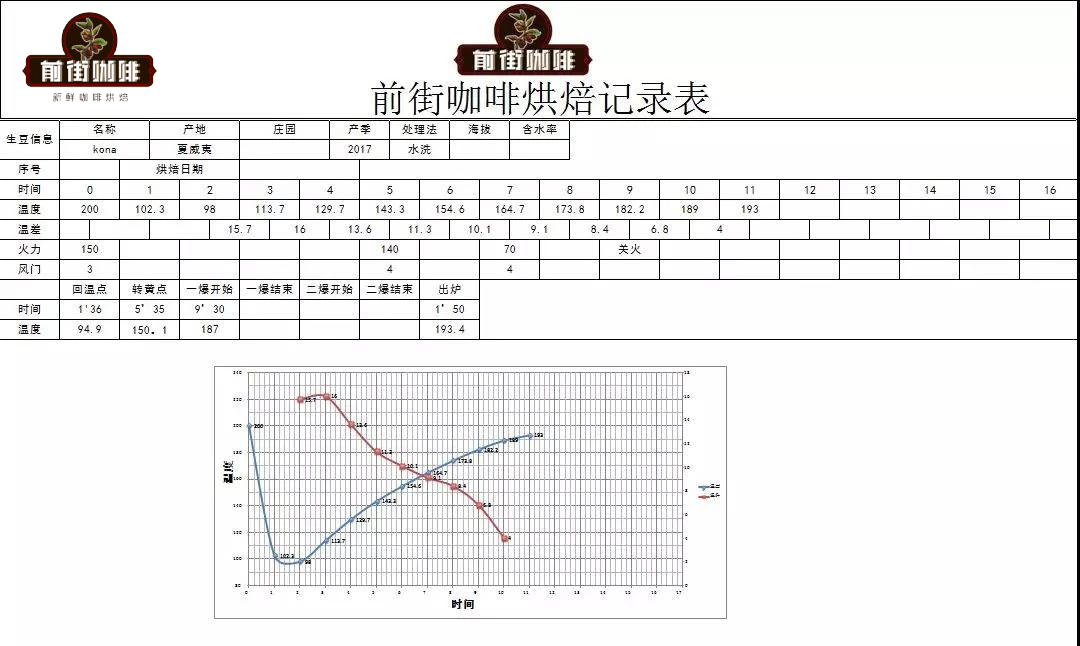
Machine: Yangjia 800N, 550g green beans. Entry temperature: 200°C. Yellowing point: 5'35", 150.1°C. First crack: 9'30", 187°C, with 1 minute 50 seconds of development after first crack and a discharge temperature of 193.4°C.
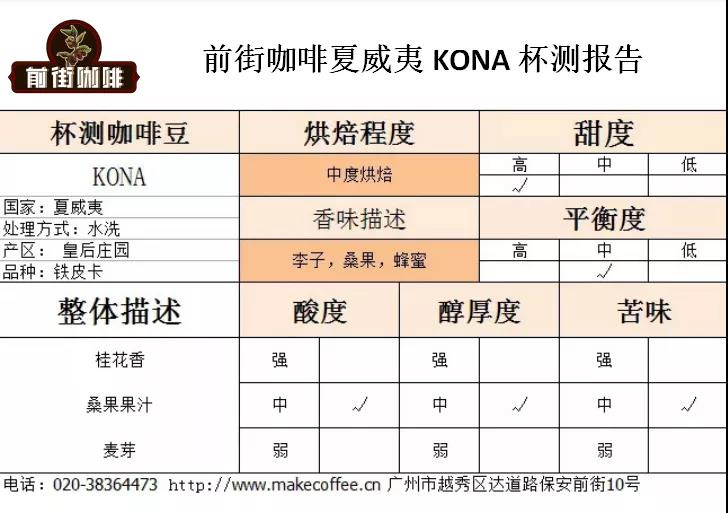
Hawaii Kona Cupping Data
Next, FrontStreet Coffee walks you through different brewing methods for the most beautiful bean in the world.
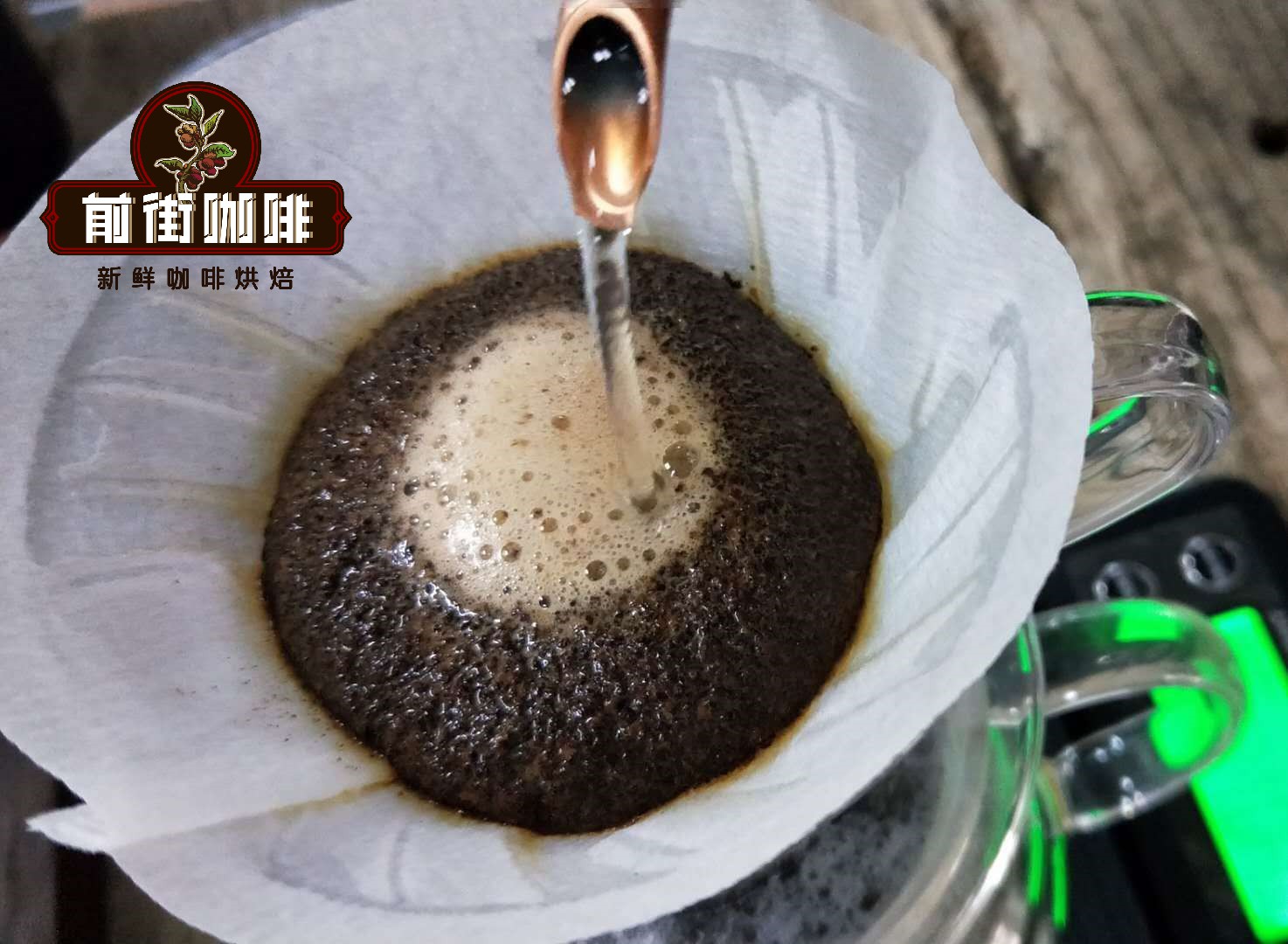
Hario V60
Parameters: 15g coffee / 1:15 / 88°C / grind size BG-5R (75% pass rate on China standard #20 sieve)
Method: bloom with 28g of water for 30 seconds, pour directly to 126g at the center, then segment. Once the coffee bed shows, pour to 227g. Remove the filter cup when the bed appears. Total extraction time: 1 minute 50 seconds.
Flavor: walnut, caramel, berries, pudding, plums, nuts, cream. Clean overall and rich in layers.
Siphon
Parameters: 20g coffee / 1:10 / grind size BG-6M (80% pass rate on China standard #20 sieve)
Method: put 210g of water in the lower pot. At 90°C, seat the upper pot tightly; when the upper pot also reaches 90°C, add the grounds and stir for full contact. Stir again after 30 seconds to break the crust. Kill the heat at one minute and wipe the lower pot with a dry cloth to speed the coffee's return.
Flavor: chestnut, caramel, almond, hazelnut, plum, toffee. A rounded taste with pronounced aroma.

AeroPress
Parameters: 10g coffee / 1:15 / 88°C / grind size BG-5R (78% pass rate on China standard #20 sieve)
Method: pour directly to 147g, then press in a cross pattern 3 times. Stir 3 circles at 50 seconds. Press out at 1 minute 30 seconds. Total extraction time: 1 minute 41 seconds.
Flavor: sandalwood, herbal notes, chocolate, plum, peach, nuts, cream. Round on the palate, layered, with soft fruit acidity.

French Press
Parameters: 17g coffee / 1:13 / 88°C / grind size BG-5R (75% pass rate on China standard #20 sieve)
Method: pour directly to 223g and stir 5 circles. At 50 seconds, stir 4 more. Insert the plunger at 1 minute and press the grounds down. Finish pouring at 1 minute 31 seconds.
Flavor: brown sugar, nuts, cream, herbs, dark chocolate. A slightly oily, very smooth texture with high sweetness.

KONO
Parameters: 17g coffee / 1:13 / 88°C / grind size BG-6M (70% pass rate on China standard #20 sieve)
Method: bloom with 31g of water for 30 seconds, pour directly to 121g at the center, then segment. Once the bed shows, pour to 222g. Remove the filter cup when the bed appears. Total extraction time: 1 minute 53 seconds.
Flavor: berries, chocolate, cream, spice, fermented notes, hazelnut. Smooth with lively fruit acidity.

FrontStreet Coffee Recommendation
Admirers of Typica nobility should not stop at Kona: FrontStreet Coffee's Jamaica Blue Mountain No. 1 - the "king" beside Kona's "queen" - comes from the historic Clifton Estate, grown at around 4,300 feet (1,310.64m) and shipped in the traditional wooden barrels with full Jamaican certification. Roasted medium-dark, it unfolds nuts, dark chocolate, and creamy caramel in perfect, quiet balance - the classic counterpart to Kona's bright, clean elegance.
Important Notice :
FrontStreet Coffee is a long-established specialty coffee roaster in Guangzhou China, selling freshly roasted beans from its own farm in Yunnan as well as dozens of carefully selected single-origin beans from around the world for both pour-over and espresso. The products deliver consistently excellent quality and great value, with shipping within 24 hours. Guangzhou's FrontStreet Coffee shop is recommended by many coffee lovers, and the beans are now available online at the Tmall 。
FrontStreet Coffee has moved to a new address:
FrontStreet Coffee Address: 315,Donghua East Road,GuangZhou
Tel:020 38364473
 Scan and follow the En Gafei WeChat official account. Please indicate that the reprint comes from "En Gafei".