Complete Guide to Coffee Bean Varieties | FrontStreet Coffee's Roasted Bean Label Interpretation and Coffee Bean Naming Rules
Understanding Coffee Bean Labels Before You Buy
Coffee beans carry strong regional character. Labels on coffee are much like labels on wine: before you buy, reading the label tells you a great deal about how the coffee will taste.
Common items include the following:
- (1) Coffee variety
- (2) Coffee name
- (3) Grade
- (4) Growing region
- (5) Estate or processing station name
- (6) Country name
- (7) Roasting date
- (8) Flavor description
Example
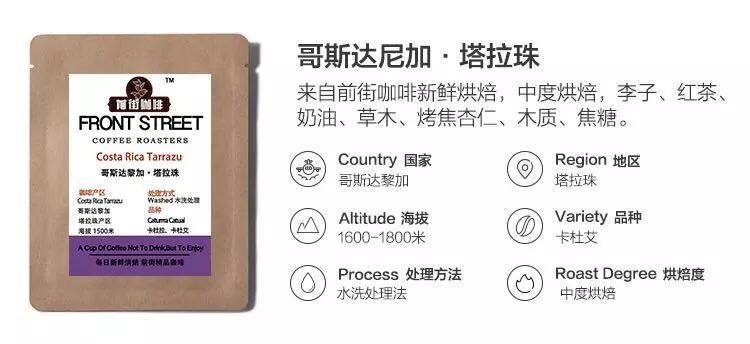
Country names --- Costa Rica, Panama, Guatemala, Rwanda, Ethiopia.
Growing regions --- Tarrazú: a major coffee-producing region in Costa Rica, located on the low-latitude volcanic belt of Central America, with excellent climate and soil conditions. Its central plateau and mountainous areas sit at roughly 800-2000 meters.
The same applies to Yirgacheffe (Ethiopian coffee region), Antigua (Guatemalan coffee region), Boquete (Panamanian coffee region), and Nyeri (Kenyan coffee region).
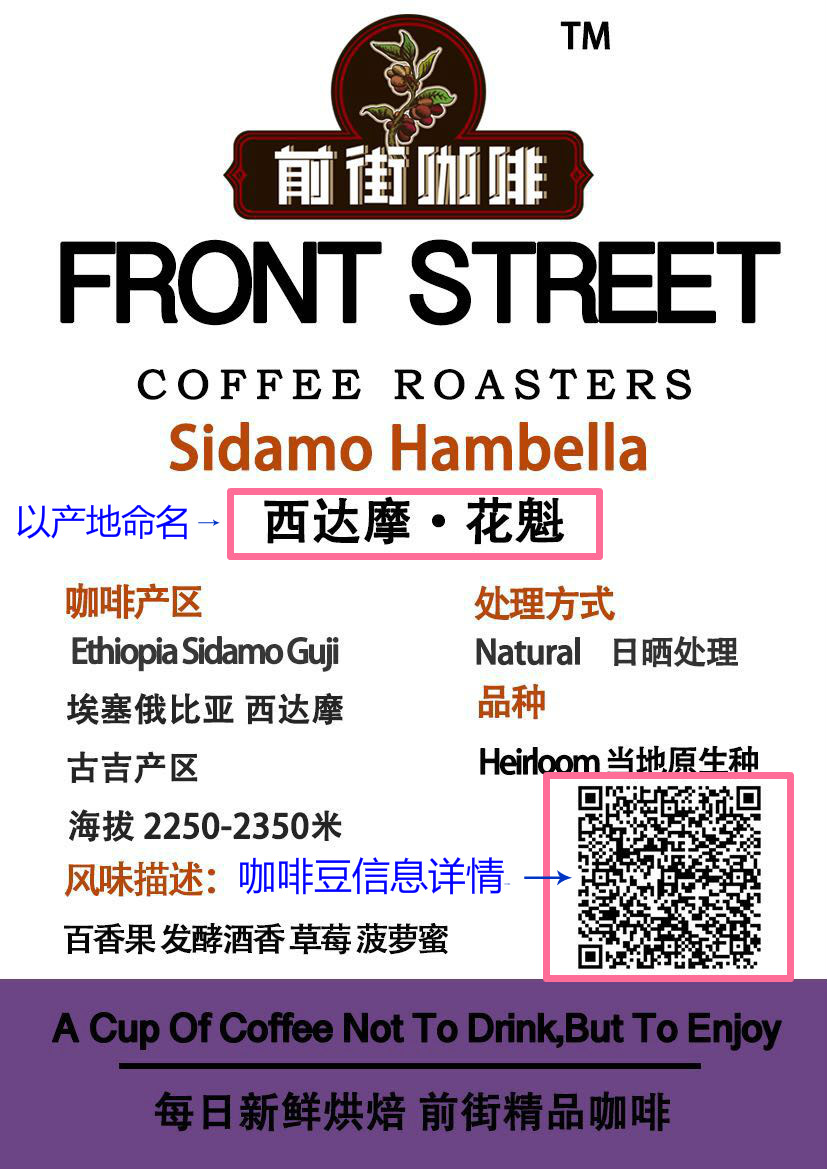
FrontStreet Coffee's new roasted-bean labels contain a hidden feature: an added QR code that points to specific growing-region information, pour-over guidance, and roasting information.
Coffee beans are generally named in the following ways.
Named by Country
Colombia, Guatemala, El Salvador, Bolivia, Nicaragua.
Named by Growing Region
Yirgacheffe, a small town under Sidamo, was separated out because of its unique flavor.
Gesha Village.
Named by Mountain Range
Blue Mountain: Jamaica.
Kilimanjaro: Tanzania.
Named by Variety
Mandheling: such as Gayo Mandheling, Lintong Mandheling, Kerinci Seblat Mandheling.
Named by Variety (continued)
Geisha: such as Panama Geisha, Colombia Geisha, Guatemala Geisha.
Named by Export Port
Mocha: a port in Yemen.
Santos: a port in Brazil.
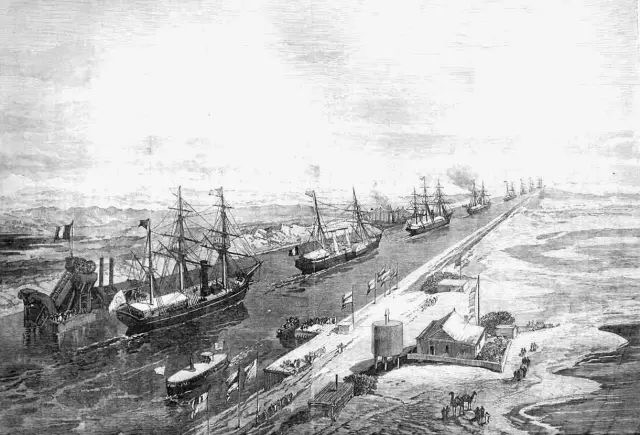
Malabar: Indian Monsooned Malabar, known as monsoon coffee beans; Malabar is a port in India.
Named by Unique Flavor or Special Processing Method
Ninety Plus takes a completely different approach from conventional specialty beans, dropping growing-region and estate names altogether and naming each bean after its flavor. Zhu Mang, for example, means "best approach" in the local dialect - the name starts from a flavor concept.
Collection | The Most Comprehensive Ninety Plus Detailed Explanation
Estate Names
Some estate-level beans indicate the estate directly. Names beginning with "La," "EL," or "finca" generally point to an estate - for example El Injerto Estate, Fazenda Rainha Estate, Panama La Esmeralda Estate, El Naranjo Estate, and Finca Canet Estate.
Processing Methods
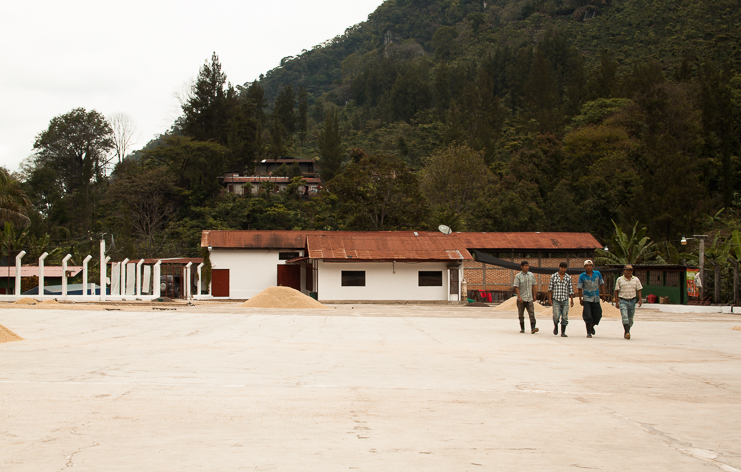
Natural, Washed, Honey, Wet-hulled, Semi-natural, Semi-washed, and others.
(Recommended reading: Professional Barista Training | Illustrated Guide to Coffee Cherry Processing, Flavor Characteristics and Roasting Changes)
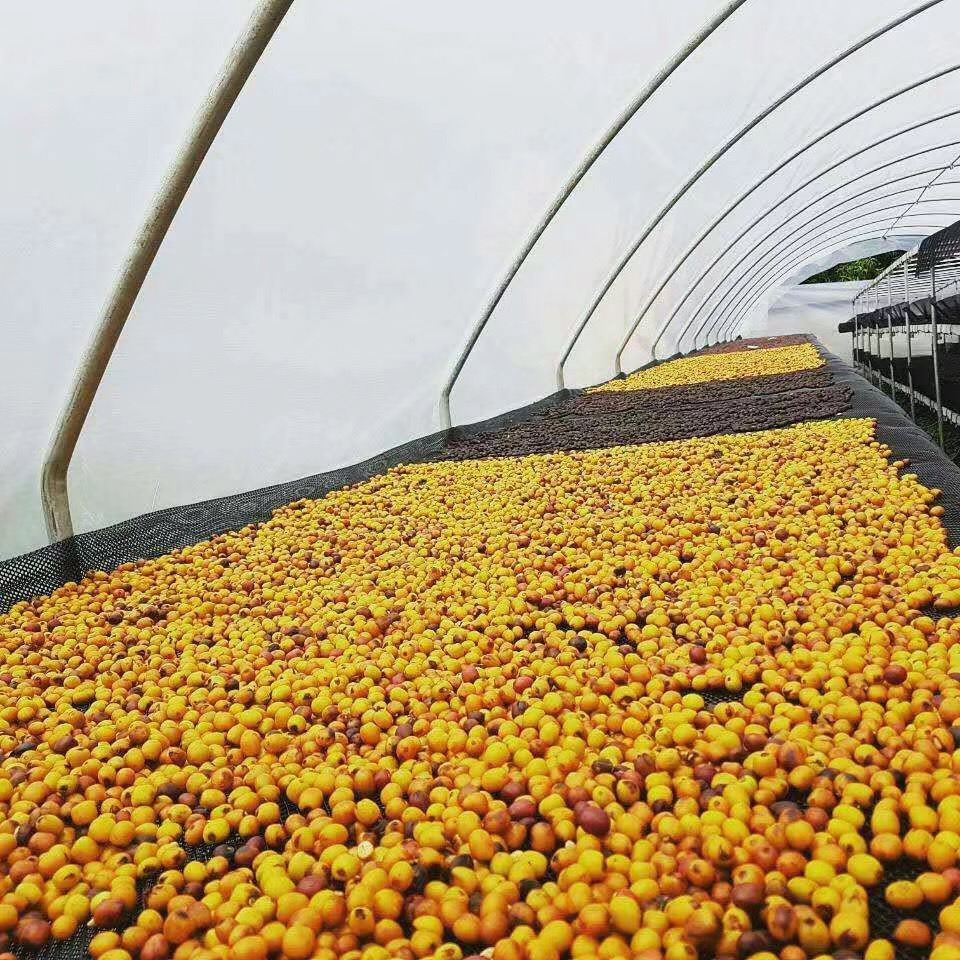
Honey Process: honey processing removes the pulp while retaining the mucilage, then dries the fruit with the parchment still on. Honey-processed coffee has higher sweetness than washed coffee, higher sugar content, and a relatively higher body.
Natural: the oldest, most original processing method. Harvested cherries are placed on patios - sometimes even spread directly on roadsides in the sun - and dried in sunlight for about 27-30 days, reducing moisture from 60% to about 12%. Natural-process characteristics: the lowest acidity, obvious sweetness, high body, and slightly lower cleanliness.
Full Washed: washed processing removes skin, pulp, and mucilage before drying. The beans are guided into a clean water tank and soaked for fermentation. Characteristics: obvious acidity, good cleanliness, medium body, high stability. (Semi-washed: see below.)
Also see Coffee Processing Methods | Indonesian Wet-hulled, Pulped Natural, Honey Process.
Varieties
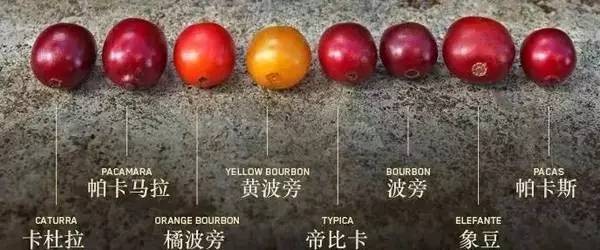
Geisha, Bourbon, Caturra, and Catuai are all coffee bean varieties. Complete Coffee Varieties | Introduction to Ancient Coffee Varieties, Introduction to Native and Mutation Varieties and Flavor Characteristics.
Bourbon: coffee produced from the Arabica Bourbon cultivar. Bourbon coffee was originally cultivated on Réunion, called Bourbon Island (Le Bourbon) before 1789, with rich chocolate aroma and nutty flavors.
Caturra: a natural mutation of the Arabica Bourbon variety.
Yellow Catuai: a hybrid of Mundo Novo and Caturra, first cultivated in 1949 by Brazil's Agronomic Institute of Campinas. Like Red Catuai, Yellow Catuai has high disease resistance and suits high-altitude cultivation. Both Catuai types have delicate, clean acidity.
Yellow Bourbon: a mutation from a cross of red-fruited Bourbon and a Typica mutation called "Amerelo de Botocatu" that produces yellow fruit, with sweet, smooth fruit sweetness, obvious nutty flavors, balanced and gentle acidity, and cleanliness.
Pacamara: a coffee variety discovered in El Salvador in the 1950s, a hybrid of Pacas (a natural mutation of Bourbon) and Maragogype (Elephant Bean).
Grading
SHB: Strictly Hard Bean, at altitudes between 1600-1700 meters. High-altitude beans are harder because they have more nutrients, a longer fruit growth cycle, and higher density, and they can withstand high-temperature roasting; the beans are hard in texture.
G1: Indonesian beans use this defect-proportion grading method and are divided into six levels, G1-G6. Ethiopia uses the same approach, grading by defect level from G1 to G5, where 2-3 defective beans per 300 grams of raw beans classifies as G1. The highest grades for natural-processed beans are G1 and G3.
AA: origins that grade by bean size. Kenya is divided into nine grades based on bean shape, including PB (Peaberry), and by size: E (Elephant), AA, AB, C, T, TT, MH, and ML. Tanzania, Uganda, and Yunnan also use AA grading.
NY 2: Brazil's system evaluates defect proportion, size, and flavor and taste scores under its own independent grading system, more complex than other countries. For example, "Brasil Santos NY 2 SC17/18 SS FC" - NY2 is defect-proportion grading, where larger numbers represent higher defect proportions: 2, 2/3, 3, 3/4, and so on. NY indicates that it follows New York grading standards. Coffee Regions | Brazilian Coffee Grading System and Four Common Brazilian Processing Methods.
Special Names
COE: Cup of Excellence, held annually. Specialty coffee growers submit their best beans to domestic or international judges for review. After at least five evaluations, the highest-scoring beans are awarded the COE designation. Cupping | How to Conduct Cupping and Scoring, Detailed Scoring Standards for SCAA and COE Cupping Items.
Micro lot: micro-lot beans come from a single estate, specially selected from the whole crop for better and more distinctive flavor. The quantity that qualifies as micro lot is extremely limited - between five and one hundred bags, usually around thirty to forty. Most micro-lot beans come from "coffee honor students" selected by individual estates or cooperatives.
FNC: the Colombian Coffee Growers Federation, established in 1927 and fully responsible for coffee-related matters, including cultivation technology research, sales, marketing, quality-standard building, and coffee-farmer education and training.
Cauca Best Cup: jointly organized by well-known American traders, local exporters, and the Colombian Coffee Association. The first Cauca Best Cup in 2014 received about 200 samples, while 2015 saw more than double that - about 500 small farmers competing. Organizers select the top 30 from 500-plus samples, then an international jury cups them to choose the final top 12. On the last day, green bean traders and roasters from around the world attending the Cauca Cup bid on them.
BOP: Best of Panama, the Panama green bean competition. 2018 Panama BOP | Auction Results Released! New Record Breaker Breaks Historical Record.
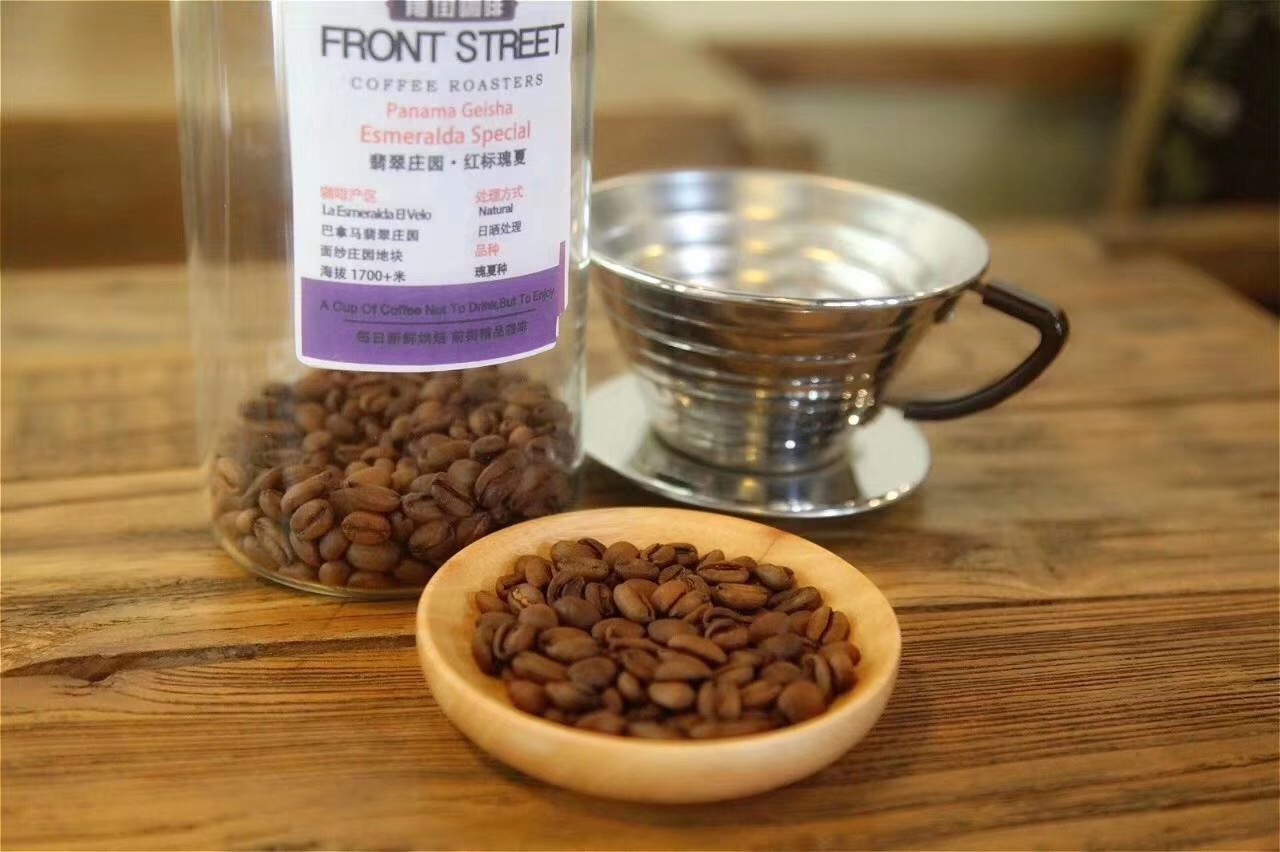
Flavor Descriptions
Citrus flavor, nutty flavor, chocolate flavor, and more.
Good beans deliver obvious sweetness, and nutty, cocoa, and honey sweetness in particular are common and popular notes.
FrontStreet Coffee Recommendation
Reading a label is one thing; tasting the region is another. FrontStreet Washed Yirgacheffe is the classic starting point for understanding how a growing region, a variety, and a processing method come together - white jasmine, bright citrus and lemon acidity, and a tea-like finish, at a price that makes it a genuine everyday bean.
To see what a specific processing station does with the same region, FrontStreet Gedingding Cooperative is graded G1 and washed in the traditional way, showing elegant white florals, citrus, orange, and green tea. And for the natural-process counterpoint, FrontStreet Red Cherry is dried from whole ripe red fruit, layering tropical fruit and honey sweetness over the familiar Yirgacheffe citrus.
Important Notice :
FrontStreet Coffee is a long-established specialty coffee roaster in Guangzhou China, selling freshly roasted beans from its own farm in Yunnan as well as dozens of carefully selected single-origin beans from around the world for both pour-over and espresso. The products deliver consistently excellent quality and great value, with shipping within 24 hours. Guangzhou's FrontStreet Coffee shop is recommended by many coffee lovers, and the beans are now available online at the Tmall 。
FrontStreet Coffee has moved to a new address:
FrontStreet Coffee Address: 315,Donghua East Road,GuangZhou
Tel:020 38364473
 Scan and follow the En Gafei WeChat official account. Please indicate that the reprint comes from "En Gafei".