Guatemala Coffee Bean Recommendations: Affordable and Delicious Finca Las Delicias Estate Coffee
Guatemala Finca Las Deliclas
01 | Introduction to Guatemala Coffee Growing Regions
The Republic of Guatemala (Spanish: República de Guatemala), translated as "Guatemala di" in Taiwan, is a country in Central America at the southern end of the North American continent. It borders the Pacific Ocean to the west, the Caribbean Sea to the east, Mexico to the north, Belize to the northeast, and Honduras and El Salvador to the southeast. Guatemala produces approximately 3.5 million bags of coffee a year, with green coffee accounting for 40% of the country's total agricultural exports. Focused primarily on coffee cultivation and export, the country has fertile soil suited to coffee trees, an appropriate climate, abundant water, and high-altitude planting conditions.
Coffee was truly introduced to Guatemala in 1750 by Jesuit priests, and German colonists developed the local coffee industry in the late 19th century. Today most of Guatemala's coffee production is in the south of the country. Guatemala has eight main coffee-growing regions: Antigua, Cobán, Lake Atitlán, Huehuetenango, Fraijanes, Oriente, and San Marcos. Among them, Huehuetenango and Antigua are the best known to enthusiasts.
Located in the tropics with many volcanoes within its borders, the northern and eastern coastal plains have a tropical rainforest climate, while the southern mountains have a subtropical one. The year divides into dry and wet seasons, with May to October the wet season and November to April of the following year the dry season. Annual precipitation in the northeast ranges from 2,000 to 3,000 millimeters, while the south receives 500 to 1,000 millimeters. Forests cover half the country, and the latitude is optimal for coffee production. Because coffee is an important local cash crop, a rich coffee culture has grown up: people drink coffee daily, and most lunches include a cup.
Guatemala Coffee Beans - Las Deliclas
Las Deliclas
The Fraijanes region surrounds the capital, Guatemala City, and features high altitude, abundant rainfall, and significant humidity swings. Volcanic ash from Pacaya, Guatemala's most active volcano, supplies essential minerals to the region's soil — though it occasionally affects personal safety and infrastructure.
The unique geography of the Fraijanes plateau — volcanic soil, high altitude, a humid and rainy climate, and active volcanism — creates ideal coffee-growing conditions. The Pacaya volcano here is the most active of Guatemala's three still-erupting volcanoes, often leaving the Fraijanes plateau under a thin layer of ash while feeding the soil abundant minerals. During the bean-drying period the plateau gets plenty of sunshine; mornings are often cloudy and foggy, but those conditions clear quickly, ensuring adequate sun.
Coffee cultivation at Las Deliclas farm on the Fraijanes plateau began in 1920. The farm grows diverse varieties including Bourbon, Caturra, and Pacamara. Of the farm's total 205 acres (1 acre = 4,046.8 square meters), 173 acres are devoted to coffee, while the remaining 32 acres of native forest serve as habitat for local wildlife. The farm holds several natural springs that provide sufficient, high-quality irrigation during the dry season; these springs also power the coffee processing plant (for washed-processing water).
02 | Guatemala Coffee Bean Processing Methods
Because of the shortcomings of traditional natural processing, the washed method was developed. It uses a depulping machine to separate most of the fruit flesh from the beans, then guides the parchment beans into a clean water tank, where they soak and ferment so the remaining pulp layer is completely removed. In the past — about five years ago — the washed method was often the first choice for processing high-quality Guatemala beans.
Through washed processing, underripe and defective beans are separated out by buoyancy, and fermentation is easier to control. The flavor therefore lacks the off-notes sometimes found in naturals, presenting instead distinct fruit acidity, slightly enhanced complexity, and a cleaner cup (free of negative flavors such as astringency or sharpness). Because it is so clean, however, the richness of flavor is somewhat weaker.
03 | Guatemala Coffee Bean Green Analysis
Like other Central American producers such as Costa Rica, El Salvador, Mexico, and Honduras, Guatemala grades its beans by altitude. Coffee grown higher generally has higher quality than coffee grown lower, because temperature falls as altitude rises. In a high-altitude environment, coffee grows more slowly, which helps desirable compounds accumulate.
The surface of the green beans carries less silver skin and almost no obvious defects, placing them at a premium grade level. The green beans show grassy and spicy aromas, with a distinctive smoky scent and a strong fragrance.
This is why altitude-based grading systems exist. So what does that system look like? Taking Guatemala beans as the example: the higher the altitude, the higher the density of the beans, and the higher the grade of the green coffee —
The highest grade of Guatemala coffee is SHB (Strictly Hard Bean), grown above 1350m.
Next is HB (Hard Bean), grown between 1200m and 1400m.
There is also SH (Semi-Hard), grown at 1200m.
Guatemala Coffee Bean Green Information
Country: Guatemala
Grade: SHB
Region: Fraijanes, Guatemala City
Altitude: 1675 meters
Harvest Period: October to February of the following year
Processing Method: Washed
Varieties: Bourbon, Caturra
Processing Plant: Las Deliclas Farm
Flavor: Black tea, floral notes, rich caramel sensation
04 | Guatemala Coffee Bean Roasting Analysis
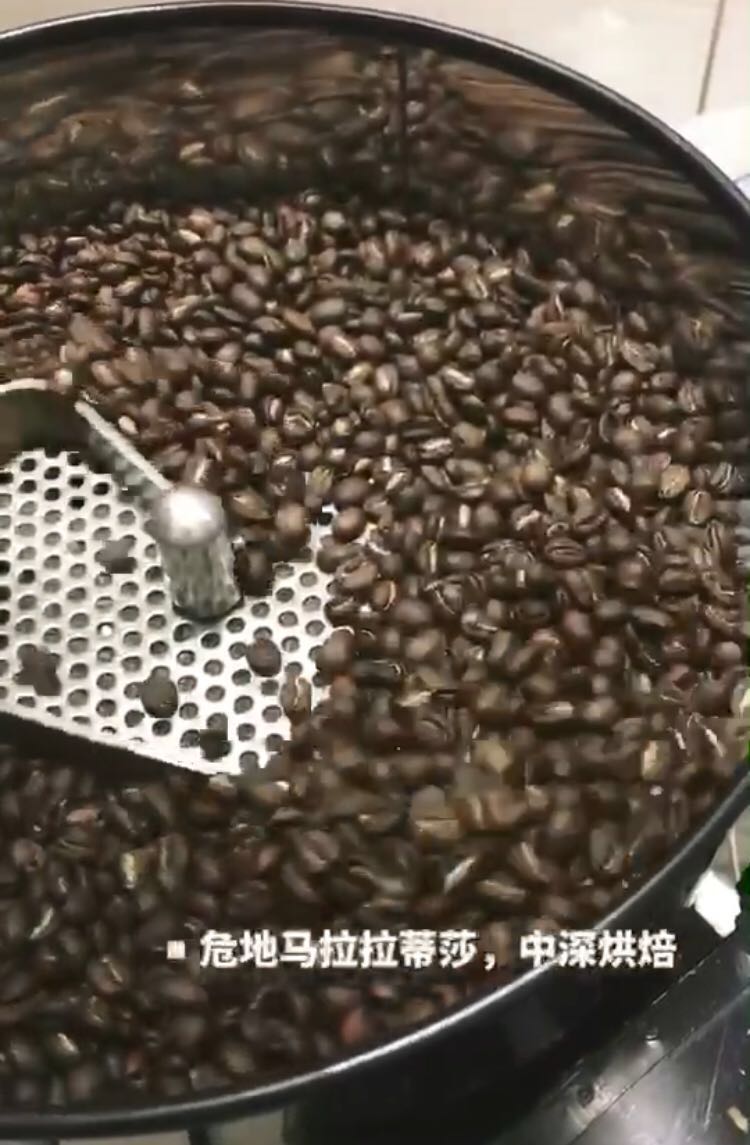
Las Deliclas is composed of two varieties with different densities. When green beans of different densities are roasted together, set the charge temperature based on the Bourbon variety, and when performing the throttling method use the Caturra variety as the standard — that is, with new-crop, high-density beans (when roasting a mixture of two or more green varieties, use the highest-density green bean as the standard for the throttling method: gentle preheating for the first minute).
Using a Yangjia 800N roaster with 550g of green beans, the specific operation:
Charge into the drum at 200°C with the damper at 3. After 1 minute of throttling, reduce heat to 160°C, keeping the damper unchanged. When the drum temperature reaches 165°C, adjust heat again, reducing to 140°C. At 5'40", the temperature reaches 153.9°C, the bean surface turns yellow, the grassy aroma disappears completely, dehydration is complete, and the damper goes to 4.
At the 9-minute mark, ugly wrinkles and black spots appear on the bean surface, and the distinct toast aroma clearly transforms into coffee aroma — the prelude to first crack. Listen carefully for the sound of first crack. First crack begins at 9'22"; reduce heat to 80°C and open the damper fully to 5 (be very careful when adjusting heat — not so low that the cracking sound disappears), then to 60°C. Discharge at 197.2°C.
Cupping Profile
Characteristics: Balanced flavor, full body, with chocolate undertones
04 | Guatemala Coffee Bean Brewing Analysis
Hand Pour Guatemala Coffee Bean Parameter Reference
Using a V60 dripper, 16g of coffee to 32g of water for a 30-second bloom, extract at 89–90°C with a 1:14 ratio, medium-fine grind at Fuji setting 4. For the second pour, add water to 140ml and pause; wait for the water to drop before slowly adding more, keeping an even speed and the water level not too high. Add water again to 220ml and stop. Extraction time 2:15. Unique smoky taste and chocolate flavor — everyone can fine-tune to their own preference.
Guatemala Coffee Bean Brand Recommendations
Guatemala coffee beans roasted by FrontStreet Coffee guarantee both brand and quality. More importantly, they offer extremely high value: a 227-gram package costs only 118 yuan, and at 15g of grounds per cup, one package makes 15 cups — about 8 yuan each. Against the dozens of yuan per cup charged by coffee shops, that is a conscientious recommendation.
FrontStreet Coffee Recommendation
If you're just starting out with specialty coffee, these FrontStreet entry-level picks are a good place to begin. From Ethiopia, the FrontStreet natural Huakui shows berry, floral, jackfruit, melon, and honey, while the FrontStreet washed Gudingding cooperative — a typical Yirgacheffe — brings jasmine, lemon acidity, and berry notes. From Brazil, the FrontStreet Cerrado Red Bourbon drinks creamy and affordable, with the classic cream, peanut, and cocoa flavors, and the FrontStreet Queen Estate, grown higher and made from the rare Yellow Bourbon, adds butter, seed, macadamia, and almond aromas on top of a sugarcane-like sweetness that stays thick and smooth whether drunk black or with milk.
For other origins, the FrontStreet Colombia Huila comes from Colombia's most famous specialty region — ringed by mountains above 1,500 meters, where the country's most important rivers converge to bring abundant water — and shows gentle florals with soft fruit acidity. Costa Rica is all about honey processing: the FrontStreet Mozart uses a raisin honey process and the FrontStreet Blackberry a black honey process, giving raisin and blueberry sweetness with osmanthus and rose fragrance that shines in pour-over, cold brew, americano, or latte. And for the most famous name of all, the FrontStreet Boquete washed Gesha is an entry-level Panama Gesha from the country's signature specialty region — a pure variety, washed, with the clear orange-blossom honey character and exceptional value.
Important Notice :
FrontStreet Coffee is a long-established specialty coffee roaster in Guangzhou China, selling freshly roasted beans from its own farm in Yunnan as well as dozens of carefully selected single-origin beans from around the world for both pour-over and espresso. The products deliver consistently excellent quality and great value, with shipping within 24 hours. Guangzhou's FrontStreet Coffee shop is recommended by many coffee lovers, and the beans are now available online at the Tmall 。
FrontStreet Coffee has moved to a new address:
FrontStreet Coffee Address: 315,Donghua East Road,GuangZhou
Tel:020 38364473
 Scan and follow the En Gafei WeChat official account. Please indicate that the reprint comes from "En Gafei".