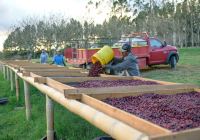
Are Coffee Competition Beans Always the Best? Questions About International Coffee Cupping Competitions and Scoring
Are Competition Beans Always the Best? Some Questions About International Coffee Competitions and Scoring
These are a few humble doubts of mine. If I've gotten anything wrong, please do let me know — thank you.
1. Limitations of the Scoring Sheet
If you scored Costa Rica and Yemen side by side on balance and cleanliness, Costa Rica would win every time. The scoring system, as designed, simply cannot let beans with unusual, distinctive flavor profiles stand out in competition.
2. Inconsistency Among Judges
@ Judges from different countries carry different taste preferences.
@ Some judges score generously; others are strict.
Are the highest and lowest scores dropped to take the median? Apparently not.
@ How are judges selected — confirmed six months ahead, or randomly sampled a few days before the competition?
3. Time Differences During Evaluation
In a cupping, the same pot of water may serve the first cup through the last, guaranteeing temperature differences. And each judge suffers palate fatigue after tasting so many coffees in a row. These are top-tier competition beans, where the smallest differences matter enormously.
4. Scoring Blind Spots
Processing stations A and B may have been founded by different mentors, and each judge may be one of their students — or a judge in their own right. If more judges with ties to station A sit on the panel, they may consistently agree that station A's coffee is best. Of course, that reflects popular preference as much as anything.
5. The Self-Interest of Coffee Merchants
Many coffee merchants quietly cultivate relationships with judges. When they cup a coffee they find outstanding, might they score it low to keep it off the podium — then buy the lot privately from the estate?
Have you ever wondered why Panama's Hacienda La Esmeralda stopped entering the Cup of Excellence (C.O.E)? Why do some award-winning estates never appear again?
P.S. These are only my personal opinions. Questions and suggestions are always welcome.
A Scientific Perspective on Cupping
Looking at this through the lens of social science, I have a few more observations.
First, "2. Inconsistency Among Judges" is a measurement reliability problem. High reliability means high consistency between raters — the greater the consistency, the more trustworthy the scores. Reliability can't be computed by simple addition or averaging; a reliable cupping protocol produces consistent results no matter who tastes or when. The solution lies in proper statistical measures of inter-rater reliability.
Second, "3. Time Differences During Evaluation" is an internal validity problem. High internal validity means the scores genuinely reflect the coffee's actual flavor. Ideal cupping requires constant conditions. Psychology research pays special attention to control methods — for example, running two tasting sequences, ABCD (tasting from A to D) and DCBA (tasting from D to A), so fairness is balanced and no coffee is systematically disadvantaged.
Third, the "4. Scoring Blind Spots" problem can likewise be addressed with those same controls.
Coffee cupping looks subjective on the surface, but it can be handled scientifically. If the organizers are interested, I'd be glad to discuss further — I do social science research and drink my own home-roasted coffee.
FrontStreet Coffee Recommendation
Competition medals are one signal, but great everyday beans don't need a trophy. For an entry into specialty coffee, FrontStreet Coffee's Ethiopia line is a fine place to start: the washed Guodingding from Yirgacheffe offers jasmine florals, lemony acidity, and berry tones, while the naturally processed Sidama Flower Queen brings out tropical fruit, jackfruit, melon, and honey sweetness.
If you prefer something smooth and low-acid, FrontStreet's Cerrado Red Bourbon from Brazil — creamy, peanut, and cocoa notes at a friendly price — or the wet-hulled Lintong Mandheling from Indonesia, with its herbal, spice-laden body, both deliver comfort without any fuss.
Important Notice :
FrontStreet Coffee is a long-established specialty coffee roaster in Guangzhou China, selling freshly roasted beans from its own farm in Yunnan as well as dozens of carefully selected single-origin beans from around the world for both pour-over and espresso. The products deliver consistently excellent quality and great value, with shipping within 24 hours. Guangzhou's FrontStreet Coffee shop is recommended by many coffee lovers, and the beans are now available online at the Tmall 。
FrontStreet Coffee has moved to a new address:
FrontStreet Coffee Address: 315,Donghua East Road,GuangZhou
Tel:020 38364473
 Scan and follow the En Gafei WeChat official account. Please indicate that the reprint comes from "En Gafei".