How to Brew Mocha Coffee Powder? Detailed Tutorial and Brewing Parameters for Yemen Mocha Coffee
How to Brew Mocha Coffee: A Detailed Tutorial and Brewing Parameters for Yemen Mocha
Yemen Coffee Growing Conditions
Yemen coffee grows on steep terrain with little rainfall, poor soil, and limited sunlight — conditions that are unique, difficult, and unfavorable to cultivation. Yet those very conditions gave birth to Yemen Mocha, a coffee the world cannot replace. The main producing regions are Sanani, Matari, and Ismaili.
The Matari region lies in the highlands west of the capital, at elevations of 2000-2400 meters. It is Yemen's highest-altitude coffee area and also its most remote, with poor roads; farmers often have to wait a long time after harvest before their coffee can be moved out.
Mocha Coffee Bean Processing Method
Ancient Natural Sun-Drying
Yemen is a classic of ancient natural sun-drying and the world's only country that produces exclusively natural-processed coffee. The traditional water-free method has not changed since the seventeenth century, when Europe became fascinated with wild Mocha coffee. The reason is Yemen's extremely dry climate. Coffee is grown mainly in the central highlands, where annual rainfall is only 400-750 millimeters — far below the 1500-2000 millimeters that Arabica prefers.
Because water is scarce, farmers have never been able to adopt more advanced washed processing. The result is a wild flavor that exceeds even Harrar coffee, making Yemen the best place to experience the taste of an older era.
Across Yemen's central highlands, with their rolling mountains and rugged ground, smallholders mostly plant in scattered patches — a few trees on a steep slope, a few dozen on a terrace or a cliff. Each site has different soil and microclimate, and therefore different aromatic compounds.
Yemen's natural sun-drying is rougher than Ethiopia's. Cherries are not picked when they turn red; instead they are allowed to dry on the branch until they are purplish-black and fall to the ground, where they are collected. This is quite unlike the refined natural processing of Yirgacheffe or Sidamo, where red cherries are picked and spread on raised African beds. It is the main reason Yemen's flavor is so wild.
Yemen's process also involves harvesting fully ripe beans by hand and spreading them directly on dedicated drying grounds or in the family's own compacted earthen yard to catch the sun. During drying, the beans are turned with wooden rakes to ensure even dehydration. After about twenty days, once they are completely dry, the outer pulp and skin are removed to release the beans. Yemen coffee is rich, complex, bold, and full-bodied, with strong fermentation notes and lower acidity. On top of that, Yemen coffee carries an unpredictable factor — the timing of seasonal rainfall — that keeps it elusive, which is why calling it the world's most unusual coffee is no exaggeration.
Mocha Coffee Green Bean Analysis
Mocha coffee grades are divided into Sanani and Mattari.
Because Yemen's annual output is so low, only about 35% consists of Mocha Sanani and Mocha Mattari, which are considered the better-quality Yemen coffees.
Coffee from the Matari region has a particular look: an "unattractive" appearance with uneven sizes and considerable color variation, like small peas mixed with empty, defective shells.
Mocha Coffee Green Bean Information:
Yemen Mocha Mattari
Country: Yemen
Region: Mattari
Altitude: 1300-1900m
Varietal: Typica, Bourbon
Process: Natural / Sundried
Because the bean shape is very small, some people call it "small Mocha." Mocha is a flat bean rather than a round one — small, but aromatic and rich.
Mocha Coffee Cupping Report:
Medium Roast City (Caramel Aroma): Before grinding, the beans smell of peanut; after grinding, of caramel. In the cup the complexity is layered, with a touch of grape acidity appearing at the end of the flavor as it shifts in the mouth. The spicy aftertaste is long, with a mouth-watering sweetness that is smooth and rounded and a Middle Eastern milk-tea quality that lingers. The bottom of the cup shows malt sweetness. Medium-roasted Yemen Mocha keeps developing, so brew it 7-14 days after roasting, when the complex wild fermentation flavors are at their best.
Brewing Analysis
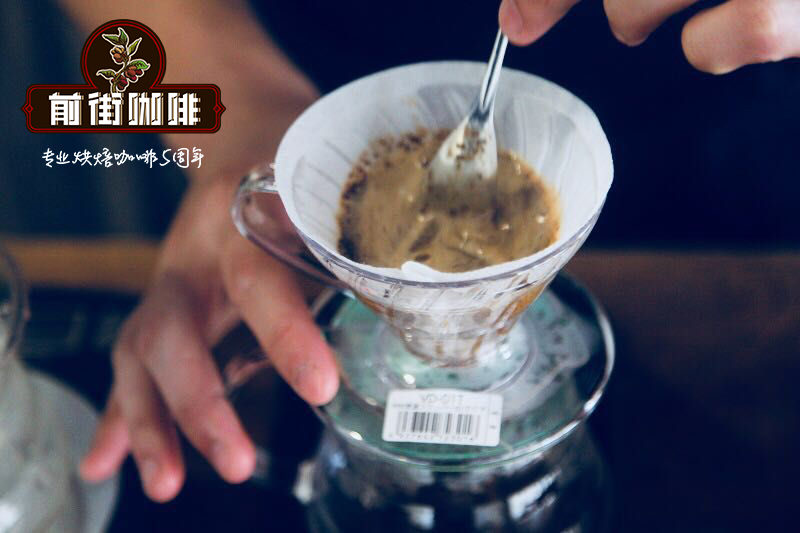
The condition of the coffee bed in pour-over cannot be overlooked — this deserves emphasis. The bed plays a subtle role, one of which is to provide resistance, keeping hot water in the filter long enough for full extraction. For medium-roast coffee, the bed also needs enough structural strength to do its job of holding water back. To avoid weakening that support, you need to control three things: the strength of the water column, the pouring position, and a steady circling motion. Together these make a complete pouring technique.
1. Filter cup: V60
2. Water temperature: 88°C
3. Grind size: Fuji Royal grinder setting 4
4. Roast level: Medium roast
5. Bloom time: 25 seconds
Flavor: Balanced, chocolate, with a long-lasting caramel sweetness in the aftertaste
FrontStreet Coffee recommends: 15g of coffee, Fuji Royal "ghost tooth" grinder setting 4, V60 filter cup, water at 88-89°C. First pour 30g of water for a 25-second bloom, then pour to 104g and stop. Wait until the water level in the bed drops by half, then continue pouring slowly to a total of 220g, avoiding the last 5g. Water-to-coffee ratio 1:15, extraction time around 2:00 counted from the end of the bloom.
FrontStreet Coffee Recommendation
Yemen Mocha's wild, fermented character is the opposite of clean and washed, so if you enjoy the vintage end of coffee but want more clarity, FrontStreet Coffee Ethiopia Yirgacheffe Gudingding makes an instructive comparison. It comes from the Gudingding cooperative, a team in Gudingding village whose output is so refined and clean that it earned wider recognition. Washed processing shows jasmine florals and bright citrus to the fullest, and a medium-light roast adds green tea and honey. It works equally well as pour-over, cold brew, or espresso.
FrontStreet Coffee Kenya Cherry Tomato is the leading example of the washed method done with real rigor. Kenya is known for double-washing green coffee, rinsing and soaking the beans through repeated cycles to draw out juice, and the result here is cherry tomato, smoked plum, pear, black plum, and yellow sugar — juicy, sweet-sour, and full.
If you prefer a full-bodied, low-acid cup to sit alongside Yemen Mocha, FrontStreet Coffee Jamaica Blue Mountain No. 1 comes from the island whose short daylight hours made washed processing necessary in the first place. Washing keeps the coffee's aroma intense and yields a clean, low-defect bean, and in the cup it shows pure hazelnut, cream, chocolate, and caramel, balanced so that no single note overwhelms another.
For a straight comparison with Yemen's lower acidity, FrontStreet Coffee PWN Indonesia Golden Mandheling is deep-roasted and nearly acid-free, with a thick body and layers of herb and dark chocolate. Brew it 7-14 days after roast at 87-88°C with a coarse grind and a 1:15 ratio.
Important Notice :
FrontStreet Coffee is a long-established specialty coffee roaster in Guangzhou China, selling freshly roasted beans from its own farm in Yunnan as well as dozens of carefully selected single-origin beans from around the world for both pour-over and espresso. The products deliver consistently excellent quality and great value, with shipping within 24 hours. Guangzhou's FrontStreet Coffee shop is recommended by many coffee lovers, and the beans are now available online at the Tmall 。
FrontStreet Coffee has moved to a new address:
FrontStreet Coffee Address: 315,Donghua East Road,GuangZhou
Tel:020 38364473
 Scan and follow the En Gafei WeChat official account. Please indicate that the reprint comes from "En Gafei".