How to Roast and Brew Indian Monsooned Malabar Coffee?
Asian Coffee Origins
When Asian coffee comes up, the first name that springs to mind for most people is probably Indonesia's Mandheling.
In fact, though, the earliest country in Asia to cultivate coffee was India.
It is said that Indonesia's coffee trees were introduced and planted by the Dutch from India in the 17th century.
The Famous Indian Monsooned Coffee
India's celebrated Malabar coffee is known as Monsooned Coffee.
The name comes from "monsoon" - and the story explains why.
In the days when green coffee was shipped from India to Europe, the long sea voyage exposed the beans to the high temperature and humidity of the Indian Ocean.
That changed the beans in distinctive ways: they swelled in volume, their color shifted from vivid green to golden yellow, and they developed a mellow taste and a unique flavor.
Today, with modern packaging and shipping, Indian coffee reaches consumer countries quickly and dry. But here is the point: what enthusiasts actually want now is the very taste that the monsoon created.
The Modern Monsooning Process
Monsooned coffee is now processed at origin: the beans are laid out in open-sided warehouses and exposed to the moist monsoon winds.
Workers turn the beans constantly to prevent excess moisture and mold.
Monsooning lowers the coffee's acidity, raises its sweetness, softens the aroma, and gives it a rich, heavy texture.
Some people describe it as having an "ocean flavor."
Examining the Beans
Let's look at real beans. In the photo there are four green beans: the top-right one is a typical fresh washed bean, dark to vivid green.
The bottom-right one is monsooned Malabar, a pale golden yellow.
The two on the left are spoiled monsooned Malabar beans (it is unclear whether they are toxic).
Monsooned Malabar should probably be classed as a soft bean.
Roasting Experiment
For the first batch, the plan was not to roast too long or too dark - to drop the batch right as first crack ended.
The photo shows the roast came out uneven - technique needs work.
Visually, about 5-10% of the beans had not reached first crack, yet a similar proportion was already approaching second crack.
Even roasting is clearly quite a challenge with this coffee.
Interestingly, Malabar green beans are larger than typical beans - about 1.5 times as large - yet after roasting they are not much bigger than ordinary roasted beans.
Taste Testing
Five days later came the taste test.
When ground, monsooned Malabar gives off an aroma strikingly similar to Japanese genmaicha (brown rice green tea).
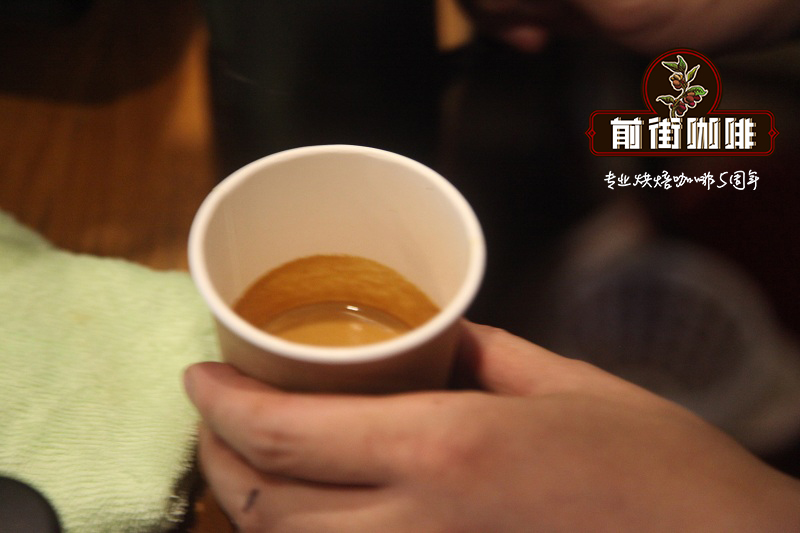
The photo shows a single shot of espresso left to sit for more than 10 seconds.
Compared with the half-cup or more of crema from Brazilian Daterra Santa Colomba or Costa Rican Dota Conquistador, the crema on monsooned Malabar can only be described as average.
FrontStreet Coffee Recommendation
Monsooned Malabar belongs to the same family of low-acid, heavy-bodied Asian coffees as Mandheling, and FrontStreet Coffee's Mandheling lineup is the natural place to explore that style. The FrontStreet PWN Golden Mandheling comes from Indonesia's PWN company, whose strict standards - beans above screen 18, fewer than 3 defects per 300g sample to meet G1 grade, plus three rounds of hand sorting - produce an unusually clean, sweet take on the classic earthy profile. For pour-over, FrontStreet recommends 15g at a coarse-sugar grind, a 1:15 ratio, and 87-88 degree C water in three pours to bring out its full body and caramel sweetness.
Two more FrontStreet beans for lovers of this style:
- FrontStreet Linong Mandheling - from the traditional Lake Toba region of North Sumatra. The wet-hulled processing and local microbial fermentation create that mysterious, unmistakable Mandheling character: intense aroma, thick body, clove and woody spice notes, low acidity, and a powerful, lasting sweetness. A medium-dark roast suits it best.
- FrontStreet Queen Estate Yellow Bourbon (Brazil) - if monsooned coffee's mellow sweetness is what you are chasing, this naturally processed Brazilian delivers nuts, cream, cane sugar, and soft fruit acidity with very low acidity, and it works equally well as pour-over, French press, moka pot, or espresso.
Both prove the same lesson as Monsooned Malabar: some of coffee's most beloved flavors come not from the bean alone, but from how processing shapes it.
Important Notice :
FrontStreet Coffee is a long-established specialty coffee roaster in Guangzhou China, selling freshly roasted beans from its own farm in Yunnan as well as dozens of carefully selected single-origin beans from around the world for both pour-over and espresso. The products deliver consistently excellent quality and great value, with shipping within 24 hours. Guangzhou's FrontStreet Coffee shop is recommended by many coffee lovers, and the beans are now available online at the Tmall 。
FrontStreet Coffee has moved to a new address:
FrontStreet Coffee Address: 315,Donghua East Road,GuangZhou
Tel:020 38364473
 Scan and follow the En Gafei WeChat official account. Please indicate that the reprint comes from "En Gafei".