Introduction to 90+ Coffee Estates Ninety Plus Geisha Coffee Bean Processing Process Flavor and Taste Description

Customers who visit FrontStreet Coffee always ask which coffee is currently the best-tasting, but FrontStreet Coffee cannot give a single answer. Everyone has their own taste preferences: some like the herbal and dark chocolate flavors of FrontStreet Coffee's Indonesian Mandheling; some enjoy the obvious sweetness and light floral notes of FrontStreet Coffee's Panama Mariposa; others prefer the rich wine aroma and fermentation character of FrontStreet Coffee's Honduras Sherry. Different strokes for different folks - so it is impossible to name one "best" coffee. However, FrontStreet Coffee can tell you which coffee is the most expensive in the store. For many specialty coffee enthusiasts, Geisha coffee is undoubtedly the "white moonlight" of their hearts, and FrontStreet Coffee's Geisha is certainly of the highest grade.
The World's Most Expensive Coffee: Panama Geisha
Although Panama is not one of the world's top coffee-producing countries, it possesses the world's most expensive coffee today: Panama Geisha. Since the Best of Panama (BOP) competition in 2004, Geisha prices have remained consistently high. Below, FrontStreet Coffee introduces three world-renowned Geisha estates: Hacienda La Esmeralda, Ninety Plus Gesha Estates, and Sophia Estate.
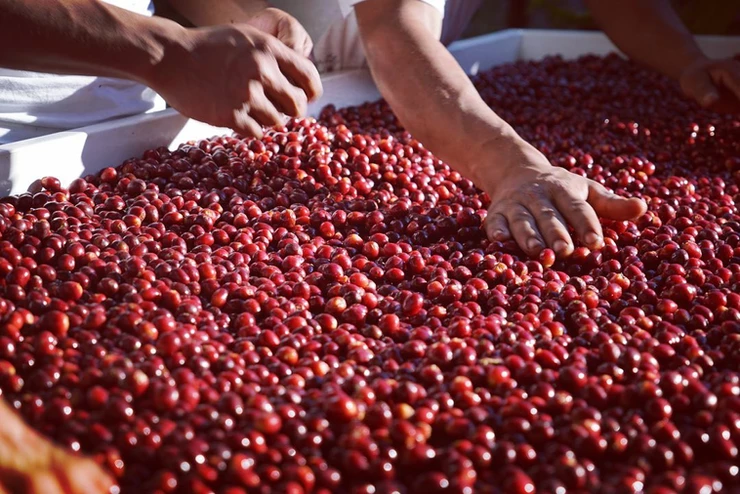
Ninety Plus Gesha Estates
The design inspiration for Ninety Plus Gesha Estates comes from the wild growth of Gesha varieties in their natural habitat in Ethiopia. The Gesha variety and all heirloom coffee varieties originate from the wild forests of Ethiopia. These heirloom varieties have very long lifespans - the longest lasting up to 100 years or even longer - and they produce relatively small quantities of coffee. In 2009, Joseph Brodsky, founder of Ninety Plus Gesha Estates, had the opportunity to acquire this land (approximately 200 hectares) and planted shade-loving Ethiopian Geisha coffee. In 2014, Ninety Plus Estates first cultivated Geisha on a large scale, and since then Ninety Plus Gesha Estates has won the World Brewers Cup championship five times within six years.

According to FrontStreet Coffee's research, Ninety Plus Estates currently has five series: Signature, Innovation, Founder's Selection, Limited Edition, and Ascent. The Signature series contains five varieties - Nekisse, Lycello, Juliette, Perci, and Lotus - plus a mixed heirloom variety collection. The Innovation series includes five coffees: Ruby, Carmo, Tigre, Yuzo, and Kule. The Founder's Selection series currently has three batches of Geisha (#0602, #0526B, #0317), with a starting price of $200 for 10 grams. The Limited Edition series currently contains only one blended Geisha coffee, with the official website clearly noting that it is only Geisha-flavored coffee, each packet containing just 1 gram of Geisha. The Ascent series contains three Geisha coffees - Drima Zede, Kemgin, and Kambera - with starting prices reaching $19, $21.85, and $24.70 respectively.
It is worth noting that Ninety Plus does not refer to coffee scoring above 90 points, but rather to a selected series of premium coffees. Ninety Plus collaborates with different estates from planting, sampling, and harvesting through subsequent processing and cupping. Coffees are processed separately according to variety, climate, and maturity to achieve optimal taste, then sold under the Ninety Plus name.

Ninety Plus's sustainable development model and environmentally friendly operations also serve as a learning experience for many coffee producers. Through coffee forest restoration projects covering over 1,500 hectares in Panama and Ethiopia, the company has built an international brand that promotes an ecological, socially oriented agricultural economic model and improves the quality of life of the people who grow its coffee. Simply put, they teach coffee farmers how to grow high-quality coffee, and the money earned is used to improve their lives and maintain healthy coffee forest ecosystems. Today, Ninety Plus coffee estates are highly sought after by coffee enthusiasts worldwide and are known as the "Louis Vuitton of the coffee world."
Hacienda La Esmeralda
The Geisha regularly featured on FrontStreet Coffee's bean list comes from Hacienda La Esmeralda. Although it has been introduced many times in previous articles, FrontStreet Coffee will explain it again here to deepen the impression.

On the history of Hacienda La Esmeralda: in 1967, a Swedish-American banker named Rudolph A. Peterson (1904-2003) purchased Hacienda La Esmeralda as a retirement enterprise. At that time the land was primarily used as pasture for grazing beef cattle, with a small amount of coffee cultivation. In 1997, the Peterson family purchased another piece of land that would later become Jaramillo Farm, at higher altitudes and dedicated to coffee cultivation, hoping to develop higher-scoring, more vibrant, and more delicate coffee.
It is said that initially Geisha was used only as a windbreak, but an accident led the Peterson family to discover this coffee. In 2004, Hacienda La Esmeralda won the Best of Panama competition with its stunning Geisha flavor, setting a record for the highest price ever paid. Since then, more and more people have paid attention to the Geisha variety. In that year's competition, the Petersons also made some unprecedented experimental divisions when grading Geisha: during processing, they separated production from different farm areas into individual batches.
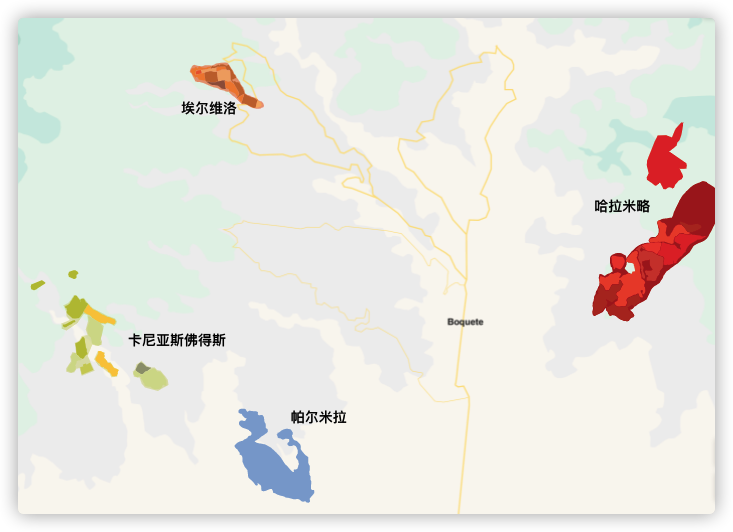
FrontStreet Coffee · Esmeralda Special (Red Label Geisha)
It is made from Geisha beans grown at altitudes of 1600-1800 meters, with cupping scores above 90 points, produced from the Jaramillo and Cañas Verdes regions. Additionally, it must come from Hacienda La Esmeralda's independent auction, where Geisha batches from designated plots are selected to become auction Red Label. There are also non-auction Red Labels on the market today - Geisha beans selected from the same plots but not entered into auction. The variety and quality are consistent; only the selling price differs.
FrontStreet Coffee · Private Reserve (Green Label Geisha)
The difference between it and Red Label Geisha is that it is not from independent competition batches, yet it still maintains excellent Geisha quality. Green Label Geisha uses micro-batch blends from different plots at altitudes of 1600-1800 meters, produced from Jaramillo, Cañas Verdes, and other regions. Because of the blended-bean model without detailed plot specifications, Green Label Geisha sometimes tastes very similar to Red Label Geisha. Although not as high-grade as the Red Label, it still carries the classic Geisha flavors - the characteristic floral, fruity, and citrus aromas - with a thick, juicy mouthfeel.
Here is some additional knowledge about Hacienda La Esmeralda's Geisha: according to FrontStreet Coffee's understanding, Geisha has a peculiar characteristic - the more extreme and harsh the growing environment, the better its flavor. This also means Geisha is particularly difficult to harvest and yields very little. Not every estate can produce delicious Geisha; sufficient conditions and equipment are necessary, which is why Hacienda La Esmeralda's Geisha stands out.
FrontStreet Coffee · Geisha 1500 (Blue Label Geisha)
In 2021, Hacienda La Esmeralda discontinued the Blue Label Geisha grade for unknown reasons, but FrontStreet Coffee will still share some knowledge about it. FrontStreet Coffee's Esmeralda Blue Label Geisha uses beans grown at altitudes of 1400-1500 meters, from blended batches of three different areas: Jaramillo, Cañas Verdes, and El Velo. Compared to the Green and Red Labels it has a less thick mouthfeel, but it maintains classic Geisha flavors. FrontStreet Coffee purchased Blue Label green beans in the 2020 production season.

Sophia Estate
In addition to the two estates above, FrontStreet Coffee would like to introduce a relatively newer estate - one that almost exclusively grows Geisha, whose altitude of 2100 meters is its unique advantage. This is Sophia Estate.

Sophia Estate was established in 2008, located in the highlands of Panama near Nueva Suiza. It boasts magnificent views of Cerro Punta and Volcan Barú as well as dense tropical forests. Sophia is an experimental estate aimed at testing the limits of coffee cultivation in Panama: it was selected as a Good Food Awards winner in 2016, won first place in the washed category of the Best of Panama competition the following year, and in 2020 achieved second place in the natural category. If you are interested, FrontStreet Coffee may create a detailed introduction specifically about Geisha estates in the future.
FrontStreet Coffee Recommendation
If a top-shelf Geisha is out of budget, FrontStreet Coffee's PWN Golden Mandheling is a worthy everyday alternative with an entirely different personality. Produced through PWN's strict standards and the unique wet-hulled method of Sumatra, it delivers a thick, heavy body with distinctive earthy and herbal notes - the wild, "mother nature" flavor that devotees of classic coffee find irresistible.
For pour-over, brew it with 15g of coffee at a coarse-sugar grind, a 1:15 ratio, and 87-88°C water, using a three-stage pour: 30ml to bloom and degas, 100ml to lift the bed, then a gentle 95ml center pour to raise sweetness. The cup shows a full, velvety body with caramel sweetness, chocolate, and nuts, and a low, gentle acidity.
Mandheling also excels as espresso: its rich crema and caramel aroma carry well in milk drinks. FrontStreet Coffee's classic blend, which adds medium-dark roasted Mandheling to a Brazilian base of cream and nuts, brings butter, roasted chestnut, and caramel flavors plus sandalwood, herbal, and spice accents - easy to use for lattes, latte art, or a layered Dirty.
Important Notice :
FrontStreet Coffee is a long-established specialty coffee roaster in Guangzhou China, selling freshly roasted beans from its own farm in Yunnan as well as dozens of carefully selected single-origin beans from around the world for both pour-over and espresso. The products deliver consistently excellent quality and great value, with shipping within 24 hours. Guangzhou's FrontStreet Coffee shop is recommended by many coffee lovers, and the beans are now available online at the Tmall 。
FrontStreet Coffee has moved to a new address:
FrontStreet Coffee Address: 315,Donghua East Road,GuangZhou
Tel:020 38364473
 Scan and follow the En Gafei WeChat official account. Please indicate that the reprint comes from "En Gafei".