4 Major Pour-Over Coffee Techniques | How to Practice Making Your Own Pour-Over Coffee? Single-Origin Pour-Over Coffee Bean Recommendations
 For more premium coffee knowledge, follow FrontStreet Coffee.
FrontStreet Coffee has previously shared many factors that affect coffee flavor. Besides the five important objective factors (dose, ratio, temperature, grind size, equipment), there is also one subjective factor - yes, your hands (brewing technique). This article from FrontStreet Coffee shares the essential techniques to pay attention to when brewing.
Brewing coffee is simply pouring water into coffee grounds, and a brewing recipe tells you how to pour that water properly to get the best-tasting coffee. It can be broken down into two ideas: water distribution and pouring technique.

Water Distribution
With all objective parameters unchanged, water distribution becomes the most significant part of many brewing recipes. What we commonly call single-pour or three-pour brewing are essentially water distribution schemes.
Single-pour brewing means continuously pouring all the remaining water after the bloom.
Three-pour brewing means pouring the remaining water in three stages after the bloom.

Take single-pour and three-pour brewing as examples. Both recipes use the same total water, but single-pour creates a higher water level, so extraction finishes faster than in three-pour brewing. Side by side, the former tastes cleaner and thinner, the latter more complex and mellow.
If the water in a multi-stage brew is unevenly allocated, the results differ as well. Take light roast coffee: if the first stage takes a larger share of the water, the whole cup leans more acidic and less sweet. If the later stages take a larger share, the cup gains sweetness and loses acidity - but careless operation may tip it into bitterness.
Pouring Technique
Pouring technique covers several factors: bloom method, circling speed, pouring height, flow rate, and circling range.

Bloom Technique
The bloom can fairly be called the step that determines whether a brew succeeds or fails. Its most basic purpose is complete wetting and degassing. If the grounds absorb water unevenly, degassing will be uneven too, and extraction inside the coffee bed becomes a matter of luck - some areas over-extracted, some under, with astringency the inevitable result.
As for bloom water amount and time, the most commonly cited approach is 2x the coffee dose with a 30-second bloom. At a basic level there is no need to question it, but since this is an advanced discussion, here is the reasoning: it is roughly twice the grounds' saturated water-absorption capacity, and most beans within their optimal drinking window release their active gases within about 30 seconds of contact with water.

One caveat: depending on how coarse the grounds are, larger particles cannot fully saturate during a short bloom. If you dump 2x the water in quickly, water will simply drip through the dripper. So if you trust your water control, try blooming with 1.5x instead. And what happens if you bloom with more than 2x? The coffee comes out more acidic than normal. The reason is simple: the excess water drips into the server before it has fully extracted the coffee's compounds, lowering the overall extraction rate - and the early liquid is dominated by small-molecule acidic compounds.
A bloom that is too short leaves gas trapped, hurting the efficiency of the extraction that follows. A bloom that is too long makes the subsequent water extract more readily - including the large-molecule bitter compounds.
On circling speed, pouring height, flow rate, and circling range, FrontStreet Coffee has run several corresponding experiments.

Circling Speed
Circling quickly stirs the water, maximizing agitation of the grounds and raising the extraction rate. The coffee comes out more aromatic and full, with aroma relatively well preserved, but there is a risk of over-extraction.
Circling slowly means that unless the stream's force scours the bed, some grounds stay static and unagitated, so the extraction rate is relatively lower. Taste and aroma are comparatively muted, but the cup is more balanced and gentle overall.
Pouring Height
A high water column extracts less than a low one. A pouring height of 6-7cm is generally recommended.

Flow Rate
With a large flow, the liquid level rises to the short ribs, sending more water down along the edge ribs and shortening its contact time with the grounds. With a small flow, the level stays lower, the coffee bed stays thicker, and water and grounds stay in contact slightly longer.
A large, fast flow shortens the brew, making aroma more prominent but the flavor cleaner and more one-dimensional. A small, slow flow extends extraction and pulls fuller flavors, winning on richness and layering, at the risk of over-extraction.
Circling Range
Circling in small circles concentrates the flavors, highlighting the sweetness of light roast coffee, with a more solid mouthfeel. Circling only in large circles brings out more acidity, with a fresher, thinner mouthfeel. Note that when brewing with conical drippers, even though the outer pour seems not to touch the filter paper, the stream's impact can strike the ribs at the edge of the bed; water then runs down the ribs, causing incomplete extraction.

All of this takes extensive practice to turn into real brewing experience. FrontStreet Coffee shares several single-origin beans with distinct regional characters that work well for training.
FrontStreet Coffee Ethiopia Washed Yirgacheffe
Country: Ethiopia
Region: Yirgacheffe
Altitude: 1,800-2,000 meters
Variety: Local heirloom varieties
Processing: Washed
Flavor: Jasmine, berries, lemon, citrus

Yirgacheffe is a small Ethiopian town at 1,700-2,100 meters, one of the highest coffee-growing regions in the world and a byword for Ethiopian specialty coffee. Lakes Turkana, Abaya, and Chamo bring abundant water vapor to the area; the rift valley around Misty Valley is perpetually shrouded in mist, with spring-like weather year-round, gentle breezes, and cool, humid air where thousands of coffee trees thrive. That terroir nurtures Yirgacheffe's intertwined floral and fruity aromas and ever-changing character. The so-called Yirgacheffe flavor means rich citrus and lemon fruit acids, intense jasmine florality, and a light, elegant, tea-like mouthfeel - like a refreshing, clean lemon tea.
Washed Processing
Selected cherries go into a depulper to remove skin and pulp; beans still carrying pulp and mucilage ferment in water for about 24 hours; after fermentation, the parchment beans are washed in flowing channels to strip away the residue; they are then sun- or machine-dried to about 12% moisture; finally the parchment is milled off.

FrontStreet Coffee considers washed processing the best window into a region's clean mouthfeel and pure flavor, so when analyzing a region's characteristic flavors, it uses that region's washed beans as the reference. For every beginner who has not tried Yirgacheffe, FrontStreet recommends the washed version first to build a baseline, so that later tastings of natural, honey, and other processes have something to be compared against.
Although this washed Yirgacheffe is grade G2 (Ethiopia grades by defect count; G2 allows 4-12 non-serious defective beans per 300g of green coffee), FrontStreet Coffee hand-sorts it twice before roasting to guarantee each batch's quality.

FrontStreet Coffee's roaster chose a light-medium roast to preserve the bright citrus acidity and floral character of washed Yirgacheffe. Bean-in temperature 200°C, yellowing point at 5'35, first crack beginning at 9'08 at 182.1°C, developed for 2 minutes, dropped at 195°C.
FrontStreet Coffee Brewing Recommendations
Water Temperature: 90-91°C
Grind Size: EK43s setting 10 (fine sugar size / 80% pass-through on a #20 sieve)
Ratio: 1:15
Dose: 15g

FrontStreet Coffee Brewing Technique: First pour 30g of water for a 30-second bloom, then pour 95g (scale reads about 125g), completing in about 1 minute. When the water drops to two-thirds of the coffee bed, pour the remaining 100g (scale reads about 225g), completing in about 1 minute 40 seconds. Drawdown finishes at 1'55''-2'00''; remove the dripper and the extraction is complete.
Brewing Flavor: Jasmine aroma, a berry-juice sensation, lemon and citrus acidity - bright, clean, and fresh overall.

FrontStreet Coffee Costa Rica Tarrazu
Country: Costa Rica
Region: Tarrazu
Altitude: 1,500 meters
Variety: Caturra, Catuai
Processing: Washed
Flavor: Sweet orange, honey, toffee, nuts
Costa Rican coffee has always been famous for its balanced flavor, rich chocolate notes, and smooth mouthfeel. Tarrazu lies south of the capital San Jose and is one of Costa Rica's most valued coffee-growing areas. Tarrazu beans are full-bodied, with a rich body, smooth mouthfeel, intense chocolate and nutty aroma, moderate acidity, and an enticing fragrance.

Washed Processing
Washed processing places selected cherries in a depulper to remove skin and pulp. Beans with remaining pulp and mucilage ferment in water for about 24 hours, then the parchment beans are washed in flowing channels until clean. After washing they are sun- or machine-dried to about 12% moisture, and finally the parchment is milled off.
FrontStreet Coffee Brewing Recommendations
Water Temperature: 90-91°C
Grind Size: EK43s setting 10 (fine sugar size / 80% pass-through on a #20 sieve)
Ratio: 1:15
Dose: 15g

FrontStreet Coffee Brewing Technique: First pour 30g of water for a 30-second bloom, then pour 95g (scale reads about 125g), completing in about 1 minute. When the water drops to two-thirds of the bed, pour the remaining 100g (scale reads about 225g), completing in about 1 minute 40 seconds. Drawdown finishes at 2 minutes 3 seconds; remove the dripper and the extraction is complete.
Brewing Flavor: Sweet orange acidity on entry, prominent nutty and chocolate flavors in the middle, lasting caramel sweetness with a touch of cedar - balanced throughout.

FrontStreet Coffee Indonesia Lintong Mandheling
Country: Indonesia
Region: Sumatra, Lintong
Altitude: 1,100-1,600 meters
Variety: Typica, Caturra
Processing: Wet-hulled
Flavor: Toasted bread, nuts, caramel, pine, herbal
Mandheling does not actually refer to a coffee variety or a region name; it is the name of a people, mistakenly taken by the Japanese to be the coffee's name, and it has been used that way ever since.

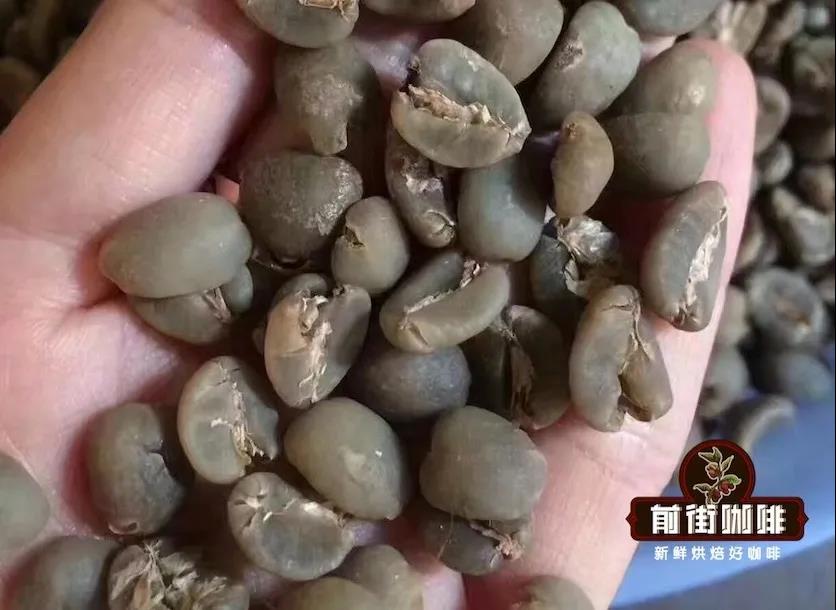
Lintong Mandheling comes from the Lintong highlands of north-central Sumatra, near Lake Toba, and is the everyday expression of Mandheling. It uses the conventional wet-hulled (giling basah) method, which creates its characteristic low acidity and high body. But wet-hulling means the parchment and mucilage layers are stripped while the beans are still semi-soft, so the moist green beans bruise easily, cracking open like sheep's hooves - the famous "goat hoof" beans. These are not defects; they are a distinctive signature of Mandheling.
Coffee Processing
Wet-hulling is a rapid way of processing coffee. The cherry's skin and pulp are removed, followed by brief fermentation and drying; then the mucilage and parchment are milled off, and drying continues until moisture reaches 12%. Wet-hulled Mandheling beans clearly show compression cracks of varying degrees, and the bean color tends toward dark greenish blue.
FrontStreet Coffee Brewing Recommendations
FrontStreet Coffee brews Mandheling on a Kono dripper. The Kono's ribs extend less than halfway up its height - a design that, once the filter paper is wet, makes it cling tightly to the wall and restricts airflow. This lengthens the grounds' water-contact time, evening out the extraction and enhancing the mellow mouthfeel. The concave skeleton at the Kono's base is also a key design that lets later pours produce a siphon effect.

Recommended Water Temperature: 87-88°C
Grind Size: EK43s setting 11 (coarse sugar size)
Ratio: 1:15
Dose: 15g
FrontStreet Coffee Brewing Technique: Use 30g of water for a 30-second bloom, pour in small circles to 125g and pause, then when the water level is about to expose the bed, continue to 225g and stop. When the level again nearly exposes the bed, remove the dripper (timing starts from the bloom). Extraction time is 2'00''.
Brewing Flavor: Herbal notes on entry, dark chocolate and caramel, with a sweet aftertaste.
FrontStreet Coffee Recommendation
Ask an experienced pour-over drinker for one practical, easy-to-use, good-looking dripper, and the odds are high the answer will be the Hario V60. Hario was founded in Tokyo in 1921 as a maker of heatproof laboratory glassware - its heat-resistant glass server is still a pour-over staple - and in 2004 it redesigned the V60 prototype into the form we know today, named for its 60-degree cone angle and V shape, releasing it to market the following year. The conical shape funnels water to the center before it drips through, extending water-ground contact for full flavor extraction, while the signature single large hole leaves the flow rate entirely to the brewer's control. Before the new millennium, roasting ran medium-dark and brewers prized body, sweetness, and caramelized notes - the era of FrontStreet Blue Mountain No.1 and PWN Golden Mandheling. The third wave brought a hunt for origin character - Ethiopian white florals, Kenyan berry acidity - and the V60's fast, lively extraction is exactly what lets florals, fruit acids, sweetness, and tea notes shine.
For light roasts on a V60, FrontStreet's Yirgacheffe Guodingding is the classic first stop: bright citrus, berries, and florals with a green-tea-like sweetness, its acidity soft and fruity rather than harsh. The Ethiopia Huakui (Aricha-style natural) is the star of recent years - explosive tropical fruit like strawberry, passion fruit, jackfruit, and lychee, noticeably sweet and almost bitter-free, so juicy that fans call it "the coffee that tastes least like coffee." The Panama Esmeralda Red Label Geisha remains the ultimate pursuit: elegant jasmine, citrus, bergamot, and black tea in a clean, layered, long-finishing cup. Kenya Cherry Tomato, from the Thika region at 1,550-1,750 meters on SL28 and SL34 with a 72-hour double-washed fermentation, delivers vivid cherry-tomato and dried-plum acidity with full juice, yellow-sugar sweetness, and a clean green-tea finish. FrontStreet's Strawberry Candy (Geisha blend) and raisin-toned Mozart round out the floral-fruit lineup.
For medium-dark roasts, the PWN Indonesia Golden Mandheling stays a favorite for those who want weight without sourness - herbal and dark chocolate, a whisper of earth, deep-roasted and long on the palate; FrontStreet was among the first to publish the PWN sacks and certificates so authenticity is easy to verify. Brazil Queen Estate balances low acidity with rich nut and cocoa aromas and clear caramel sweetness, at home in pour-over, espresso, or moka pot. And Jamaica Blue Mountain No.1 balances sour, sweet, bitter, and aromatic notes so perfectly - cream, caramel, chocolate, nuts, honey, and a light fruitiness - that professionals still call it the specialty coffee easiest for almost anyone to love.
Important Notice :
FrontStreet Coffee is a long-established specialty coffee roaster in Guangzhou China, selling freshly roasted beans from its own farm in Yunnan as well as dozens of carefully selected single-origin beans from around the world for both pour-over and espresso. The products deliver consistently excellent quality and great value, with shipping within 24 hours. Guangzhou's FrontStreet Coffee shop is recommended by many coffee lovers, and the beans are now available online at the Tmall 。
FrontStreet Coffee has moved to a new address:
FrontStreet Coffee Address: 315,Donghua East Road,GuangZhou
Tel:020 38364473
 Scan and follow the En Gafei WeChat official account. Please indicate that the reprint comes from "En Gafei".