Single Origin Coffee Beans vs. Blend Coffee Beans: Which Tastes Better?

Coffee blending dates back centuries. As early as the 17th century, people were mixing Indonesian Java coffee with Yemeni Mocha coffee to create the famous Mocha Java blend. Blends later became a staple of espresso, with well-known recipes such as the Mengba blend, which combines Mandheling and Brazilian beans in specific proportions for espresso. So what are the benefits of blended coffee, and how do you build a blending formula? FrontStreet Coffee shares its own formulas below.
What Are Espresso Coffee Beans?
Espresso coffee beans are, in fact, espresso blend beans. "Blending" means mixing coffee beans of different origins and varieties, usually two or three types. The purpose is clear: to combine the flavor characteristics of different beans into an entirely new profile that is more balanced and can serve as a coffee shop's signature blend. If one bean is smooth but lacks aroma, for example, another with a rich fragrance can be added so the two complement each other. A second purpose of espresso blends is cost reduction. Traditional espresso blends often include Robusta beans, which produce a richer, thicker crema for milk-based drinks and create the viscous, smooth texture that forms the base of milk coffees.

Four Principles of Espresso Blending
1. The beans chosen for a blend should each have distinct characteristics; avoid beans with similar flavors, such as those sharing the same processing method, origin, or flavor profile.
2. Ratios: every coffee shop builds different ratios around its own character. In general, a 1:1 ratio should be avoided, because equal proportions can cancel out each other's distinctive flavors. A blend should have primary and secondary components so the result is more interesting than a single origin.
3. Blending and roasting: beans can be blended before roasting (raw blending), mixing green beans according to a ratio, or after roasting (post-roast blending), combining them once roasting is complete. Which you choose depends on the flavor you want.
4. Flavor balance: a blend should balance sweetness and acidity. Generally 2-6 types of coffee are used. Whatever the bean types or roast level, too many varieties make it hard to express the coffee's unique character.
5. Blending requires constant experimentation. The goal is usually flavor stability. Before blending, draft a plan using a mathematical combination approach, then determine the best formula through cupping.

Before You Blend
1. Set your goal, such as the general flavor direction.
2. Understand each bean, familiarizing yourself with the subtle relationship between each single origin's character, roast level, and flavor.
3. Identify the most prominent characteristic of each bean. Since several beans are used, clarify what each one is meant to contribute, whether a smooth bitterness, a bright acidity, or a heavy body.

When blending espresso with Yunnan small-bean coffee, the ideal espresso should have low acidity and a thick body, with rich, velvety, thick reddish-brown crema that carries the coffee's aroma and flavor. Crema is an important indicator of espresso quality; it must capture the coffee's intense flavor. During extraction, steam is trapped in fine oil foam, and when you drink the espresso, that foam releases volatile aromatic molecules that travel from the mouth to the nasal olfactory receptors. The foam also clings to the taste buds, creating a long aftertaste that can last up to an hour. The advantage of using Yunnan as a blending bean lies in the Catimor variety's Robusta genetics, which inherently supply the elements a traditional espresso needs.
To add flavor components to your formula, choose one or two coffees you genuinely love for their aroma and taste. Brazilian coffee is characterized by moderate body and low acidity. You then need to balance the formula so that every distinctive characteristic blends together without any single element overpowering the others. It should be smooth, gentle, and full-bodied, without unpleasant bitterness, and perceived as low in acidity. The crema should be rich, smooth, velvety, and slow to dissipate. Pay special attention to the aftertaste; the aroma must be very pleasant. Both Brazilian and Yunnan small-bean coffees are medium-dark roasted, providing sufficient body. The Robusta genetics of Catimor supply the necessary oils, creating a blend with balanced texture, low acidity, moderate body, and stable crema.
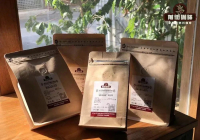
Take FrontStreet Coffee's four espresso beans as examples: Basic Blend, Commercial Blend, Specialty Blend, and Sunflower Warm Sun Blend.
I. FrontStreet Coffee Basic Blend

Flavor: soft fruit acidity, caramel sweetness, nut and dark chocolate notes, smooth and viscous, but relatively light in taste.
Formula: Yunnan : Brazil = 3:7
II. FrontStreet Coffee Commercial Blend

Robusta beans have strong resistance to disease and pests and high yields. They typically lack the acidity of Arabica and often carry a slightly woody aroma. With a caffeine content of 2.2%, higher than Arabica's 1.2%, and higher chlorogenic acid content, they are quite bitter and are usually used in commercial blends because they are cheaper than Arabica.
On their own, commercial beans produce coffee far inferior in taste to specialty beans. They are generally chosen for blending, and with the right formula they can produce excellent coffee for lattes, cappuccinos, and other espresso drinks. When FrontStreet Coffee's commercial blend is used for espresso, the Robusta beans create a richer crema and a classic taste of caramel sweetness, nut and cocoa flavors, and dark chocolate, balanced sweet and sour, with a slight pleasant bitterness and a persistent aftertaste.

Flavor: caramel sweetness, nut and cocoa flavors, dark chocolate notes, balanced sweet and sour, with a slight pleasant bitterness and a persistent aftertaste.
Formula: Colombia : Brazil : Robusta = 3:6:1
III. FrontStreet Coffee Specialty Blend

The Colombian beans FrontStreet Coffee selects come from Huila, in southwestern Colombia, one of the main coffee-growing regions. Colombian coffee generally grows at altitudes of 1500-1800 meters, mostly Bourbon and Caturra varieties, washed processing, high density, uniform bean size, and full-bodied beans that are thicker from core to surface. Because the Huila region is dotted with famous coffee-growing areas, the names of its small districts have become brand names in circulation. Although growing conditions there are excellent, coffee infrastructure and surrounding facilities are not yet well developed, and green-bean drying or washing equipment is incomplete, which is regrettable. Coffee from Huila has an intense flavor and heavier texture. The nutty, chocolate, and caramel aromas and the appropriate acidity of Huila coffee can be called high-quality specialty coffee.
Brazilian coffee generally grows at altitudes of 1000-1300 meters, so its density is relatively low. It is mostly Bourbon, semi-dry processed, with moderate moisture content, a softer bean texture, and a thinner distance from surface to core, making it unsuitable for roasting at too high a temperature; the drum's inner-wall temperature would scorch the bean surface and create burnt bitterness. To express nuts, milk chocolate, and good body thickness, and to use it as a blending base, FrontStreet Coffee uses a medium-heat bean introduction, maintaining heat through the dehydration stage, making fine adjustments as the temperature rises after first crack begins, promoting more complete caramelization, and discharging the beans as the temperature approaches second crack.

Flavor: soft, slightly acidic, with clear sweetness, a nutty aftertaste, an overall feel that is not too stimulating, balanced, with medium crema.
Formula: Colombia : Brazil = 3:7
IV. FrontStreet Coffee Sunflower Warm Sun Blend
FrontStreet Coffee's Sunflower Warm Sun Blend uses sherry-barrel-processed coffee beans and natural-processed Yirgacheffe Red Cherry Project beans in a 6:4 ratio. Sixty percent Honduras sherry-barrel beans provide flavor and body, while forty percent natural Yirgacheffe provides more aroma and acidity.

Flavor: obvious fruit acidity, light berry aroma, wine fragrance, rich chocolate flavor, with a distinct aftertaste.
Formula: Honduras Sherry : Yirgacheffe Red Cherry = 6:4
FrontStreet Espresso Extraction Parameters
Grinder: Mahlkonig E65S
Grind size: 1.6
Pressure: 9 bar
Temperature: 94°C
Time: 20-30 seconds
Dose: 20g (double shot espresso)
Yield: 40ml
Espresso extraction flavor: smooth texture, medium body, with obvious fruit acidity accompanied by light berry aroma, whiskey fragrance, rich chocolate flavor, and a distinct aftertaste.

FrontStreet Coffee Recommendation
Blending is at the heart of good espresso, and FrontStreet Coffee's Classic Blend is a fine place to start. It builds creaminess and nuttiness from Brazilian beans, adds medium-dark roasted Mandheling for butter, roasted chestnut, and caramel depth, and finishes with a touch of Robusta for a richer crema. That combination makes it easy to pull a smooth shot for a latte or a layered Dirty.
Important Notice :
FrontStreet Coffee is a long-established specialty coffee roaster in Guangzhou China, selling freshly roasted beans from its own farm in Yunnan as well as dozens of carefully selected single-origin beans from around the world for both pour-over and espresso. The products deliver consistently excellent quality and great value, with shipping within 24 hours. Guangzhou's FrontStreet Coffee shop is recommended by many coffee lovers, and the beans are now available online at the Tmall 。
FrontStreet Coffee has moved to a new address:
FrontStreet Coffee Address: 315,Donghua East Road,GuangZhou
Tel:020 38364473
 Scan and follow the En Gafei WeChat official account. Please indicate that the reprint comes from "En Gafei".