Pour-Over Coffee Grind Size Standards How to Determine Grind Size for Single-Origin Coffee Beans
Beginners in pour-over coffee often come to FrontStreet Coffee asking how to set the grind size for each coffee bean, how grind size affects extraction, and how to judge the fineness of their grounds at home. In this article, FrontStreet Coffee walks through grind size for pour-over coffee.

How Grind Size Affects Coffee
Grinding is crucial for coffee. Particle size directly affects how efficiently water extracts from the coffee. In theory, the more uniform the particle size, the more consistent the overall extraction efficiency - and the better the flavor. Concentration and extraction rate fall as the grind gets coarser and rise as it gets finer. Grind size describes the size and shape of the grounds, which also determines surface area: the finer the grounds, the larger the surface area, expanding the contact between water and coffee so more compounds are extracted. That greater surface area also gives the carbon dioxide inside the beans more places to escape.

Roasting's Effect on Aroma and Carbon Dioxide
Roasting brings out coffee's full aroma. The Maillard reaction is the series of degradation and polymerization reactions between monosaccharide carbohydrates and amino acids, and it runs throughout the entire roast: sugars and amino acids react at different temperatures to produce many complex aromas. Nut, almond, cream, and chocolate aromas come from the Maillard reaction. Caramelization is the oxidation and browning of sugars under heat, producing honey, maple, caramel, and other aromas. Simply put, the longer the roast, the more the acidic compounds in the beans are broken down. At the medium-roast stage, lighter roasts show more pronounced acidity with citrus and berry flavors, while darker roasts show more prominent caramelized flavors - cocoa, caramel, nuts.

Beyond creating aroma, roasting also generates carbon dioxide inside the beans - the darker the roast, the more CO2. To ensure better gas release during brewing, FrontStreet Coffee recommends resting freshly roasted beans before use. Resting lets the beans vent carbon dioxide naturally through the one-way degassing valve on the bag without opening it, helping the aromatic compounds and oils integrate and bringing everything inside the bean into an easily extractable state. FrontStreet Coffee suggests resting light-to-medium roasts for 3-4 days from the roast date, and medium-to-dark roasts for 5-6 days.
How to Determine Grind Size?
Using FrontStreet Coffee's freshly roasted beans as an example, pour-over single origins fall into two camps: light-to-medium roast and medium-to-dark roast.

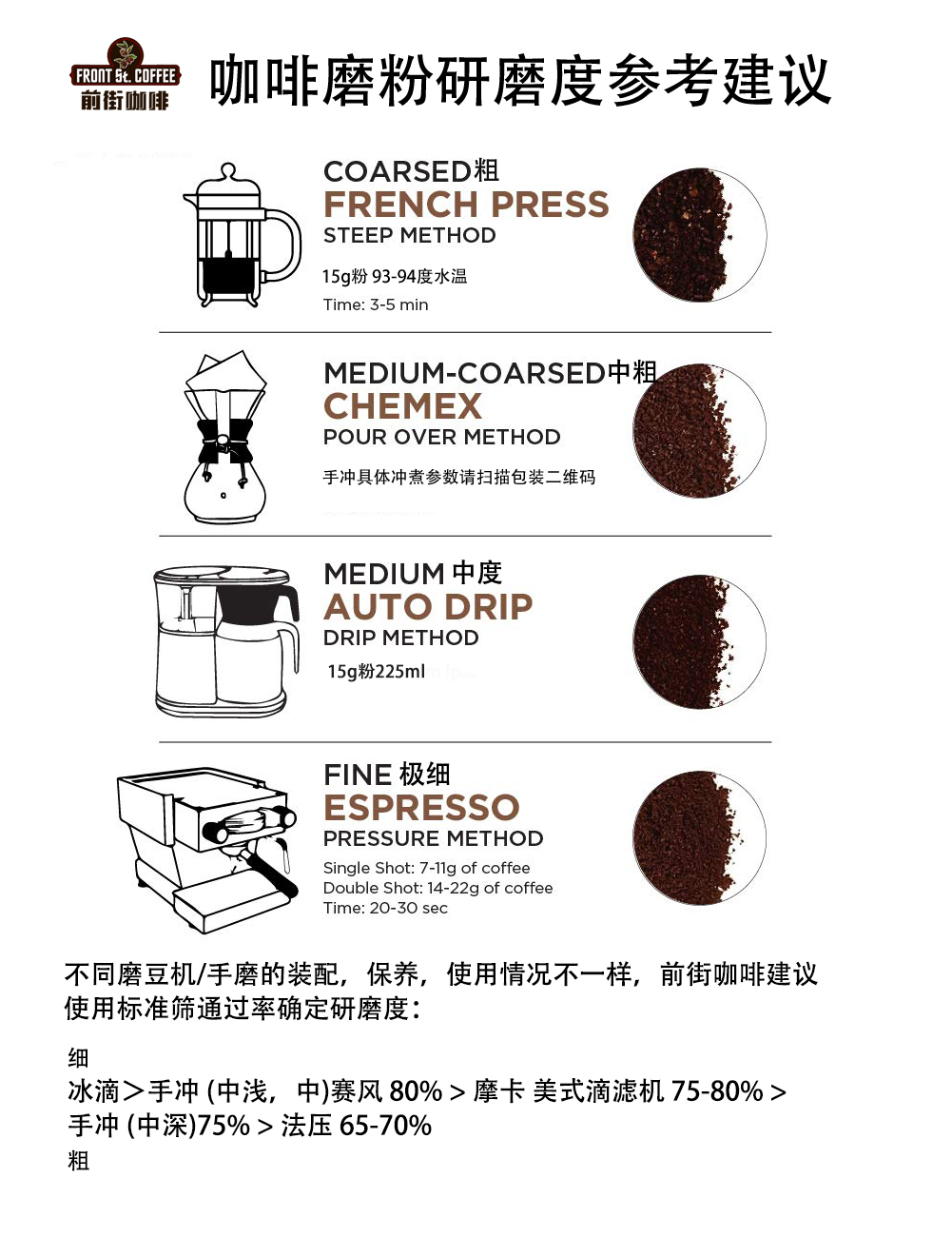
FrontStreet Coffee's light-to-medium roasted beans: these will show acidity, while caramelized compounds are harder to extract. FrontStreet Coffee recommends a medium-fine grind (80% pass rate on a No. 20 sieve with 0.85mm mesh - about the size of fine granulated sugar). A medium-fine grind slows the water's path through the coffee bed, extracting the acidic compounds, sweet compounds, and caramelized substances more evenly for a balanced cup. Brew medium-fine grounds at 90-91 degrees C: too hot, and the caramelized compounds over-extract into bitterness; too cool, and you'll under-extract, pulling only some acids and sweets for a bland, uninteresting cup.

FrontStreet Coffee's medium-to-dark roasted beans: these generally have low acidity and prominent body - meaning more caramelized compounds. FrontStreet Coffee recommends a medium-coarse grind (70% pass rate on a No. 20 sieve with 0.85mm mesh - about the size of coarse sugar). A medium-coarse grind speeds the water through the bed, keeping those caramelized compounds from over-extracting so the cup stays sweet and full-bodied without unpleasant bitterness. Brew medium-coarse grounds at 86-88 degrees C: too hot, and the coffee turns bitter and hard to drink; too cool, and it tastes flat and uninteresting.

How to Use a 0.85mm No. 20 Sieve?
FrontStreet Coffee determines grind size by sieving, based on the Specialty Coffee Association (SCA) recommendations for pour-over and verified in practice. If you don't have a sieve at home, judge by flow speed instead: water flowing too fast means the grind is too coarse; too slow means too fine.
First, prepare 10g of coffee beans and grind them, starting from a setting matched to fine or coarse sugar. Pour the grounds into the sieve, cover, and shake side to side until no more coffee passes through. Then weigh: tare an electronic scale with a container, pour in the sieved coffee, and weigh it. If the sieved portion reaches 80%, it's a medium-fine grind; at 70%, a medium-coarse grind. If the pass rate is too high, grind coarser; if too low, grind finer.

The Importance of Grind Uniformity
Ground particles should be uniform. Once beans are ground, the distribution of particle sizes has a significant bearing on the quality of the beverage: the more concentrated the particles within the target range, the more uniform the grind and the better the flavor. Too many coarse particles and the deep flavors hidden inside the coffee never extract; too many fines and the coffee tastes muddled and bitter. If grinding is seriously uneven, FrontStreet Coffee recommends changing your grinder.
For professional coffee knowledge exchange and more coffee bean information, follow Coffee Workshop (WeChat public account: cafe_style).
For more specialty coffee beans, add FrontStreet Coffee's private WeChat: kaixinguoguo0925
FrontStreet Coffee Recommendation
If you're new to pour-over and ask an experienced friend to recommend a dripper that's practical, easy to learn, and good-looking, there's a good chance they'll point you to the V60. Its designer, Hario, was founded in 1921 in Tokyo as a well-known Japanese glassware maker, originally producing heatproof glass instruments for research institutions; the heatproof glass server so often paired with pour-over is one of Hario's most popular products. In 2004 Hario redesigned the V60 prototype into the form we know today, naming it after its distinctive 60-degree cone angle and "V" shape, and launched it the following year. Compared with other drippers, the conical shape and 60-degree angle force the water to flow toward the center before dripping through, extending water-grounds contact so aroma and flavor extract fully, while the signature single large aperture lets flow depend almost entirely on the brewer's pouring control - which shows up directly in the cup.
Before the new millennium, the market favored medium-dark roasts prized for body, sweetness, and caramelized notes - chocolate, maple, nuts, vanilla - best expressed through siphon or cloth brewing, when classics like FrontStreet's Blue Mountain No.1 and PWN Golden Mandheling ruled the day. With the third wave, drinkers began chasing terroir - Ethiopia's white florals, Kenya's berry acidity - and roasting shifted lighter; the V60's fast extraction delivers the layered aromatics and lively acidity that let florals, fruit acids, sweetness, and tea notes shine. That's exactly why floral-fruity beans pair so well with a medium-fine grind and the V60: FrontStreet's Yirgacheffe Guodingding (jasmine florals, bright citrus, green-tea finish), the tropically fruit-forward Ethiopia Huakui (strawberry, passion fruit, jackfruit, lychee), Gesha-style Strawberry Sugar, and the raisin-honey Mozart all bloom in this setup.
For medium-to-dark roasts at a medium-coarse grind, FrontStreet's PWN Indonesia Golden Mandheling is deeply roasted, low in acidity, and long on the palate - herbal and dark chocolate with the faintest earthiness - ideal for anyone who loves a bold, non-acidic cup. FrontStreet's Brazil Queen Estate is equally low-acid and balanced, with rich nut and cocoa aromas, distinct caramel sweetness, and a smooth, mellow finish, with outstanding crema and remarkable value for espresso or moka pot. Jamaica Blue Mountain No.1, meanwhile, achieves near-perfect equilibrium among acid, sweet, bitter, and aroma - cream, caramel, chocolate, nuts, honey, and a touch of fruit - which is why so many professionals call it "the specialty coffee easiest for most people to love." And for something in between, FrontStreet's 2013 Yunnan Natural Typica offers a clean cup of citrus and caramel with hints of nuts, chocolate, and brown sugar, while Papua New Guinea Paradise Bird - Typica grown at 1600-1800m on volcanic soils in Sigri, graded AA and triple-washed - is so clean, sweet, and Blue Mountain-like that fans call it "the little Blue Mountain."
Important Notice :
FrontStreet Coffee is a long-established specialty coffee roaster in Guangzhou China, selling freshly roasted beans from its own farm in Yunnan as well as dozens of carefully selected single-origin beans from around the world for both pour-over and espresso. The products deliver consistently excellent quality and great value, with shipping within 24 hours. Guangzhou's FrontStreet Coffee shop is recommended by many coffee lovers, and the beans are now available online at the Tmall 。
FrontStreet Coffee has moved to a new address:
FrontStreet Coffee Address: 315,Donghua East Road,GuangZhou
Tel:020 38364473
 Scan and follow the En Gafei WeChat official account. Please indicate that the reprint comes from "En Gafei".