Premium Yemen Coffee Origins: Flavor Characteristics of Yemen's Most Expensive Mocha Coffee Beans
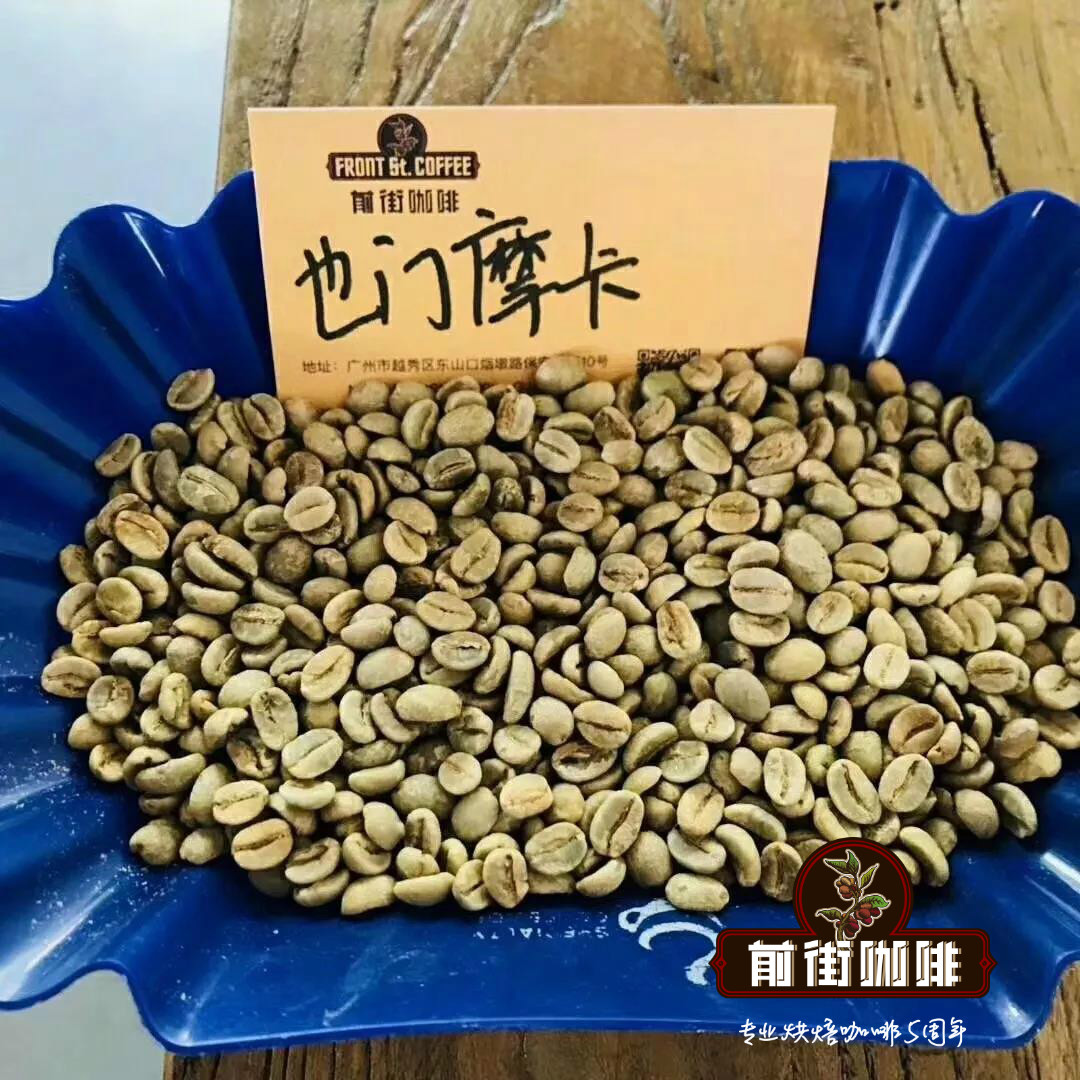
Yemen: The Ancient Birthplace of Coffee
Although the specialty coffee wave represents a revival of craftsmanship over machinery, the market still runs on supply and demand. Downstream businesses use different brewing methods to express different coffee styles, while upstream farmers develop distinctive processing methods in response to market trends. Yet there is one country that has been producing coffee with the most primitive methods since the 6th century: Yemen.
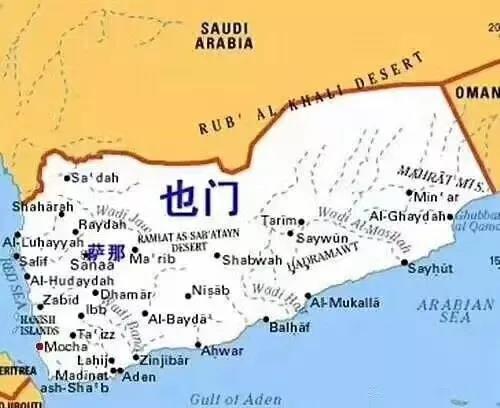
Yemen sits in Western Asia, just a step away from the African continent. Had Islamic clerics not promoted coffee across the Arabian Peninsula, it might still be a wild plant in Ethiopia today. According to legend, coffee arrived in the 6th century, when Ethiopia ruled the region, and was named Qahwa, meaning wine in Arabic. The Ottoman Empire later invaded in 1536 and took control of the coffee trade. To protect export revenue, the authorities strictly prohibited the export of raw beans and required seeds to be boiled in water before leaving the country.
One of the World's Most Arid Countries
Yemen is one of the most arid countries in the world. Economically it currently depends on oil exports for three-quarters of its income, though the World Bank predicts its reserves will run out around 2017. A nation that was once self-sufficient in agriculture now imports 80% of its agricultural products. The reasons include population growth and water shortages caused by farmers over-cultivating Qat, also known as khat or Arabian tea, a crop with a history as long as coffee's.
Qat is a common social drug on the Arabian Peninsula. Yemenis enjoy receiving guests at home, chewing Qat while chatting with friends. It contains cathinone, a stimulant with effects similar to mild amphetamines that sharpens the mind, although users feel low once the effect fades. The World Health Organization has not classified it as a drug, but many Western countries have banned its import.
Yemen has also long been plagued by drought. Its major cities depend on groundwater, agriculture consumes 90% of drinking water, and Qat cultivation alone uses a great deal of it. The authorities predict that underground water reserves in the capital, Sana'a, will be depleted by 2017. Most Yemeni cities are built on high mountains, and residents rely on government or private wells to survive. The country has between 40,000 and 70,000 wells, some reaching 600 meters underground. Pumping water uphill is also costly, and the government spends as much as $7 billion a year on drilling and pumping. In recent years the authorities have therefore decided to ban Qat, which wastes water and cannot satisfy hunger, and to replace it with other crops. Coinciding with the rise of specialty coffee, the Yemeni government is now actively encouraging farmers to switch to coffee, which uses half as much water as Qat.
Using the Most Primitive Production Methods
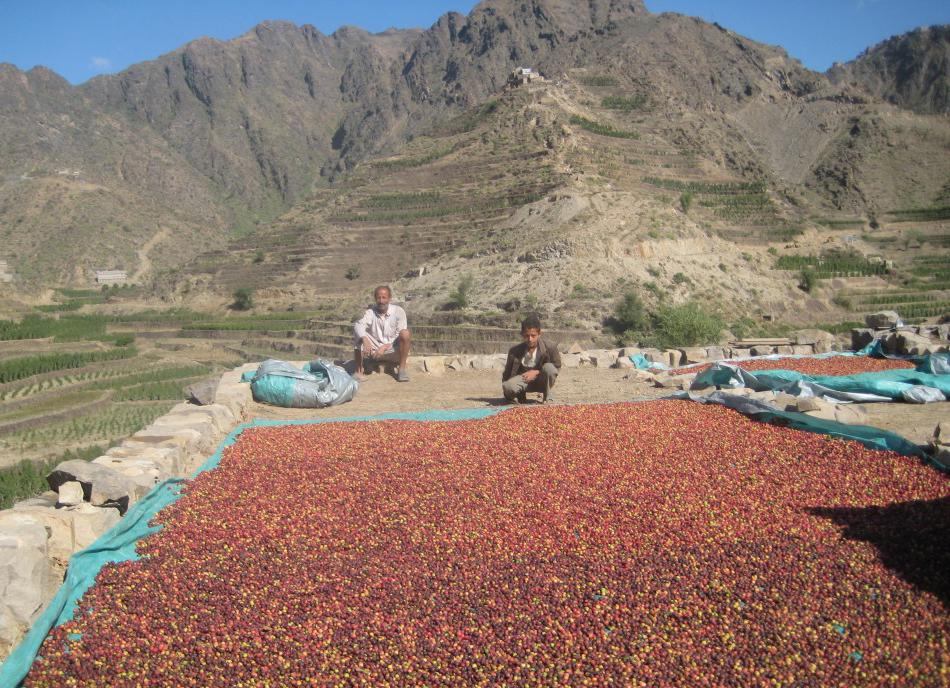
True Yemeni coffee is quite rare. Farmers harvest the fruit by hand when it ripens on the tree and dry it on the rooftops of stone houses built along the mountainsides. Removing the pulp and hulling rely entirely on simple stone grinding equipment. Because transport is difficult, the coffee typically changes hands several times, mixing beans of different sizes, qualities, and ages. Add in numerous defects and improper processing, and Yemeni coffee rarely reaches specialty grade by modern cupping standards. High-quality Yemeni coffee, however, has flavors found nowhere else: complex Middle Eastern spices, cured meat, ripe fruit, wine notes, and cocoa, with a rich body and a strong sweet aftertaste. Like durian and stinky tofu, it polarizes people into lovers and haters.
The Unique Taste of High-Quality Yemeni Coffee
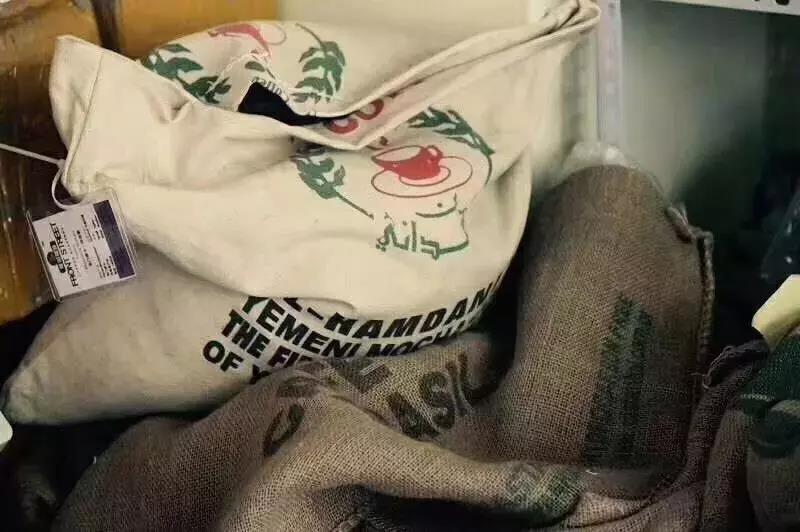
In terms of growing regions, Mattari, west of the capital, is known for its heavy body and cocoa notes. Harazi has higher acidity and a lighter body. Other regions include Dhamari, also known as Anisi, Ibb, and Sana'a, named after the capital. Sana'a, however, is not really a growing region but a brand name used by intermediaries to blend and export coffee collected from nearby villages, much as Yemeni coffee historically used the port name Mocha.
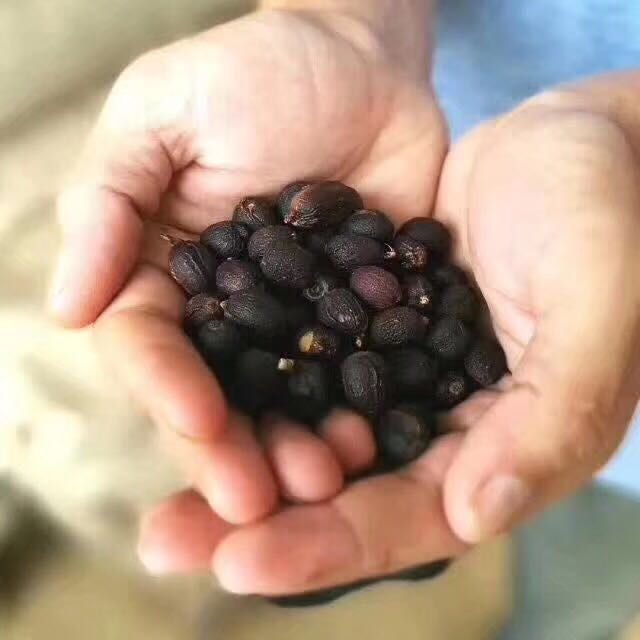
Unlike the washed processing used in most coffee-growing regions worldwide, Yemeni coffee is entirely natural-processed and sun-dried. Stone mills, grinding between two stones, break the beans and leave an uneven appearance. Raw beans are often mixed with small twigs, small stones, and even dried insects, which are screened out during roasting. Yemeni coffee also possesses the world's most unique, rich, and fascinating complex aromas: red wine fragrance, wild flavor, dried fruit notes, blueberry, grape, cinnamon, tobacco, sweet spices, woody notes, and even chocolate. You will see every kind of adjective used to describe Yemeni Mocha.
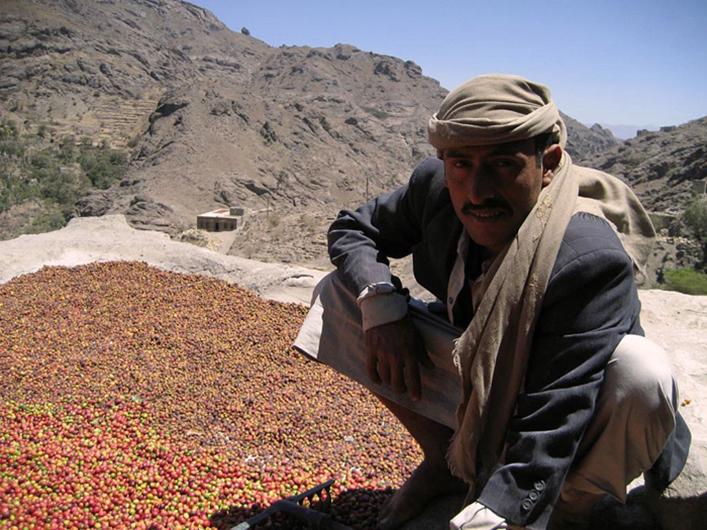
Because the beans are dried with the pulp intact, coffee berry flavors have a chance to infuse into them. When the fruit falls on the dry soil of the African highlands it also absorbs the flavors of surrounding organic matter, and on top of that come the "solar taste" imparted by the fierce Arabian Peninsula winter sun, the kind of aroma you can smell on a sun-dried quilt, the natural fermented ripe-fruit flavors from the pulp, and a slight earthy note. The 300,000 coffee farms spread across elevations from 3,000 to 8,000 feet, combined with ancient, 100% organic processing methods, create the world's unique Yemeni Mocha.
Among common Yemeni Mochas, Mokha Mattari is the most renowned. Produced in the Bani Matar, also known as Bany Mattar, province, Mattari is high-altitude coffee, typically showing excellent red wine aromas, dried fruit flavors, and a rich body, and often revealing chocolate-caramel sweetness when dark roasted.
Because of Yemen's political instability and sharply reduced production in recent years, the famous Mokha Mattari has become a target for adulteration, with frequent reports of lower-grade beans being mixed in. Today, even beans labeled Mattari are no guarantee of high quality. Good-quality Mattari beans are small, with raw beans carrying a fragrant sweet wine aroma and a moderate ripe-fruit fermentation. An excellent Mattari will never disappoint a coffee connoisseur.
A coffee expert once said that Yemeni Mocha flavors are so varied that not only do different origins, varieties, and batches differ, but so does each sack, and even each cup. Because of that complexity and variability, roasting Yemeni Mocha so that it gives its best is a real challenge for any roaster. A light to medium roast reveals fruity sweet aromas and gentle, warm sun-dried fermentation notes, while a dark roast brings out rich red wine aromas and a bittersweet chocolate aftertaste that makes people savor it again and again, with a finish that lingers for days. This explains why so many passionate coffee lovers name Yemeni Mocha as their favorite.
Confusing Nomenclature
Yemeni coffee naming still lacks universal standards, and there is no official grading system. Local residents have their own classification, with hundreds of coffee codes and names for internal use, but these do not apply to the commercial export market. In the commercial market, Yemeni Mocha usually adopts one of two naming methods: origin naming or variety naming.
Mokha Mattari and Mokha San'ani use origin naming, indicating production from Bani Matar province and the hillside areas near the capital, San'a, respectively. Mokha Ismaili uses variety naming, and its production is in Hirazi, southwest of Bani Matar.
Mokha Mattari: The best-known market name, from Mattari in Bani Mattar, also spelled Bany Mattar, west of Yemen's capital, Sana'a. It is high-altitude coffee, typically showing excellent red wine aromas, dried fruit flavors, and a rich body, and often revealing bittersweet chocolate notes when dark roasted. Good-quality Mattari beans are small, with raw beans carrying a fragrant sweet wine aroma and a moderate ripe-fruit fermentation. It consistently comes out ahead because its Yemeni character is more pronounced.
Mokha San'ani: A broad market name for coffee from several growing areas west of Yemen's capital, Sana'a. It is a blend from tens of thousands of small farms on the hillsides near the capital, and it grows at slightly lower altitudes than Mattari, generally with a lighter body and lower acidity but good fruit aromas, often with riper fruit and wilder flavors than Mattari. In my experience, San'ani quality has varied greatly in recent years, with the occasional inferior lot showing flat flavors, earthy notes, and excessive fermentation. Careful cupping and selection is essential work for a coffee merchant, and there is no room for cutting corners.
Mokha Ismaili: One of the traditional ancient varieties, a market name for famous coffee from central Yemen, also described as a traditional Yemeni coffee plant classification with higher beverage quality. It grows at very high altitudes, above 6,500 feet, and is characterized by rounder bean shapes, smaller than Mattari, with a rich body, high complexity, and a record of often outperforming Mattari. It is the least produced and most expensive Yemeni Mocha, in a category that is already not cheap. Excellent Mokha Ismaili comes from the high mountain slopes of the Hirazi region, which, though less famous than Bani Matar, has the best local reputation in Yemen, and Hirazi's highest altitudes reach 8,000 feet.
Mokha Rimi: Produced in the Djebel Remi, also known as Raimi or Rayma, region, its quality is similar to San'ani, and it typically shows slightly heavier fermentation, occasionally with a surprisingly rich raisin sweetness. When properly roasted, the beans smell like opening a jar of rich fruit jam.
Mokha Yafeh: Produced in Yemen's southern Yafeh, also known as Yaffe, province, it is an uncommon Yemeni Mocha and the country's only "southern flavor." Production is limited and almost entirely exported to the neighboring United Arab Emirates, so it is rarely seen on the international specialty market.
Arabian Mocha: A single-origin coffee from the mountainous regions of Yemen on the southwestern Arabian Peninsula bordering the Red Sea. It is among the world's best cultivated coffees, famous for its high viscosity and its special, rich, wine-like acidity.

Yemeni Mocha divides into different schools according to growing area, just as Mattari Mocha is known for chocolate and acidity, and Sanani Mocha for wildness and fragrance.
Characteristics of Yemeni Coffee
Despite its superior quality, smoothness, and aroma, Yemeni coffee has an unsatisfying side: quality cannot be consistently guaranteed.
The grading of the beans is uncertain as well. Traditionally, Yemen's best beans come from Mattari, followed by Sharki, then Sanani. These beans are low in caffeine. Dark-roasted Yemeni coffee often reveals chocolate-like bittersweet notes.
That is also why today's chocolate-flavored specialty coffees are labeled with the word "Mocha."
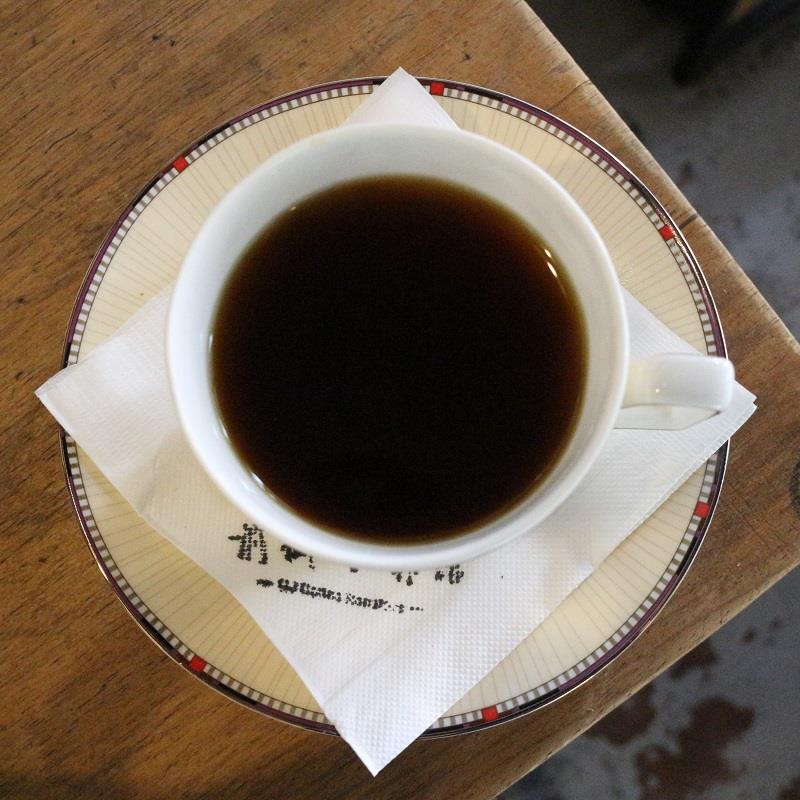
Yemeni coffee possesses the world's most unique, rich, and fascinating complex aromas: red wine fragrance, wild flavor, dried fruit notes, blueberry, grape, cinnamon, tobacco, sweet spices, woody notes, and even chocolate. You will see every kind of adjective used to describe Yemeni Mocha.
Just as Mocha has many meanings, its English spelling varies as well: Moka, Moca, and Mocca are all common. On Yemeni coffee sacks and documents, local spellings include four variations, "Mokha," "Makha," "Morkha," and "Mukha," all carrying the same meaning.
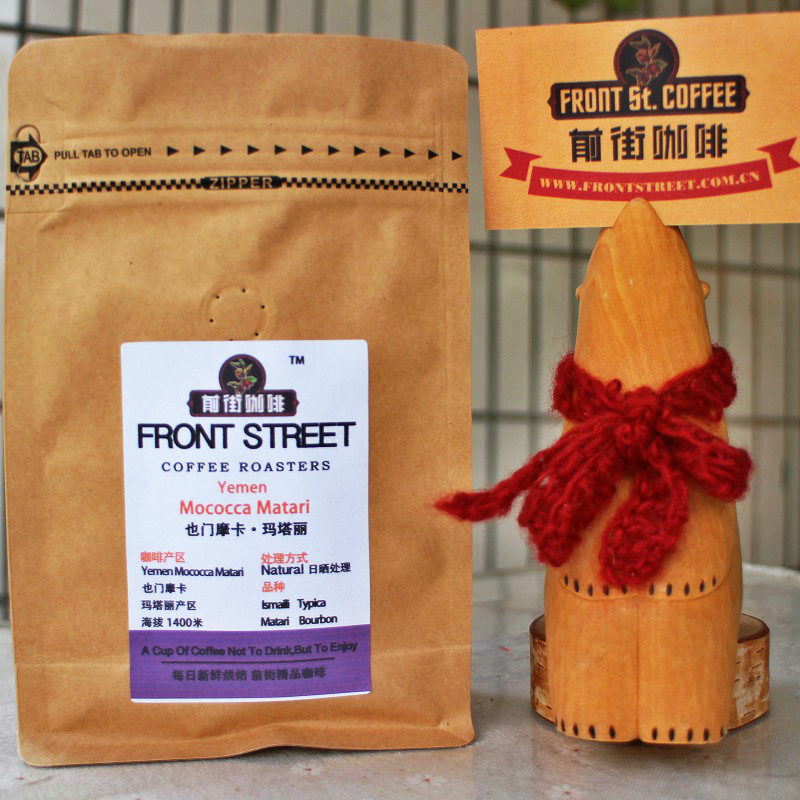
FrontStreet Coffee Recommendation
Yemen and Ethiopia are the two oldest chapters of the same story, and if Yemeni Mocha's wild, wine-like complexity appeals to you, Ethiopia is the place to explore next. FrontStreet Coffee's washed Yirgacheffe is the classic starting point: grown around a small town in southern Ethiopia where spring-like weather, drifting mist, and cool humidity have let thousands of coffee varieties flourish, it shows clear jasmine and bright citrus acidity, a light and elegant body, and a tea-like quality that drinks like a clean glass of lemon tea.
To follow Ethiopia's native varieties into wilder territory, FrontStreet Coffee's Kaffa Forest is worth seeking out. Unlike the garden-farming model in which growers plant coffee in their backyards, Kaffa Forest is best known for wild coffee, with trees growing in shade between 1,400 and 2,100 meters, where a pristine ecosystem, a distinctive microclimate, red soil, and plentiful rain give the trees an excellent environment. Given a medium-light roast, it shows pronounced white florals when ground, bright lemon acidity and sweet orange on entry, bergamot, a faint melon and nut sweetness in the finish, and a green-tea-like body.
And for the fermented fruit character that gives Yemeni Mocha its intensity, FrontStreet Coffee's natural-processed Huakui from Hambella in Guji, Sidamo, is a natural comparison. Ripe cherries are dried on raised beds for 21 days, turned constantly for even drying, and hand-sorted every three to five days to remove defects. Dried with pulp and skin intact and given a medium-light roast, it shows a light ferment, florals, citrus, and mango, with honeyed sweetness, cocoa, a touch of spice, a thick body, and a long finish.
Important Notice :
FrontStreet Coffee is a long-established specialty coffee roaster in Guangzhou China, selling freshly roasted beans from its own farm in Yunnan as well as dozens of carefully selected single-origin beans from around the world for both pour-over and espresso. The products deliver consistently excellent quality and great value, with shipping within 24 hours. Guangzhou's FrontStreet Coffee shop is recommended by many coffee lovers, and the beans are now available online at the Tmall 。
FrontStreet Coffee has moved to a new address:
FrontStreet Coffee Address: 315,Donghua East Road,GuangZhou
Tel:020 38364473
 Scan and follow the En Gafei WeChat official account. Please indicate that the reprint comes from "En Gafei".