Starbucks China responds to carcinogenic coffee controversy: Latest updates on acrylamide content and its impact
Professional Coffee Knowledge Exchange
For more coffee bean information, follow Coffee Workshop on WeChat (official account: cafe_style).
California Court Rules Starbucks Must Label Coffee with a Cancer Warning
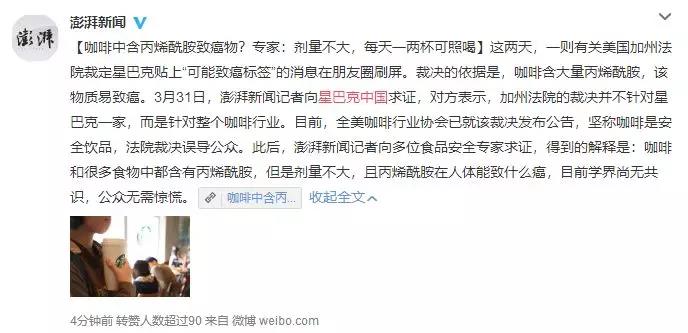
In recent days, news that a California court has ruled Starbucks must label its coffee with a "potential cancer warning" has been trending on social media. The basis for the ruling is that coffee contains high levels of acrylamide, a substance that is easily carcinogenic.
The ruling does not target Starbucks alone, but the entire coffee industry. The latest news is that on the evening of March 31, Starbucks China issued a media statement to The Paper, stating that regarding the court ruling, the National Coffee Association of the United States has issued a bulletin insisting that coffee is a safe beverage and that the ruling misleads the public.
Yesterday, an article claiming that Starbucks' biggest scandal had been exposed went viral on social media. Fortunately, most people stayed rational, and rumors stop with the wise.
Public Reactions
@ThisCupOfCoffeeIsNotTooCold: There are too many carcinogens in this world. Who doesn't live until they die? Don't just let coffee take the blame for this.
@Heaven'sWill: Drinking coffee causes cancer from acrylamide? You'd need to drink 300-400 cups of coffee per day to reach that dose. You'd die of caffeine poisoning before you got cancer. Or, to put it another way, a normal person drinking 400 cups of water a day would also die. A friend just educated me about this!
@OldXu: This morning I saw those alarmist people constantly sharing the idea that coffee causes cancer on social media. I didn't even bother to read it. I just treat it as statements from people who don't like coffee. It's like with fans: for every celebrity some people like, there will always be people who hate them. There are so many carcinogenic substances out there. I'll have my two cups a day regardless.
@Zhii: Haha, I just laughed. I don't believe the people who filed this lawsuit don't drink coffee or eat fried foods. Really unbelievable.
@MaoHaizi: Come to China. Chinese people have long been immune to this.
This eye-catching headline is like a nightmare for coffee lovers. Is coffee really undrinkable? Fortunately, Coffee Workshop has not spread rumors and has always kept an objective and fair attitude when reporting on this matter.
How Much Acrylamide Is in a Cup of Coffee?
What Is Acrylamide and How Does It Affect the Human Body?
Acrylamide is a toxic chemical substance. In 2002, Swedish scientists first discovered that fried potato chips, French fries, and other foods can easily form acrylamide through chemical reactions. Since then, scientists have found that many foods contain acrylamide, especially those rich in carbohydrates and cooked at high temperatures.
According to a report issued by the China Food and Drug Administration in July 2014, experts from the China National Center for Food Safety Risk Assessment and the College of Food Science and Nutritional Engineering at China Agricultural University believe that acrylamide has neurotoxic effects on both humans and animals. In animals, it also has reproductive toxicity, mutagenicity, and carcinogenicity.
Simply put, current academic research has only found that this substance may be carcinogenic in animals; what cancers it may cause in humans is still unclear.
In 2005, at the 64th meeting of the Joint FAO/WHO Expert Committee on Food Additives (JECFA), 6,752 acrylamide detection data points from food in 24 countries between 2002 and 2004 were collected. Among them, the average acrylamide content in coffee (brewed) was 13 μg/kg, with a maximum of 116 μg/kg. For coffee (roasted, ground, unbrewed), the average acrylamide content was 288 μg/kg, with a maximum of 1,291 μg/kg.
How is this calculated? Let's use the most conservative estimate. For a 70 kg person, the daily tolerable intake of acrylamide is 182 micrograms (70 × 2.6 = 182). In other words, they would need to drink at least 404 cups of black coffee per day (182 ÷ 0.45 = 404) to reach a carcinogenic dose. Similarly, a 50 kg coffee lover would need to drink 318 cups of black coffee per day to consume a carcinogenic dose of acrylamide. It is safe to assume that no normal person could drink such an enormous amount of coffee in a single day.

10 g of caffeine is roughly equivalent to the amount in 28 medium cups of Starbucks coffee.
Try drinking 28 cups of Starbucks in a day. So don't worry about this.

Acrylamide in Roasted Coffee
In the article "Current Research on Acrylamide in Roasted Coffee" by Xu Tongyu, Zeng Shaodong, and others, published in the Journal of Food Safety and Quality Detection, the authors point out that the main factors affecting acrylamide formation in coffee include coffee type, roasting temperature, and time. For example, when the roasting temperature is between 120 and 180°C, reducing processing temperature and heating time can reduce the final acrylamide that forms. When the roasting temperature is above 200°C, higher temperatures and longer times result in lower final acrylamide content.
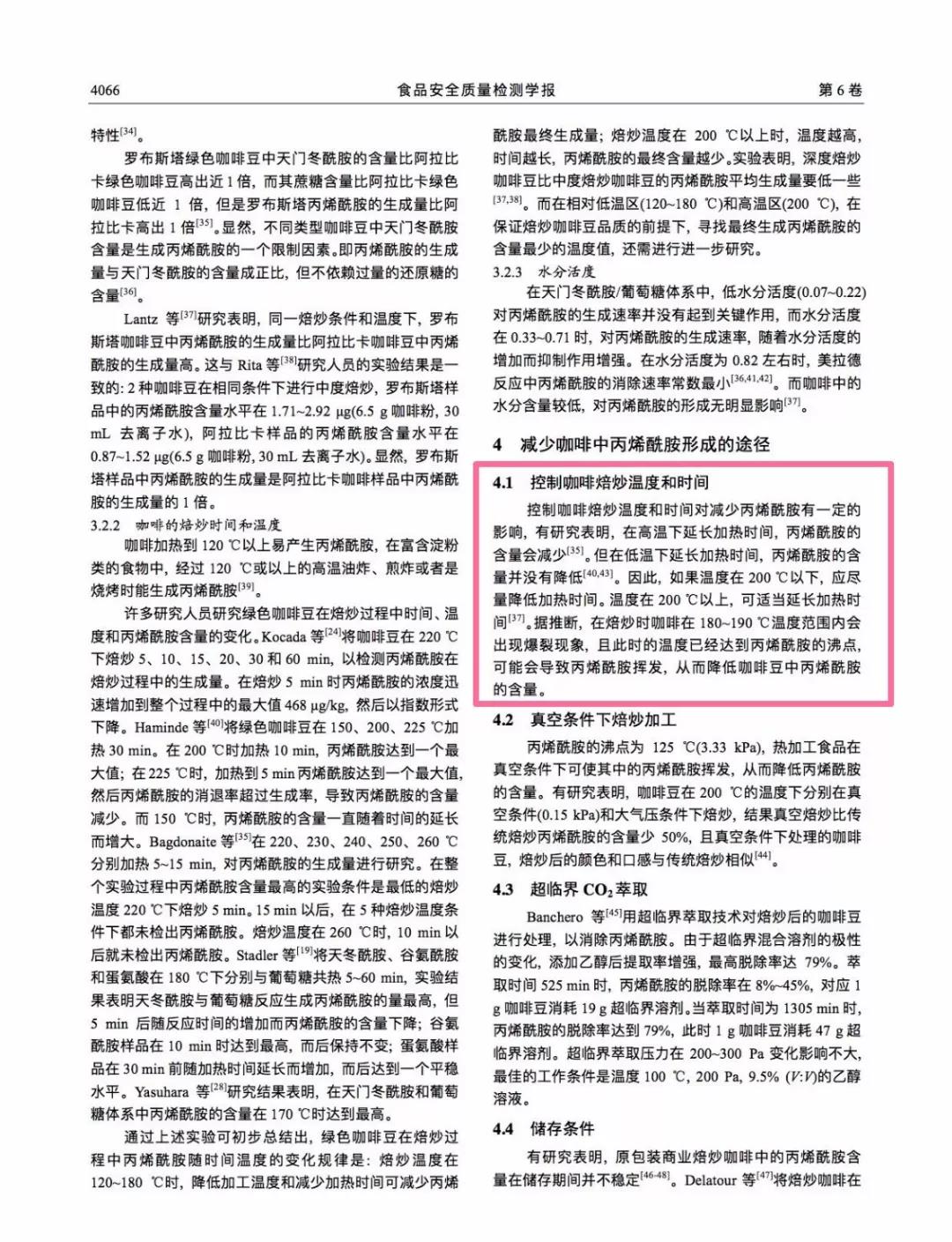
This means it is a good idea for coffee lovers to drink coffee made from lightly roasted beans to reduce acrylamide intake, such as FrontStreet Coffee's pour-over single-origin coffees.
Discussing Toxicity Without Dosage Is Irresponsible
Acrylamide also exists not only in coffee but, more importantly, in fried and overly baked foods. As a rule, try to eat fewer fried foods. (Content below is in micrograms per kilogram.)
- Cooked grains and noodles (113 samples): 15
- Roasted and stir-fried vegetables (39 samples): 59
- Fresh vegetables (45 samples): 4.2
- Coffee extract (20 samples): 1,100
- Decaffeinated coffee (26 samples): 688
- Fried chicken legs (10 samples): 81-271
Final Expert Conclusion: the Dose Is Not Significant, One or Two Cups a Day Is Fine
So there is really no need to worry too much. Normal eating and drinking will not harm your health. Compared with drinking one or two cups of black coffee, it may be more meaningful to cut back on non-dairy creamer, sugar, and salt, to eat fewer fried and grilled foods, and to eat fewer cookies and potato chips.
Do what you need to do, drink your single-origin coffee as usual,
drink your Starbucks as usual,
and as our netizens say,
Chinese people have long been immune to this, hahaha.

FrontStreet Coffee Recommendation
If you would like to build your daily habit around lighter roasts, FrontStreet's pour-over single-origin coffees are an easy and enjoyable place to start. FrontStreet's washed Yirgacheffe Gedidingding is a classic light-roast Ethiopian: jasmine florals, lemon and citrus acidity, and a tea-like body, clean and bright in the cup and gentle enough for anyone easing into lighter coffee.
For a touch more fruit, FrontStreet Ethiopia Huakui is a natural-processed bean from Hambella in Guji, Sidama, light-medium roasted to keep the tropical aromatics intact. Often described as the coffee that does not taste like coffee, it delivers strawberry, passion fruit, and even lychee aromas with a juicy body and very little bitterness, a genuinely approachable way to enjoy a lighter roast every day.
Important Notice :
FrontStreet Coffee is a long-established specialty coffee roaster in Guangzhou China, selling freshly roasted beans from its own farm in Yunnan as well as dozens of carefully selected single-origin beans from around the world for both pour-over and espresso. The products deliver consistently excellent quality and great value, with shipping within 24 hours. Guangzhou's FrontStreet Coffee shop is recommended by many coffee lovers, and the beans are now available online at the Tmall 。
FrontStreet Coffee has moved to a new address:
FrontStreet Coffee Address: 315,Donghua East Road,GuangZhou
Tel:020 38364473
 Scan and follow the En Gafei WeChat official account. Please indicate that the reprint comes from "En Gafei".