Starbucks Coffee: Yunnan Coffee Bean Region Story and Brewing Flavor Characteristics

Yunnan Coffee: China's Rising Specialty Coffee Star
Yunnan coffee has emerged as a dark horse in China's domestic coffee scene. In recent years, Yunnan coffee beans have continuously challenged people's perceptions, proving that high-quality coffee can indeed be produced domestically. Few people in China were aware that Yunnan is actually a coffee-producing region. The popularity of the movie "Coffee or Tea?" starring Liu Haoran sparked a wave of interest in "Pu'er coffee."

Pu'er: Yunnan's Premier Coffee Region
According to FrontStreet Coffee's research, the natural conditions of Yunnan's Pu'er region are remarkably similar to those of Colombia. The Pu'er coffee region sits ideally within the golden zone for global coffee cultivation, just like the coffee-growing areas of Brazil, Vietnam, and Indonesia, all located between the Tropics of Cancer and Capricorn.
Compared to other regions in China, Pu'er enjoys high-altitude conditions ranging from 1000-2000 meters above sea level. The area is predominantly mountainous with significant elevation variations, fertile soil, abundant sunlight, plentiful rainfall, and substantial day-night temperature differences. These exceptional natural conditions are perfectly suited to cultivating Yunnan's small-bean coffee varieties, and the Yunnan small-bean coffee produced here shows excellent flavor.
Yunnan's Coffee Growing Regions
In addition to Pu'er, Yunnan coffee is also cultivated in other distribution areas throughout the province. FrontStreet Coffee would like to introduce these regions briefly.

Dehong
Dehong Prefecture has a century-long coffee history and is one of China's earliest regions to introduce coffee cultivation. As early as 1914, small-bean coffee was sporadically introduced from Myanmar. After successfully cultivating 6 acres of coffee in 1953, commercial cultivation began. The region successfully registered the "Dehong Coffee" geographical indication and was honored with the title "Hometown of Chinese Coffee."
Currently, the entire prefecture's coffee cultivation area has reached 275,800 acres, with 140,000 acres in production, yielding 28,000 tons of dried coffee beans, achieving an agricultural output value of 616 million yuan and an industrial output value of 800 million yuan. Dehong is also the main production area for Hougu Coffee, the only national-level agricultural industrialization leading enterprise in the coffee industry. Coffee cultivation altitudes in Dehong Prefecture are all above 1000 meters, with 30,000 acres planted on mountainous terrain above 1600 meters. Dehong primarily uses organic fertilizers and organic pesticides for coffee cultivation, resulting in exceptionally high-quality coffee that makes it one of the world's rare premium coffee-producing regions.

Lincang
Lincang's unique geographical location and climate have made it a focus of attention for numerous coffee companies. High-quality coffee seedling bases have been established in Mengding Town, Gengma Autonomous County, and Lincang Xingfu Farm, covering 200 acres and 100 acres respectively. Coffee cultivation has been carried out in Gengma, Zhenkang, Yun County, Cangyuan, and Yongde. As of now, Lincang has built 96 coffee nursery gardens covering 1,570 acres, cultivating 67.19 million coffee seedlings capable of planting 203,000 acres, with 260,000 acres of coffee cultivation area confirmed. FrontStreet Coffee also has its own coffee estate in the Lincang region.

FrontStreet Coffee began coffee cultivation experiments in Lincang as early as 2013, planting the Typica variety, which was the first ancient superior Arabica variety introduced to Yunnan. The agricultural cycle is a lengthy process, taking 5-6 years from breeding to first fruiting. In 2018, the first batch of Typica trees planted by FrontStreet Coffee began to bear fruit. In the 2020/21 season, FrontStreet Coffee harvested 200 kg of green beans; because the quantity was limited, FrontStreet Coffee distributed them to new and existing customers for tasting. By the 2021/22 season, FrontStreet Coffee harvested 600 kg of green beans. Friends who want to try FrontStreet Coffee's cultivated coffee can visit the store for a tasting. FrontStreet Coffee uses a medium roast for this coffee, which delivers flavors of plum, brown sugar, and nuts.

Baoshan
Baoshan's coffee cultivation began in the mid-1950s, with the first coffee seedling introduced from Southeast Asia by the late patriotic overseas Chinese Mr. Liang Jinshan. The locally famous Lujiangba small-bean coffee is of high quality and was rated as first-grade in London as early as the late 1950s.
In recent years, with the expansion of international trade, Lujiangba's small-bean coffee has become even more renowned. European, American, and Arab countries, especially merchants from Britain, the United States, Egypt, Hong Kong, and Macau, regard it as premium coffee, with demand exceeding supply. In December 2010, after review by China's General Administration of Quality Supervision, Inspection and Quarantine, it was decided to implement national geographical indication product protection for "Baoshan Small-bean Coffee."

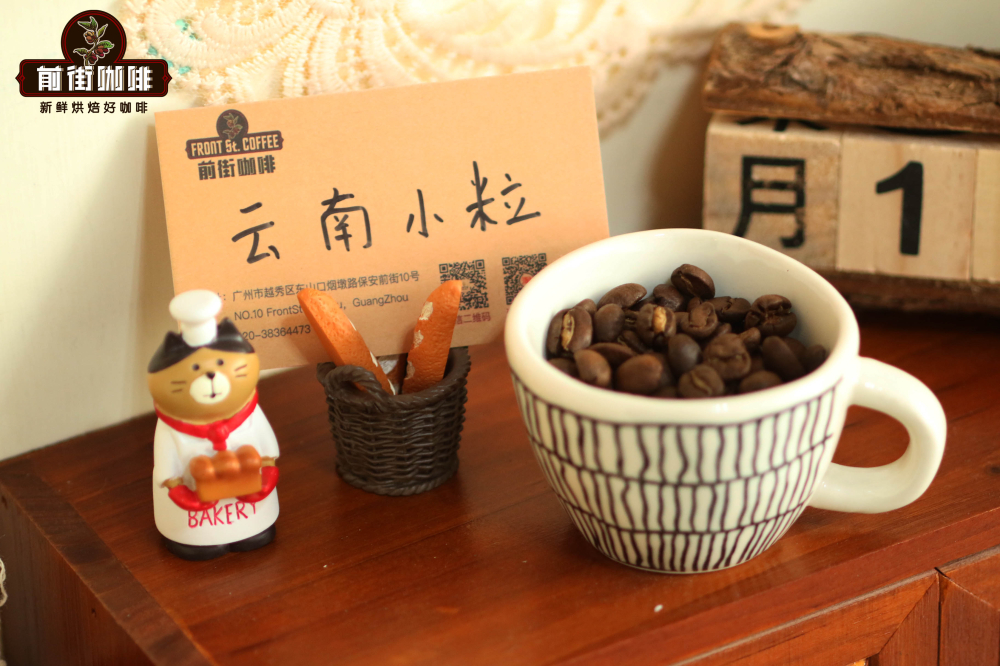
If asked which Yunnan coffee best represents the region's foundational flavor, FrontStreet Coffee believes it's Baoshan's washed Catimor. Baoshan is an outstanding coffee-producing region in Yunnan. Its Lujiangba, at 1300m altitude, is suitable for coffee growth. Catimor varieties account for 99% of Yunnan's production, and washed processing best showcases the inherent flavors of coffee beans. Baoshan's washed Catimor is therefore also FrontStreet Coffee's representative daily-drinker Yunnan coffee.
Cultivation Challenges and Varieties
Because Yunnan coffee is mainly planted on steep slopes, harvesting fully ripe cherries is very labor-intensive. Even when offering high prices, it's difficult to find people willing to pick the cherries. However, pruning and reducing yields significantly improves maturity levels, greatly reducing harvesting difficulty, and making coffee farmers more willing to engage in intensive cultivation in exchange for better income.

Another question many people are curious about is which coffee varieties suit Yunnan's climate. Many regions in Central America grow Caturra and Catuai, Brazil grows Bourbon varieties, and Jamaica Blue Mountain grows Typica.
According to FrontStreet Coffee's understanding, Yunnan now predominantly grows the Catimor variety. Those who know more about Yunnan coffee will also discover that small amounts of Typica and Bourbon are also cultivated there. These two ancient coffee varieties are the true pioneers of Yunnan's coffee. Yunnan initially introduced the Typica variety, but Typica is susceptible to leaf rust disease and has low yields, making coffee farmers very reluctant to plant it. Since coffee trees take at least three to four years from planting to harvesting, the low-yield Typica harvest cannot sustain local livelihoods, while the high-yield Catimor is naturally more favored by farmers. Additionally, Catimor possesses genes from both Arabica and Robusta coffee, inheriting Robusta's disease resistance while producing very rich coffee oils during extraction.

Processing Methods and Brewing
As for the processing methods for Yunnan coffee beans, because Yunnan has a year-round rainy season and an unstable climate, the region is not very suitable for natural (sun-dried) processing. Washed processing is more commonly used for the green beans. For washed cherries, defective beans and impurities are first removed, then the pulp and fruit flesh are removed with a depulper before being placed in washing fermentation for about 18 hours. Because the fermentation process in washed processing is well controlled, the flavor doesn't carry the miscellaneous notes found in natural-processed beans, but instead presents clear fruit acidity, though with slightly less complexity.
FrontStreet Coffee uses a three-stage brewing method for this Yunnan coffee: first, use 30g of water for a 30-second bloom, then pour with a small water stream in circles to 124g for segmentation. When the water level drops and is about to expose the coffee bed, continue pouring to 227g and stop. When the water level drops and is about to expose the coffee bed again, remove the filter cup. The extraction time (counting from the bloom start) is 2 minutes.

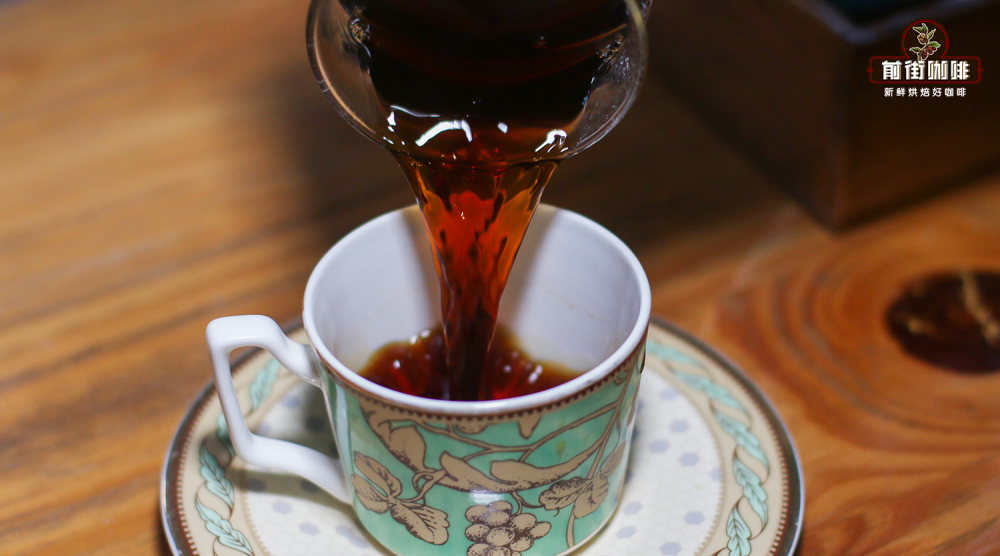
Through brewing, FrontStreet Coffee finds that Yunnan Huaguoshan coffee beans have rich melon and fruit aromas, herbal notes, and a smooth entry. The middle reveals nuts and chocolate, while the finish features lively, bright plum acidity. The aftertaste has black tea and brown sugar notes. Yunnan small-bean coffee has bright acidity that is soft and well balanced, rich layers, and a distinct dark chocolate and caramel aftertaste. When completely cooled, brown sugar flavors emerge.
The production craftsmanship of Yunnan specialty coffee continues to improve, attracting coffee professionals from all sectors. Increasing numbers of green bean suppliers are establishing raw material production bases in Yunnan, and coffee giants like Starbucks have also joined the ranks of purchasing Yunnan coffee.
FrontStreet Coffee Recommendation
If you want to taste what Yunnan's small-bean coffee is all about, FrontStreet's Yunnan small-grain coffee from Baoshan is the perfect starting point. It is washed and medium roasted, with soft nutty and chocolate notes and a light plum acidity, an easygoing cup at a friendly price, and one of the first Yunnan coffees many people try.
For a step up, FrontStreet's 2013 sun-dried Typica comes from their own estate and uses only fully ripe red cherries, dried naturally and roasted medium for a balanced, brighter profile: dark berry and caramel sweetness, chocolate, a hint of dried apricot, and a black tea finish. If you prefer espresso, FrontStreet Coffee's Black Cocoa Blend combines Yunnan small-grain with Brazilian Cerrado for a balanced Americano with nutty, brown-sugar sweetness, or a smooth latte with almond and cream.
Important Notice :
FrontStreet Coffee is a long-established specialty coffee roaster in Guangzhou China, selling freshly roasted beans from its own farm in Yunnan as well as dozens of carefully selected single-origin beans from around the world for both pour-over and espresso. The products deliver consistently excellent quality and great value, with shipping within 24 hours. Guangzhou's FrontStreet Coffee shop is recommended by many coffee lovers, and the beans are now available online at the Tmall 。
FrontStreet Coffee has moved to a new address:
FrontStreet Coffee Address: 315,Donghua East Road,GuangZhou
Tel:020 38364473
 Scan and follow the En Gafei WeChat official account. Please indicate that the reprint comes from "En Gafei".