Espresso Brewing Secrets: Illustrated Guide to Complex Italian Coffee Machine Operations and Principles
Espresso, the Italian Way
Espresso is the lifeblood of coffee lovers. The espresso machine behind the counter is both complicated and highly professional to operate. Here, FrontStreet Coffee breaks espresso machine operation down into clear steps so you can pull espresso at home too—provided, of course, that you already own a machine.
What Is Espresso?
Espresso originally described a method of brewing Italian coffee: high temperature and high pressure used to extract a concentrated coffee quickly. Over time it simply became known as espresso.
What Makes Espresso Distinct?
Under high temperature and pressure the coffee oils emulsify, trapping air and water. The result is a thick layer of foam (crema) on top and a milky liquid below, which delivers:
- Greater viscosity: the emulsified liquid tastes thicker and richer
- More aroma: the coffee fats carry the fragrance
- Longer finish: the fragrance lingers on the lips and teeth
What Makes a Great Espresso?
According to the Specialty Coffee Association of America (SCAA), the key conditions are:
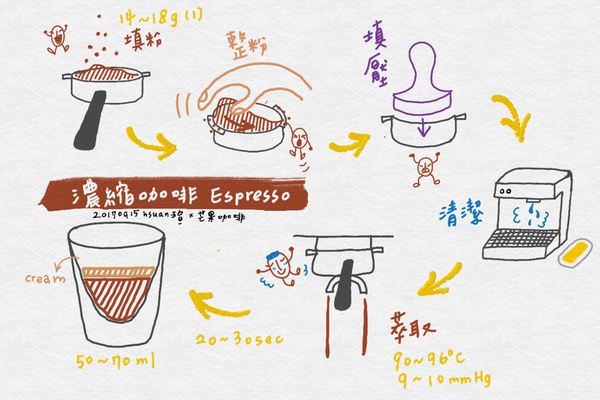
- Dose: 14-18 grams
- Grind size: pour-over grind 3.5, espresso grind 1
- Water temperature: 90-96°C
- Extraction pressure: 9-10 atmospheres
- Percolation time: 20-30 seconds
- Volume: 50-70 milliliters
Water temperature affects how the crema forms: the higher the temperature, the wetter the crema.
Let's Begin the Brew
Dosing
Purpose: fill the ground coffee into the portafilter.
Technique: how much to fill takes experience, which is why dosing grinders exist.
Leveling
Purpose: level the grounds in the portafilter.
Technique: slide your finger from the high point of the coffee to the low point. Finally, brush off any residual coffee from the "ears," the locking lugs on both sides of the portafilter.
Tamping
Purpose: compress the fluffy grounds firmly.
Technique: hold the tamper as you would a trumpet valve, letting your index finger and thumb feel whether you are pressing evenly, so one side does not end up higher than the other. Many tampers now have anti-mistake lines to stop baristas from pressing too hard and flattening the bed.
Cleaning
Purpose: clear residual coffee from the previous shot out of the group head and drip tray.
This step is extremely important in barista competitions.
Technique: first run the brew action to flush water through, then wipe the flushed water away with a clean cloth. The cloth belongs on the small side dish, not on the drip tray.
Extraction
Purpose: brew the grounds with high temperature and high pressure to produce espresso.
Technique: when installing the portafilter, bend down to check the locking position so you don't waste time fiddling with it and disturb the leveled bed. Constant clanging of the lock sounds unprofessional.
Press the brew button and start timing, then take a cup and get ready to catch the espresso.
At this point you can judge how the extraction is going:
- Uneven flow from both spouts: uneven tamping or inconsistent density
- Dripping flow: tamping density too high or inconsistent
- Flow too slow: tamped too tight
- Water overflowing from the sides: basket filled too full
When you see the flow begin to shift, prepare to stop the extraction. When white spots appear, stop immediately—white spots are a sign of over-extraction and they spoil the finished product.
The Extraction in Stages
Espresso pulled across different periods shows, from left to right, the first coffee extracted through to the last moment. The first cup is the essence of the shot within 30 seconds—the best-tasting part. The last cup has been extracted until nothing is left, pale in color and watery in taste. Coffee sold outside, though, usually packs all four cups together; it looks like a lot, but it wastes the beauty of the first cup, which is a shame.
Checking the Finished Product
- Crema on top: different beans give different colors (golden, nut-brown…), and white spots are a warning.
- After brewing and standing a while, the crema disappears and dissolves back into the coffee.
- Coffee below: color, impurities…
- The puck: skirt shape, height, hardness…
- A skirt shape indicates insufficient tamping, which lets the puck retain too much water.
Those are the steps for pulling espresso on an Italian espresso machine.
Detailed steps for espresso extraction—the common knowledge of Italian espresso.
FrontStreet Coffee Recommendation
Great technique needs the right bean, and espresso is where a bean's body and oils are put on display. FrontStreet's Brazil Queen Estate is a natural fit: a rare Yellow Bourbon grown in Mogiana on fertile red volcanic soil, it brings sugarcane sweetness, gentle fruit, and chocolate in a low-acid, balanced cup that holds its shape under pressure and pulls a generous, golden crema. It works just as well in a moka pot or a home espresso machine, and it is the kind of bean that makes an americano, latte, or cappuccino taste effortlessly smooth.
If you want the deeper, wilder side of espresso, work with a medium-dark roast and keep an eye on those 9-10 atmospheres and 20-30 seconds. Choose a bean with enough body to stand up to milk, dial in your grind until the flow runs evenly from both spouts, and stop the shot the instant you see white spots—then you'll taste why the first 30 seconds are worth chasing.
Important Notice :
FrontStreet Coffee is a long-established specialty coffee roaster in Guangzhou China, selling freshly roasted beans from its own farm in Yunnan as well as dozens of carefully selected single-origin beans from around the world for both pour-over and espresso. The products deliver consistently excellent quality and great value, with shipping within 24 hours. Guangzhou's FrontStreet Coffee shop is recommended by many coffee lovers, and the beans are now available online at the Tmall 。
FrontStreet Coffee has moved to a new address:
FrontStreet Coffee Address: 315,Donghua East Road,GuangZhou
Tel:020 38364473
 Scan and follow the En Gafei WeChat official account. Please indicate that the reprint comes from "En Gafei".