French Press vs Moka Pot: Which is Better, What Coffee Beans for French Press, and Moka Pot Features and Stories
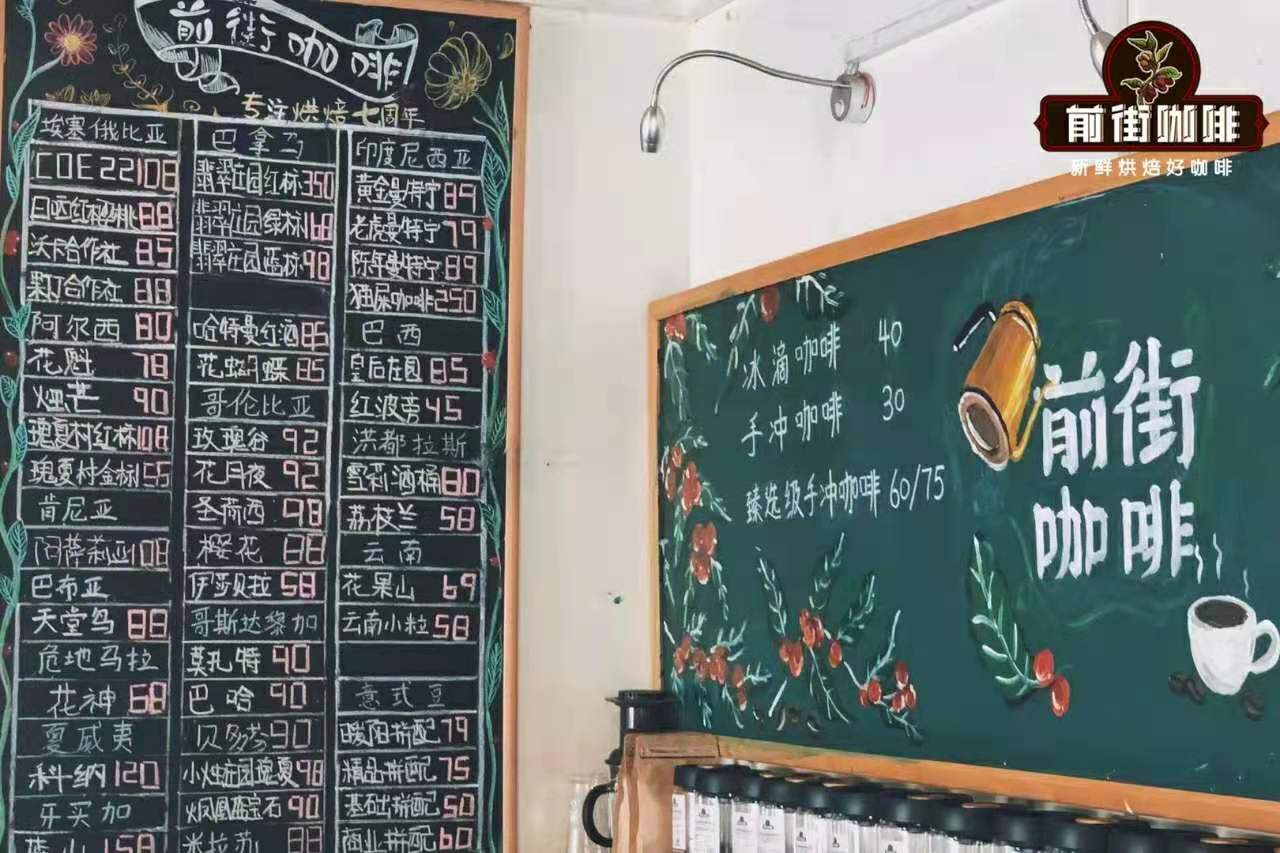
FrontStreet Coffee's core business is pour-over single-origin coffee — we carry more than 50 single-origin beans from origins around the world. That means choosing brewing equipment that can show these beans at their best, and after extensive side-by-side experiments, we keep coming back to simple pour-over methods.

That said, the pour-over is far from the only way to brew. There are plenty of other devices on the market — moka pots, French presses, and more. In this article, we'll walk through these two classic brewers, how they differ, and how to get the best out of each.
French Press
The French press originated in France around 1850. It's a beautifully simple device: a heat-resistant glass carafe paired with a metal mesh filter on a plunger rod.

Together with the moka pot, the French press is often lumped into the "lazy brewer" category — effortless to operate, yet still capable of a full-flavored cup. In fact, immersion extraction in a French press is the method closest to cupping: it draws out the oils, aromatics, and soluble flavors to their fullest, delivering a smooth, sweet, rich mouthfeel. For all these reasons, it remains one of the best-value pieces of coffee equipment you can own.
How to Make Coffee with a French Press
Step 1: Bean Selection
Single-origin beans, or any coffee with pronounced fruity acidity, work well. Medium to dark roasts are recommended.

Step 2: Grind Size and Coffee-to-Water Ratio
Plan on at least 20g of coffee. Grind slightly coarser than you would for pour-over — because the grounds steep in direct contact with hot water, going too fine invites over-extraction. A medium setting works; if the grind is too fine, particles slip through the mesh and the cup turns murky. For reference, here is FrontStreet Coffee's grind-size standard by sieve pass rate:
FrontStreet Coffee's grind sieve pass-rate standards: Cold drip > Pour-over, Siphon 80% > Moka, American drip 75-80% > Cupping 70-75% > French press 65-70%.

Start at a 1:10 ratio — for two cups, that's 20g of coffee to roughly 200g of water — then adjust to taste. Steep for about 3-4 minutes; the longer the steep, the stronger the flavor and the more pronounced the acidity. Every bean behaves differently and palates differ, so expect to fine-tune. During the steep, leave the plunger up — give the coffee and water plenty of time and space to interact before pressing.
Step 3: Brewing
1. Grind the beans and pour them into the French press. Don't obsess over grinding coarse — a plain medium grind is fine.

2. Boil water and let it settle to about 93°C, then pour in your measured water — we used 200g over 20g of grounds. Stir gently with a spoon to saturate everything evenly.

3. Cap the press with the filter screen held at its highest position and let it rest for 4 minutes.

4. Before pressing, lift the lid and skim off the foam and floating flecks with a spoon, then press the plunger slowly to the bottom.
5. Brewing done — pour immediately into a preheated serving vessel! Don't let it sit, because the grounds are still steeping. Then serve and enjoy.

Tips for French Press Success
Get an electronic scale. Even with a press that has volume markings and a measuring spoon, a scale is worth it: bean density varies with growing altitude, roast level, and more, so weight is the only reliable measure. And when you brew a cup you love, a recorded ratio lets you reproduce it — or, if a cup goes wrong, the data tells you exactly what to adjust.
Use fresh, soft water. Hard or unfiltered water will hold back even the best beans. Finally, be gentle: pressing slowly is the French press's virtue. If you stir or plunge aggressively at the last moment, you're essentially turbo-charging extraction right at the end — after the coffee has already given up everything good, what comes next is bitterness.

Want a milk coffee? The French press can froth for you. Pour warm milk about one-third up a clean press, insert the plunger, and pump it repeatedly until the milk doubles in volume — silky, fully frothed milk, ready to pour over coffee.
Moka Pot
The moka pot takes its name from Mocha: since the first Mocha coffee reached Venice in the 17th century, "Mocha" became shorthand for coffee itself in northern Italy. The moka pot is, in effect, simply "the coffee pot" — a device that lets any household produce a rich, aromatic cup.

The pot has three parts: the lower chamber (water reservoir), the filter basket (which holds finely ground coffee), and the upper chamber (which collects the brewed coffee). Extraction is driven by steam pressure — once pressure in the lower chamber builds enough to push hot water up through the coffee bed, the brew rises into the upper chamber as concentrated, aromatic coffee.
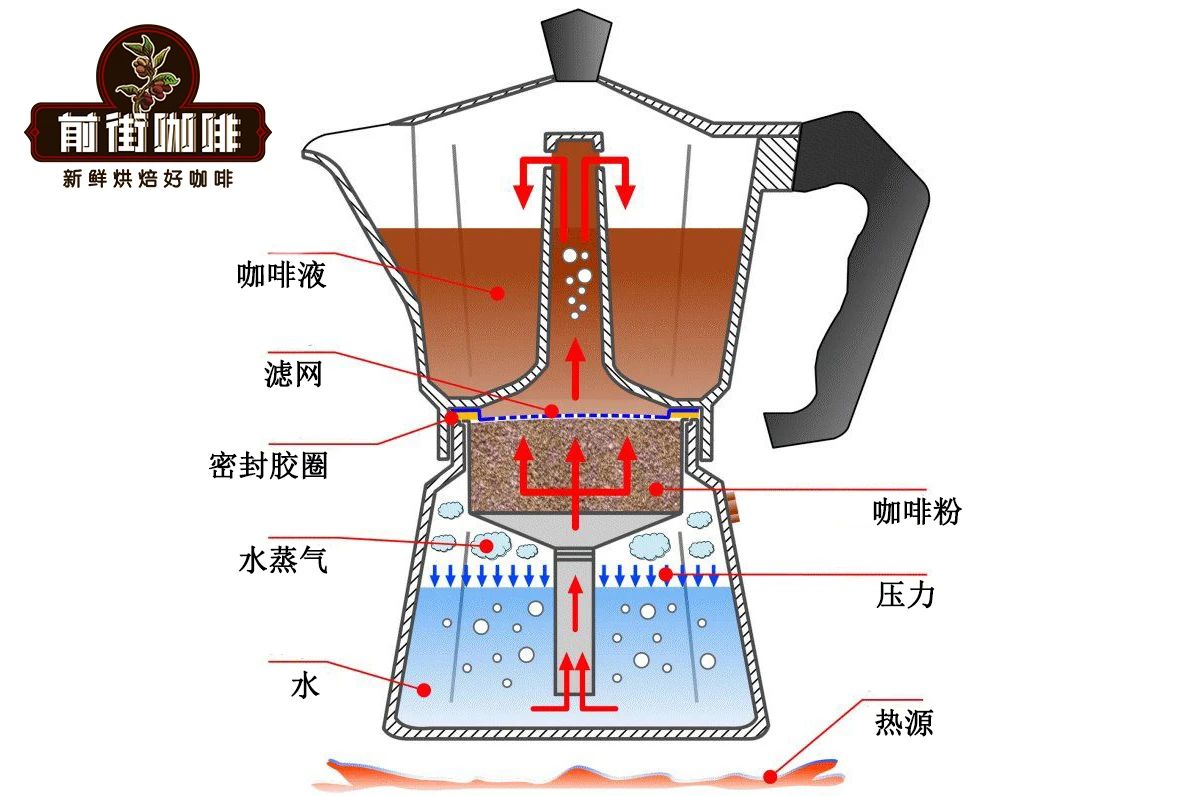
Moka Pot Brewing Process
Moka pot coffee is intense by nature, so we suggest dark roasted beans that can hold their own and express that rich, full-bodied character. FrontStreet Coffee uses beans from Brazil's Queen Estate (Fazenda Rainha).

1. Fill the lower chamber with purified water until the level sits about 0.5cm below the pressure relief valve.

2. Grind slightly coarser than espresso. A good reference is the mesh of the basket's filter plate — the particles should not fall through into the lower chamber. Fill the basket slowly, tap gently to settle the grounds evenly, and level the surface once a small mound forms.

3. Seat the basket in the lower chamber, screw the top and bottom together firmly, and set the pot on an electric ceramic stove over high heat.

4. Once the pot is hot and the coffee starts flowing with a distinct gurgling hiss, turn the heat to low and open the lid.

5. When the coffee in the upper chamber reaches about half full, kill the heat — residual heat and pressure will push the remaining coffee up on its own.

6. When extraction finishes, pour and enjoy. Moka pot coffee is very concentrated — it can even produce crema — and a splash of hot water or milk makes it even more approachable.
FrontStreet Coffee Recommendation
For the moka pot, the easiest path is an espresso-style blend. Our Classic Blend was designed specifically for espresso machines and moka pots — its standout strength is exceptionally rich crema, so even a beginner on a basic home machine can pull dense, silky foam. It follows the traditional Mocha-Mandheling formula with a mellow, rounded body, and it powers lattes, cappuccinos, and Dirty drinks beautifully. If crema is less of a priority, FrontStreet Coffee's Black Cocoa Blend uses 100% Arabica beans with generous crema, a full-bodied cup, and a friendlier price.
Single-origin options work wonderfully too. FrontStreet Coffee's Brazil Queen Estate beans are low in acidity and beautifully balanced, with rich nut and cocoa aromatics, clear caramel sweetness, and a smooth, lingering finish — great for pour-over, espresso, or moka pot alike. Our PWN Indonesian Golden Mandheling, dark roasted, offers herbal and dark chocolate notes with a faint earthiness and almost no acidity, ideal for drinkers who love body and dislike sourness. And Papua New Guinea Paradise Bird, grown at 1,600-1,800m on volcanic soil and triple washed, is often called a "little Blue Mountain" — clean, sweet, and remarkably smooth.
If you crave something fruitier for iced or fruit-forward drinks, try FrontStreet Coffee's Colombia Sidra: a competition-winning variety from 1,650-1,800m, double anaerobic natural-processed and medium-light roasted, with jasmine and citrus aromatics, juicy passion fruit, blueberry, grape, and apricot, and a persistent cocoa finish. Or the Strawberry Candy Blend — a crowd-pleasing fruit-toned espresso blend that mimics fresh strawberry gummies and works across pour-over, moka pot, espresso, and cold brew.
Important Notice :
FrontStreet Coffee is a long-established specialty coffee roaster in Guangzhou China, selling freshly roasted beans from its own farm in Yunnan as well as dozens of carefully selected single-origin beans from around the world for both pour-over and espresso. The products deliver consistently excellent quality and great value, with shipping within 24 hours. Guangzhou's FrontStreet Coffee shop is recommended by many coffee lovers, and the beans are now available online at the Tmall 。
FrontStreet Coffee has moved to a new address:
FrontStreet Coffee Address: 315,Donghua East Road,GuangZhou
Tel:020 38364473
 Scan and follow the En Gafei WeChat official account. Please indicate that the reprint comes from "En Gafei".