Papua New Guinea Coffee Roasting and Pour-Over Brewing Records
FrontStreet Coffee · An Introduction to Papua New Guinea Coffee Origins
Ever since I began buying green coffee to roast at home, beans from "mysterious countries" have exerted a powerful pull on me. Papua New Guinea (the Independent State of Papua New Guinea, usually shortened to PNG) is exactly that kind of origin. In my memory it showed up in high school geography (that country bordering Indonesia), in history class (a remote Western colony), and in university sociology seminars (how indigenous tribes collide with modern society and capitalism). I also found the country's name genuinely hard to pronounce — I was never sure where the "ya" syllables went, or that there were two of them. The short version: coffee from a country this hard to reach on the map simply has to be tried.
Papua New Guinea: An Island Nation of Coffee Excellence
Papua New Guinea is an island nation in the southwestern Pacific, sharing its western border with Indonesia and lying near the Solomon Islands to the east. Remarkably, despite its highlands, coffee is essentially its only cash crop. The most famous offering is "Bird of Paradise Coffee," above all from Sigri Estate, which ships it to buyers around the world. Sigri sits in the Wahgi Valley of the Western Highlands at an average altitude of 1,600 meters, where the cool climate and abundant rainfall give the coffee trees near-ideal growing conditions.
FrontStreet Coffee's Papua New Guinea Coffee Region: Chimbu
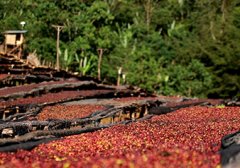
The green beans I bought, however, come from Chimbu in the Eastern Highlands. The better-known coffee region there is actually Goroka, long famous for producing both coffee and gold. Chimbu's history of growing coffee is comparatively short, but it has rich soil, high altitude, and a mild climate year-round — plus meticulous green-bean preparation: farmers hand-pick only ripe cherries and truck them to the Goroka mill for depulping and fermentation. Washed processing and sun-drying, along with the now-fashionable honey process, keep quality consistent and give the beans a rich, mellow cup — genuinely excellent coffee.
Coffee Tasting with the Roaster
First Roast
This one accidentally went too dark — during the one-minute glide before dropping the beans, there was a steady run of second-crack pops.
After resting the beans for 72 hours, I brewed them as pour-over with filter paper (water at 90°C, a 40-second bloom) at a coffee-to-water ratio of 10 g to 120 ml. As expected, the cup was very rich and mellow with a long, lingering finish — but no fruit aromatics or acidity to speak of.
Second Roast
This time I listened for the first crack, then rode a full minute of dense popping. Hoping to coax out a fruit-forward profile, I let the beans glide for about 10 seconds past the crack before dropping them. I had high hopes for this second batch.
After 48 hours of rest, I brewed with filter paper again (water at 90°C, 40-second bloom). Since the last cup had felt so heavy, I opened the ratio up to 10 g to 150 ml. The finish was still long, with fruit aromatics up front. The acidity stayed understated, but — there was sweetness! And it lingered on the palate, with a coffee flavor that seemed to detonate in the mouth and refuse to fade. Genuinely delicious.
FrontStreet Coffee Recommendation
If Indonesia's coffee in general interests you, the best growing regions across the archipelago are Java, Sumatra, and Sulawesi — three islands behind three signature coffees. FrontStreet Mandheling comes from Sumatra: moderately acidic with an intensely heavy aroma. Java coffee, an arabica, grows on Java island, while Sulawesi coffee has full, plump beans and a rich fragrance — though about 90% of that island's output is robusta.
When Indonesia comes up, start with FrontStreet Mandheling. Mandheling refers to arabica from Sumatra, processed mainly with the local wet-hulled method: because the parchment is stripped off while the beans are still half-dry and half-wet, the green beans dry fully exposed to the air, which gives the coffee its characteristic herbal and spice notes. FrontStreet's Mandheling comes from the Lake Toba area of the Lintong region; to bring out the classic Mandheling profile it takes a medium-dark roast, yielding a low-acid, full-bodied cup with rich notes of caramel, dark chocolate, and toast, and a sweet finish that lingers — a great fit for anyone who likes their coffee bold.
For top-shelf Indonesian coffee, the pick is FrontStreet PWN Golden Mandheling. PWN is a trading company that buys up premium local lots of Mandheling green coffee and sells only specialty-grade beans; "Golden Mandheling" is its flagship product. Production follows strict defect-screening standards covering bean density, size, shape, and color, and each lot is machine-sorted plus hand-sorted once to remove defects — ensuring the beans are whole, even, large, and translucent, while reducing the earthy and grassy notes Mandheling is sometimes dinged for. Legend has it the name came from the way the beans gleam golden in the sun. Freshly roasted FrontStreet PWN Golden Mandheling shows sandalwood, herbal, spice, roasted hazelnut, caramel, and dark chocolate flavors — clean, mellow, aromatic, and layered; fine for everyday drinking and even better as a gift.
Important Notice :
FrontStreet Coffee is a long-established specialty coffee roaster in Guangzhou China, selling freshly roasted beans from its own farm in Yunnan as well as dozens of carefully selected single-origin beans from around the world for both pour-over and espresso. The products deliver consistently excellent quality and great value, with shipping within 24 hours. Guangzhou's FrontStreet Coffee shop is recommended by many coffee lovers, and the beans are now available online at the Tmall 。
FrontStreet Coffee has moved to a new address:
FrontStreet Coffee Address: 315,Donghua East Road,GuangZhou
Tel:020 38364473
 Scan and follow the En Gafei WeChat official account. Please indicate that the reprint comes from "En Gafei".