Panama Esmeralda Estate Blue Label Geisha Pour-Over: Temperature, Grind Size, Water-to-Coffee Ratio Records & Brewing Techniques
Ask people today which beverage is the most expensive and many will answer coffee, especially specialty coffee. Top-tier lots can command extraordinary prices, and at the very peak sits Gesha. There is a saying among coffee lovers that if you have never tasted Gesha in your lifetime, every other coffee experience has been in vain.
The Origin and Discovery of Gesha Coffee
Named "Geisha," pronounced the same as the Japanese word for geisha, this coffee is also known as Geisha coffee. Because the trees grow taller than typical coffee trees, they were originally planted in a small area of the estate and used as windbreaks. When the estate owner's son wanted to enter the annual Best of Panama competition, he searched through every variety on the estate for a contender, giving Geisha its chance to shine. Since then it has competed around the world, winning eleven championships in total.
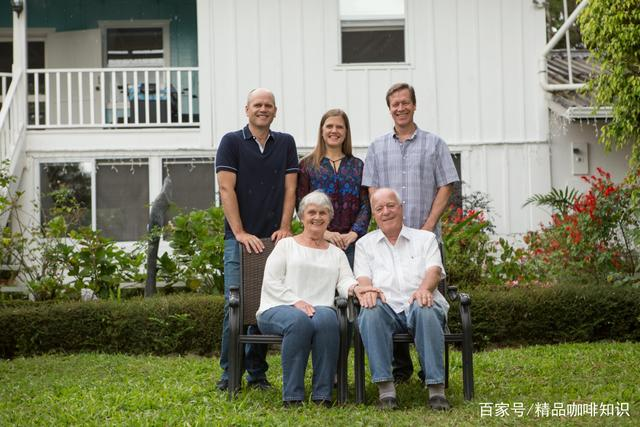
The Geisha variety was discovered in 1931 in the Geisha forest of Ethiopia and then sent to the Coffee Research Institute in Kenya. In 1936 it was introduced to Uganda and Tanzania, and in 1953 Costa Rica brought it in. For a long time Geisha drew little attention, until Don Pachi first brought it from the small town of Gesha in southwestern Ethiopia to Costa Rica. Later, Geisha entered Panama along the southern route, where Panama's Hacienda La Esmeralda separated it from other varieties and went on to win the national coffee championship.
Geisha offers rich sweetness, an exceptionally clean taste, and abundant aromas ranging from berries and citrus to mango, papaya, and peach. A very distinct bergamot-like aftertaste is also one of its typical cupping characteristics. To this day, Geisha remains the champion among coffee varieties.
Panama is the most important country on the world coffee map. Auction lots there annually fetch prices exceeding hundreds of US dollars.
Awards and Recognition
Award records (these are the records of Hacienda La Esmeralda):
Specialty Coffee Association of America (SCAA) Annual Cupping Competition Champion
1st Place, Specialty Coffee Association of America
Roasters Guild Cupping Pavilion
Specialty Coffee Association of America (SCAA) Annual Cupping Competition Second Place
2nd Place, Coffee of the Year
Best of Panama Champion
1st Place, "Best of Panama"
Rainforest Alliance Coffee Quality Cupping Competition Champion
1st Place, Rainforest Alliance for Quality
Panama Geisha (Hacienda La Esmeralda)

Country: Panama
Grade: Blue Label
Region: Boquete
Roast Level: Light Roast
Processing Method: Washed
Variety: Gesha
Estate: Hacienda La Esmeralda
Flavor: Oolong tea aroma, peach aroma, honey aroma
Panama - Hacienda La Esmeralda Gesha Coffee Beans
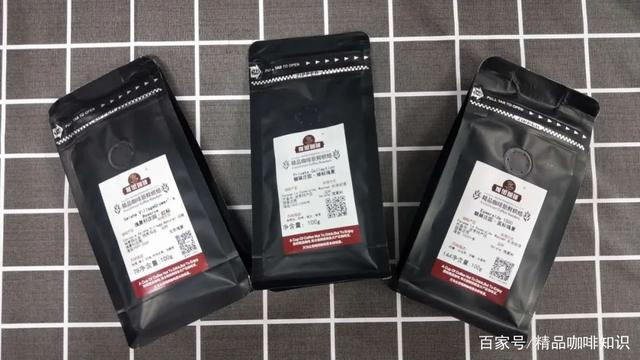
Panama Geisha (Hacienda La Esmeralda)
[Origin]: Panama
[Region]: On the slopes of Baru Volcano, the highest peak in western Panama
[Estate]: Hacienda La Esmeralda
[Grade]: Blue Label
[Growing Altitude]: 1450M
[Processing Method]: Fine washed processing
[Special Certification]: Rainforest Alliance Certified
[Roast Level]: Light roast city
Panama Coffee Auction
What is the Panama auction?
In 1996, during the lowest period of international coffee prices, seven coffee estates in the Boquete and Volcan regions saw the dawn of the specialty coffee era and organized the famous Specialty Coffees of Panama association, known as SCAP. In 2013, the highest bid for washed Gesha in the BOP Gesha category exceeded $160 per pound, while the highest bid for natural Gesha went to a natural Gesha from Hacienda La Esmeralda at over $350 per pound.
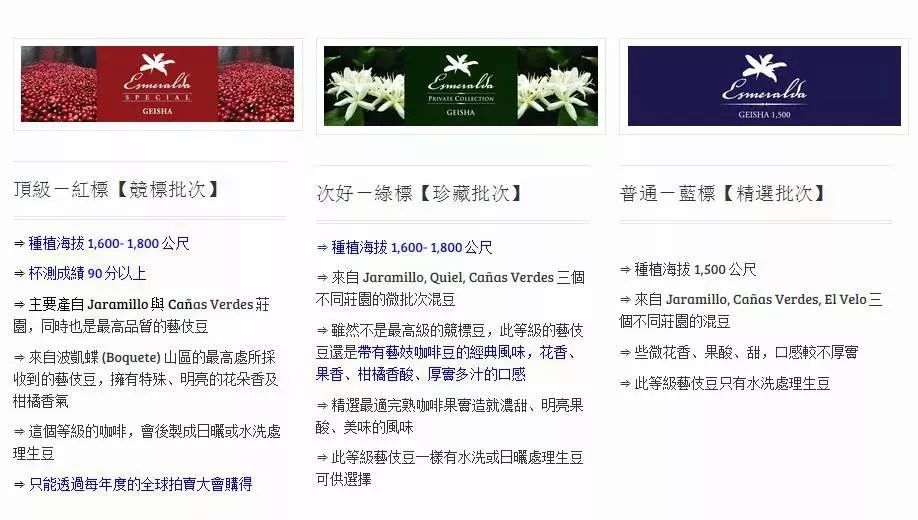
Hacienda La Esmeralda Gesha has three brands, divided by altitude:
Auction Gesha (Esmeralda Special) (Red Label), selected from altitudes above 1,550 meters.
Boquete Geisha (Green Label), specially selected Gesha from 1,500 meters.
(Esmeralda 1,500) (Blue Label), specially selected Gesha varieties from around 1,500 meters altitude.
[Flavor Description]: Oolong tea aroma, peach aroma, honey aroma, refreshing and comfortable, bright yet balanced, with extremely strong aromatic layers. The whole aroma is wrapped in caramel sweetness, with noticeable fruit acidity on the tongue on entry. The mouthfeel is gentle and rounded, with strong fruity sweetness and aftertaste, like swallowing a mouthful of fresh fruit tea that deeply satisfies the senses. The lower the temperature, the more delicate the acidity. The aftertaste is quite long-lasting.
Brewing Methods
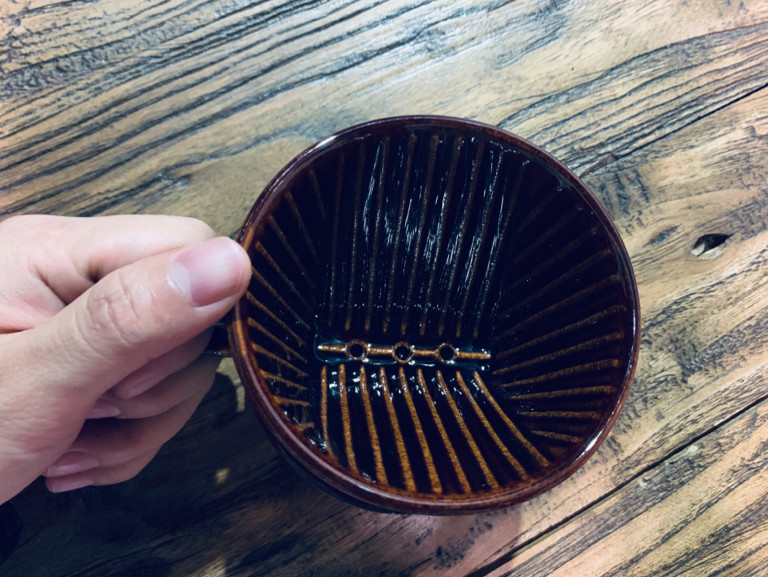
Kalita Three-Hole Trajectory Dripper
The Kalita trapezoidal dripper, also known as a fan-shaped or trapezoidal dripper, has smaller holes at the bottom. Its cup walls carry many ribs, distributed in straight lines at consistent spacing, designed to increase exhaust and water-flow speed. Its flow rate is relatively slow, relying primarily on immersion extraction.
Parameters and technique:
Water temperature: 90 degrees Celsius; medium-fine grind (BG 5R: 58% pass-through rate on a China standard #20 sieve), coffee-to-water ratio 1:15.
15 g of grounds, bloom with 30 g of water for 30 seconds, pour to 129 g in stages, continue to 230 g when the water level drops and is about to expose the bed. Timing starts from the bloom. Extraction time: 1:55.
Flavor: entry reveals distinct citrus, lemon, and bergamot flavors, with fresh jasmine and ginger flower aromas, honey sweetness, and green tea notes.

V60
The V60 dripper is designed around the speed at which the water level falls, letting coffee particles extract more effectively with a faster flow. Its internal ribs use a curved vortex structure that helps accelerate the flow, running from bottom to top for smooth exhaust. The curved ribs lengthen the water's path, extending contact time between the coffee particles and the water.
Parameters and technique:
Water temperature: 90 degrees Celsius; medium-fine grind (BG 5R: 58% pass-through rate on a China standard #20 sieve), coffee-to-water ratio 1:15.
15 g of grounds, bloom with 28 g of water for 30 seconds, pour to 128 g in stages, continue to 230 g when the water level drops and is about to expose the bed. Timing starts from the bloom. Extraction time: 1:50.
Flavor: the aroma carries ginger flower fragrance; entry reveals citrus and lemon acidity, the mid-palate has honey sweetness, and the finish shows green tea notes and brown-sugar sweetness.
Cake Dripper
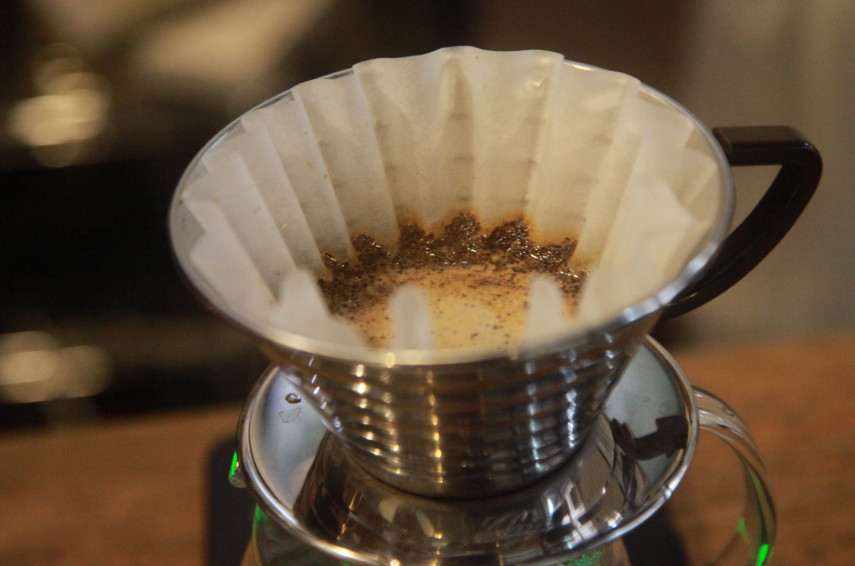
The cake dripper has a flat bottom and belongs to the semi-immersion family, with a longer immersion time. The bottom has 4 holes, ensuring a relatively uniform flow rate.
Parameters and technique:
Water temperature: 90 degrees Celsius; medium-fine grind (BG 5R: 58% pass-through rate on a China standard #20 sieve), coffee-to-water ratio 1:15.
15 g of grounds, bloom with 30 g of water for 30 seconds, pour to 130 g in stages, continue to 230 g when the water level drops and is about to expose the bed. Timing starts from the bloom. Extraction time: 1:52.
Flavor: the aroma reveals jasmine fragrance; entry shows citrus sweet-and-sour notes, the mid-palate has chocolate and nut flavors with honey sweetness. The mouthfeel is relatively rich and overall well balanced.
Cold Brew
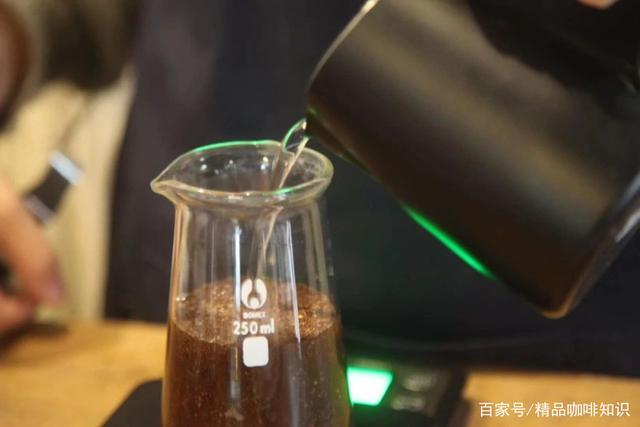
Cold brew is a form of cold extraction in which grounds and water sit in a low-temperature environment for an extended period, then are filtered to finish.
Parameters and technique:
Grind size: medium-fine (BG 5R: 58% pass-through rate on a China standard #20 sieve), 20 g of grounds, coffee-to-water ratio 1:10. Pour the grounds into a cup, add 200 g of room-temperature water, and stir ten circles with a stir bar to saturate the grounds fully. After steeping for 12 hours, filter the coffee liquid.
Flavor: the aroma carries light ginger flower and jasmine fragrances; entry reveals lemon, honey, nut, and green tea flavors, overall refreshing and clean.
FrontStreet Coffee Recommendation
A "Blue Label" Gesha sits at the very top of the coffee world, and if a legendary, perfectly balanced cup is what you are after, FrontStreet Coffee's Jamaica Blue Mountain No. 1 belongs in the same conversation. It comes from the certified Blue Mountain range, from the historic Clifton Mount estate, where coffee has been grown since around 1750 on land averaging 4,300 feet (about 1,310.64 meters): high altitude, drifting mist, volcanic soil, and a mild climate let the cherries ripen slowly, producing the balance Blue Mountain is famous for. Neither sharply fruity like some African coffees nor heavily bitter like a dark roast, it lands squarely between sweet, sour, bitter, and aromatic, with layered cream, caramel, chocolate, nut, and honey notes and a clean, long finish. It is a medium-dark roast, and traditional Blue Mountain is shipped in wooden barrels of 15, 45, and 70 kilograms, each stamped with the lot's details.
Blue Mountain is graded, and No. 1 is among the highest tiers by bean size, defect rate, and overall quality. Brewed as pour-over at a 1:15 to 1:16 ratio with 85 to 88 degrees Celsius water and a medium-coarse grind, it highlights cream, caramel, and nut while keeping a soft, bright acidity; a moka pot or espresso machine will bring out chocolate and caramel and a fuller body, and it also works beautifully with milk. If you enjoy this mellow, low-acid style but want something a little different, the Papua New Guinea Paradise Bird from the Sigri region is a Typica grown at 1,600 to 1,800 meters on volcanic soil, AA graded, and triple washed, so clean and sweet that many drinkers call it a "little Blue Mountain."
Important Notice :
FrontStreet Coffee is a long-established specialty coffee roaster in Guangzhou China, selling freshly roasted beans from its own farm in Yunnan as well as dozens of carefully selected single-origin beans from around the world for both pour-over and espresso. The products deliver consistently excellent quality and great value, with shipping within 24 hours. Guangzhou's FrontStreet Coffee shop is recommended by many coffee lovers, and the beans are now available online at the Tmall 。
FrontStreet Coffee has moved to a new address:
FrontStreet Coffee Address: 315,Donghua East Road,GuangZhou
Tel:020 38364473
 Scan and follow the En Gafei WeChat official account. Please indicate that the reprint comes from "En Gafei".