Yirgacheffe Banko Gotiti Coffee Bean Washed Processing Flavor Characteristics and Story | Yirgacheffe Pour-Over Brewing Parameters

Ethiopia Yirgacheffe Banko Gotiti Coop
FrontStreet Coffee Customer Service · Ethiopia Yirgacheffe Banko Gotiti Coop
Country: Ethiopia
Region: Yirgacheffe, Gedeo Zone
Altitude: 2000-2100m
Variety: Heirloom
Processing: Washed
Grade: G1
Yirgacheffe is one of the regions celebrated for its citrus fruit flavors, and it has been enthusiastically embraced by coffee lovers everywhere. FrontStreet Coffee explores Yirgacheffe beans as well, and has found a coffee of exceptional flavor: FrontStreet Coffee's washed Yirgacheffe produced by the Banko Gotiti Cooperative.
About Yirgacheffe
Yirgacheffe was originally a small town in Ethiopia, located in the Sidamo administrative region. The town has been a wetland since ancient times; in the local language, "Yirga" means "settle down" and "Cheffe" means "wetland." Yirgacheffe is one of the world's highest coffee-growing regions and a synonym for Ethiopian specialty coffee. At an elevation of 1700-2100 meters, with consistently cool, foggy weather and a spring-like climate all year, its geography and unique cultivation system give it ideal conditions for specialty coffee.

Strictly speaking, Yirgacheffe is a sub-region of Sidamo. The town sits in the northwest of Sidamo, nestled among mountains and lakes, and is one of Ethiopia's highest coffee-growing areas. Thanks to its distinctive flavor, it broke away from Sidamo to establish its own identity, becoming one of Africa's most prestigious coffee regions.
The "Yirgacheffe flavor" people talk about includes intense jasmine florals, lemon or lime citrus aromas, and peach and almond sweetness with tea-like notes. FrontStreet Coffee's Yirgacheffe is layered and delicate, with captivating flavors and a sweet aftertaste. The phrase "flowers bloom as the coffee enters your mouth" captures it well, evoking the pleasure of flowers awakening the taste buds and the olfactory cells. Beyond the florals, the delicate body feels like silk massaging the mouth, a marvelous tactile experience.

Yirgacheffe Region Introduction
Gedeb is a town below Kochere, 60 kilometers from Yirgacheffe town, and a renowned specialty coffee region in Ethiopia. At an altitude of 1900-2200 meters, it sits notably higher than most of Yirgacheffe, and that advantage makes Gedeb an exceptionally favorable place for coffee: a micro-region that is steadily emerging. Although the ECX auction market classifies the town within the Kochere region, it holds the same administrative level as Kochere.

In the specialty coffee industry, it can be distinguished from Kochere as an independent Yirgacheffe sub-region at the same level. The town includes villages such as Worka Sakaro, Halo Bariti, Banko Gotiti, and Banko Dahato that produce coffee.
Banko Gotiti Cooperative
The Banko Gotiti Cooperative is located in the Worka area at the southeastern end of Yirgacheffe. It was originally part of the Worka Cooperative under the Yirgacheffe Coffee Farmers Cooperative Union (YCFCU). As the pursuit of traceability grew, individual "single origins" were gradually discovered by coffee hunters worldwide. So in 2012, Banko Gotiti, with roughly 300 member farmers, independently established the "Banko Gotiti Cooperative."

Banko Gotiti village was one of the first village areas to become independent. Many of its smallholders were originally members of the Worka Cooperative, so their coffee-production skills are beyond question. Known as the last pure land of Yirgacheffe, the cooperative also follows very traditional processing methods, both washed and natural.
Processing Method
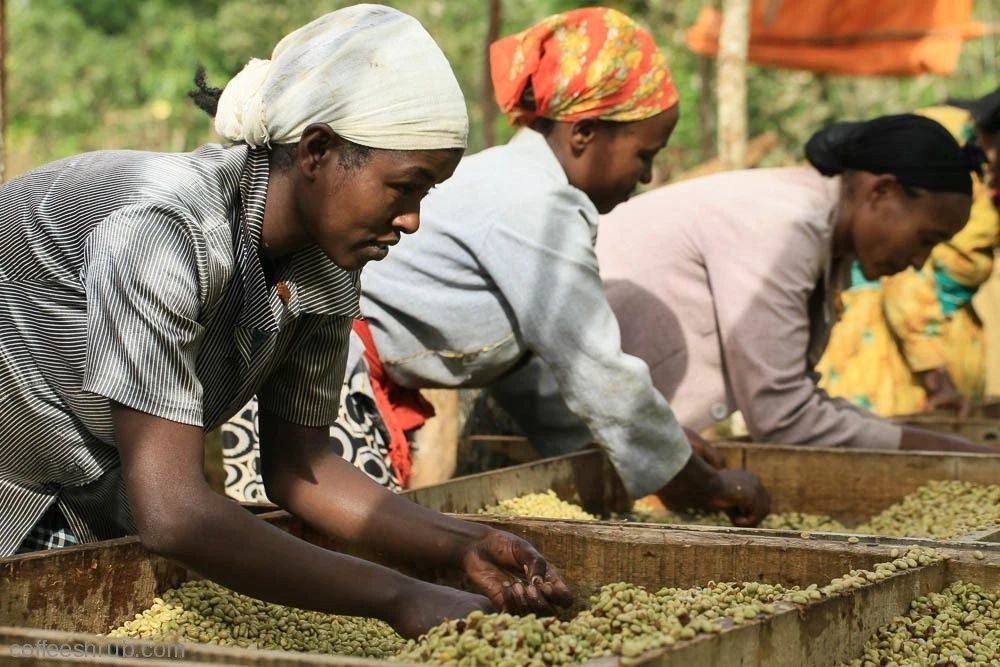
After harvesting, cherries are sent for processing immediately, typically within 6 to 12 hours of picking. They are first weighed, then soaked in water so that low-quality floaters can be separated out.
Next, the cherries go to a pulping machine to remove the skin and pulp. The depulped cherries are then placed in fermentation tanks or barrels for 18 to 36 hours, where enzymes break down the mucilage and pectin. The demucilaged cherries are washed with appropriate amounts of water, and stirring during washing removes the pectin breakdown products from the bean surface. What remains after washing is only the parchment, silver skin, and green bean.

The washed beans are then sorted to remove defects before heading to drying areas such as waterproof tarps, cement floors, or raised beds. Drying time depends on the climate and generally ranges from 5 to 14 days, during which the beans' moisture content drops from 55% to 11%.
FrontStreet Coffee's Roasting Reference
For Yirgacheffe beans, FrontStreet Coffee's roasters usually use a light roast to bring out the floral and fruity character. For this washed Banko Gotiti, we again use low heat to extend the dehydration time.
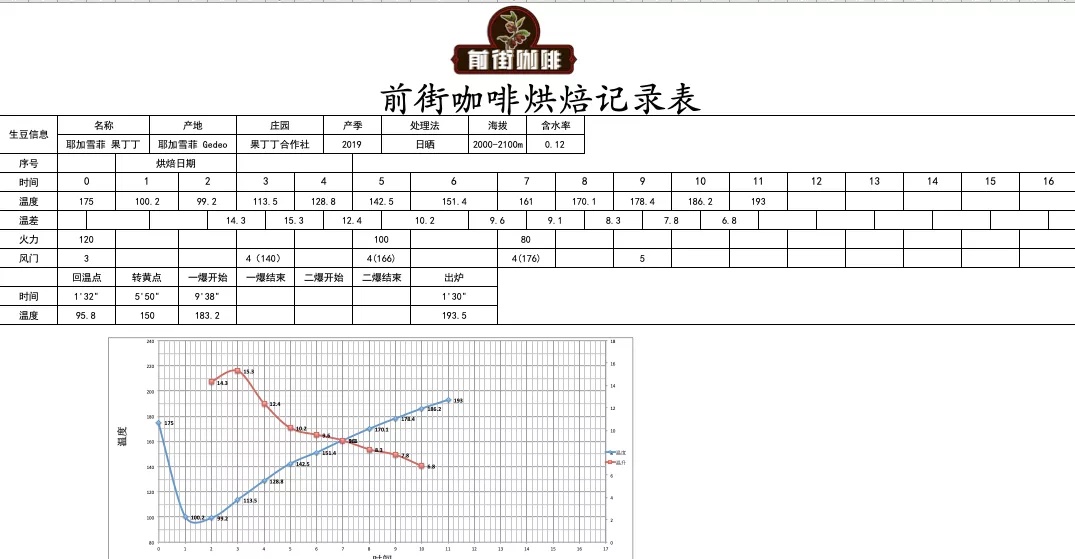
Preheat the roaster to 175°C, start with the airflow at 3, and set heat to 120. The turnback point is at 1'32". When the drum reaches 140°C, hold the heat and raise the airflow to 4. At this point the bean surface turns yellow, the grassy smell disappears entirely, and dehydration begins. At 166°C reduce the heat to 100, and at 176°C reduce it to 80, keeping the airflow unchanged.
At 8'28", ugly wrinkles and black spots appear on the bean surface and the toast aroma clearly shifts to coffee aroma, the prelude to first crack. Listen carefully for the crack. First crack begins at 9'38"; adjust the airflow to 5 (adjust heat with great care, never so low that cracking stops), develop for 1'30" after first crack, and drop at 193.5°C.
FrontStreet Coffee's Brewing Reference
Recommended brewing method: Pour-over
Dripper: Hario V60
Water temperature: 92°C
Dose: 15 grams
Ratio: 1:15
Grind size: Medium-fine (Chinese standard 20-mesh sieve 80% pass-through)

Brewing technique: segmented extraction. Use 30g of water for a 30-second bloom. With a small flow, pour in circles to 120g and pause. When the water level drops and is about to expose the coffee bed, continue pouring to 225g and stop. Wait for the level to drop until the bed is about to be exposed again, then remove the filter cup. (Counting from the bloom) Extraction time is 1'50".

Flavor: The overall mouthfeel is solid, with fermentation aroma and tropical fruit notes standing out. As the temperature changes, berry and cream flavors emerge. The sweet-and-sour citrus sensation that lingers between the teeth and lips is remarkably persistent.
FrontStreet Coffee Recommendation
If Yirgacheffe's floral, citrus-driven style is what you enjoy, FrontStreet offers a few ways to explore it.
FrontStreet Washed Yirgacheffe
The classic introduction to the region, known for white jasmine, bright citrus and lemon acidity, and a tea-like quality, at an approachable price that makes it many drinkers' first specialty bean. Yirgacheffe is a small town in Ethiopia's Sidamo zone at roughly 1700-2100 meters; trees grow above 1800 meters, making it one of the world's highest coffee regions.
FrontStreet Guodingding Cooperative
From Guodingding village at the southeastern end of Yirgacheffe, in the Worka area, this cooperative was once part of the Worka Cooperative under the YCFCU. Its traditional washed processing is why it is called Yirgacheffe's last pure land. It has no traditional bitterness, instead bringing clean, bright citrus and lemon acidity with jasmine fragrance.
FrontStreet Natural Red Cherry
Processed as whole-cherry natural from only fully ripe, sound fruit. After a first sorting, the cherries sun-dry on raised beds and are turned every 2-3 hours in the first days to avoid uneven heat and over-fermentation. After three to five weeks the outer pulp is removed by machine. Because the cherries dry with the fruit on, the cup blends classic Yirgacheffe character with tropical fruit: citrus-like acidity, a berry-juice quality, honey sweetness, and creamy smoothness.
Important Notice :
FrontStreet Coffee is a long-established specialty coffee roaster in Guangzhou China, selling freshly roasted beans from its own farm in Yunnan as well as dozens of carefully selected single-origin beans from around the world for both pour-over and espresso. The products deliver consistently excellent quality and great value, with shipping within 24 hours. Guangzhou's FrontStreet Coffee shop is recommended by many coffee lovers, and the beans are now available online at the Tmall 。
FrontStreet Coffee has moved to a new address:
FrontStreet Coffee Address: 315,Donghua East Road,GuangZhou
Tel:020 38364473
 Scan and follow the En Gafei WeChat official account. Please indicate that the reprint comes from "En Gafei".