Introduction to Fazenda Rainha (Queen Farm) in Brazil
Fazenda Rainha (Queen Farm)
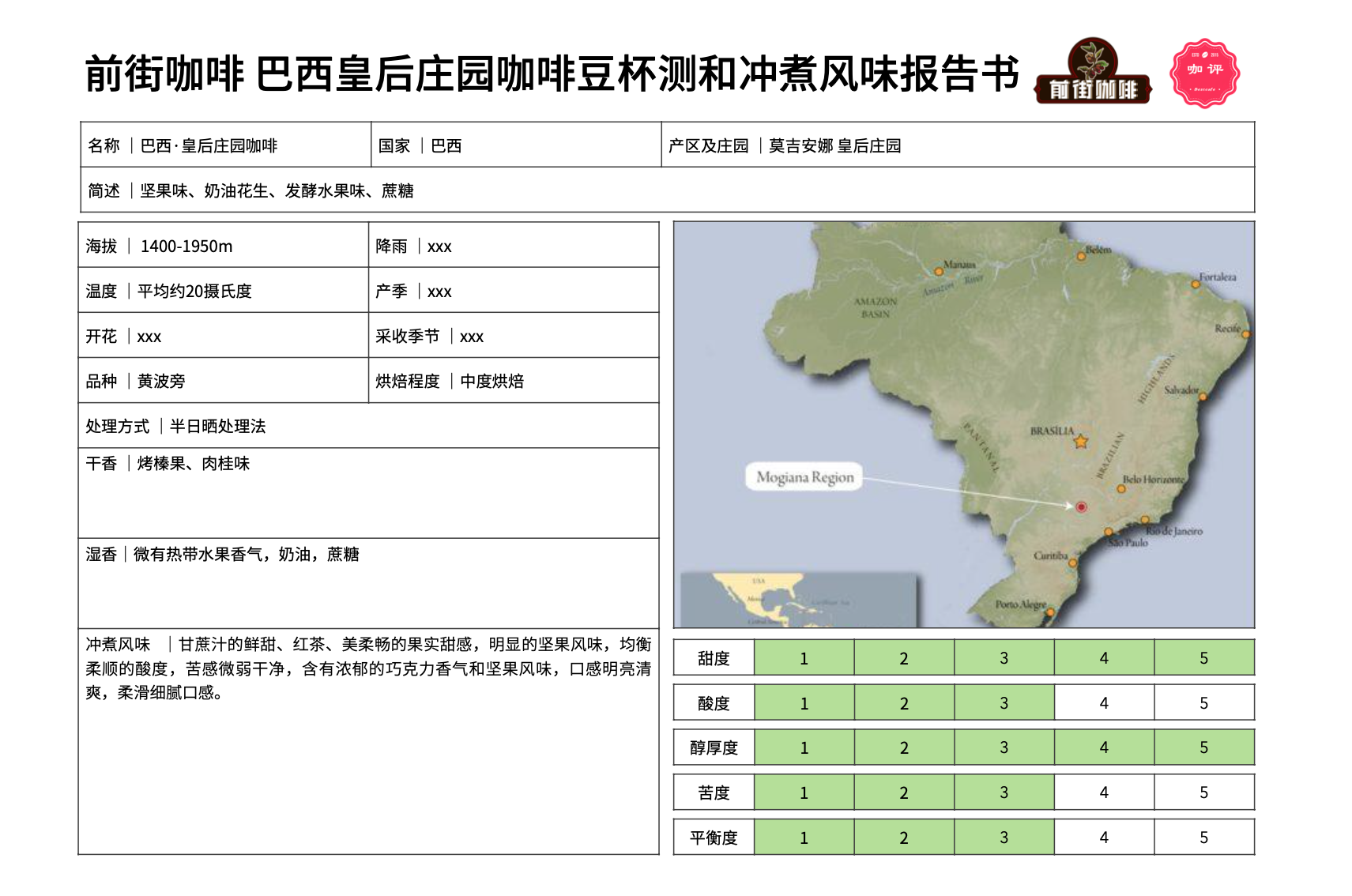
Country: Brazil
Region: Mogiana
Farm Name: Fazenda Rainha (Queen Farm)
Owner: Regina Helena Mello de Carvalho Dias of the Carvalho Dias family
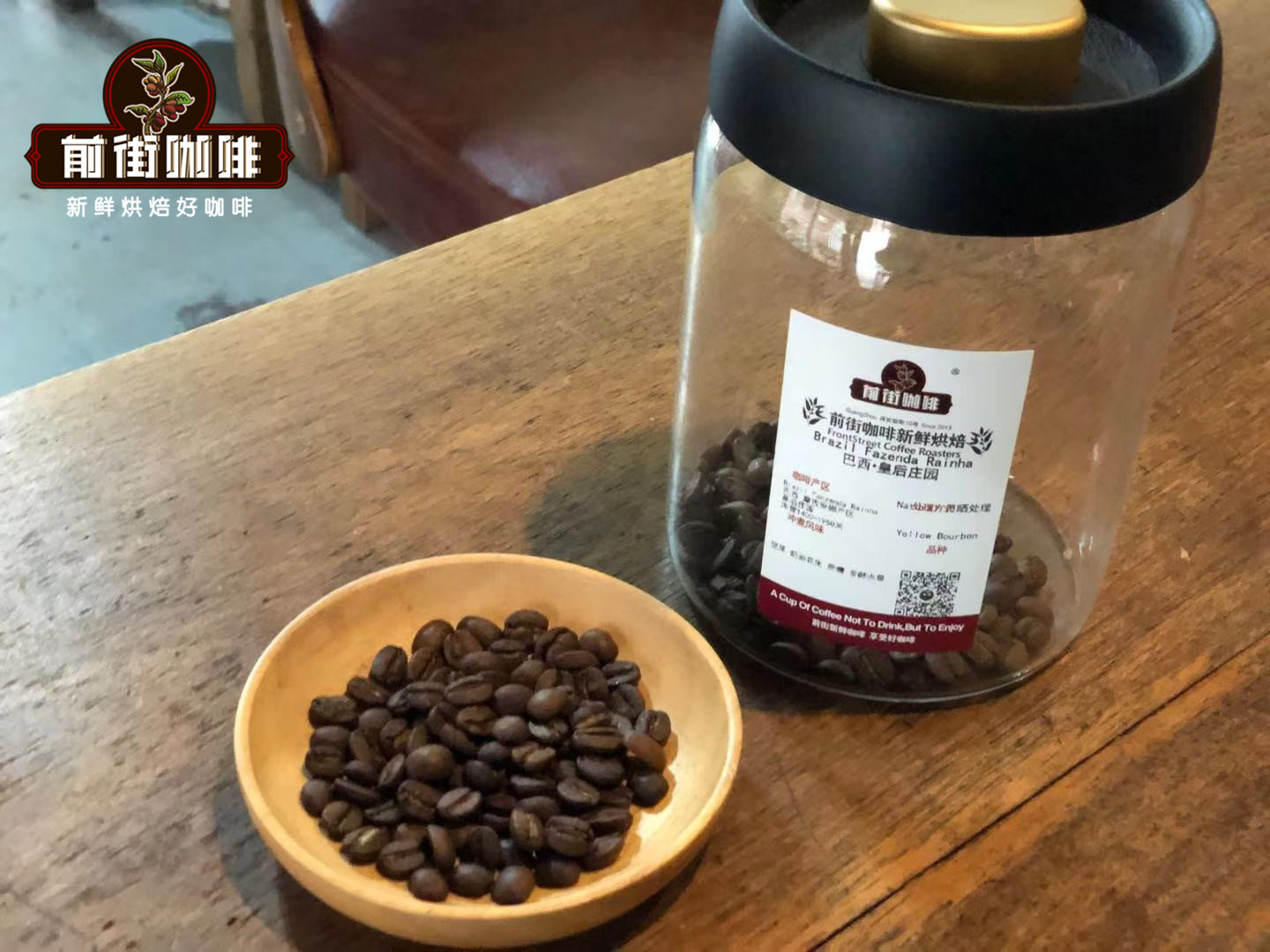
Variety: Yellow Bourbon
Processing Method: Pulped Natural
Altitude: 1400 - 1950m
Flavor Profile: Sweet bean character, clean taste. The semi-washed processing brings bright yet well-integrated acidity with sweetness, and some batches even show tropical fruit notes.
Brazilian Coffee
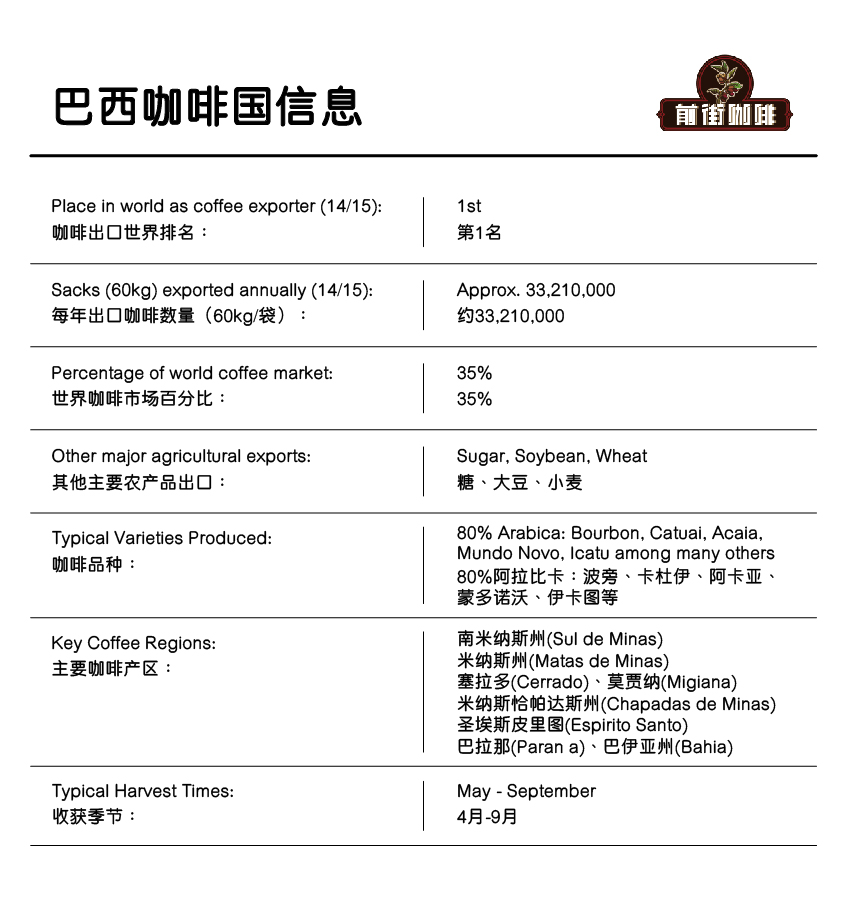
Brazil is the world's largest coffee producer and consumer. With 98% of local households drinking coffee, Brazilian farmers never have to worry about finding a market — FrontStreet Coffee believes hardly any other producing country can make that claim. The Republic of Brazil was established in 1890, its early years resembling a military dictatorship. As sugar and gold lost international value, the government began to recognize coffee's importance as a source of profit.
Compared with other Central and South American countries, Brazil's coffee regions sit at markedly lower altitudes, with flat terrain, few microclimates, and unshaded cultivation. This produces Brazil's characteristic "soft bean" profile. After cupping Brazilian beans, FrontStreet Coffee's partners noted low acidity, nutty flavors, chocolate sweetness, a balanced acid-bitter structure, and excellent body, usually with some woody and earthy notes — quite different from the obvious florals and citrus of African beans.
As the world's largest producing country, Brazil ranks first in total output, accounting for about one-third of global supply. The main producing areas cluster in the central and southern states. Brazilian coffee comes in many varieties, and like other Arabicas, most of it is sun-dried rather than washed. Beans are classified by state of origin and shipping port.
Brazil has 21 states, 17 of which produce coffee, but 5 states account for 98% of total production: Parana, Sao Paulo, Minas Gerais, Espirito Santo, and Bahia. Parana in the south historically had the most impressive output, accounting for 50% of the total.
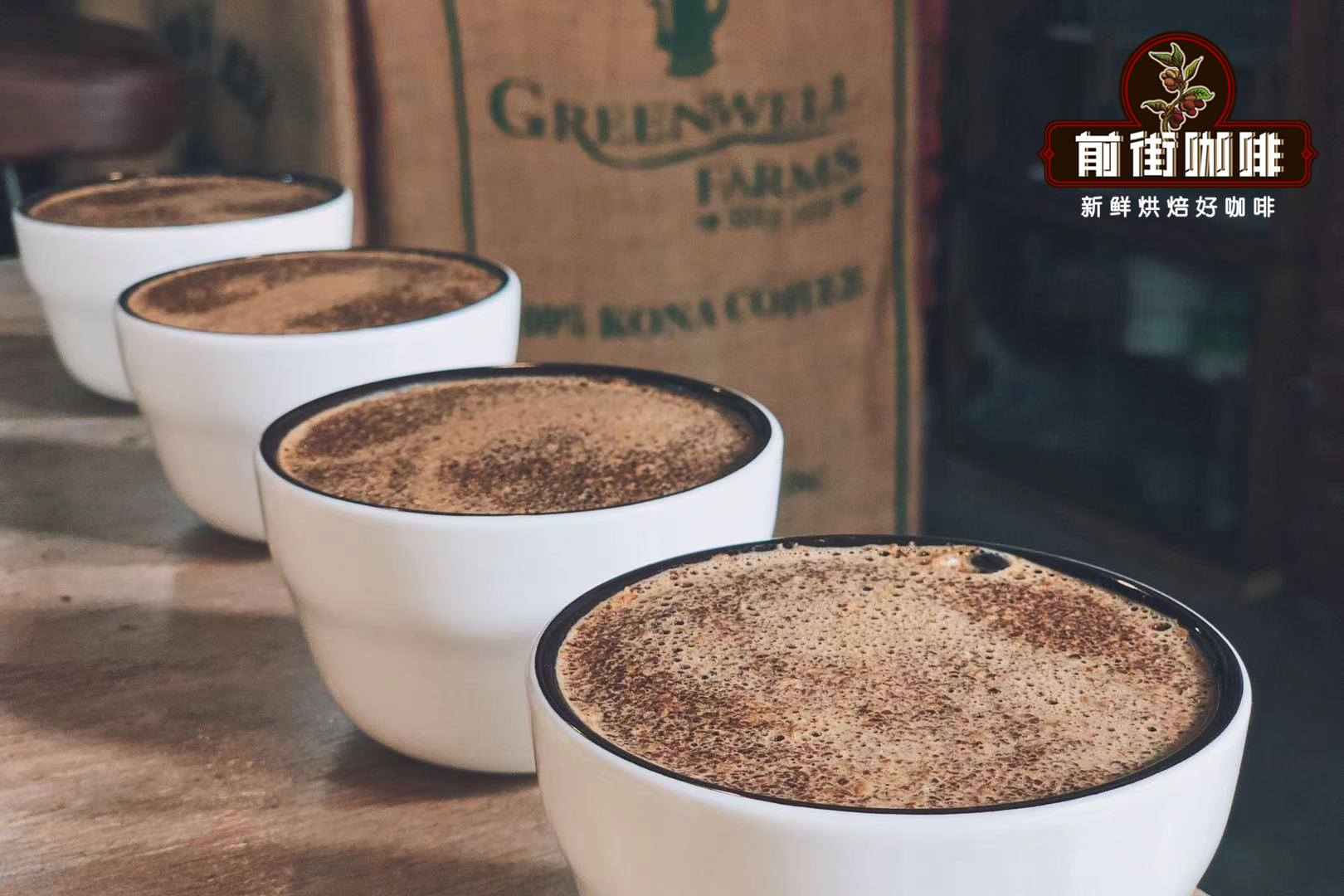
Five Flavor Classifications Based on Aroma
Brazilian coffee emphasizes the body and sweetness of soft beans, with an overall mild, smooth profile. Five grades are used to distinguish different soft beans: Strictly Soft, Soft, Softish, Hardish, and Rioy.
These five grades correspond to different Brazilian regions:
Strictly Soft: South Minas, Cerrado, Mogiana, Bahia Diamond Plateau.
Soft: Bahia, the Minas Southeast mountain forest region, Parana, the Sao Paulo Midwest, and the Espirito Santo highlands.
Softish: eastern and northeastern Minas.
Hardish: low-altitude areas of Parana and Espirito Santo.
Rioy: the flat areas of Espirito Santo and lower-altitude southeastern Minas.
Brazilian coffee may look monotonous to some, but Brazil has recently produced many specialty beans, with South Minas, Cerrado, Mogiana, and the Bahia Diamond Plateau showing the most potential.
Processing Methods
Brazilian coffee uses natural, pulped natural, and washed methods. The choice depends mainly on how dry or humid each region's farms are, aiming to present the best flavor of each area with as much diversity as possible.
Why do most people still believe Brazil mainly uses natural processing? FrontStreet Coffee sees one significant reason that cannot be ignored: before 1990, Brazil relied almost entirely on rough natural processing, which made green beans prone to earthy and woody flavors, dragging down quality and badly damaging the country's reputation.
After 1990, Brazil developed the pulped natural method, which reduces processing time, enhances fruit aroma and sweetness, and minimizes the risk of off-flavors, markedly improving quality and making it very suitable for single-origin brewing.
The choice of method comes down to local humidity: each region's farms adopt whatever approach best reduces mold during processing.
Brazilian Coffee Regions
Knowing which region your Brazilian coffee comes from helps you understand its flavor, aroma, and potential quality. With that in mind, here is a tour of the country's main Arabica regions.
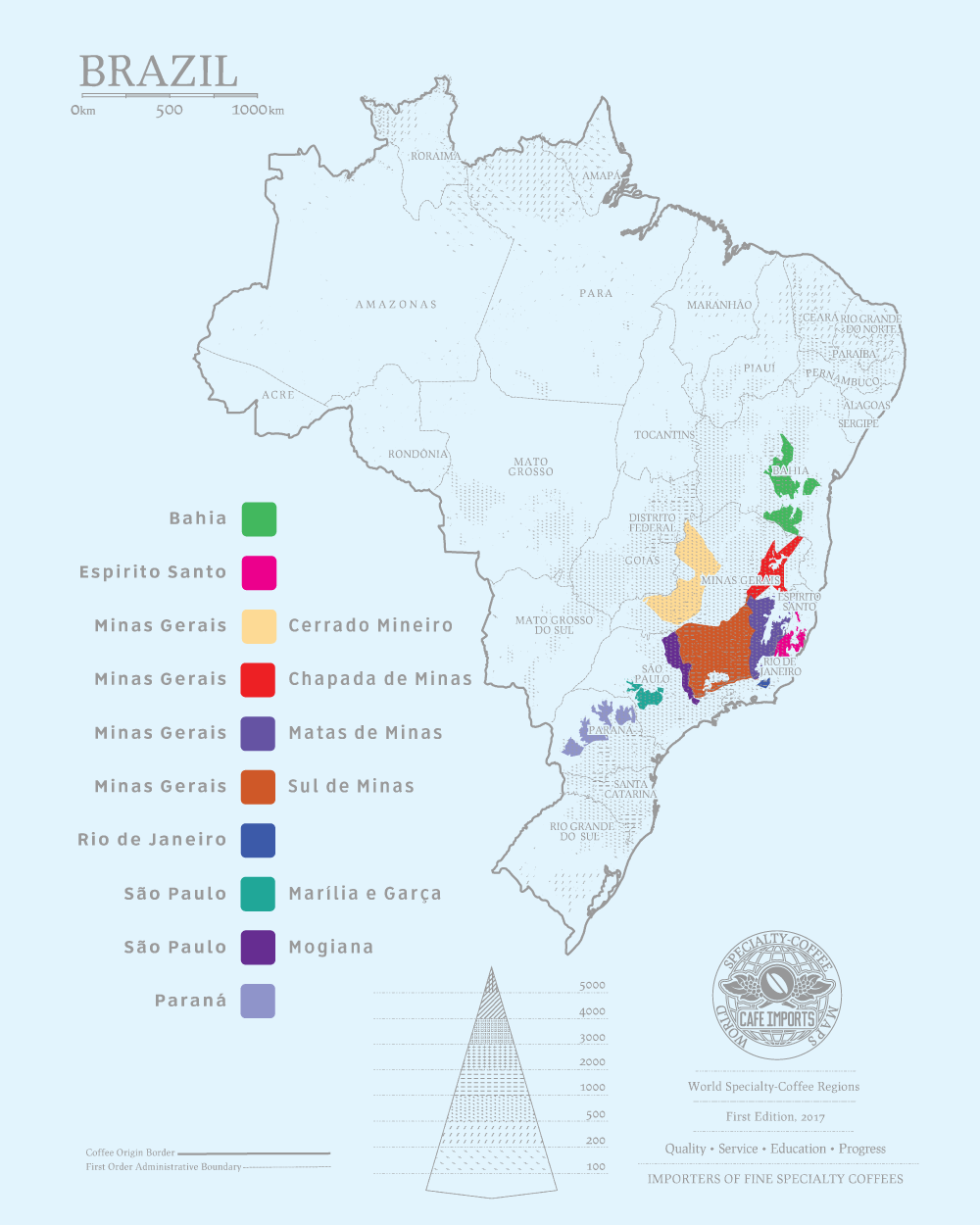
Minas Gerais
Minas Gerais is Brazil's largest coffee-producing state, accounting for nearly 50% of national output — and, not coincidentally, the main source of Brazil's specialty coffee.
Its producing regions include:
Sul de Minas (South Minas)
High altitude averaging 950m, with a moderate annual temperature around 22°C, accounting for about 30% of Brazil's coffee production, mainly on small farms of 10 to 100 hectares.
Main varieties include Catuai, Mundo Novo, Icatu, Obata, and Catuai Rubi. In the cup you typically find coffee that is full-bodied with subtle lemon and fruit notes.
Cerrado de Minas
Cerrado de Minas was Brazil's first coffee region to receive Designation of Origin status (Cerrado Mineiro), giving it recognition similar to famous wine regions. The area is vast, comprising 55 cities across Alto Paranaiba, Triangulo Mineiro, and northwestern Minas Gerais, with farms ranging from medium-sized (2-300 hectares) to large estates.
The region sits at 800-1,300m with distinct seasons (humid summers, mild dry winters), ideal for specialty coffee. Mundo Novo and Catuai are grown here, and Cerrado de Minas coffee shows higher acidity.
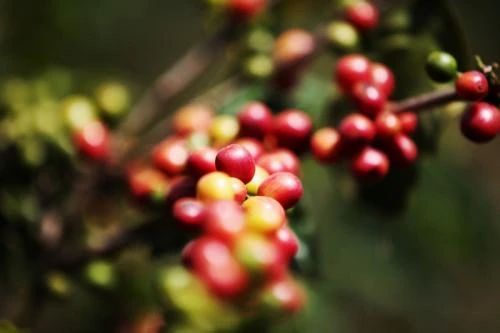
Chapada de Minas
The highland areas of Chapada de Minas are scattered with valleys and suited to mechanized production. Catuai and Mundo Novo are both grown here.
Matas de Minas
Matas de Minas lies in the Atlantic Forest, with undulating terrain and a warm, humid climate. About 80% of its farms are smaller than 20 hectares. It is known for rising specialty coffee production, typically with sweet caramel or chocolate flavors, and grows Catuai and Mundo Novo.
Sao Paulo
Sao Paulo is one of Brazil's historic coffee-producing states, and home to the country's main coffee export port, the Port of Santos.
Its main producing regions include:
Mogiana
Mogiana's favorable altitude (1400-1950m), moderate temperatures (average 20°C), and uneven terrain create outstanding coffee quality with very sweet, balanced flavors. Mundo Novo and Catuai grow here.
Centro-Oeste de Sao Paulo
This hilly region comprises cities such as Marilia, Garca, Ourinhos, and Avare. Like Mogiana, the terrain is uneven, and most farms are small to medium-sized.
Espirito Santo
Espirito Santo is Brazil's second-largest coffee-producing state and the largest producer of Robusta.
Regions within Espirito Santo include:
Montanhas do Espirito Santo
This highland region has moderate temperatures and altitudes between 700-1,000m, capable of satisfactory specialty coffee. It is known for high acidity and fruity flavors, with Mundo Novo and Catuai the main varieties.
Conilon Capixaba
Brazilian Robusta (Conilon) is grown here, typically on small farms in low-altitude areas.
Bahia
Bahia, in northeastern Brazil, is a newer coffee region where cultivation began in the 1970s, known for quality beans and technological application. About 75% of its crop is Arabica.
Bahia has two producing regions:
Cerrado and Planalto da Bahia
This is Brazil's most high-tech coffee region, with full mechanization from planting to harvest. Its significance goes beyond productivity: Antonio Rigo de Oliveira of Fazenda Sao Judas Tadeu in Piata won Brazil's 2015 Pulped Naturals Cup of Excellence with 91.22 points, and was also awarded the Presidential Coffee Seal for scoring above 90. The local climate features high altitude, warm temperatures, dry summers, and rainy winters.
Atlantico Baiano
Like Conilon Capixaba, this region produces Conilon (Robusta) on small farms at low altitude.
Parana
Parana has intensive, productive Norte Pioneiro do Parana coffee plantations.
Rondonia
This region specializes in Conilon (Robusta) coffee, with a tropical climate of high temperatures and low-altitude areas.
Fazenda Rainha (Queen Farm)
Fazenda Rainha sits in the Alta Mogiana region of Sao Paulo state, north of Sao Paulo city. The farm is highly regarded in Brazil and owned by the Carvalho Dias family, which holds four major farms that have won awards every year since the first Brazil Cup of Excellence in 1999 — more than 12 wins over 7 years. In 2004 they swept first place, 9th place, 11th place, and more. With countless farms of all sizes competing for recognition, this family's four farms have taken home multiple awards year after year. Fazenda Rainha's own record is impressive: 2nd place in 2000, 3rd in 2001, and 29th in 2005, and to date it has won awards 3 times. Yellow Bourbon beans are inherently sweet and clean, and natural (or pulped natural) processing leaves their acidity slightly subdued but beautifully integrated with sweetness, with tropical fruit notes.
The Carvalho Dias family are founding members of the Brazilian Specialty Coffee Association, with an evident commitment to quality and the environment. On their farms they use natural waterfalls to generate pollution-free hydroelectric power and meet their own electricity needs — another family award-winning farm takes its name from that waterfall, Waterfall Farm. They build churches, classrooms, nurseries, and medical stations, insist on preserving native forest and wildlife, and continue reforestation. Fazenda Rainha is a good example of how thorough that commitment is. Because of the high altitude and uneven terrain, machines cannot harvest the crop, so all fruit is hand-picked, and low-yield, high-quality Bourbon varieties are grown — making it a representative estate of Brazil's premium coffee.
This batch of Fazenda Rainha belongs to the Carvalho Dias family, and the farm is over 116 years old. It lies in the high-altitude mountains of Sao Paulo state near the Minas border, at 1200-1400 meters, with abundant annual rainfall exceeding 1800mm that does not cause flooding and an average annual temperature of only 19°C. The slightly slower growth gives the beans sufficient density; production is smaller, but the aroma and flavor are unmatched by ordinary Brazilian plateau beans. The farm mainly grows Bourbon varieties, including some trees over 110 years old. Beyond the variety, Fazenda Rainha's meticulous, careful processing is another key to its quality.
Fazenda Rainha's Depulping System
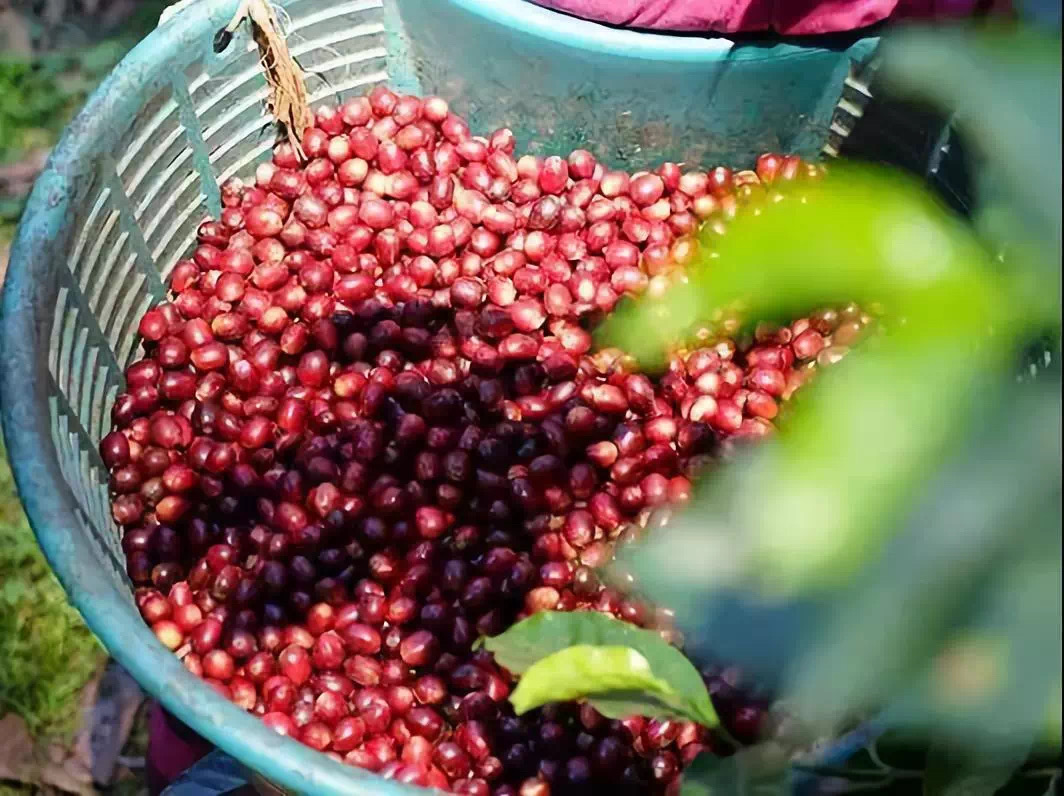
Ripe cherries are hand-picked into cloth bags to keep them from falling and touching the ground. Fruit harvested on the same day is always sent to the farm's processing facility for pulped natural processing that same day. Hand-picking into cloth bags avoids earthy flavors and improper fermentation. On arrival, the cherries are immediately "washed" — cleaned and screened by size to remove unqualified or dried beans (bóia beans). Qualified beans continue through the depulper.
The farm grows 200 acres of Yellow Bourbon trees. The rolling mountain terrain rules out large-scale mechanical harvesting, so all coffee here is hand-picked.
The farm uses natural and pulped natural processing. The semi-washed method uses drying racks and mechanical drying, with mechanical screening followed by manual screening. The extensive work means farm employees live on the farm year-round, and all employees and their families receive housing, healthcare, and education there.
The farm belongs to a medium-sized farm organization in the local Grama Valley, mainly exporting Bourbon-variety specialty coffee. The organization's office is in nearby Pocos de Caldas, and it also runs a national-level cupping laboratory with large warehouses. It collaborates with local universities and other institutions on research, including Lavras University — the famous Dr. Flavio Borem comes from that university's agricultural research center.
Fazenda Rainha Award Records
2014 Cup of Excellence 13th Place
2013 Cup of Excellence 2nd Place
2012 Cup of Excellence 8th Place
2011 Cup of Excellence Champion
2010 Cup of Excellence 20th Place
2009 Cup of Excellence 6th Place
2008 Cup of Excellence 14th Place
Green Bean Analysis
This bean uses the Cerezadescascado method (depulped method) invented in Brazil. FrontStreet Coffee finds this honey-like natural processing makes the coffee flavor more rounded, sitting between washed and full natural processing. The process first uses a small amount of water to remove pulp and skin, then places the coffee directly on drying racks for sun-drying, turning constantly so all the coffee meets the sun. After several days, mechanical drying brings it to the right moisture content.
Roasting Analysis
The green beans have a solid texture and excellent flavor performance, with slight orange peel and spice notes. Green bean moisture content is 9.9%.
That relatively low moisture makes heat absorption very strong. FrontStreet Coffee's plan is to start at 200°C, then use high heat and low airflow to speed dehydration. After the dehydration phase, use medium airflow and medium heat for the Maillard reaction, without rushing, finishing near the end of first crack.
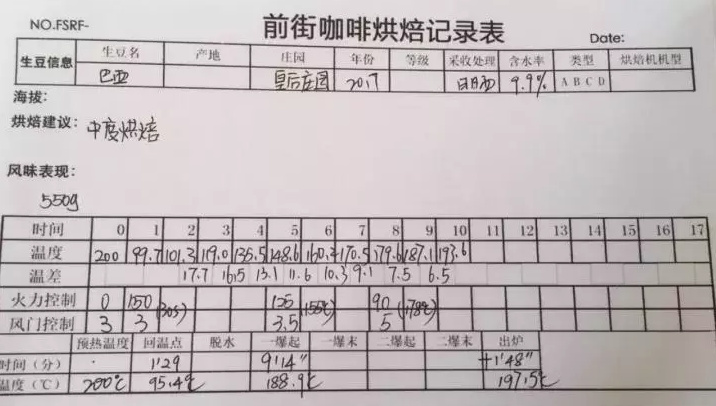
FrontStreet Coffee ran 4 trial roasts and finally chose to finish between 1 minute 45 seconds and 2 minutes after first crack ended. The flavor shows obvious but not monotonous sweetness, with subtle lemon notes in the background that come forward in the wet aroma. The finish shows clear dark chocolate, with an overall rounded feel that embodies Brazil's character while keeping something lively.
Charge amount: 550g
Brewing Reference
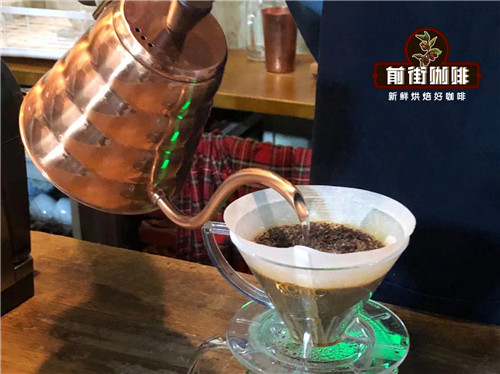
Brazil Fazenda Rainha: 15g coffee, medium grind (Fuji Royal hand grinder #4)
V60 dripper, 88-89°C water, first pour 30g with a 27-second bloom
Pour to 105g and pause; wait for the water level to drop by half before continuing, slowly pouring to 225g total. Avoid the tail end. Water-to-coffee ratio 1:15, extraction time 2:00
Flavor Profile
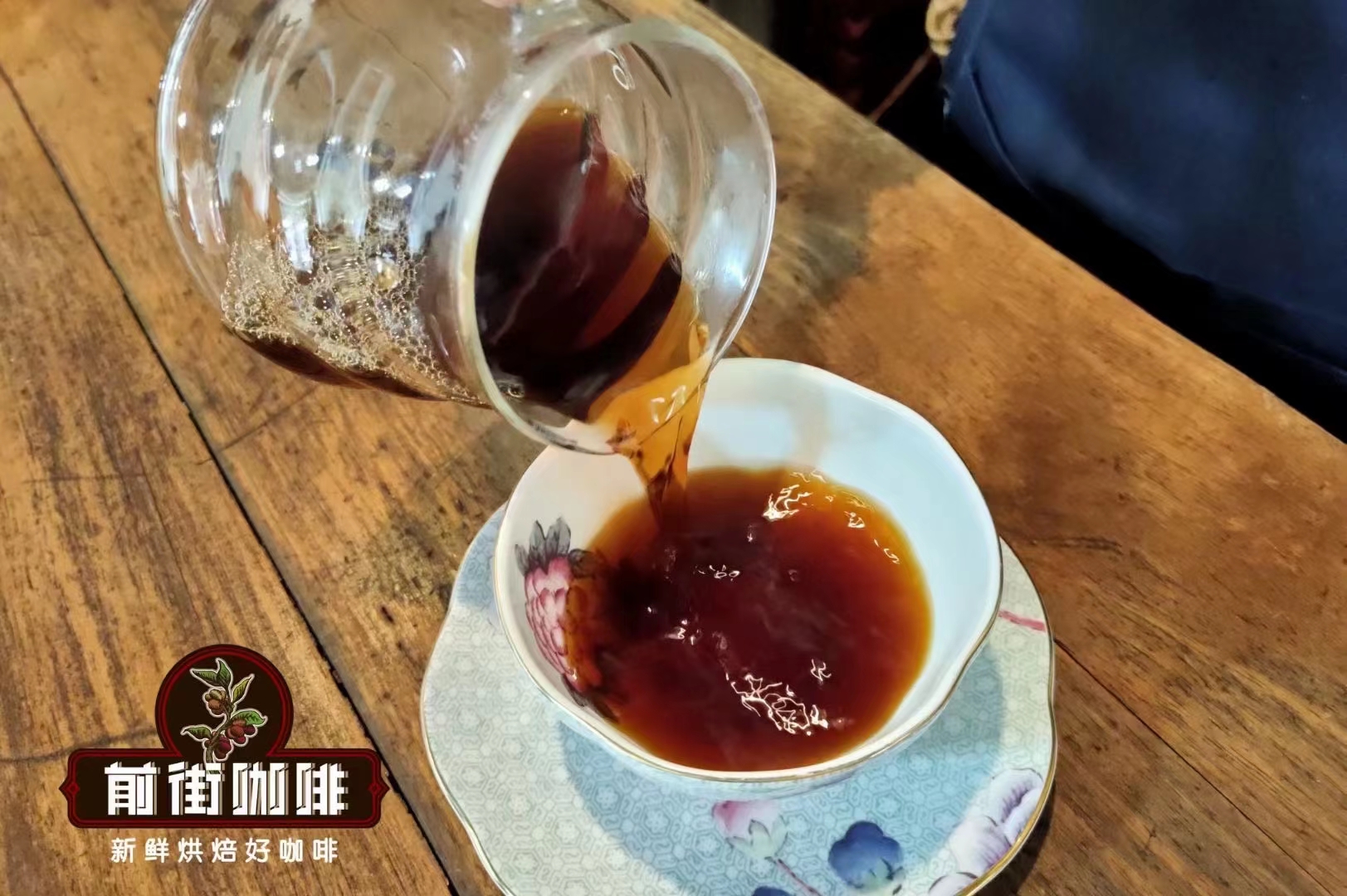
Sweet bean character, clean taste. Pulped natural processing brings bright yet well-integrated acidity with sweetness, and some batches even show tropical fruit notes. The abundant aroma during brewing is especially captivating: fresh sweetness of sugarcane juice, black tea, smooth and pleasant fruit sweetness, obvious nutty flavors, balanced and smooth acidity, subtle and clean bitterness, and rich chocolate and nut aromas. The mouthfeel is bright and refreshing, the texture smooth and delicate.
FrontStreet Coffee Recommendation
Fazenda Rainha shows how much Brazil can achieve when a farm treats terroir and processing with the same care as any famous estate — and it makes a good benchmark for the country's single origins. If you want to explore that side of Brazil, FrontStreet Brazil Cerrado is the classic entry: a pulped-natural single origin from Cerrado, a region known for high-quality beans, grown from the Red Bourbon variety common in South America and medium roasted for cream, peanut, toast, caramel, and hazelnut aromas with a rounded, low-acid cup and a light bitter edge. It adapts to pour-over, moka pot, SOE, siphon, and French press. FrontStreet Brazil Queen Farm is the other single-origin reference point, from Mogiana near South Minas, where fertile red volcanic soil builds full aroma; its rare Yellow Bourbon variety brings a sugarcane sweetness unique to the region along with fruit and chocolate notes.
Brazil is also the backbone of espresso, which is why its low-acid, balanced character anchors so many FrontStreet Coffee blends. FrontStreet Classic Blend delivers rich crema and a mellow, full body; FrontStreet Premium Blend leans nutty, echoing the almond, walnut, and chocolate notes Brazil is known for; FrontStreet Dark Cocoa Blend balances Brazil's nutty smoothness with Yunnan's ripe plum acidity for a creamy, caramel-tailed espresso; and FrontStreet Commercial Blend keeps costs in check while preserving the chocolate-cream aroma and soft sweet-sour-bitter balance that makes extraction stable. In every one of them, the Brazilian component supplies chocolate and cream aromas plus the even, low-acid structure that keeps a recipe consistent.
For brewing a Brazilian single origin, medium grind and a moderate temperature work best. FrontStreet's reference is 15g of coffee at a 1:15 ratio, a V60 at 88-89°C, a first pour of 30g with a 27-second bloom, then pouring to 105g and pausing before continuing slowly to 225g, avoiding the tail end and finishing around 2:00. That keeps the sugarcane sweetness, nut and chocolate depth, and clean bitterness in balance — exactly the qualities that make Fazenda Rainha such a fine representative of Brazilian coffee.
Important Notice :
FrontStreet Coffee is a long-established specialty coffee roaster in Guangzhou China, selling freshly roasted beans from its own farm in Yunnan as well as dozens of carefully selected single-origin beans from around the world for both pour-over and espresso. The products deliver consistently excellent quality and great value, with shipping within 24 hours. Guangzhou's FrontStreet Coffee shop is recommended by many coffee lovers, and the beans are now available online at the Tmall 。
FrontStreet Coffee has moved to a new address:
FrontStreet Coffee Address: 315,Donghua East Road,GuangZhou
Tel:020 38364473
 Scan and follow the En Gafei WeChat official account. Please indicate that the reprint comes from "En Gafei".