Costa Rica Pour-Over Single Origin Coffee Beans: Flavor Characteristics, Tasting Notes, and Regional Introduction
Costa Rica is one of Latin America's best-known coffee origins, and its processing is remarkably sophisticated. From the familiar trio of washed, natural, and honey processing all the way to anaerobic and raisin honey methods, Costa Rican beans offer everything a coffee lover could ask for. Many people buy their favorite Costa Rican beans to brew at home, only to find the cup falls short of what they taste in a cafe. Is the bean at fault, or is the brewing method? This article walks through pour-over technique and the flavor characteristics of FrontStreet Coffee's Costa Rican beans.
Costa Rican Coffee Growing Conditions
Coffee beans are an agricultural product, so their flavor is shaped by geography, soil, and climate, and further influenced by variety and processing. This section introduces how Costa Rican flavor comes together through those key factors.
According to FrontStreet Coffee's research, Costa Rica was the first country in Central America to receive coffee cultivation, and it has a long history. Its volcanic soil is exceptionally fertile and drains well, particularly in the Central Plateau at elevations of 1,200-1,600 meters. The harvest runs from November to March, across three main sub-regions: San José, Heredia, and Alajuela. Three high-altitude volcanoes, Irazú, Barva, and Poás, feed the surrounding coffee plants with rich nutrients. The superior microclimate, combined with two types of volcanic soil, gives beans from this region exceptional character: chocolate and cocoa flavors, bright fruit acidity, and elegant aromas.
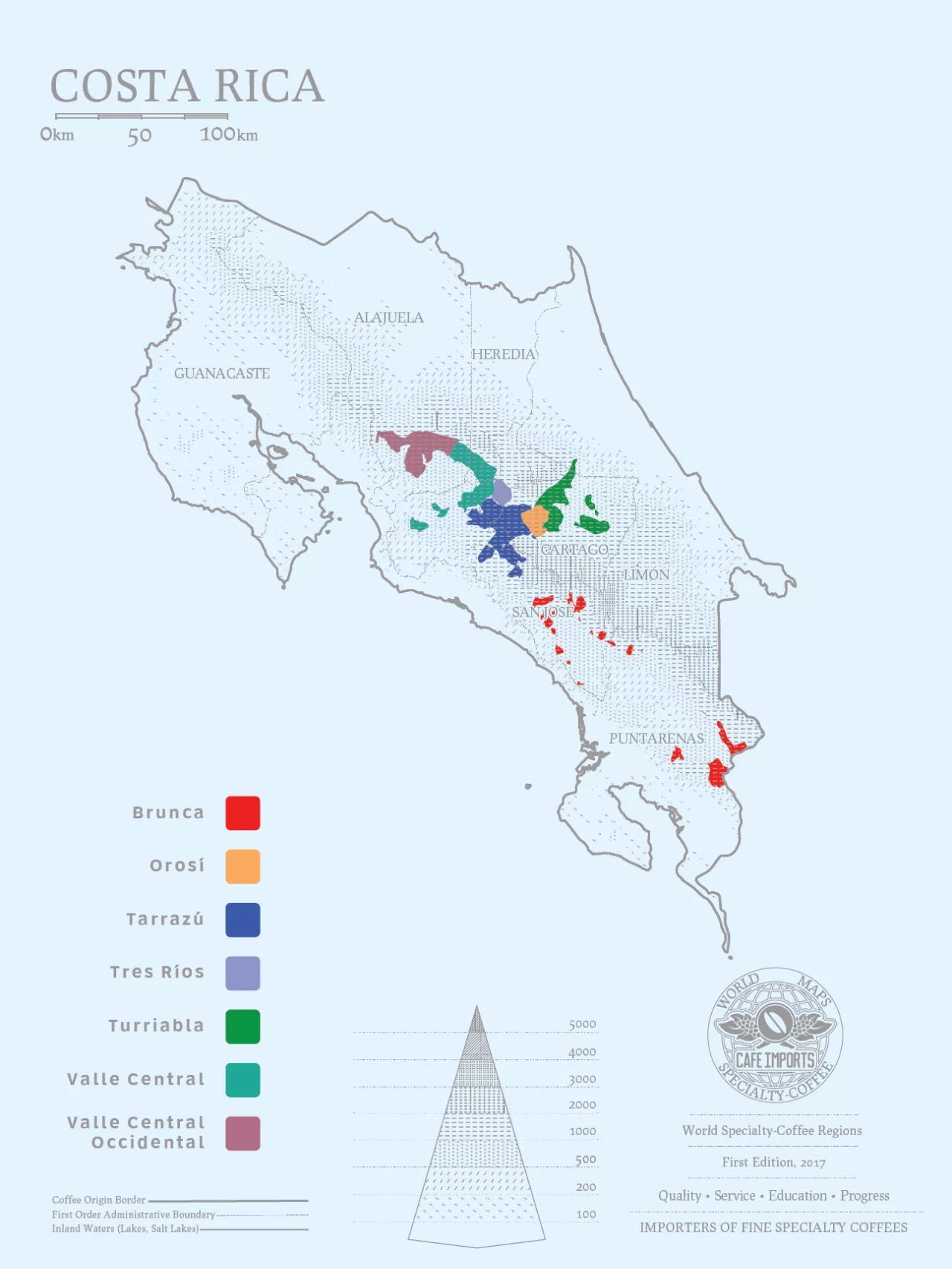
Costa Rica's main coffee-producing regions include Western Valley (Valley Central Occidental), Central Valley (Valley Central), Tarrazú, Tres Ríos, Orosi, Brunca, and Turrialba. Most of the country's specialty coffee comes from Tarrazú, which is why FrontStreet Coffee selected beans from there as its Costa Rican daily drinker, so everyone can get to know the country's coffee.

So what makes Tarrazú so special? Tarrazú lies south of the capital, San José, at elevations of 1,200-1,700 meters, with the harvest running from December to March. The region is known for high acidity, hard and full-bodied beans, and rich aromas. As a world-renowned region, its defining trait is the peerless balance of the cup, created by high-altitude growing conditions.

Tarrazú is a heavyweight in the specialty world and one of the globe's major coffee regions. In the 2014 Cup of Excellence competition, 17 of the 23 winning beans came from Tarrazú, a clear sign of the region's quality.
That, of course, comes down to soil and topography. Tarrazú sits in the fertile volcanic belt of Central America, with a humid climate and rich volcanic rock soil. Abundant year-round rainfall, high elevation, and dense natural forest shade give coffee an ideal growing environment, and no pesticides or artificial fertilizers are used during cultivation. The care Costa Rican farmers put into quality explains why the country produces such high-quality beans.
Main Costa Rican Coffee Varieties
Costa Rica grows the same main varieties as other Latin American countries, chiefly Bourbon, Caturra, and Catuai. It also has local varieties such as Villasarchi and Villalobos. Here are their characteristics.

Bourbon
Bourbon is a variant of early Typica that was transplanted to Yemen, where its bean shape changed from pointed and slender to round. In 1715, after France moved round Yemen Mocha beans to Bourbon Island off the east coast of Africa (renamed Réunion Island after the French Revolution), the variety took the name Bourbon. Round Bourbon beans spread to Brazil and Central and South America in 1727. In 1732 Britain also transplanted Yemen Mocha to St. Helena Island (where Napoleon was later imprisoned), and those were round Bourbon beans as well. Bourbon is a frequent champion in American specialty cupping competitions.

Caturra
Caturra is a natural variant of the Arabica variety Bourbon, discovered in Brazil in 1937. Its plant is shorter and more compact than Bourbon. Although it inherited Bourbon lineage, giving it relative disease resistance, it yields more than Bourbon. Despite being found in Brazil, Caturra doesn't grow well there and was never widely planted. Instead it became popular across Central and South America, with large-scale cultivation in Colombia, Costa Rica, and Nicaragua.

Catuai
Catuai is a hybrid of Mundo Novo and Caturra, essentially a second-generation cross. It keeps Caturra's advantage of low plant height while covering its weakness of fragile fruit that drops easily; the fruit holds firmly and resists strong winds. Its biggest regret is a flavor slightly more monotonous than Caturra's. Catuai also comes in red- and yellow-fruited types, with the red generally offering better flavor.

Villasarchi
Villasarchi is a Bourbon variety: a green-topped dwarf natural mutant of Bourbon discovered in Costa Rica in 1950, followed by pedigree selection across successive generations. It was not widely grown in Costa Rica, however. In 1974 it was introduced to Honduras by the Honduran Coffee Institute (IHCAFE). Aroma-wise it is a coffee of quite high complexity, suited to medium-dark roasting, and the dry fragrance after grinding carries floral nectar and cherry notes mixed with sweet spices such as cinnamon.
Costa Rican Coffee Bean Processing Methods
The most widely used method in Costa Rica is undoubtedly honey processing. Honey processing means drying the raw beans in the sun with the mucilage, also called pectin, still on them. After the outer pulp is removed, a sticky gelatinous layer of pectin remains. Traditional washed processing rinses it away with clean water, but water is limited in some high-altitude areas, so this direct sun-drying method was developed instead.
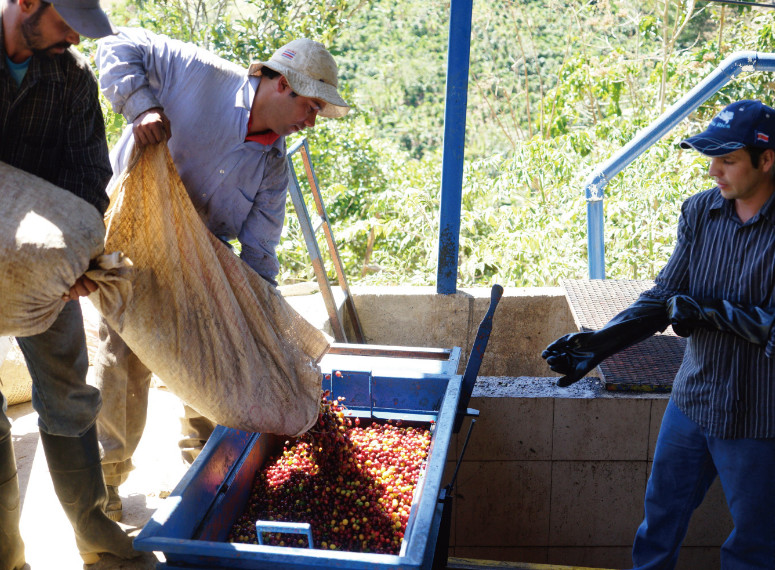
Costa Rican honey-processed beans keep some of the cleanliness of washed coffee. Brightness drops somewhat, but sweetness and a caramel mouthfeel increase. Depending on the degree of honey processing, these beans are divided into yellow honey, red honey, and black honey.
To summarize simply:
Sweetness: Black honey > Red honey > Yellow honey
Cleanliness: Yellow honey > Red honey > Black honey
Balance: Red honey = Yellow honey > Black honey
That covers FrontStreet Coffee's summary of the three key factors shaping Costa Rican flavor. We hope it helps you understand how that flavor comes together. Next, FrontStreet Coffee offers a pour-over tutorial using the widely available honey-processed beans.

FrontStreet Coffee · Costa Rica Canet Musician Series - Baha Coffee
Country: Costa Rica
Region: Tarrazú
Elevation: 1,950m
Processing: Raisin Honey Processing
Grade: Strictly Hard Bean (SHB)
Variety: H1

FrontStreet Coffee · Costa Rica Canet Musician Series - Mozart Coffee
Country: Costa Rica
Region: Tarrazú
Elevation: 1,800m
Processing: Raisin Honey Processing
Grade: SHB
Variety: H1
FrontStreet Coffee Costa Rican Coffee Bean Brewing Recommendations
Dripper: Hario V60 #01
Dose: 15g
Ratio: 1:15
Temperature: 90°C
Grind: Medium-fine (80% pass-through on China standard #20 sieve)

FrontStreet Coffee Brewing Method: Segmented Extraction
First, use 30g of water to thoroughly wet the grounds into a "hamburger" shape and bloom for 30 seconds, then move to the second stage. FrontStreet Coffee uses a steady medium-fine stream in circular motions for the second stage, pouring to 125g at 55 seconds on the timer, then stopping to wait for the water level to drop to 2/3 of the bed before the third stage. FrontStreet Coffee continues with a steady hand until 1 minute 55 seconds.

FrontStreet Coffee Baha Coffee Bean Brewing Flavor:
At high temperature: grape-like sweet-and-sour with wine-like fermentation notes. As it cools: a red-berry-juice sensation with rose aromatics. The aftertaste is caramel-like sweetness.
FrontStreet Coffee Mozart Coffee Bean Brewing Flavor:
Berry notes and fermented aromatics, with raisin and sweet orange on entry. Fermented wine fragrance and osmanthus aroma become more apparent as the temperature changes.
That is FrontStreet Coffee's sharing of pour-over parameters for Costa Rican beans. We hope it helps every coffee lover brew the right flavors in future pour-overs.
For more on the beans that suit a fast, high-clarity pour-over, see the recommendations below.
FrontStreet Coffee Recommendation
Costa Rica's honey processing and the V60 dripper's fast, clean extraction are a natural match. These FrontStreet selections bring out the best of that combination.
FrontStreet Mozart
A Costa Rican coffee with a raisin-forward character. Honey processing leaves a rich sweetness and caramel mouthfeel, and the V60's quick extraction keeps the cup lively and clear. It suits anyone who enjoys dried-fruit sweetness with balanced acidity.
FrontStreet Strawberry Candy
Designed as an accessible take on Geisha character, this blends Costa Rican honey-processed coffee with Panama Geisha, so the cup carries both delicate florals and sweet fruit. It works not only as a pour-over but also in a moka pot or on an espresso machine, and it makes a refreshing, cool cold brew as well.
FrontStreet Flower Champion
One of the most successful specialty coffees in recent years, with an extremely prominent tropical fruit aroma that often reads as strawberry, passion fruit, jackfruit, and even lychee. It is notably sweet with very little bitterness, smooth and full of juice on the palate, which is why drinkers call it "the coffee that least tastes like coffee." It suits a quick, high-clarity pour-over.
Important Notice :
FrontStreet Coffee is a long-established specialty coffee roaster in Guangzhou China, selling freshly roasted beans from its own farm in Yunnan as well as dozens of carefully selected single-origin beans from around the world for both pour-over and espresso. The products deliver consistently excellent quality and great value, with shipping within 24 hours. Guangzhou's FrontStreet Coffee shop is recommended by many coffee lovers, and the beans are now available online at the Tmall 。
FrontStreet Coffee has moved to a new address:
FrontStreet Coffee Address: 315,Donghua East Road,GuangZhou
Tel:020 38364473
 Scan and follow the En Gafei WeChat official account. Please indicate that the reprint comes from "En Gafei".