Sidamo Coffee Grading System Characteristics: Understanding Ethiopian Coffee Bean Grades G1 and G2
Anyone who buys Ethiopian beans regularly has probably noticed packaging marked G1, G2 or G3. What do these mean, and how do they differ? FrontStreet Coffee is here to explain what Ethiopian G1 and G2 actually mean.
Ethiopian Coffee Grades
Under Ethiopia's Ministry of Agriculture there is a department called the CLU (Cupping and Liquoring Unit), specifically responsible for quality approval of exported coffee, which includes the important task of defining grades. The CLU existed before the emergence of ECX.
Before ECX appeared, washed coffee was divided into export grades G1 and G2, while natural coffee was graded G3, G4 and G5, meaning the highest grade for natural coffee was G3.
After ECX emerged, grading was redefined. The grade names for washed coffee stayed the same, but for natural coffee, G1 appeared for the first time. That is why the market now sees Ethiopian natural coffee as G1 and G2, while G3 is gradually becoming less common.
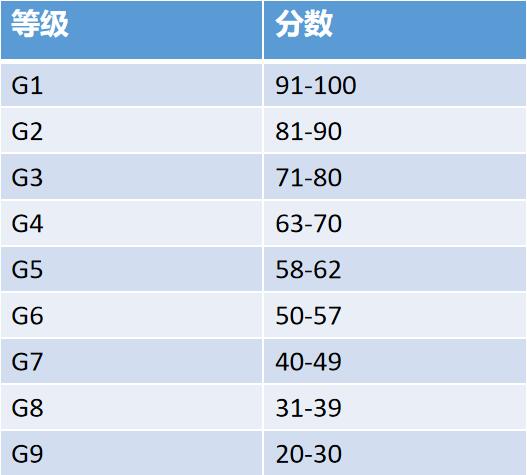
Ethiopia's old grading system was based solely on defect counts, with the highest grade for washed coffee being Grade 1 (G1) and the highest for natural coffee being Grade 3 (G3). The current system, established by ECX, combines physical attribute characteristics with cupping flavor characteristics to determine grade levels.
All coffee is categorized into three types based on processing method, natural or washed:
a. Specialty (washed & unwashed): few defects, high cupping quality;
b. Commercial (washed & unwashed): does not reach specialty grade but is higher than the domestic consumption grade;
c. Local/Domestic (washed & unwashed): coffee with many defects (unripe beans), off-season, and poor storage conditions resulting in relatively poor flavor.
Specialty and Commercial are for export to international markets, while Local is for domestic sales.
ECX Specific Grading and Scoring Standards
A. Scoring Definition for Washed Processing
1. Physical characteristics account for 40%: defect count (20%), appearance size (10%), color (5%), aroma (5%)
2. Cupping quality accounts for 60%: cleanliness (15%), acidity (15%), mouthfeel (15%), flavor characteristics (15%)
B. Scoring Definition for Natural Processing
1. Physical characteristics account for 40%: defect count (30%), aroma (10%)
2. Cupping quality accounts for 60%: cleanliness (15%), acidity (15%), mouthfeel (15%), flavor characteristics (15%)
C. Overall Summary:
1. All coffee is first classified by processing method: natural or washed;
2. Each is then scored on physical characteristics and basic cupping quality into 9 grades, G1-G9;
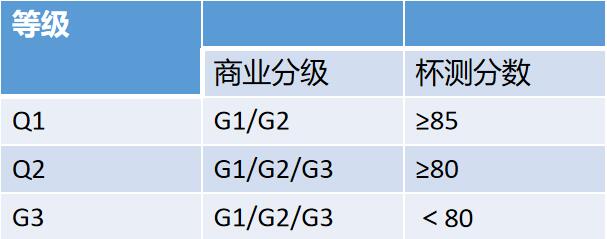
3. G1-G3 undergo additional cupping according to SCAA standards for more detailed flavor attribute evaluation. G1 and G2 scoring 85 points or above are rated Q1 grade;
4. G1, G2 and G3 scoring between 80-85 points are rated Q2 grade. All G1, G2 and G3 scoring below 80 points are rated G3 grade;
5. Q1 and Q2 are classified as Specialty Grade for export. G4-G9 keep their original grading and, along with G3, are classified as Commercial Grade for export.
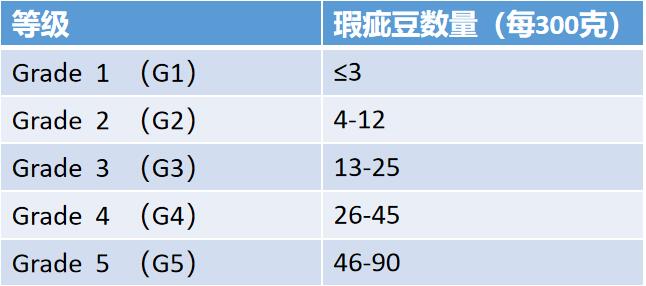
Washed Grade 1 represents 0-3 defective beans per 300 grams of green coffee; Grade 2 represents 4-12 defective beans per 300 grams. In reality, sellers' and buyers' defect standards differ somewhat, but the comparison of defect rates is still easy to make. G1 has significantly fewer defective beans than G2, which means that apart from the influence of specific flavors and roast levels, Ethiopian G1 beans are of higher quality and scoring than G2 beans, at least in terms of defect flavors.
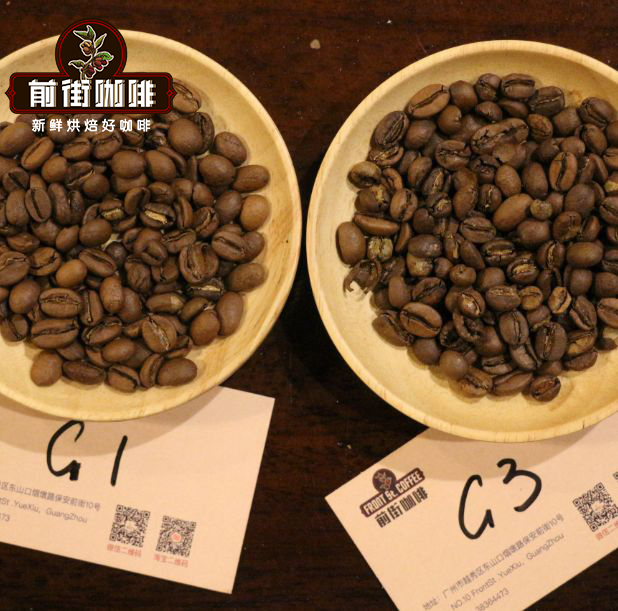
Now that we know G1 and G2 are Ethiopian coffee grades, what flavor differences exist? Our editor selected natural G1 and G3 from Sidamo to compare.
From the beans themselves, G1's overall appearance is much better than G3's, looking more uniform with relatively fewer defective beans.
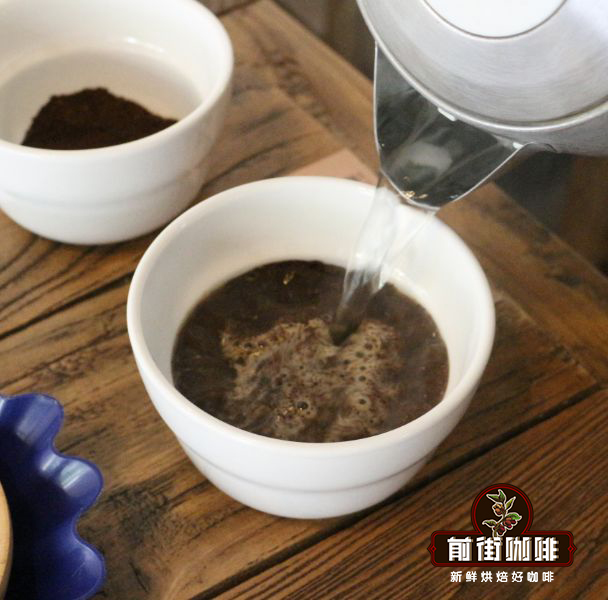
After cupping comparisons, we found that both natural Sidamo G1 and G3 perform well in sweetness and acidity, but G1 has clearer and brighter flavors.
In fact, without tasting them side by side, the difference would not be that significant. The main difference between G1 and G3 is the defect rate, which is more obvious from the bean appearance, and G1 beans carry fewer defect flavors.
What G1 Grade Coffee Beans Does Sidamo Have?
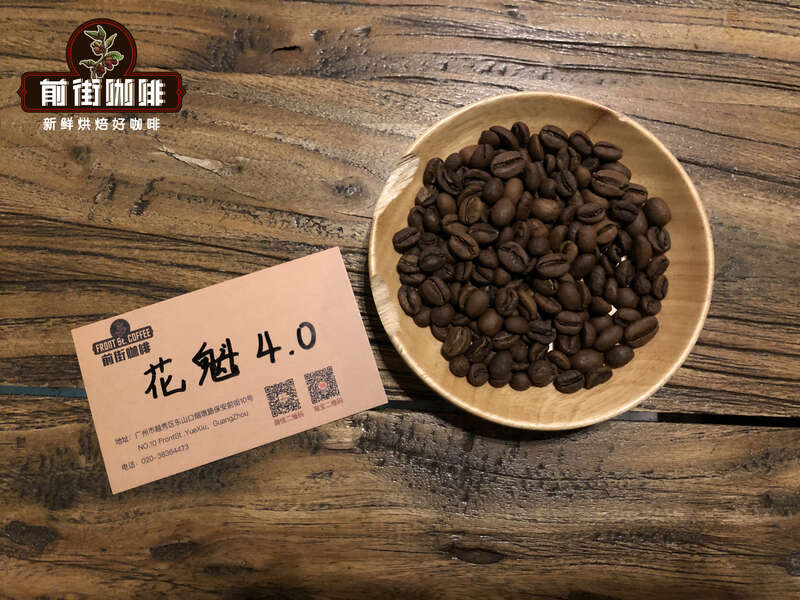
FrontStreet Coffee Ethiopia Flower Queen 4.0
Region: Guji Hambella
Processing Station: Buku Able
Altitude: 2350 meters
Variety: Dega
Processing Method: Natural
Grade: G1
Batch: 2020 new batch
Flavor: Rose, cream strawberry, citrus, passion fruit, oolong tea
Coffee Growing Region
The Guji region was formerly part of the Sidamo region but was established as an independent new region by the Ethiopia Commodity Exchange (ECX) in 2010. Guji lies southeast of Yirgacheffe and has complex terrain including towering mountains, valleys and plains. Its geology is fertile black soil (Vertisol) reaching nearly two meters deep, with an average altitude above 1800 meters. The significant day-night temperature difference created by the geography provides all the terroir conditions for producing high-quality specialty coffee.
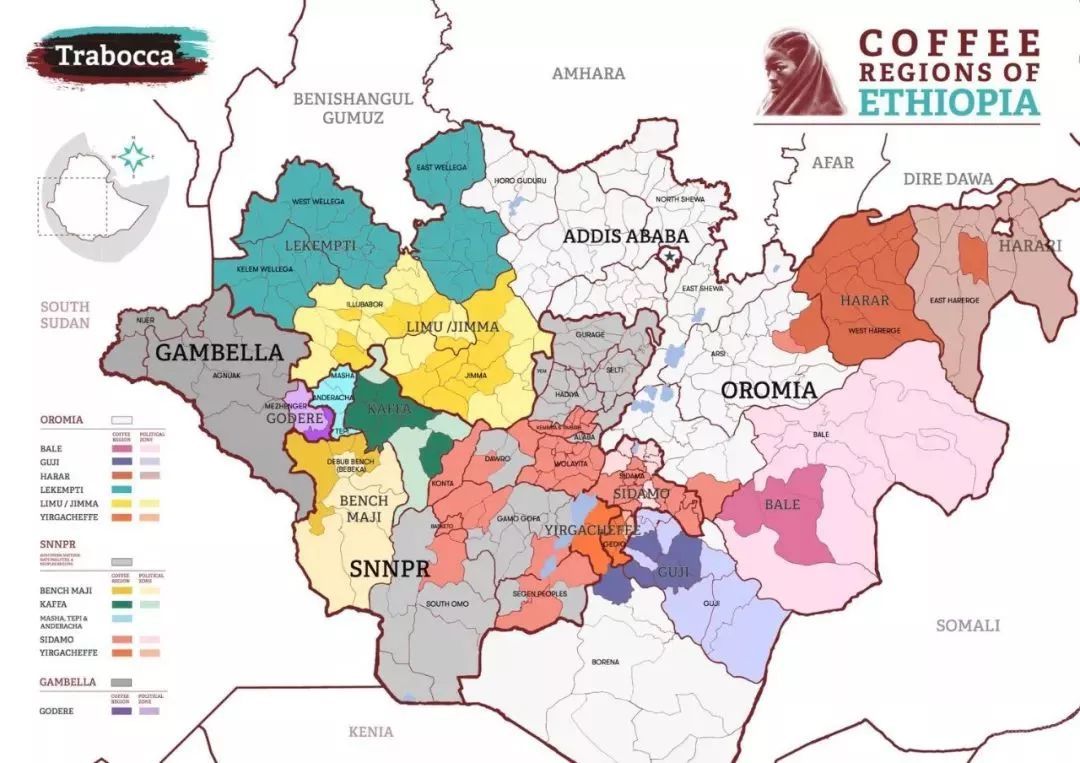
Hambella lies in Ethiopia's largest coffee region, Guji, and administratively belongs to the Oromia Regional State. Hambella's west faces Yirgacheffe's Kochore across mountains, the two regions separated by highlands reaching 3200 meters in altitude and about 30 kilometers wide. To the southeast, east and north it borders Guji's Shakiso, Uraga and Kercha sub-regions respectively, making it Ethiopia's highest-altitude coffee sub-region (Harrar is Ethiopia's highest-altitude main region).
Among all these estates and processing stations, strictly speaking, only natural coffee beans from the "Buku Abel" processing station can be called "Flower Queen coffee beans." That is why Flower Queen 2.0 and 3.0 appeared in 2018 and 2019 respectively, followed by Flower Queen 3.1.
The original Flower Queen was included in Flower Queen 2.0 and 3.0. FrontStreet Coffee found that in the batches from these two years, the flavors were very close to the original Flower Queen, but the body and aftertaste were not as good as the original 2017 Flower Queen. Surprisingly, we could sometimes identify green beans identical to the original Flower Queen batch within these two batches. As for Flower Queen 3.1, FrontStreet Coffee found during cupping that the flavor was far from the original Flower Queen and instead closer to Gesha flavor (not Panamanian Gesha, but similar to Gesha Village's Gesha flavor, actually a completely different style of bean), and we confirmed this change with the green bean supplier.
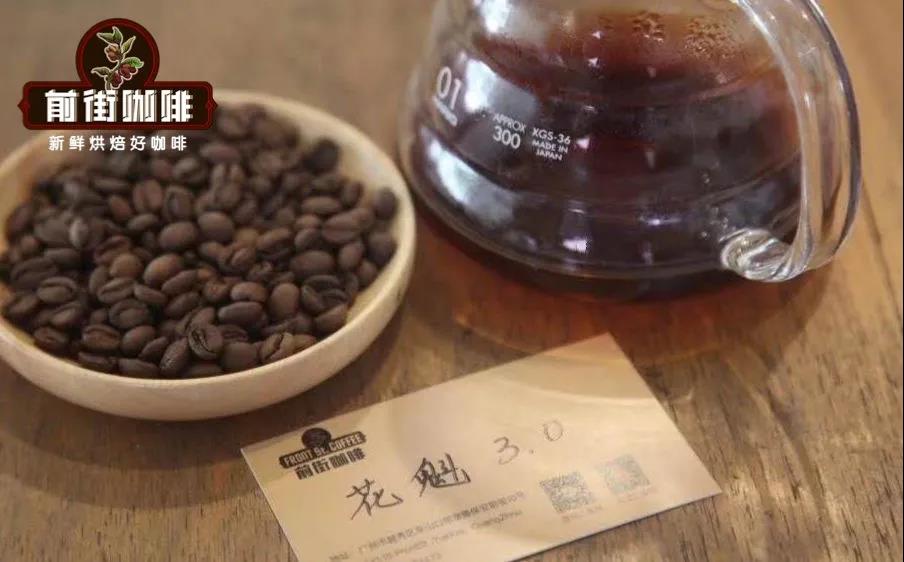
It is rare to see multiple flavor profiles in beans of the same year and same variety. Understanding Flower Queen's origin and its changes after winning championships helps explain the inconsistencies before and after. Similarly, according to the old Flower Queen's flavor profile, Flower Queen 4.0 is not the same style, but 4.0's sweetness and aroma are better than 3.0's.
The Flower Queen 4.0 batch purchased by FrontStreet Coffee has a smaller bean size than Flower Queen 3.0 because of the different variety. Flower Queen 3.0 uses the Ethiopian heirloom variety, while Flower Queen 4.0 uses the Dega variety.
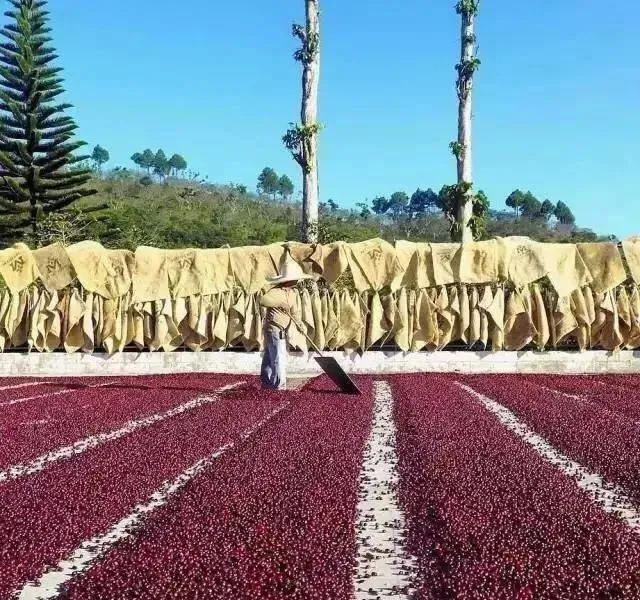
Flower Queen Coffee Beans Natural Processing Method
During the annual coffee harvesting and processing season (December-January), the cherries must have a sugar content above 30 before natural processing can begin. During the first two days of natural processing, the moisture of the cherries must be maintained to allow full fermentation of the fruit sugars. The high-altitude location also lets the processing station's nighttime temperature drop to around 12°C, preventing over-fermentation from high heat. During hot midday hours, timely shading prevents the cherries from sunburn. At night, thick plastic sheets are used as covers against sudden rainfall.
This lets the cherries ferment and dehydrate at relatively low temperatures. After 18 days of natural processing, when the green bean moisture content drops to about 13%, natural processing is stopped. The beans are bagged in jute bags and stored in warehouses at 12-22°C and 45-55% humidity for about 50 days of green bean resting and further dehydration. When the green bean moisture content reaches about 11%, they are transported to the processing station for hulling, screening and sale.
FrontStreet Coffee Roasting Analysis
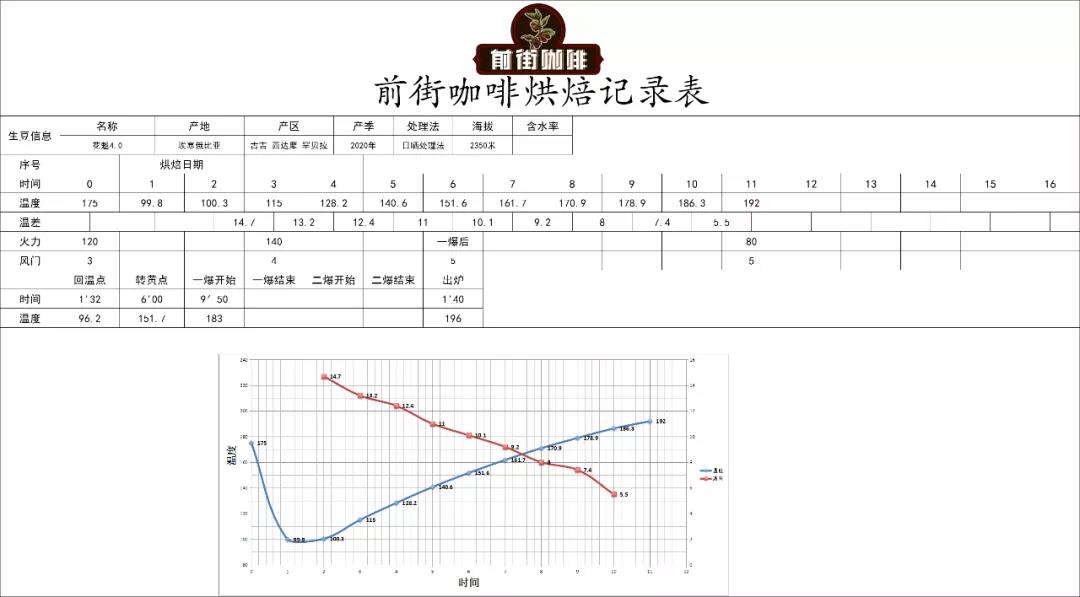
FrontStreet Coffee first reviews the flavor descriptions provided by the green bean supplier, then checks the bean moisture content. Freshly received green beans have a fermented wine aroma of coffee flowers, completely different from the grassy aroma of typical green beans. Flower Queen green beans also vary in size with many pointed ends (Ethiopian heirloom), with good moisture content around 11%, but they are not the very hard SHB type. Because of their high density and hardness, the initial dehydration time is extended, with temperature increases before first crack to enter it, minimizing the loss of aromatic substances like florals.
FrontStreet Coffee Brewing Recommendations
FrontStreet Coffee uses higher water temperature and a finer grind size to fully extract Flower Queen's rich layering, but to avoid over-extraction at high temperature it uses faster-flowing drippers such as the V60. The V60 has a 60° conical shape that concentrates the coffee bed, and the angle lets the water flow converge toward the center during pouring, ensuring enough contact time between water and coffee to extract a suitable liquid. The V60's internal ribs also spiral clockwise from bottom to top, creating enough space between the filter paper and the dripper for good flow, and combined with the large bottom hole the flow rate is relatively fast compared with many drippers.

FrontStreet Coffee's specific brewing parameters are: V60 dripper, water temperature 90°C, water-to-coffee ratio 1:15, coffee amount 15g, grind size 80% pass-through rate with China No. 20 standard sieve.
FrontStreet Coffee uses segmented extraction, with the bloom water amount being twice the coffee dose, that is 30g of water for a 30-second bloom. Pour in small circles to 125g, then segment. When the water level drops and is about to expose the coffee bed, continue pouring to 225g and stop. Total extraction time, including bloom, is 2 minutes.
FrontStreet Coffee Recommendation
Ethiopia is the birthplace of coffee and home to countless native varieties, which is why it remains such a treasure for enthusiasts. If you are exploring the country's specialty coffee for the first time, FrontStreet Washed Yirgacheffe is the entry point, with clear jasmine florals and bright citrus acidity, light and elegant with a tea-like body that drinks like clean lemon tea. FrontStreet Gudingding Cooperative goes further: the cooperative sits in the Woka area of southeastern Yirgacheffe and began as part of the Woka cooperative under the YCFCU, before roughly 300 member farmers formed the independent Gudingding Cooperative in 2012. Removing the fruit before drying makes the bean's own aroma clearer, showing citrus, lemon and elegant white florals.
For a natural-process Ethiopian coffee, FrontStreet Huakui comes from the Hambella area of Guji in Sidamo, where the farm covers 200 hectares and uses a traditional natural process. To keep the drying fruit from molding or picking up off-flavors, workers spread the ripe cherries on raised beds, turning them constantly for even drying and removing defective or moldy beans by hand every three to five days. Once the fruit has dried hard, a huller removes it. Because the fruit and skin stay with the bean throughout drying, a medium-light roast delivers a light fermented wine note, florals, citrus and mango, with a richer, more complex body, honey sweetness, cocoa and a touch of spice, and a long finish.
Two more single origins round out the Ethiopian selection. FrontStreet Sidamo Natural Hamashu comes from a washing station whose quality and distinctive flavor have made it a regular on Ethiopian competition lists; it centers on the JARC 74 series of disease-resistant varieties, and the small-beaned 74158 in particular shows a striking floral and fruit character, with perfume lemon, strawberry and star fruit sweetness up front and delicate florals emerging behind. FrontStreet Kafa Forest represents the wild side of Ethiopia, with trees growing at 1400-2100 meters under shade; given a medium-light roast, it shows clear white florals when ground, bright lemon acidity on entry, sweet orange and bergamot, and a green-tea-like body with a faint melon and nut sweetness in the finish.
Important Notice :
FrontStreet Coffee is a long-established specialty coffee roaster in Guangzhou China, selling freshly roasted beans from its own farm in Yunnan as well as dozens of carefully selected single-origin beans from around the world for both pour-over and espresso. The products deliver consistently excellent quality and great value, with shipping within 24 hours. Guangzhou's FrontStreet Coffee shop is recommended by many coffee lovers, and the beans are now available online at the Tmall 。
FrontStreet Coffee has moved to a new address:
FrontStreet Coffee Address: 315,Donghua East Road,GuangZhou
Tel:020 38364473
 Scan and follow the En Gafei WeChat official account. Please indicate that the reprint comes from "En Gafei".